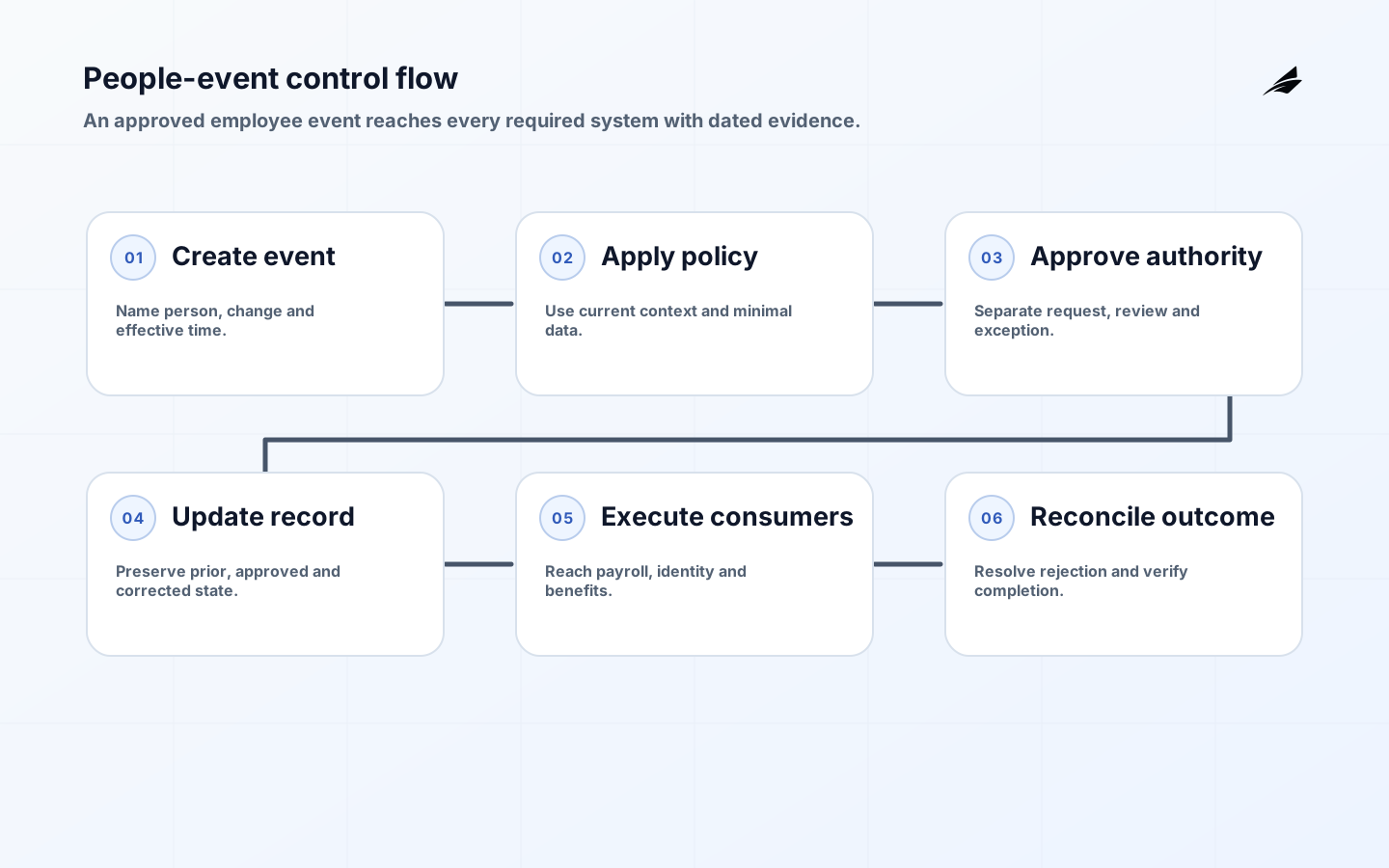
HRMS workflows turn people events into coordinated changes across employment records, payroll, benefits, identity, equipment, finance and reporting. The difficult part is not routing a form. It is preserving who requested and approved a change, when it takes effect, which record is authoritative, who may see it, and how downstream systems confirm completion. A job transfer that updates payroll but not access is both an employee problem and an operational risk.
Design around employee lifecycle events rather than application screens. The role-based operations guide helps define authority, while the system-of-record guide clarifies ownership across integrated systems.
Key takeaways
- Model hire, transfer, leave, compensation and exit as dated business events.
- Separate request, recommendation, approval, record update and downstream execution.
- Give each attribute and transition an authoritative owner.
- Minimize sensitive data in tasks, notifications, logs and analytics.
- Reconcile payroll, identity and benefits against the approved HR event.
- Test late, cancelled, corrected and emergency cases before launch.
Model people events and effective time
Represent a hire, transfer, promotion, leave, return and termination as events with subject, legal entity, location, effective time, initiator, authority and prior state. Distinguish transaction time from effective time: a promotion approved today may take effect next month, while an urgent access suspension may act immediately. Never silently overwrite the event that was originally approved; create a correction with reason and authority.
Define the minimum data needed at each stage. A manager can initiate a transfer without seeing bank or health information. Payroll needs approved compensation and effective date, not interview notes. The NIST Privacy Framework supports managing privacy risk through purpose, processing and governance. Apply retention and access to attachments and workflow history, not only profile fields.
| People event | Critical decision | Downstream confirmation |
|---|---|---|
| Hire | Identity, terms, start date and approvals | Payroll, access and equipment ready |
| Transfer | New role, manager, location and effective date | Access removed and granted correctly |
| Compensation change | Amount, currency, period and authority | Payroll accepts the dated change |
| Leave | Status, dates and policy outcome | Benefits, schedule and access align |
| Exit | Last day, obligations and access timing | Pay, assets and identities reconciled |
Separate authority from workflow convenience
Map who may request, recommend, approve, execute and correct each transition. Avoid self-approval and broad administrator roles. Temporary delegation needs a start, end, scope and audit trail. High-impact changes such as compensation, termination and bank details deserve step-up authentication or independent verification appropriate to risk. NIST's current Digital Identity Guidelines cover identity proofing, authentication and federation considerations.
Authorization belongs at the receiving system as well as the workflow. A signed message from an integration should not make every requested action valid. Validate the actor, event type, permitted fields, effective time and current state. OWASP's Application Security Verification Standard provides a useful application-control reference for authentication, access, validation and logging.
| Control | Purpose | Evidence |
|---|---|---|
| Role and scope | Limit who can initiate or approve | Current assignment and policy |
| Effective dating | Prevent early or late downstream action | Approved event and timezone |
| Dual control | Protect high-impact changes | Independent approver |
| Field minimization | Reduce unnecessary disclosure | Purpose-based payload |
| Reconciliation | Prove every consumer completed | Acknowledgement and exception |
Integrate payroll, identity and benefits explicitly
Publish stable, versioned events or use an orchestrated workflow with correlation identifiers. Define duplicate, late, missing-prerequisite and rejected behavior. A consumer acknowledgement should state whether the change was applied, deferred or rejected, with a reason. Do not mark the employee event complete merely because a message was delivered. Track each required consumer and expose unresolved handoffs to one accountable queue.

For a transfer, HR may approve the new position effective Monday. Payroll schedules the new cost center and rate; identity removes the former role and grants the new one; equipment ownership changes; directory and reporting update. If the transfer is cancelled Friday, the correction must reach every consumer before Monday. The master data management guide helps govern shared codes and identities.
Operate with exceptions and privacy in view
Monitor outcome signals: hires not ready by start time, exits with active access, payroll rejections, stale approvals, repeated corrections and events awaiting a consumer. Google SRE's monitoring guidance is useful for separating actionable alerts from diagnostic detail. An alert needs an owner and response; a report can support trend review. Protect personal data in alert text and support channels.
Review access, delegations and workflow rules regularly and after organizational change. Sample ordinary and corrected events. Include HR, payroll, identity, security and employee-support perspectives. NIST's Cybersecurity Framework 2.0 connects governance, protection, detection, response and recovery. Use that lifecycle to plan how a compromised administrator, bad integration or erroneous bulk update is contained and corrected.
Design cutoff, cancellation and correction rules
Every dated event eventually meets a downstream cutoff. Payroll may close before the employment effective date; benefits may require advance enrollment; identity may need immediate suspension even when the HR record closes later. Record cutoffs as owned business rules with timezone, calendar and consequence, not as hidden integration schedules. Show requesters when a date will trigger a later pay correction or manual review. A workflow that accepts an impossible effective date and fails days later has not protected the employee from operational complexity.
Cancellation is a new event, not deletion. It should reference the approved event, explain why it no longer applies and state which downstream effects must be reversed. If a new role already granted access, the cancellation may need an urgent revocation even though payroll had not yet acted. If compensation was paid, correction may require a governed payroll process rather than a simple inverse message. Preserve both the business history and the current truth.
Retroactive correction deserves a dedicated route. Ask which value was wrong, when it should have applied, what evidence supports the correction and which closed periods or reports are affected. Calculate impacted consumers before approval. For example, changing a work location can alter tax, benefits, access and reporting. The user approving the HR record may not have authority to approve every consequence, so the workflow should coordinate specialists rather than hide the complexity behind one button.
Migrate and release HRMS workflows safely
Inventory open and future-dated events before moving platforms. A profile snapshot does not capture an approved promotion scheduled next month, a leave awaiting evidence or a termination with timed access removal. Classify each in-flight case: migrate with full history, complete in the old system, recreate under controlled approval or pause for manual review. Reconcile employee identifiers, legal entities, positions, dates and consumer references before enabling new outbound events.
Run a bounded parallel period for high-risk consumers. Compare payroll changes, account grants, revocations and benefit transactions by employee event, not only aggregate counts. Prevent both systems from issuing the same effect. Define the moment authority transfers and how late acknowledgements from the old path are handled. Keep the old evidence readable for the required retention period even after it can no longer initiate changes.
A useful release rehearsal follows one joiner, mover and leaver. The joiner has a delayed start; the mover changes manager and location across a pay boundary; the leaver has privileged access that must close at a precise time. Inject one duplicate and one consumer rejection. HR, payroll, identity and support should identify current state from the same correlation record, apply the right correction and explain the result without sharing unnecessary employee details.
Treat bulk change as a separate product capability. Require a bounded population, preview of old and new values, policy validation, independent approval and a correlation identifier for the batch and each employee event. Set value and volume limits, then execute in resumable chunks. A rollback plan should describe compensating events and downstream reconciliation rather than promising to restore a spreadsheet. Sample results early and stop automatically when rejection or difference thresholds are exceeded.
Communicate with employees according to the event and timing. A confirmation should show the approved values, effective date, next step and correction route, but omit sensitive fields that do not belong in email or push notifications. When a downstream delay affects pay, access or benefits, state the impact and accountable support channel rather than leaving the workflow marked processing indefinitely. Communication is part of operational control because it helps affected people detect an incorrect outcome quickly.
HRMS workflow release checklist
- Each event has an owner, effective date, prior state and correction route.
- Request, approval, execution and correction authorities are separated.
- Payloads and notifications contain only purpose-required employee data.
- Every downstream consumer returns applied, deferred or rejected status.
- Duplicates, late events, cancellation and partial failure are tested.
- Start-date readiness and exit-access closure are reconciled.
- Users can report an incorrect record and reach an accountable resolver.
- Bulk change, integration failure and privileged misuse recovery are rehearsed.
Frequently asked questions
Should the HRMS own every employee field?
No. It often owns core employment facts, but identity, payroll, benefits and learning systems may own specialized records. Define ownership per attribute and transition. Copies should retain source, effective time and correction behavior.
Can email approval be part of an HRMS workflow?
A notification link can take an authorized person to a controlled approval, but an email reply alone often lacks reliable identity, current context and structured evidence. High-impact decisions should occur in a system that validates authority and records the exact terms approved.
How should HRMS workflow success be measured?
Measure readiness and correctness: completed events by effective date, downstream rejection, correction rate, exception age, access closure and employee support contacts. Review examples because a fast average can hide a severe missed exit or incorrect pay event.
Conclusion
Reliable HRMS workflows preserve the meaning, timing and authority of people events across systems. Model dated transitions, minimize data, validate every handoff and reconcile outcomes. That discipline supports employees and operators while reducing the access, payroll and privacy failures that fragmented automation can amplify.