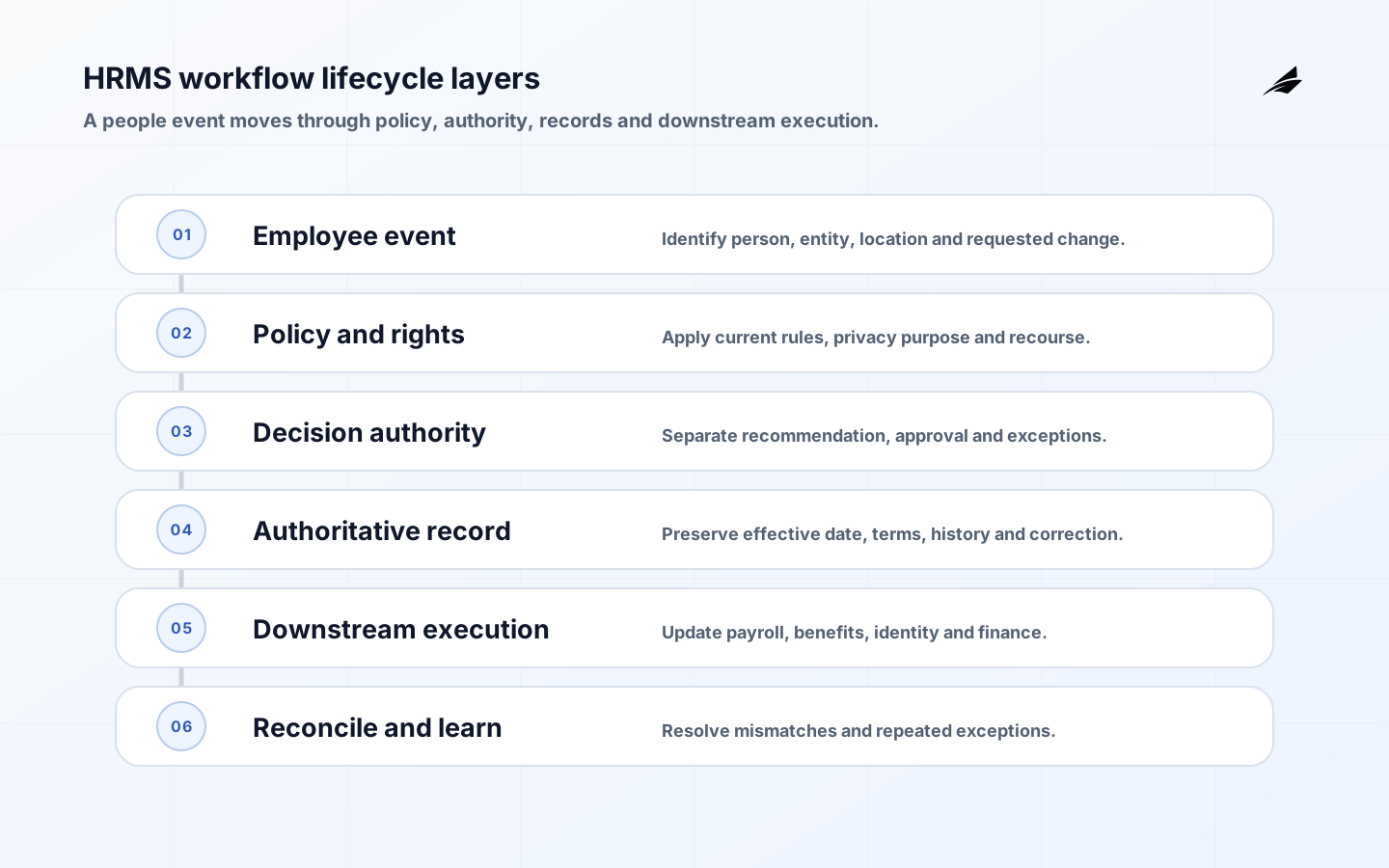
HRMS workflows coordinate events that affect people, pay, benefits, documents, and access, so their design has to be both timely and restrained. A manager change or departure may require several systems to act, yet sensitive detail should travel only where it is necessary. This guide gives founders a plain-language way to define authorized workforce events, data minimization, exception handling, completion evidence, and recurring review across the employee lifecycle.
For implementation depth, see Edilec’s HRMS workflow security review, founder guide to HRMS workflows, and HRMS workflows in production.
Frame the HRMS workflows decision
Give each HRMS workflow a precise employment outcome before discussing screens or connectors. For example: when an approved transfer becomes effective, payroll, reporting lines, cost allocation, and system access must reflect the same authorized event at the right time. Name the HR role accountable for that outcome, the application that records approval, every service allowed to consume it, and the latest safe completion point. This framing exposes disagreements that a process diagram can conceal, such as whether a manager request is evidence of intent or a final instruction. Record who may approve an exception, which facts they must see, and how a temporary decision expires. NIST's data-governance work is useful here because it treats decision authority as an organizational responsibility rather than an attribute of whichever application holds a convenient copy. The HRMS workflow engineering notes translate that boundary into practical security checks.
Define records, states, and boundaries
Model a workforce change as a dated business event whose meaning survives movement between applications. A proposed hire, accepted offer, active employment record, scheduled leave, completed transfer, and ended assignment are not interchangeable statuses. For each one, specify the fact that changes, its effective date, the approving role, and whether a later correction replaces a proposal or amends an already effective record. Then decide what a consumer receives. Payroll may require compensation and tax facts; an identity platform may only need a worker identifier, access profile, location, and activation window. Sending a complete personnel profile to both expands risk without improving the outcome. The NIST Data Governance and Management Profile links data authority to privacy and cybersecurity management. Apply that principle by keeping ownership with the designated HR or payroll source, documenting derived copies, and preventing an integration database from becoming authoritative merely because it is easy to search.
| Design question | Good operational answer | Evidence to retain |
|---|---|---|
| Employment event | Who confirms it | Minimum completion evidence |
| New hire | Recruiting and the authorized HR approver | Accepted terms, worker ID, start date, and downstream activation results |
| Internal move | HR plus the manager or compensation authority required by policy | Old and new assignment, effective date, approvals, payroll and access acknowledgements |
| Leave or return | HR or the designated leave administrator | Authorized dates, restricted disclosure, benefits impact, and restored-state checks |
| Separation | The role permitted to end the employment relationship | Effective time, pay and benefits disposition, access revocation, asset tasks, and exceptions |
Design the exchange and exception path
Specify the exchange from the receiving application's point of view. It needs to know which workforce event arrived, whether it is approved or merely scheduled, when it takes effect, which prior version it supersedes, and which response proves completion. Establish an immutable event key so redelivery cannot create two accounts or apply a pay change twice. A rejection should return an actionable reason and remain connected to a named queue, service target, and escalation path. Avoid treating technical receipt as business completion: an identity connector can accept a termination message even though one privileged account remains active. Keep the initiating reference across payroll, benefits, identity, facilities, and reporting so HR can reconcile the outcome without correlating approximate timestamps. The system-of-record design guidance helps teams distinguish the owner of an employment fact from systems that legitimately use a limited projection of it.
Control access and change
Place safeguards around the moments that alter employment, money, benefits, or access. Role design should prevent a requester from quietly approving their own sensitive change, while delegated authority must carry an expiry and visible scope. Mask or omit health, identity, bank, and compensation details in logs, notifications, test fixtures, and general support tools. Preserve attributable history for changes to employment status, effective dates, compensation inputs, mappings, and workflow rules. The NIST Cybersecurity Framework connects protection with detection, response, and recovery; for an HR platform, that means the team must notice an improper change and be able to contain and correct its downstream effects. Before releasing a rule or interface update, record why it is needed, which worker population it can affect, the cases tested, the approver, the deployment window, and the restoration plan. Local HR and legal policy should set the decision boundary; software configuration should implement it, not invent it.
| Signal | Likely interpretation | First accountable response |
|---|---|---|
| Scheduled change misses its effective date | Approval, source data, or a downstream service did not finish | Prioritize by employee impact and route the case to the owner able to complete or defer it |
| Retroactive amendments increase | The intake rule or cutoff does not match how employment decisions are made | Review affected cases with HR and payroll, then repair the common policy or data cause |
| One worker receives repeated tasks or accounts | Consumers cannot recognize a redelivered event | Suspend replay, reconcile by worker and event key, and add idempotent acceptance |
| Sensitive details appear in tickets or chat | The governed workflow lacks a safe way to explain or resolve an exception | Provide a restricted case route and remove unnecessary personal data from operational messages |
Protect And Operate Hrms Workflows
Turn support readiness into a scenario review rather than a document-signing exercise. Follow a hire, transfer, leave, and departure through the actual payroll, identity, benefits, finance, and service-desk paths. Introduce a wrong effective date, withdrawn decision, missing approver, unavailable consumer, and partial access revocation. For every variation, ask HR operations to identify the controlling record, engineering to show the failed state, and support to demonstrate the message and escalation the affected person receives. Finance or a control owner should verify any monetary or access consequence. CISA's incident response planning guidance focuses on security events, but its preparation lesson applies: roles, communications, and decisions work better when rehearsed before urgency arrives. Routine defects need routine handling; consequential failures need an explicit commander, containment choice, and recovery proof.
Release in small, observable slices
Select an initial cohort whose records can be reconciled individually, such as hires for one legal entity or transfers within one division. Observe the existing process long enough to count missed dates, repeated entry, manual chasing, payroll corrections, and access defects. During the pilot, compare the authorized population with every accepted, rejected, pending, and completed downstream event. Watch specifically for premature disclosure of candidate data, access granted from an unapproved manager change, incomplete departures, misattached documents, personal details copied into general tickets, and retention that exceeds the stated purpose. Set numerical pause conditions and give one person authority to invoke them. Keep a workable manual route until the new path proves both timing and completeness. Parallel operation is especially valuable for future-dated and dual-role cases because those reveal whether a consumer's acknowledgement actually represents the intended workforce state.
Measure useful operation
Build measures around whether the employment event took effect accurately and on time. Track starts completed before day one, departures with lingering access, payroll-impacting changes missed at cutoff, failed consumer deliveries, pending cases by age, and privileged changes without a supporting HR event. Add a privacy measure for each integration's field set so unnecessary attributes do not quietly accumulate. Google's monitoring guidance separates rapid detection from the richer evidence needed for diagnosis; use the same pattern here. A missed revocation may demand an immediate alert, while recurring location-code failures belong in a trend reviewed with their source owner. Sample actual cases alongside rates, because a green average can hide one seriously harmed employee. The production operations guide provides a cadence for reviewing exceptions, planned changes, noisy alerts, and ownership.
Trace one job change across the enterprise
Example: a future-dated promotion

Consider an employee promoted on 18 July with a new title, manager, pay rate, cost center, system role, and effective date of 1 August. The workflow must distinguish decision date from effective date and decide which details are visible before announcement. It should validate compensation authority, preserve approved terms, update payroll and identity at the correct time, and notify only people who need to act. A delayed payroll integration must not silently leave the employee underpaid while every other system reports completion.
Walk the case with HR operations, payroll, the manager, identity, finance, privacy, and employee support. Add variants: the employee is on leave, the manager changes, the promotion is withdrawn, payroll cutoff has passed, or the employee disputes the record. For each, name the authoritative field, permitted viewer, deadline, escalation owner, and correction route. Measure completion only after downstream systems reconcile. Queue age, retroactive corrections, excess access, inquiries, and missed effective dates are stronger signals than forms routed.
Key takeaways
- Describe the employment outcome first, then name the HR role accountable for approving and correcting it.
- Keep proposal, approval, scheduled execution, effective state, and amendment distinct across applications.
- Send each consumer only the workforce facts required for its purpose and retain a shared event reference.
- Test withdrawn, late, duplicated, partially completed, and privacy-sensitive cases before broad rollout.
- Judge operation by employee impact, downstream reconciliation, exception age, and evidence of timely recovery.
Frequently asked questions
Which HR process should be automated first?
Choose a frequent, rules-stable event with a clear owner, authoritative record, and reversible correction rather than a judgment-heavy employee decision.
Should managers see every field in a case?
No. Access should follow purpose and role across screens, exports, notifications, APIs, reports, and support tools.
What is the first practical step for HRMS workflows?
Choose one recurring HRMS workflow event that currently causes rework or uncertainty, name its accountable owner, and map its source, states, consumers, deadline, and correction route. That produces a testable boundary for HRMS workflows without requiring an enterprise-wide redesign.
When is automation ready?
Automation in HRMS workflows is ready when the team can explain the normal result, duplicate behavior, rejection route, correction method, and who is allowed to change the rule. Test those cases with representative HRMS workflow records before relying on volume or a dashboard as evidence of readiness.
Conclusion
Good HRMS workflows preserve operational accuracy and human dignity. Model the lifecycle event, effective date, authority, privacy boundary, downstream effects, and recourse before automating handoffs. Test real exceptions and reconcile material systems. The result is a dependable employee record and a process people can understand and challenge.