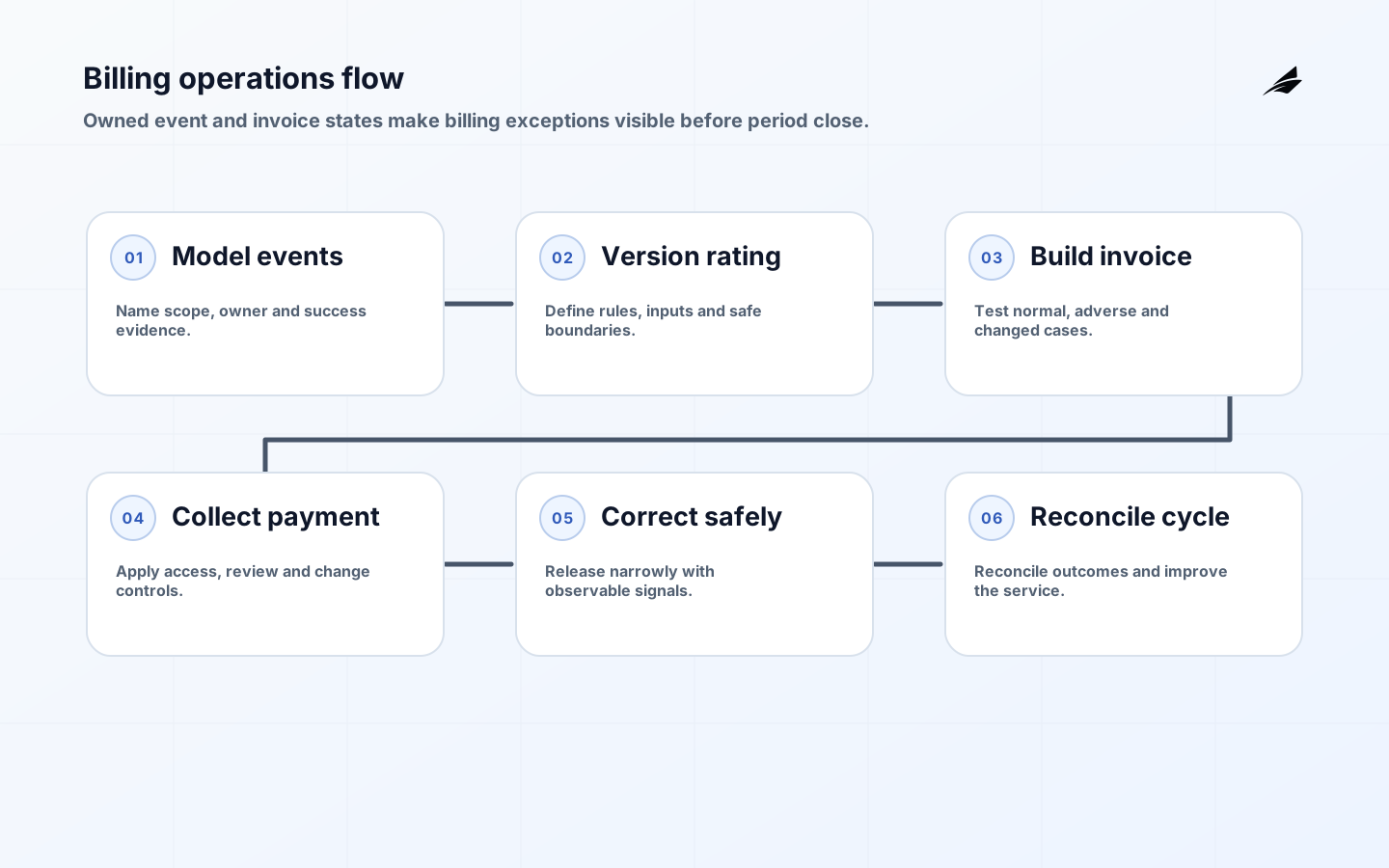
Billing operations planning connects what a customer agreed to, what the service delivered, what the company charged, and what was ultimately paid or corrected. The practical unit is an invoice line whose quantity, rate, period, currency, tax treatment, and customer can be traced to authoritative contract and event records. Planning around that chain reveals which team owns amendments, late usage, credit approval, settlement matching, and reconciliation. It also prevents a billing platform project from becoming a configuration exercise detached from commercial reality. The founder ERP integration guide covers downstream integration choices. Use the finance systems operating guide for ledger and close concerns and system-of-record design when deciding whether CRM, contract, metering, billing, or finance owns a disputed fact.
Map the billable event before the invoice
Create a lifecycle map for contract, entitlement, billable event, rating, invoice, receivable, payment, credit, and write-off. For each state transition, name the trigger, effective time, permitted actor, authoritative system, and durable identifier. Distinguish cancellation of future service from reversal of a charge already issued. Distinguish an event that occurred late from one that was processed late, because the correct invoice and accounting period may differ. Walk a duplicate event, backdated amendment, contested quantity, partial settlement, and ledger mismatch through the map. If staff cannot determine the appropriate state and owner without an offline note, the plan still contains an implicit rule. Resolve that ambiguity before automation makes it operate at scale.
| Billing plan element | Rule to decide | Required record |
|---|---|---|
| Commercial trigger | Specify the service event or milestone that becomes eligible for rating. | Contract term, event type, inclusion criteria, and occurrence time. |
| Rate ownership | Name who approves price logic, amendments, exceptions, and effective dates. | Price version, approval, activation date, and superseded rule. |
| Lineage and periods | Connect service period and event time to rating, invoice, and accounting periods. | Event, calculation, invoice-line, journal, and adjustment identifiers. |
| Correction treatment | Decide when to re-rate, credit, carry forward, reallocate, or escalate a dispute. | Original effect, reason, authorized remedy, and reconciled balance. |
Keep contracts, usage, and price versions connected
Assign authority by billing effect. Commercial operations may maintain approved contract terms; product systems attest to delivered usage; pricing owners govern rate logic; billing operations issues invoices and resolves defined exceptions; finance governs accounting treatment, write-offs, and close; support communicates but should not silently rewrite charges. Material price overrides, credits, refunds, and bank-detail changes need explicit limits and, where appropriate, independent approval. Represent proposed and approved values separately so an operator can see what changed and who accepted it. Replace broad administrator access with task-specific actions such as re-rate one event, resend one invoice, or request a credit. Constrained actions make normal recovery possible without granting the ability to reshape an entire billing period.
- Define each billable event at a grain that pricing and invoicing can reproduce.
- Version contracts and rates with explicit effective dates for mid-cycle change.
- Preserve event, charge, invoice, payment, and adjustment lineage in the operational record.
- Assign named queues for unrated events, invoice failures, disputed lines, and unmatched settlements.
- Verify late arrival, deduplication, partial payment, credit, and close-period treatment before rollout.
Design reconciliation as a daily operating practice
Preserve a lineage chain from contract clause and billable event through rating decision, invoice line, receivable, payment application, and any adjustment. Store the effective price version, source-event fingerprint, calculation inputs, rounding rule, actor or service identity, and timestamps needed to reproduce the charge. An override requires a structured reason and authorized approver; a replay must reference the original event and prove idempotency; a credit or reversal must link to the item it compensates. Operators should reach this evidence from one case view rather than manually correlate exports. This chain lets the team challenge an invoice, repair a bounded population, and verify that a temporary exception did not become an unowned pricing rule.
| Reconciliation gap | Preventive or detective control | Population to inspect |
|---|---|---|
| Source events exceed rated events | Validate contract and price eligibility, then age every unrated item. | Event counts and value by rejection reason. |
| Rated charges exceed invoice lines | Use invoice-run manifests and idempotent line creation. | Charges omitted, repeated, or held at issuance. |
| Invoices exceed posted receivables | Reconcile billing totals to finance batches by entity, currency, and period. | Unposted or differently classified invoice populations. |
| Cash exceeds applied settlements | Match provider and bank evidence to customer balances with controlled suspense. | Unapplied payments, ageing, and later reallocations. |
Make corrections and customer disputes explainable
Pilot one contract archetype and invoice cycle from source to reconciliation. Select accounts that cover ordinary usage, zero usage, an amendment, a tax or currency distinction, and a legitimate credit. Introduce a repeated event, a late event, an invalid price reference, payment-provider outage, and invoice-delivery failure. Define the expected queue, user message, permitted correction, and final control total for each case before execution. Compare billed events and amounts with the source population, then compare issued invoices and settlements with finance records. Keep new issuance pausable and use linked credits or corrected invoices for effects that cannot simply roll back. Expand only after operators can trace and resolve the pilot without engineering editing production data.
Prepare the close without freezing operational reality
Use operating measures to locate broken assumptions. Track unrated-event value and age, events without a valid contract or price, invoice generation and delivery failures, payments unmatched to receivables, credits by cause, dispute age, and differences between billing and finance totals. Break results down by event source, price version, product, currency, contract type, and billing period. Set an action threshold and owner for each signal; an alert with no permissible response merely creates noise. Review recurring manual re-rates, spreadsheet allocations, and support escalations as demand for a supported rule or interface. When a metric moves, inspect representative records before choosing a fix, because the same backlog can arise from source lateness, invalid contracts, integration failure, or insufficient operator authority.
Review the operating design before expansion
Use scenario workshops to resolve timing and ownership before configuration. Walk a customer who upgrades halfway through a service period, usage delivered after the invoice cutoff, a payment that covers only part of two invoices, and a credit requested for service disruption. Sales, product, billing, support, and finance should state which record they trust, what the customer sees, who may decide an exception, and which period receives the effect. Ask where processing can pause without losing the original event and how downstream systems learn of a correction. Document disagreements as explicit design decisions with owners and effective dates. These ordinary cases are more revealing than a polished happy-path demonstration because they force the plan to distinguish commercial intent, operational timing, and accounting consequence.
Design a durable billing evidence record. At minimum, connect customer and legal entity, contract and amendment version, billable-event identifier and occurrence time, rating rule and inputs, service period, invoice and line, payment allocation, and any credit, refund, reversal, or write-off. Preserve source references even when detail is archived, and make retention long enough to support disputes, audit, and correction obligations. Restrict access by task: a support agent may see an explanation without payment credentials, while a finance reviewer can inspect accounting links. Dashboards and exports are projections, not the authoritative history. The underlying references must survive report redesign so an investigator can trace backward from balance to event and forward from a corrected source to every affected result.
Specify exception treatment by lifecycle stage. An event rejected before rating can be corrected and replayed with the same idempotency identity. A late but valid event may enter the next invoice, trigger an approved adjustment, or require a reopened period depending on contract and accounting policy. An issued but disputed charge should remain visible while collection pauses and an authorized reviewer decides whether to credit it. A payment posted to the wrong invoice needs a traceable reallocation, not deletion. Give operators record-level recovery tools, reason codes, and verification totals; reserve broad batch replay for controlled engineering procedures. Link every compensating action to its original effect so the customer balance and historical explanation remain consistent.
The billing workspace should answer four operator questions: why does this charge exist, which record controls it, what action is allowed now, and how will that action affect the customer and ledger? Present source events, price explanation, invoice and payment status, reconciliation differences, and linked adjustments on the case. Use role-specific commands rather than editable fields, and show confirmation text that names the amount, currency, period, and consequence. Support users need customer-safe explanations and an escalation path; billing specialists need correction tools; finance reviewers need posting evidence. Train with disputed, late, and corrected scenarios, then keep the runbook linked from the action screen. When policy changes, update validation, interface copy, queued cases, and support guidance in the same release.
Gate expansion on demonstrable reconciliation and exception control. Before adding a product, country, event source, or billing cadence, require the current scope to account for expected events, reproduce calculated charges, deliver invoices, match settlements, and clear material differences within agreed ageing. Sample ordinary and corrected accounts for lineage completeness. Define stop thresholds for invalid pricing, manual overrides, unexplained credits, access exceptions, and unresolved balance differences. Also verify that operator capacity and customer communication can absorb the new population. These gates let leadership distinguish a proven billing pattern from a fragile workflow whose throughput merely looks healthy because corrections accumulate elsewhere.
Use evidence and controls deliberately
Apply external guidance to the particular risks in a billing chain. The NIST Cybersecurity Framework can structure ownership for protecting invoicing, payment, and recovery capabilities. The NIST Privacy Framework helps teams question the purpose, access, and retention of customer and payer information across exports and support views. Google SRE monitoring guidance is useful when separating a page-worthy unbilled backlog from the record detail needed for diagnosis. The OWASP Application Security Verification Standard provides testable controls for identities, authorization, validation, audit trails, and high-impact actions. Map these ideas to named billing states, roles, and evidence; none of the documents can decide the company's price authority, credit thresholds, or accounting treatment.
Walk a billing cycle before configuring it

Build a replay pack with a new subscription, quantity increase, downgrade, trial conversion, late usage, duplicate event, failed payment, tax gap, partial credit, cancellation, and refund. For each case, write expected entitlement, rated amount, invoice timing, customer message, collection behavior, ledger handoff, correction, and reconciliation. Fixed identifiers and totals let the same pack test migration, provider updates, pricing changes, and incident repair before customers encounter them.
Use this review with the article tables and linked Edilec guides. Sample completed records as well as exceptions, retain the rule and source versions that produced each outcome, and assign every corrective action to a policy, data, interface, integration, security, or operating owner. Metrics indicate where to investigate; representative cases reveal what must change. Before scope expands, repeat the exercise with an unavailable dependency, a delayed message, an unauthorized user, and a correction after the nominal process has finished. This review is specific to billing events and invoice reconciliation.
- Define canonical billing identifiers.
- Record event and receipt time.
- Assign ownership for every state.
- Preserve original evidence in corrections.
- Reconcile counts and money at boundaries.
- Run replay pack in shadow mode.
Key takeaways
- Plan billing around the complete path from contractual entitlement to settled receivable.
- Keep occurrence, processing, service-period, invoice, payment, and correction dates distinct.
- Use stable identifiers and versioned rules to reproduce each invoice line.
- Reconcile event, rating, issuance, posting, and settlement populations on a routine cadence.
- Turn repeated disputes and manual adjustments into owned contract, source, pricing, or interface improvements.
Frequently asked questions
Why keep event time as well as processing time?
Event time says when service occurred; processing time says when the platform received it. Keeping both makes late data, cut-off policy, and investigation explainable.
Can reconciliation wait until month end?
It can, but frequent population checks make missing events and mapping faults much cheaper to correct. Month end should confirm a practiced control.
Conclusion
Dependable billing preserves a coherent story from agreement and service event to invoice, settlement, and correction. Define effective-time rules, ownership, lineage, and record-level recovery before adding scale. Daily reconciliation and evidence reviews then turn exceptions into improvements, allowing the billing system to support commercial change without sacrificing explainability or control.