Inventory systems make a claim about the physical world: an item exists, it is in a place, it is available for a purpose, and a movement changed its state. That claim is more demanding than a simple quantity field. CTOs need a design that can explain why available stock changed, reconcile system records with counts, and handle fulfillment, procurement, returns, and adjustments without inventing inventory through retries or integration errors.
Build inventory systems around an accountable operating model
Start by defining the inventory unit and the decisions it supports. A business may need product-level availability, batch or lot traceability, serial-level custody, or all three. Then define locations, ownership, states such as on-hand or reserved, and the events that can move quantity. Keep demand forecasting and warehouse optimization separate from the foundational ledger; they consume inventory evidence but should not be allowed to silently rewrite it. Teams planning adjacent work should also consider this master data management guide, because shared records and handoffs often determine whether an apparently local improvement survives production use.

Define the records and states that make inventory systems explainable
Treat inventory movements as append-only events with a product identifier, location, quantity, unit of measure, reason, source document, actor or system, and time. Derive balances from the ledger or maintain a controlled projection with reconciliation. Reservations should be explicit claims against available stock with expiry and release behavior. A direct “set quantity” operation may be necessary for a count adjustment, but it needs a reason, authorization, and reference to the count evidence.
| Decision | Practical definition | Why it matters |
|---|---|---|
| Tracking level | Product, lot, serial, or combination | Matches traceability to business need |
| Movement model | Append-only event with reason and source | Explains how balances changed |
| Availability | On-hand, reserved, in transit, damaged, or held | Prevents over-promising stock |
| Adjustment | Count evidence, authority, and financial treatment | Controls corrections to physical reality |
Set ownership and controls before automating the happy path
Operations owns physical processes and count policy, finance owns valuation and accounting treatment, and technology owns system reliability and integration controls. Restrict who can make manual adjustments, transfer stock, alter unit-of-measure configuration, or release reservations. When traceability is required, preserve the lot or serial relationship through receiving, movement, transformation, and dispatch. Technical convenience must not erase the business evidence needed to investigate a discrepancy or recall. The related billing operations guide is a useful comparison when the design includes cross-team rules, because both practices depend on knowing whose decision controls the next state.
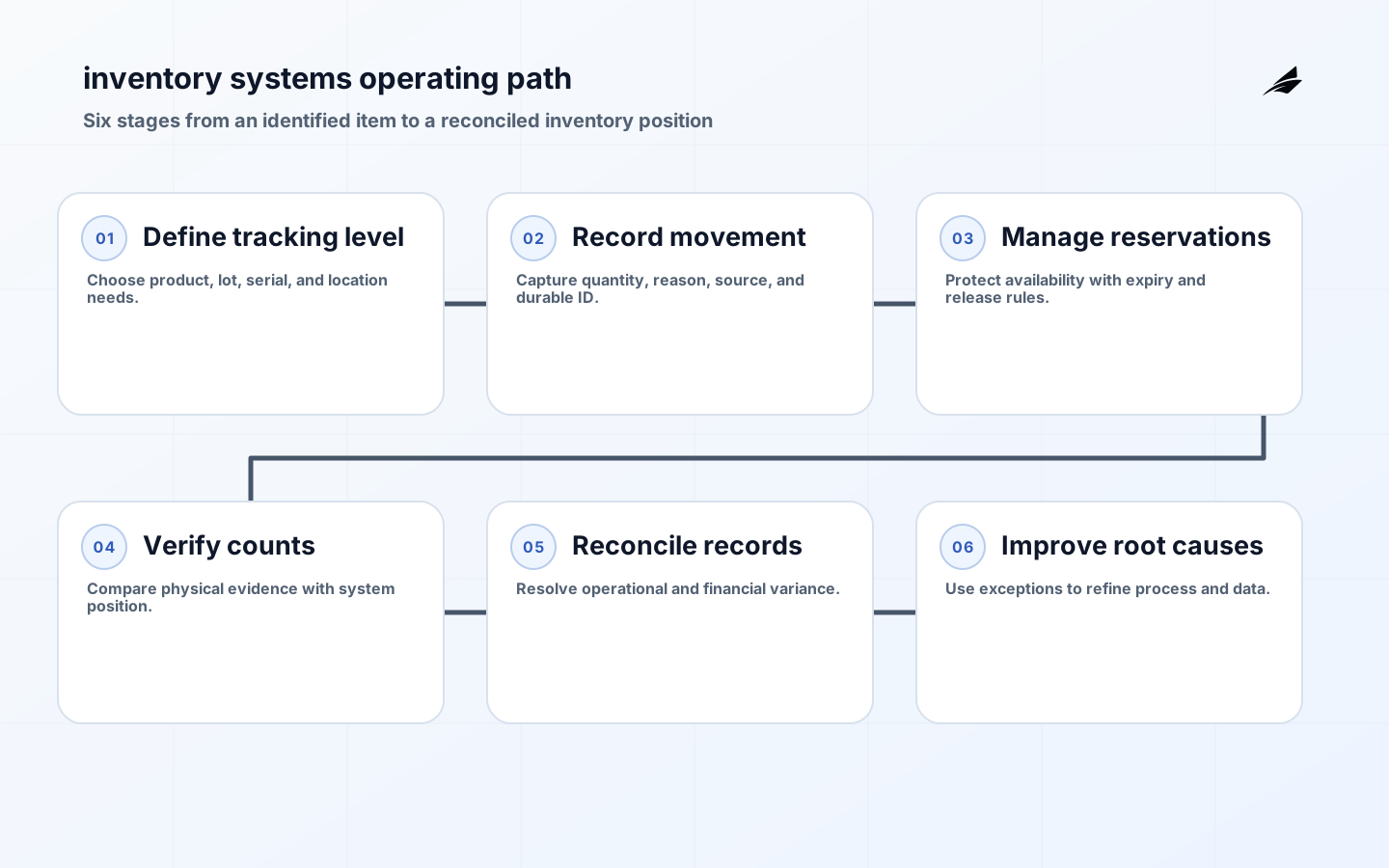
- Define the inventory unit, locations, ownership, and states needed for one flow.
- Record movements with durable IDs, reasons, and source-document references.
- Model reservations separately from on-hand quantity and test their release behavior.
- Restrict manual adjustments and retain count evidence for every correction.
- Pilot one site and test duplicate, offline, partial, and variance scenarios.
- Review reconciliation, negative balance, and adjustment trends by location.
Deliver inventory systems in slices and make exceptions visible
Pilot one facility, product family, and movement path such as receive-to-pick or return-to-available. Test concurrent reservation, partial fulfillment, damaged stock, transfer in transit, cancellation after reservation, duplicate scanner upload, offline device synchronization, and a physical count variance. Use idempotent event identifiers at integration boundaries and provide a controlled exception process for movements that cannot be applied automatically.
Use operating signals that lead to an action
Measure stock accuracy from cycle counts, negative or impossible balances, reservation expiry, unposted movement age, fulfillment discrepancy, and reconciliation variance between operations and finance. Interpret metrics by location and flow; an aggregate accuracy number can hide a warehouse or product line that drives most customer impact. Review adjustment reasons regularly because repeated write-offs or overrides may signal a process, device, or master-data problem.
| Control area | Signal to review | Accountable role |
|---|---|---|
| Accuracy | Cycle-count and ledger variance by location | Operations owner |
| Integrity | Negative or impossible balance exceptions | Inventory system owner |
| Reservation | Expired or conflicting reservation rate | Fulfillment owner |
| Adjustment | Reason, value, and recurring root cause | Finance and operations |
Common inventory systems failure modes and practical responses
Inventory systems have their own failure patterns. A configured tool can still fail because a key record is ambiguous, authority is missing, or an integration hides a rejected change. Treat each repeated exception as a case with evidence, a named owner, and a specific decision about whether policy, data, process, or code must change. That approach preserves operational learning without normalizing a workaround as part of the system.
Use a decision workshop before expanding scope
A useful decision workshop for inventory systems starts with a concrete operating case rather than a platform diagram. Put the people who create the record, apply the policy, consume the result, and repair failures in the same discussion. Ask them to trace the first design choice: tracking level. The team should agree on product, lot, serial, or combination and why it matters: matches traceability to business need. Then repeat the exercise for movement model. Disagreement is useful evidence; it often reveals that two teams have been using the same term for different business conditions.
Turn the workshop into a short operational rehearsal. First, define the inventory unit, locations, ownership, and states needed for one flow. Next, record movements with durable ids, reasons, and source-document references. Then test whether the team can model reservations separately from on-hand quantity and test their release behavior. Do this with a representative, non-sensitive record and an ordinary time constraint. A review that only describes the ideal path will miss the handoff, authorization, or missing-data condition that causes the real escalation. The purpose is to make ownership and evidence usable before more users depend on the workflow.
The exception path deserves equal design attention. Use the next steps as a practical test: restrict manual adjustments and retain count evidence for every correction. Also, pilot one site and test duplicate, offline, partial, and variance scenarios. Finally, review reconciliation, negative balance, and adjustment trends by location. Record the decision with the relevant source evidence and avoid repairing a symptom in a private message. When an exception returns, compare it with the earlier case; recurrence is a signal to change the input rule, policy, mapping, or service boundary rather than simply closing another ticket.
As scope grows, preserve the second set of design choices. For availability, the operating definition is on-hand, reserved, in transit, damaged, or held; this matters because it prevents over-promising stock. For adjustment, use count evidence, authority, and financial treatment so the team can control corrections to physical reality. These details are where a pilot becomes a service other teams can rely on. They also give reviewers a stable way to distinguish a legitimate exception from an undocumented bypass.
Review evidence on a regular cadence with the people able to change the system. Look at accuracy through cycle-count and ledger variance by location, owned by operations owner. Pair that with integrity: negative or impossible balance exceptions. The goal is not a perfect dashboard. It is a short list of decisions: which failure needs an immediate repair, which trend needs a policy change, and which measurement no longer represents the operating outcome the team cares about.
Use a written acceptance test for the next release of inventory systems. The test should show that a normal record completes, an invalid record is stopped with a useful reason, and a corrected record can continue without creating a second outcome. It should also prove the policy behind tracking level remains visible to the person reviewing the result. These tests create shared confidence between the business owner and the delivery team, especially when a change crosses an integration boundary.
Keep the review practical by sampling a recent case and asking the questions users actually ask: Should inventory be tracked by product, lot, or serial number? Why do negative inventory balances occur? How often should stock be reconciled? Then compare the answers with the current evidence in the system. The control view should help the responsible team inspect reservation through expired or conflicting reservation rate, and decide whether the next improvement belongs in policy, data, product behavior, or operations. This small discipline prevents a growing system from accumulating unexplained exceptions.
Key inventory systems takeaways
- An inventory balance is the result of traceable movements, not a standalone fact.
- Reservations and manual adjustments need explicit lifecycle and authority.
- Reconciliation connects operational stock claims to finance and physical counts.
Frequently asked questions about inventory systems
Should inventory be tracked by product, lot, or serial number?
Use the level of identification required by the business risk and process. Product-level records may suit simple count-based operations; lots help isolate a batch; serialized records support individual-item custody. Higher granularity adds capture and process cost.
Why do negative inventory balances occur?
They can result from late or duplicate movements, incorrect units, unmodeled transfers, integration failures, or a process that ships before recording receipt. Treat them as an investigation signal, not a quantity to overwrite without evidence.
How often should stock be reconciled?
The appropriate cadence depends on volume, value, regulation, and operational risk. Set a cycle-count and reconciliation policy that can detect meaningful variance early, then use recurring differences to improve the flow and data controls.
Conclusion
Inventory systems should preserve the evidence behind every quantity, not merely display the latest balance. Define the unit, location, state, and movement rules before selecting a platform or writing integrations. A narrowly deployed ledger with tested reconciliation will scale more safely than a broad implementation that cannot explain a count difference.