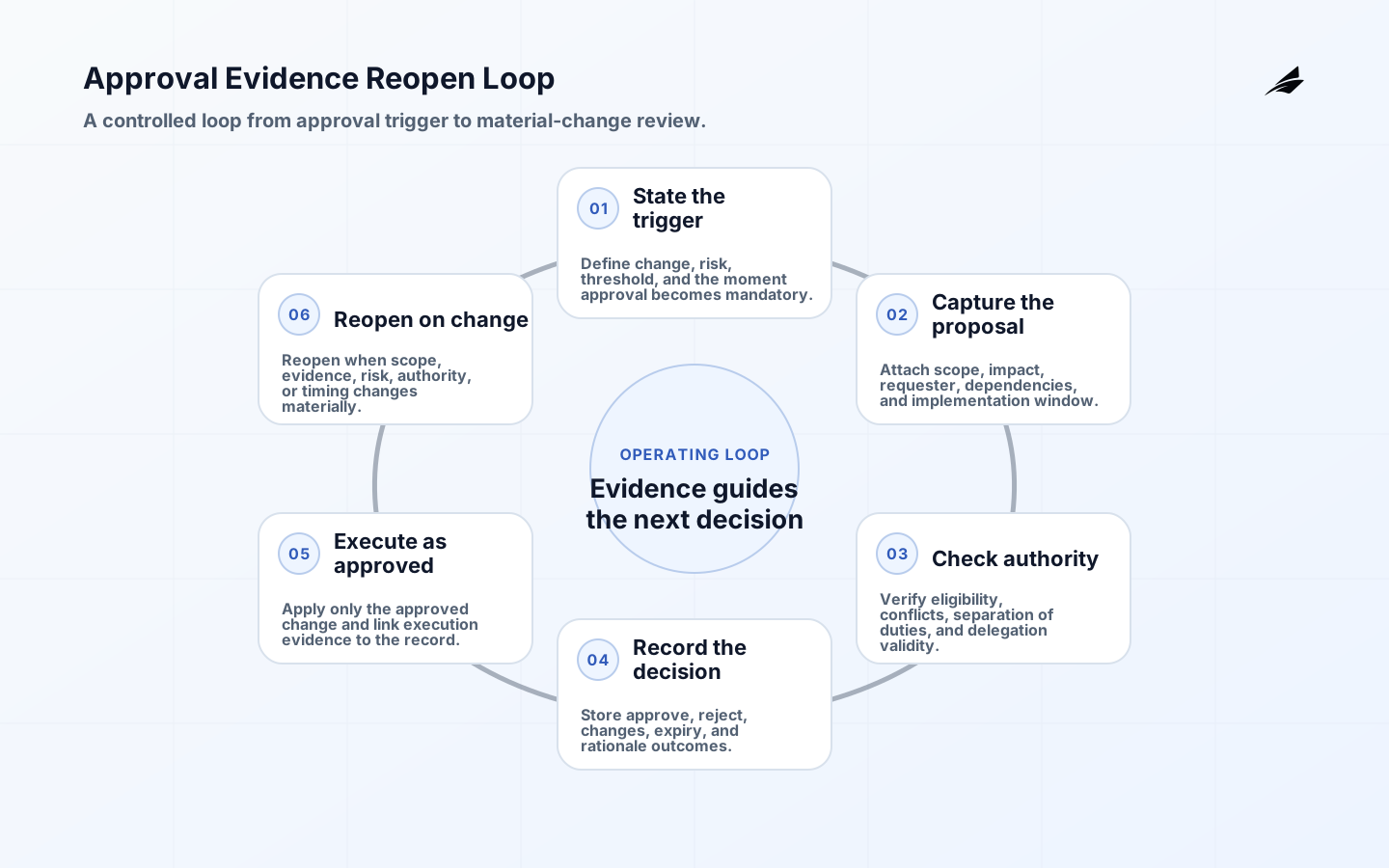
For approval workflows, approval workflows are how an organization turns a policy or delegated decision right into a repeatable operational action. At the approval boundary, they are useful when a request changes money, risk, customer commitment, access, legal position, or a shared operating record. During a decision review, the point is not to make every task wait for a manager. On the controlled-change path, the point is to ensure that the person with the right authority sees sufficient evidence, makes an explicit decision, and leaves a record that can be acted on and reviewed. For approval owners, a workflow with too little control invites untraceable exceptions; one with too much control creates delays and ritual approval. Good implementation matches the control to the decision's consequence.
For approval workflows, this guide uses NIST SP 800-128, Create and test an approval workflow with Power Automate, Top scenarios for approval flows, NIST SP 800-40 Rev. Within this evidence workflow, 4 to connect the implementation boundary with authoritative evidence, operating checks, and a visible correction path. For approval workflows, at this checkpoint, the references are applied to the concrete decisions, records, and failure cases discussed below.
Approval workflows: define the decision and authority
At the approval boundary, state the decision in a sentence: approve a supplier payment above a threshold, grant access to a sensitive role, accept a nonstandard customer term, or release a production change. During a decision review, specify the policy basis, requester, approver role, value or risk threshold, required evidence, expiration, and downstream effect. Define delegation conditions and separation-of-duty rules early. On the controlled-change path, the NIST Cybersecurity Framework is a useful governance reference because it links organizational accountability to actual protective and recovery activity. For approval owners, an approver title is not enough; the system must be able to tell whether that person has authority for this amount, entity, region, or type of decision.

| Approval element | Implementation question | Evidence |
|---|---|---|
| Decision | What specific action is authorized? | Request type and policy reference. |
| Authority | Who may approve at this threshold? | Role and delegation rule. |
| Evidence | What must be true before approval? | Attached facts and validations. |
| Outcome | What happens after approve, reject, or expire? | State, action, and notifications. |
Approval workflows: collect sufficient evidence
Evidence should help the approver decide, not bury them in attachments. Within this evidence workflow, present the requested action, relevant context, amount or impact, policy checks, exceptions, alternatives, and a link to source records. For approval workflows, validate information that can be checked automatically before sending it to a person. At the approval boundary, mark assumptions and missing facts clearly rather than making the request look complete. During a decision review, for sensitive material, minimize what appears in notifications and limit access to the full record. On the controlled-change path, the NIST Privacy Framework is a helpful reminder that legitimate operational purpose does not justify broad distribution of personal or confidential data.
- Show the requested action and its operational consequence first.
- Validate mandatory fields and policy thresholds before routing.
- Attach source references instead of copying sensitive content into every message.
- For approval owners, make an exception visible and require an explicit rationale to approve it.
- Within this evidence workflow, set an expiry or revalidation rule when the facts may become stale.
Approval workflows: route, delegate, and escalate
For approval workflows, route on decision attributes such as legal entity, amount, risk class, cost center, and requester relationship, not on an ambiguous team name. At the approval boundary, delegation should be time-bounded, authorized, and visible to the original authority where appropriate. During a decision review, escalation is different: it handles an approval that cannot be completed within the needed time or needs a higher decision right. On the controlled-change path, keep the requested action unchanged unless an authorized person amends it; otherwise the audit history no longer proves what was approved. For approval owners, the approval workflows guide offers further examples of making thresholds and ownership understandable to people who must use them under time pressure.
| State | Meaning | Next owner |
|---|---|---|
| Ready for approval | Evidence and policy checks are complete. | Named approver. |
| Needs information | A required fact or exception explanation is absent. | Requester or record owner. |
| Delegated | Authorized substitute may decide within scope. | Delegate with recorded authority. |
| Escalated | Time or risk requires a higher decision. | Escalation authority. |
Approval workflows: execute with controls
Approval is an authorization, not proof that the downstream action happened. Within this evidence workflow, connect approval to a controlled execution step and record whether the action was completed, failed, cancelled, or superseded. For approval workflows, protect this boundary with authorization checks, immutable decision records, input validation, and sensible error handling. At the approval boundary, the OWASP Application Security Verification Standard is relevant because an attacker or ordinary configuration error should not be able to substitute a request after approval or execute an action outside the decision's scope. During a decision review, preserve decision time, actor, role, evidence version, outcome, and target reference for the life required by the process.
Approval workflows: make approvals usable under time pressure
For approval owners, provide a controlled way to amend a request before or after review. Within this evidence workflow, small factual corrections may preserve the original route, while a changed amount, supplier, scope, or risk should trigger revalidation. Show the requester what changed and why the decision state moved. For approval workflows, this avoids a common failure where people cancel and recreate requests repeatedly, leaving approvers and downstream teams unsure which record represents the current authorized action.
Keep the approval history readable after the request is complete. At the approval boundary, a later reviewer should see the original request, significant amendments, required checks, approvers, decision times, execution result, and any reversal without assembling those facts from separate systems. During a decision review, that record supports audit and dispute handling, but it also helps the operating team answer ordinary questions about why work was delayed, changed, or declined. Retention should follow the process requirement and minimize unnecessary sensitive detail.
On the controlled-change path, finally, test approver experience with the real devices and notification channels people use. For approval owners, a workflow that is clear on a large desktop screen may obscure a critical exception or supporting document on a mobile device. Within this evidence workflow, the test should confirm that an approver can review, request clarification, and make or defer a decision without bypassing the controlled route.
For approval workflows, an approval workflow fails in practice when the responsible person cannot understand the request quickly enough to decide. At the approval boundary, design the review screen or message around the decision: what is being authorized, why now, what policy applies, what is unusual, and what will happen after a choice. During a decision review, put supporting records behind links or expandable context rather than forcing an approver to scan a long form. On the controlled-change path, use a summary that is generated from controlled fields, not free-text paraphrase alone. For approval owners, an approver should be able to ask for information, reject with a useful reason, or escalate without inventing a parallel email process.
Time limits need thoughtful behavior. Within this evidence workflow, a request that expires should not silently disappear if the underlying action still matters. For approval workflows, decide whether expiry returns it to the requester, raises it to a service owner, blocks execution, or permits a documented recovery route. At the approval boundary, avoid automatic approval solely because a clock elapsed unless the policy truly intends that risk transfer. During a decision review, for urgent work, define an emergency route with narrower evidence requirements only where necessary, followed by a timely retrospective review. On the controlled-change path, emergency does not mean unrecorded; it means the organization knows how to make a fast, bounded decision.
Communication is part of control. For approval owners, notify the requester when a decision is needed, made, expired, or blocked, but tailor the message so it does not reveal confidential evidence to people without access. Notify downstream operators only when their action can begin. Within this evidence workflow, a clear status prevents people from making duplicate requests or bypassing the process because they believe nothing happened. For approval workflows, review notification fatigue as a real operational problem: repeated low-value reminders can teach approvers to ignore the one request that deserves attention.
Approval workflows: measure friction and control
At the approval boundary, track time to first decision, age of pending high-impact requests, approval reversal rate, policy exceptions, delegation use, expired approvals, and execution failures after approval. During a decision review, review samples of fast approvals and late ones to learn whether delay comes from evidence quality, routing, workload, or an unclear policy. On the controlled-change path, google SRE monitoring guidance helps make signals actionable: alert on an aged high-risk approval, but retain detailed history for the periodic review that improves the workflow. For approval owners, the role-based operations guide can help when the system's roles fail to reflect the actual authority structure.
Make approval evidence part of the transaction
Within this evidence workflow, an approval workflow should answer what changed, which rule required review, who was eligible to approve, what evidence they saw, and when the decision took effect. Imagine a purchase request above a threshold. For approval workflows, the requester can prepare it, a budget owner can approve the spend, and a procurement reviewer can confirm supplier terms. At the approval boundary, if the amount changes after approval, the workflow should either restart or state why the change is immaterial. During a decision review, keep the prior value visible when a request is rejected so the record remains understandable.
On the controlled-change path, microsoft’s workflow guidance highlights sequential approvals, separation of duties, and retention of prior values; NIST control guidance adds useful context for auditability and access review. For approval owners, use those principles to test delegation, timeout, withdrawal, duplicate submission, and service outage. Do not treat an email notification as the approval record. Within this evidence workflow, the durable record belongs with the transaction, with a stable status and the evidence needed for later review. That is what turns automation into an accountable control.
For approval workflows, for approval workflows, review event analytics notes, KPI governance principles, and finance reporting fixes before assigning decision rights when evidence or delegation changes materially.
Approval workflows: approval-control checks to carry forward
- At the approval boundary, define the decision, authority, evidence, threshold, and downstream effect in one operating rule.
- Collect decision-useful evidence and make exceptions explicit.
- Separate delegation from escalation and retain both in the history.
- Bind approval to a controlled, auditable execution step.
- During a decision review, use pending age, reversal, exception, and execution-failure evidence to improve the design.
Frequently asked questions
When does an approval workflow need separation of duties?
On the controlled-change path, use separation when one person should not be able to request, approve, and execute an action with meaningful financial, access, customer, or compliance consequences. For approval owners, the rule should be tied to the actual decision and risk, not applied as a blanket obstacle to ordinary work.
What happens when the approver is unavailable?
Within this evidence workflow, use a documented delegation or escalation path with scope, effective time, and recorded authority. For approval workflows, avoid informal forwarding because it makes it difficult to prove who was authorized to decide and why.
Conclusion: preserve the decision record
At the approval boundary, useful approval workflows are clear about who may decide, what they must see, and what their decision enables. During a decision review, that clarity makes control less theatrical and more practical: people can move important work forward without losing accountability.