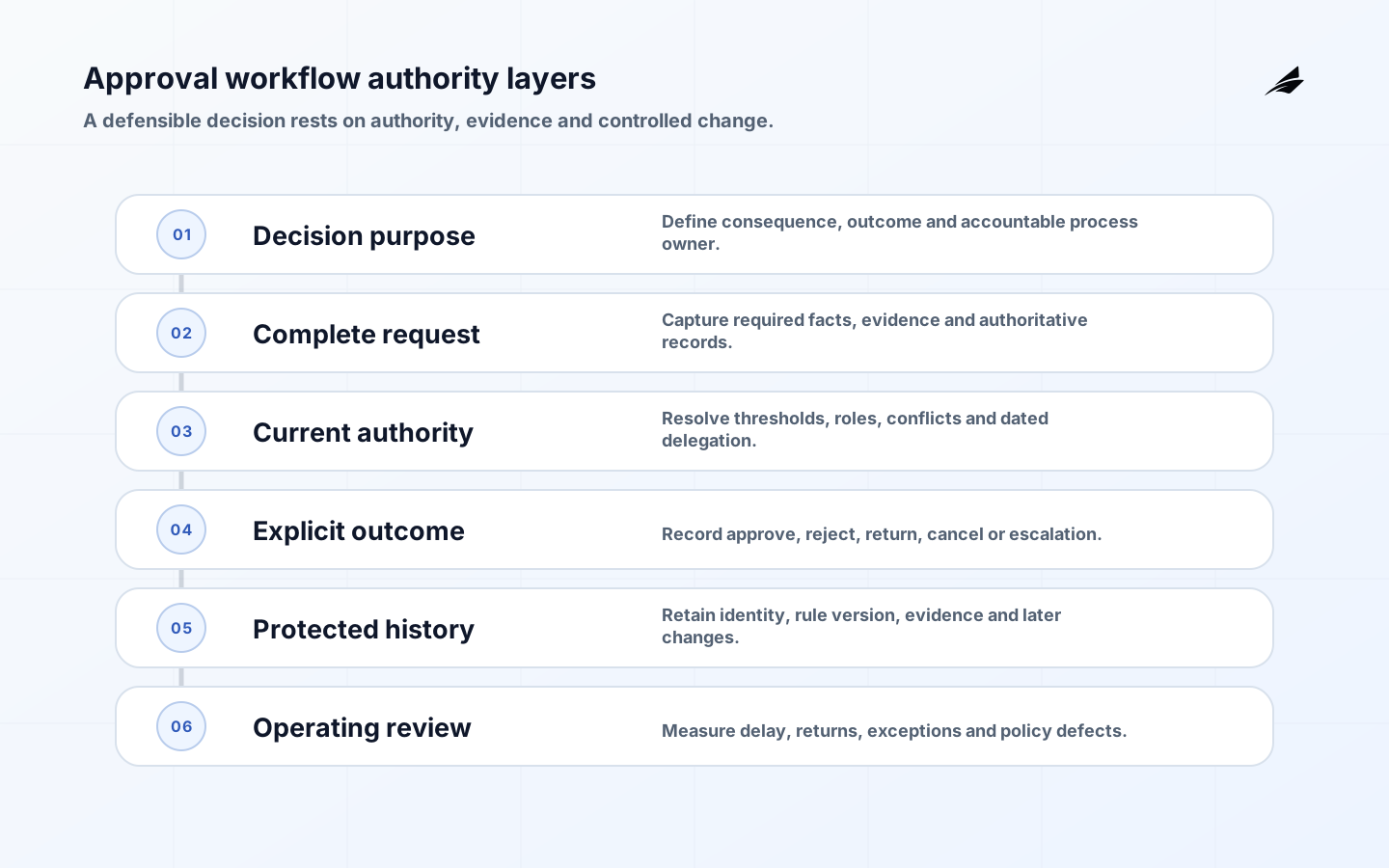
Approval workflows convert organizational authority into repeatable decisions. Their purpose is not to collect clicks; it is to ensure the right person decides with the right evidence, within a useful time, while unusual cases remain visible. This guide extends Edilec’s approval workflow implementation checklist, product-team guide, and production workflow guide.
Frame the approval workflows decision
Start an approval design with the controlled act, not the notification route. State exactly what cannot proceed without authority: issuing a purchase order above a threshold, granting privileged access, changing a supplier’s bank details, or publishing a regulated statement. Then identify the policy clause, request owner, decision class, financial or operational limit, and evidence an approver needs. A line manager may understand workload while lacking delegated spending authority; the workflow must route by the authority register rather than an organisation-chart shortcut. Define the decision deadline and the safe outcome when nobody qualified is available. NIST’s data-governance definition is helpful because approval records are enterprise assets whose ownership and decision rights need formal treatment. Record which system owns the request, which service may execute an accepted decision, and who can authorize a temporary exception. The approval workflow engineering notes translate these questions into implementation checks.
Define records, states, and boundaries
Treat the request, authority assignment, decision, and execution as separate governed records. A request moves from draft to submitted only when required evidence is present; a decision can be approved, rejected, returned, expired, or superseded; execution records whether the exact approved revision was acted upon. Delegation needs a decision class, limit, start and end time, delegator, delegate, and any prohibition on further delegation. Never erase a rejection or materially edit an approved request in place—create a new revision and require re-evaluation when price, payee, legal entity, risk category, or attachment changes. Distribute references to the approved record rather than letting downstream applications reinterpret the authority. The NIST Data Governance and Management Profile links data use with privacy and cybersecurity governance; for approvals, that means limiting both who can see sensitive evidence and who can alter the facts on which a decision rests.
| Design question | Good operational answer | Evidence to retain |
|---|---|---|
| What starts work? | A named business event with a source and effective time | Source reference and correlation ID |
| Who may decide? | A current role or assigned owner, not an assumed inbox | Authority or assignment record |
| What can fail? | A defined rejection, retry, and escalation path | Error reason and handoff history |
| How is it corrected? | A controlled reversal or amendment, not a silent overwrite | Old value, new value, reason, and actor |
Design the exchange and exception path
Build routing from explicit policy attributes. A purchase request might use legal entity, cost centre, category, total commitment, currency-normalized amount, and conflict status to select a current authority. Validate those inputs before seeking a decision, then freeze a revision hash so the execution service can verify that the payee, amount, and terms are unchanged. If an approver is absent, use a dated delegation record or escalate to another person holding the same authority; do not infer approval from silence. Duplicate submissions should resolve to one decision case, while a corrected submission should create a traceable successor. Distinguish policy rejection from a technical delivery failure and from a request returned for evidence, because each has a different owner and next step. Preserve a common request identifier through intake, decision, procurement, and payment. The system-of-record design guidance helps resolve which application owns policy facts and which merely displays them.
Control access and change
Enforce separation where the consequence warrants it: a requester should not approve the same commitment, an authority-register administrator should not silently grant themselves a limit, and an execution account should accept only a valid decision token for the current request revision. Protect attachments and decision comments according to their content instead of copying them into email threads. Make break-glass approval narrowly scoped, time-limited, visibly labelled, and subject to retrospective review. The NIST Cybersecurity Framework offers a useful lifecycle for governing authority data, protecting records, detecting misuse, responding to exceptions, and recovering from faulty changes. Version policy tables and delegation imports; test boundary values, conflicting roles, expired authority, and currency conversion before deployment. Retain who proposed and approved the rule change, the cases it could affect, and how it can be reversed. This evidence supports both access investigation and business assurance without turning every low-risk request into excessive ceremony.
| Signal | Likely interpretation | First accountable response |
|---|---|---|
| Records wait past their target | An owner, validation, or downstream dependency is blocked | Inspect the oldest items and assign a named resolver |
| Manual corrections rise | A rule, master record, or upstream process is drifting | Sample corrections and fix the shared cause |
| Duplicates or repeats appear | Retries lack a stable business key or matching rule | Pause unsafe replay and reconcile the affected population |
| Users work around the system | The path is slow, unclear, or missing an exception state | Observe the real task before adding another form |
Control Approval Workflow Changes
Run approval governance as a joint responsibility. The policy owner defines decision classes and limits; HR or identity teams maintain role status; finance, legal, security, or risk owners supply domain rules; the service team keeps routing and evidence available; internal control samples whether execution matched authority. Review aged requests, unusual delegations, repeated returns, emergency decisions, and actions performed after expiry. Rehearse a scenario in which an erroneous authority import allows a person to approve above their limit. The response must suspend affected routes, locate decisions made under the bad revision, determine which executions require review, restore the correct register, and communicate with process owners. CISA’s incident response planning guidance reinforces the value of prepared responsibilities and communications. Applied here, it ensures a control failure has an agreed investigation and remediation path instead of being handled through private messages.

Release in small, observable slices
Pilot one decision class with a stable policy and a modest, reviewable volume, such as domestic purchases within a defined band. Replay recent cases through the proposed authority rules and compare routes, decisions, and evidence with the existing process before enabling execution. Include threshold boundary values, delegates whose term begins or ends mid-case, requesters who change roles, rejected requests resubmitted with edits, and approvals that expire before action. During live use, reconcile submitted revisions to decisions and executed transactions; no approved item should disappear, and no action should lack a current decision. Pause if self-approval appears, authority cannot be demonstrated, material edits bypass reapproval, or attachments leak into uncontrolled channels. Expand to another entity or decision class only after policy owners accept the exception pattern and operators can reverse or re-route a case safely. This staged approach discovers differences in delegation and local policy while the population remains correctable.
Measure useful operation
Measure whether valid requests reach an authorized, timely, and executable decision. Track median and tail decision time by class, time waiting for requester evidence, expiries, returns, delegation use, routes with no eligible approver, break-glass decisions, and attempted execution against a stale revision. Reconcile approved request identifiers with downstream transactions and sample the supporting policy evidence. Segment results by legal entity, threshold band, authority-table version, and request channel to reveal a weak branch hidden by the average. Following Google SRE monitoring guidance, alerts should indicate an action such as disabling a route with no valid authority, while diagnostic records explain the policy attributes and candidate evaluation. Assign policy and service owners to every threshold. A regular control review should inspect actual cases, retire obsolete delegations, and feed corrections into rule tests. The production operations guide provides more detail on that operating cadence.
Worked example: purchase approval with defensible delegation
Consider a purchase request that requires a cost-center owner below one threshold and finance plus procurement above it. Capture amount, currency, supplier, category, budget reference, contract status, requester, and supporting evidence at submission. Resolve approvers from versioned authority data, not names embedded in workflow code. If an approver is absent, delegation must have a start, end, scope, and delegating authority; it must never allow the requester to approve their own request.
Design explicit outcomes: approved, rejected with reason, returned for information, cancelled, expired, and escalated. Preserve the evidence seen by the decision-maker and record rule version, identity, timestamp, comments, and subsequent changes. Test boundary amounts, currency conversion, changed cost centers, duplicate submissions, withdrawn requests, unavailable approvers, and amended purchases. Measure decision lead time by path, overdue work, return rate, policy exceptions, delegation use, and post-approval changes rather than celebrating the number of approvals processed.
Key takeaways
- Begin approval workflows with one consequential decision and a named process owner.
- Define lifecycle states, authority, effective time, and correction before automating handoffs.
- Use stable references and an explicit exception path across every consequential exchange.
- Protect sensitive data and high-impact changes with proportionate access, review, and audit records.
- Release with reconciliation and real failure cases, then use operating evidence to improve the path.
Frequently asked questions
What is the first practical step for approval workflows?
Choose one recurring approval workflow event that currently causes rework or uncertainty, name its accountable owner, and map its source, states, consumers, deadline, and correction route. That produces a testable boundary for approval workflows without requiring an enterprise-wide redesign.
When is automation ready?
An automated approval route is ready only when representative requests prove the full control: policy attributes select a currently authorized person, the decision binds to an immutable request revision, duplicates do not create extra commitments, rejection prevents execution, and a material correction forces reapproval. The team must also demonstrate who can change authority data and how an erroneous rule is contained.
Conclusion
A dependable approval workflow proves four things together: what was requested, which policy applied, who held authority at that moment, and whether the approved revision was executed. Designing delegation, expiry, amendment, emergency access, and reconciliation as first-class paths prevents an inbox sequence from masquerading as control. The result is faster routine authorization with stronger evidence for the decisions that deserve scrutiny.