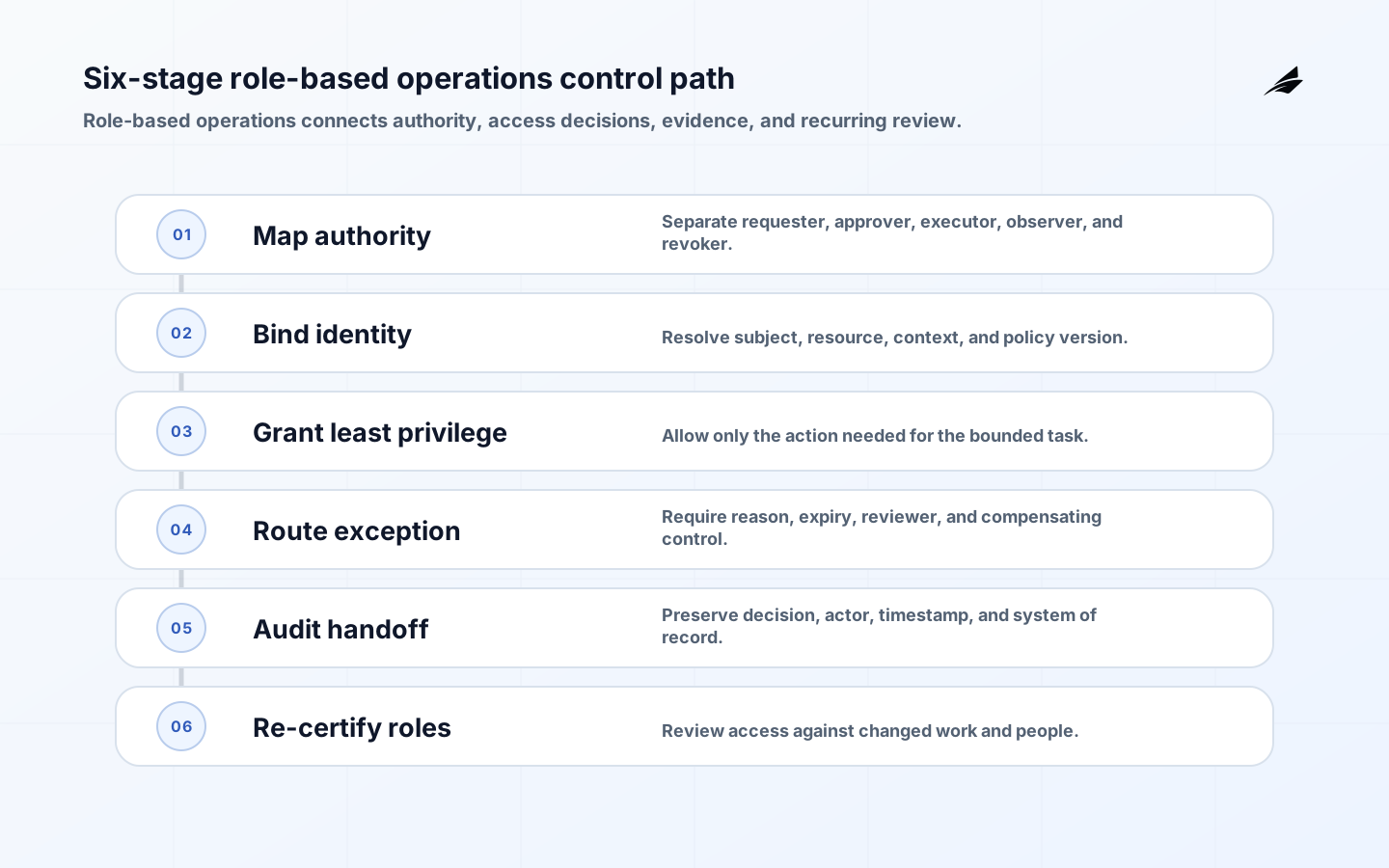
The role-based operating model is not a screen-design exercise. Before a team builds it, they need to agree on the operational action that enters the system, the decision it supports, and the evidence that proves the result. The practical aim is access that allows timely work while keeping sensitive authority deliberate. That requires a shared model for who can act, which system is authoritative, when a handoff is complete, and what happens when the usual path fails, for role authority. Starting with those decisions keep a useful operating tool from becoming a second inbox with a more expensive interface, at the access boundary.
Role-based operations: Define the role-based operations operating decision
A build starts with a bounded decision, not a feature inventory. For role-based operations, describe the normal operational action, the people involved (business role owner, manager, security administrator, and auditor), and the point at which the organization can say that the outcome is valid. The accountable authority is the role definition, entitlement source, approval rule, and access review. Write this in ordinary business language before turning it into fields, queues, or integrations, at the access boundary. A useful test is whether a new operator can explain what must be true before they take the next action, who can settle a dispute, and what record they would consult, during recertification.
| Design question | Decision to record | Evidence to retain |
|---|---|---|
| Purpose | Which decision does the operational action support? | Named owner, timing, and desired outcome. |
| Authority | What proves the current state for role-based operations? | the role definition, entitlement source, approval rule, and access review |
| Boundary | Which actions require review or must stay manual? | Policy rule, approver, and exception reason. |
| Completion | When is a operational action actually complete? | Timestamp, actor, and supporting record. |
Role-based operations: Set boundaries before connecting systems
The architecture for role-based operations should distinguish the user surface from the decision logic and the systems that hold authoritative facts. The user interface may collect a request or show progress, but it should not quietly redefine ownership, for role authority. Integration contracts need identifiers, expected state changes, time semantics, and a clear behavior for delayed or duplicated messages, at the access boundary. Treat a broad entitlement granting an action that no current business responsibility justifies as a design scenario, not a theoretical warning: trace how it is detected, who receives it, what data they need, and how they return the work to a safe state.
Role-based operations: Design a narrow first release
The right first release for role-based operations is one role whose access crosses a sensitive approval or data boundary. Observe the work with the people who perform it instead of relying on a diagram from a planning meeting, during recertification. Capture the happy path, the wait states, the missing-information path, and the decision a person refuses to make without more evidence, for role authority. Then choose one measurable improvement. A narrow release makes assumptions visible: it shows whether the role definitions are usable, whether integration events arrive in the required order, and whether users can recover without engineering intervention, at the access boundary. Broad scope hides all three problems until adoption is at risk.
Build the route around explicit states rather than a single vague label such as open or done, for role authority. Each state should have a permitted transition, an accountable next owner, and a service expectation where time matters, at the access boundary. Store the reason for a rejection, reassignment, or override next to the action, during recertification. That history allows role-based operations to support operating review rather than forcing teams to reconstruct decisions from email. It also keeps reports honest: a waiting item, a blocked item, and a completed item should mean different things to a manager, for role authority.
| Release element | Minimum behavior | Failure signal |
|---|---|---|
| Intake | Validate the operational action and show what is missing. | Repeated corrections or abandoned intake. |
| Routing | Assign an owner and due expectation from an explicit rule. | Unassigned work or manual rerouting. |
| Decision | Record reviewer, rationale, and supporting evidence. | Unexplained override or conflicting state. |
| Recovery | Pause, retry, or escalate without duplicating work. | Duplicate action, lost context, or stale queue. |
Role-based operations: Protect data and decisions in the workflow
Role-based operations needs permissions that reflect the work, not a generic split between administrators and everyone else. Separate the ability to view sensitive details, change a decision, assign work, approve an exception, and configure routing, at the access boundary. Review access when responsibilities change, and log actions that materially affect another person, a customer, money, or a retained record, during recertification. Security is not only a perimeter concern here; it is a way to make responsibility legible when a decision is challenged weeks later, for role authority.
Role-based operations: Test the real operating path
Test role-based operations with representative records and awkward conditions: a late integration event, an unavailable dependency, a reassigned owner, a rejected decision, and a correction after closure. The goal is not merely to prove that the normal screen works, for role authority. It is to prove that the system preserves context and does not create a silent second version of the truth, at the access boundary. Rehearse recovery with the people who will operate it, including the communication they need to send and the evidence they must retain, during recertification. A polished demo cannot substitute for that operational test.
Role-based operations: Measure outcomes and improve deliberately
Use a small operating review for role-based operations. Start with orphaned access, approval turnaround, denied-action investigation, privileged-role use, and review completion. Pair volume measures with quality checks so a faster route does not mask poor decisions or suppressed work, during recertification. Read a sample of completed and exceptional items, compare the system state with underlying evidence, and ask whether the assigned owner had enough context at the time of action, for role authority. When a measure moves, investigate the workflow and policy behind it before tuning a dashboard, at the access boundary. The best improvements usually come from a repeated exception, an unclear handoff, or a data field that nobody truly owns, during recertification.
Role-based operations: Use authoritative guidance as a control lens
The implementation details will vary, but the control questions are stable. The NIST SP 800-30 Rev. 1 provides a useful lens for identifying the business outcome, protecting the authority to change it, detecting failures, and recovering. NIST SP 800-53 is a reference for access, audit, and accountability controls; NIST SP 800-34 informs recovery planning; and NIST SP 800-92 explains why logs need purpose, retention, and review, during recertification. Apply these sources to the risks and decisions in role-based operations, rather than treating them as a checklist detached from operations.
Role-based operations: Review role-based operations before launch
Before production launch, convene the people who own the role-based operations decision, the supporting records, and the support path. Walk through one ordinary item and one uncomfortable item from intake to outcome, during recertification. Ask what happens when a required fact arrives late, a responsible person is unavailable, a user challenges a decision, or an integration confirms an action twice, for role authority. Confirm that the system shows the current owner, the reason for its state, and the evidence needed to continue or reverse the work, at the access boundary. Check that alerts go to someone who can act rather than to a shared mailbox with no obligation, during recertification. This review is particularly valuable for role-based operations because the first production incident usually exposes a boundary that looked harmless in a diagram. Record the finding, choose an owner and due date, and rerun the scenario after the correction, for role authority.
Key takeaways for role-based operations
- Define the decision and authority for every important operational action before choosing screens or integrations.
- Make normal states, exception states, and recovery actions visible to business role owner, manager, security administrator, and auditor.
- Launch one role whose access crosses a sensitive approval or data boundary, then expand only after the route produces reliable evidence.
- Review orphaned access, approval turnaround, denied-action investigation, privileged-role use, and review completion with samples of real work, not aggregate metrics alone.
Role-based operations FAQ
What is the best first scope for role-based operations?
Start with one role whose access crosses a sensitive approval or data boundary. It is small enough to observe end to end, yet meaningful enough to reveal whether ownership, data quality, and recovery rules are workable, for role authority.
How should a team choose authority in role-based operations?
For role-based operations, authority belongs with the system and accountable role that can produce the best evidence for the specific decision. State its boundary explicitly, including the fields or states it does not own, for role authority. When another system enriches or consumes the fact, define the event, timing, and reconciliation route so that a disagreement becomes visible instead of silently overwriting the record, at the access boundary.
What shows that role-based operations is working?
Look for fewer unresolved handoffs, clearer evidence for decisions, and improvement in orphaned access, approval turnaround, denied-action investigation, privileged-role use, and review completion. Confirm the numbers by reviewing real cases with operators and decision owners, at the access boundary.
Conclusion
Role-based operations becomes dependable when the team treats it as a living operating capability: a bounded decision, explicit authority, observable handoffs, and a recovery path that people can actually use. Build the smallest route that proves those choices with real work, then extend it as evidence accumulates, at the access boundary. Related reading: system-of-record design, CRM automation, workflow exception handling.
For role-based operations, anchor the first release to one recurring handoff: name the requester, approver, executor, resource boundary, and revocation path. Preserve identity context, policy versions, and decision receipts so an access dispute can be reconstructed without relying on an administrator’s memory by design now.
For role-based operations, test a new hire, transfer, contractor expiry, delegated approval, resource change, revoked session, and emergency exception. Confirm that each path records authority, scope, expiry, and review, while avoiding broad access merely because the normal approver is unavailable during access reviews and incident response exercises with accountable owners present.
| Decision area | Question to answer | Evidence or response |
|---|---|---|
| Define scope | What must be true before release? | Named owner and boundary record |
| Validate evidence | Is the input current and authoritative? | Source, version, and test result |
| Apply control | What action is allowed? | Policy decision and durable receipt |
| Review state | What happens when assumptions change? | Status, exception route, and owner |
Review role-based operations under change
The release is not complete when the role-based operating model works once. Exercise a delegated action, conflicting role assignment, sensitive record, expired approval, unavailable identity provider, and urgent access request. For each case, name the authoritative source, accountable owner, decision window, safe degraded state, and evidence that must survive correction, at the access boundary. Decide in advance whether the result is held, marked provisional, quarantined, retried, reversed, or escalated to a person, during recertification. Keep a durable receipt with the input version, policy or rule version, actor, timestamp, correlation identifier, outcome, and reason for any exception, for role authority. This makes a later investigation answerable without relying on memory or a screenshot, at the access boundary. Review both false alarms and missed failures: a noisy control teaches operators to ignore important signals, while a silent failure creates unrecorded business risk, during recertification. Measure the signals that matter to the decision, such as freshness, exception age, manual bypasses, correction time, duplicate effects, failed dependencies, and the percentage of cases that reach a named owner before the deadline, for role authority. Do not treat activity as success; a report viewed, workflow completed, or gateway connected can still be operationally weak if users export data, work around the control, or cannot recover safely, at the access boundary. For role-based operations, compare the first related canonical guide, the second related canonical guide, and the third related canonical guide as adjacent context. Expand scope only after the first path has a stable ownership model, a tested exception route, and evidence that users make a better or safer decision because the service exists, during recertification. The next iteration should remove one repeated ambiguity, reduce one costly manual handoff, and make one failure condition easier to see, for role authority. That is the practical standard for a professional operating release: bounded authority, inspectable evidence, visible uncertainty, and a recovery path that remains usable after the original builder has moved on, at the access boundary. Access review is recurring work. Compare effective permissions with current responsibilities, remove unused grants, inspect emergency access, and verify revoked identities cannot continue through cached sessions or integration tokens. Record the reviewer and decision. A role model earns trust when it is understandable to operators and defensible to auditors.