Billing Operations Decisions That Matter before the First Build
Billing operations convert a commercial promise into an amount a customer can understand, approve, and pay. The work looks simple until contract amendments, usage corrections, tax treatment, credits, multiple legal entities, and payment failures arrive together. The first build should not attempt every pricing model. It should make one invoice explainable from agreement through charge, adjustment, delivery, and settlement. When a finance or customer-success colleague asks why an amount changed, the system needs evidence rather than a calculation that only its original builder can interpret.
Start with the billable event and the contract rule
Choose a single billable motion and write its contract in operational language. State what triggers the charge, which time boundary applies, how quantity is measured, what makes an event ineligible, and who can approve an exception. Distinguish a commercial term from the technical evidence used to apply it. For example, a contract may promise monthly active users while the evidence is an agreed identity rule and measurement window. Without that distinction, disputes become arguments about implementation rather than a review of a shared billing policy.
| Commercial rule | Operational evidence | Exception owner |
|---|---|---|
| Fixed subscription | Entitlement start, end, plan, currency, legal entity. | Billing operations approves backdated amendments. |
| Usage charge | Meter event, unit, aggregation window, source status. | Product and finance resolve disputed measurements. |
| Credit or refund | Original invoice line, reason code, authorization. | Finance approves material adjustments. |
| Tax treatment | Customer tax profile, supply location, invoice jurisdiction. | Tax specialist reviews uncertain treatment. |
Keep a charge ledger separate from the invoice presentation
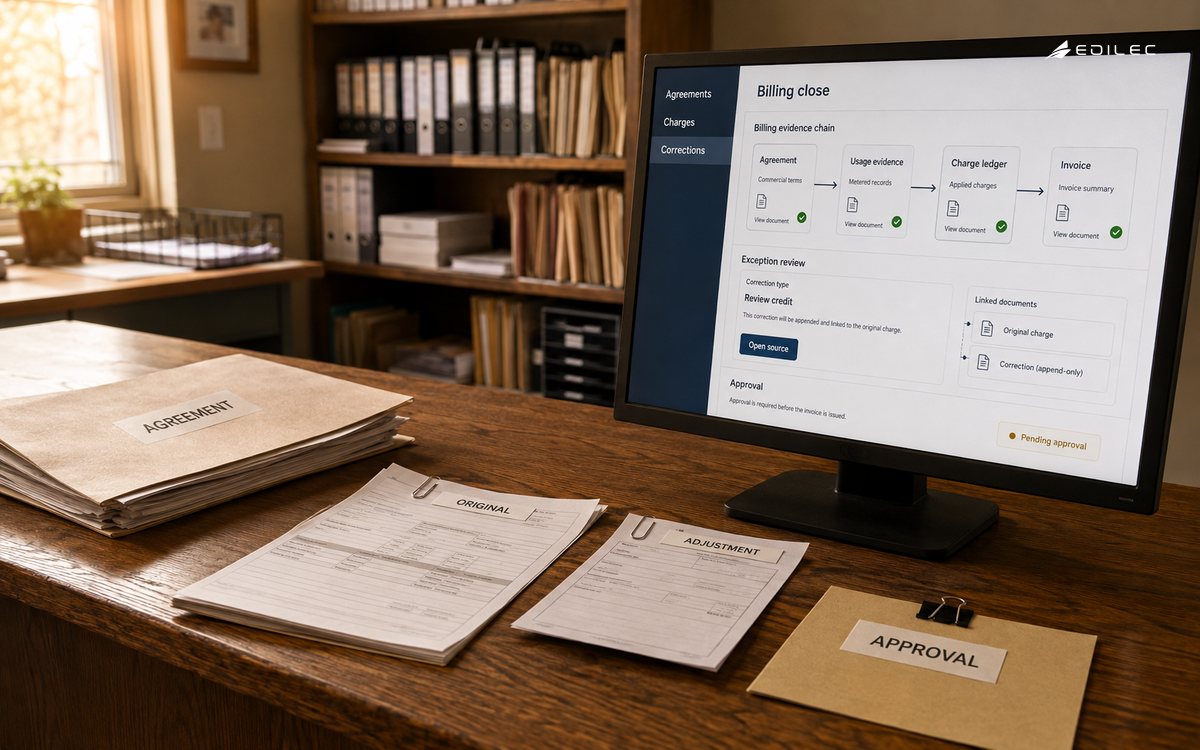
Treat the charge ledger as the durable record of what was earned, corrected, waived, or reversed. Each entry should point to the agreement version, its originating event or period, calculation inputs, currency, effective time, and approval when applicable. An invoice is a customer-facing grouping of those entries, not the only record of them. This design makes it possible to issue a correction without editing history, reconcile an invoice to source evidence, and explain why a current balance differs from a previous statement.
PCI Security Standards describe protections for environments handling payment account data; the NIST Privacy Framework helps frame data purpose and minimization; NIST SP 800-53 provides access and audit-control concepts; and W3C PROV-DM offers a useful vocabulary for origin and derivation. Applied to billing, the practical lesson is simple: protect sensitive payment information, retain the business evidence needed to explain an amount, and do not mix either concern into untraceable manual adjustments.
| Record | Purpose | Review question |
|---|---|---|
| Agreement version | Captures authorized commercial terms. | Was this term effective for the billed period? |
| Meter or fulfilment event | Supplies the measurable charge basis. | Is it complete, unique, and within the correct window? |
| Charge ledger entry | Records calculated debit, credit, or reversal. | Which rule and input produced this value? |
| Invoice and payment state | Communicates amount due and settlement status. | Can the customer and finance team reconcile the balance? |
Pilot the whole correction path
Build the first path from contract creation through an invoice, payment status, and a controlled correction. Include a late usage event, an amendment that takes effect mid-period, and a customer who changes billing contact. Verify that a customer-facing document, the ledger, and the accounting handoff tell the same story. The point is not to automate every exception at once. It is to establish which exceptions need review, how they are authorized, and how the team avoids silently changing a previously issued financial record.
- Assign immutable identifiers to agreements, invoice lines, charge entries, adjustments, and payment attempts.
- Store only the payment data necessary for the chosen processor and keep operational users out of sensitive account-data paths.
- Require a reason, actor, and linked source record for every credit, write-off, or manual charge.
- Reconcile billed quantities, ledger totals, invoice totals, and payment status on a defined schedule.
Watch the boundaries where billing becomes misleading
The most costly billing failures often happen at boundaries: usage arrives late, a plan change is interpreted differently by sales and finance, an invoice is regenerated after a correction, or a collection action runs against a customer already in dispute. Avoid using a single editable balance as the system of record. Avoid placing card data in support notes or export files. And avoid treating revenue recognition, invoicing, and cash collection as interchangeable; they are connected operations with different decisions, evidence, and owners.
Run a close-minded operating review
At each billing run, review exceptions before sending invoices: incomplete usage, failed tax lookup, missing contract reference, unusually large changes, unapproved credits, and delivery failures. After the run, reconcile a risk-based sample from source event to invoice line and payment outcome. Track dispute reasons and time to resolution because repeated questions usually reveal a missing definition or weak customer explanation. A billing review should identify what must be fixed before the next cycle, not merely certify that a batch completed.
Add complexity only with a clear owner
New currencies, legal entities, pricing dimensions, and partner channels multiply the number of rules that interact. Add one dimension only after defining its source of truth, effective-date behavior, accounting handoff, customer communication, and exception ownership. Keep a product catalogue and price catalogue distinct from historical contract commitments. This protects existing invoices when a current list price changes and lets the team test a new offer without accidentally revising an older customer agreement.
Billing operations takeaways
For every billing run, preserve a small audit sample that includes an ordinary invoice, a usage-based charge, a credit, and a failed collection attempt. A reviewer should be able to follow each example from agreement to ledger and customer communication without asking the original analyst for interpretation. When the sample cannot be explained, fix the rule, data contract, or exception process before adding pricing complexity. This discipline protects customer trust and gives finance a concrete basis for deciding whether a new offer can be operated safely.
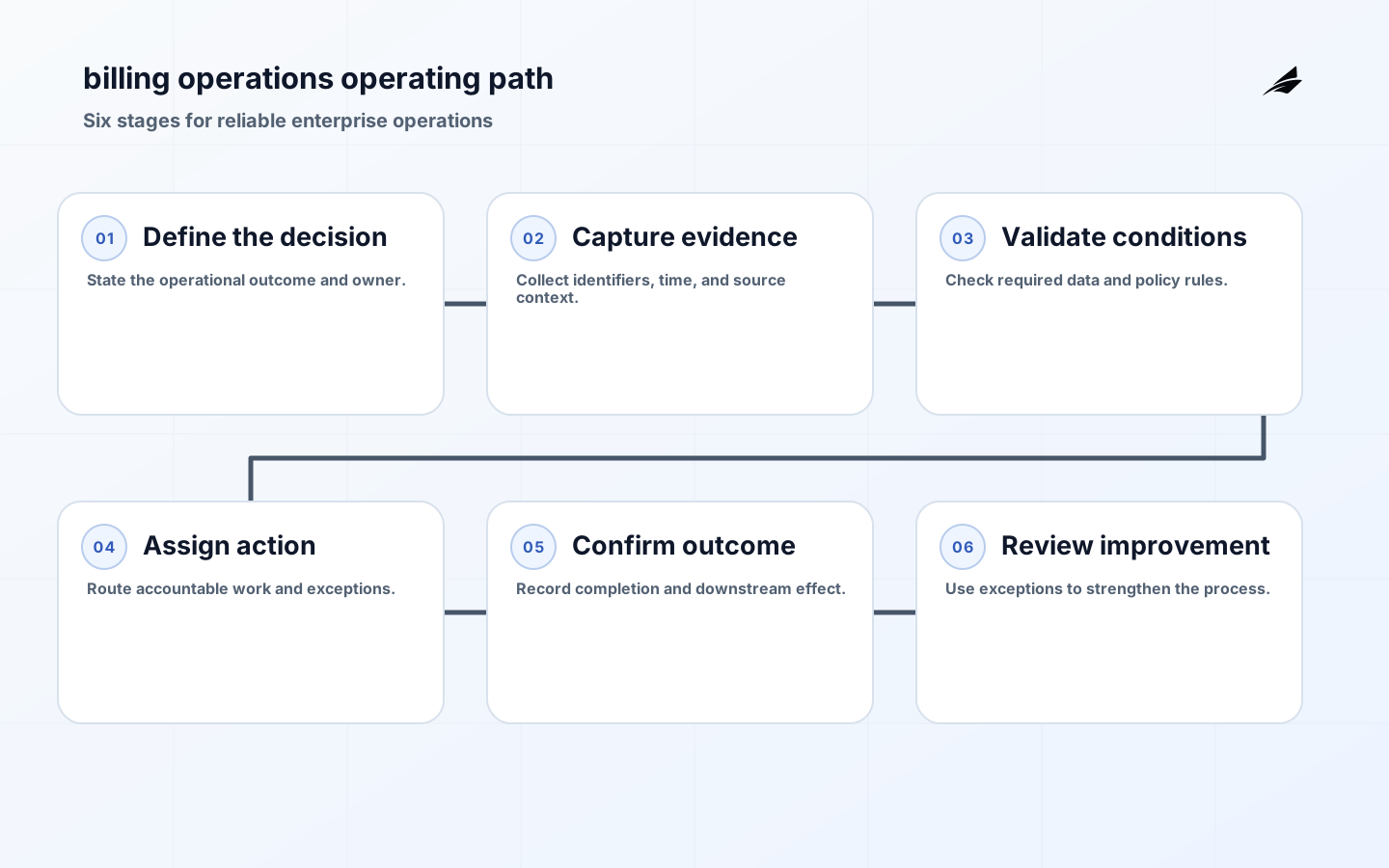
For billing operations, make the next review concrete: select a recent exception, trace the record from its first source through every handoff, compare the stated rule with the action taken, and record the owner of the correction. Include timing, access, communication, and reconciliation rather than treating the technical result alone as success. This compact evidence exercise reveals where the workflow is unclear and gives the team a measured basis for its next improvement.
- Billing operations need a traceable chain from contract rule to charge evidence, invoice, adjustment, and settlement.
- Use an append-only charge ledger so corrections remain understandable after an invoice is issued.
- Separate payment-data protection from the business records needed to explain a customer balance.
- Related reading: finance systems, ERP integration, and inventory systems.
Billing operations FAQ
Can a spreadsheet run early billing operations?
A spreadsheet can support a narrowly controlled early process, particularly when invoice volume is low, but it must not be the only place where contract versions, approvals, and payment-sensitive data live. Give it an owner, protect formulas, record revisions, and reconcile it to the accounting system. Move to a more integrated workflow when manual corrections or volume make those controls unreliable.
What makes usage data billable?
Usage is billable when the agreement, meter definition, time boundary, and eligibility rules are all documented and the source event meets those rules. A technically received event is not automatically a commercial entitlement. Keep late-arrival and correction policies visible, especially when customers can inspect usage before invoicing. That policy determines whether an event belongs in the current run, a future adjustment, or an exception review.
Conclusion: make every amount explainable
Billing operations become dependable when the organization can trace an amount from a customer promise to the evidence, calculation, approval, and payment status behind it. Begin with one billing motion, deliberately exercise a correction, and review exceptions before they become customer disputes. The result is not only faster invoicing; it is a financial conversation the company can stand behind.
Make reconciliation and correction first-class billing work
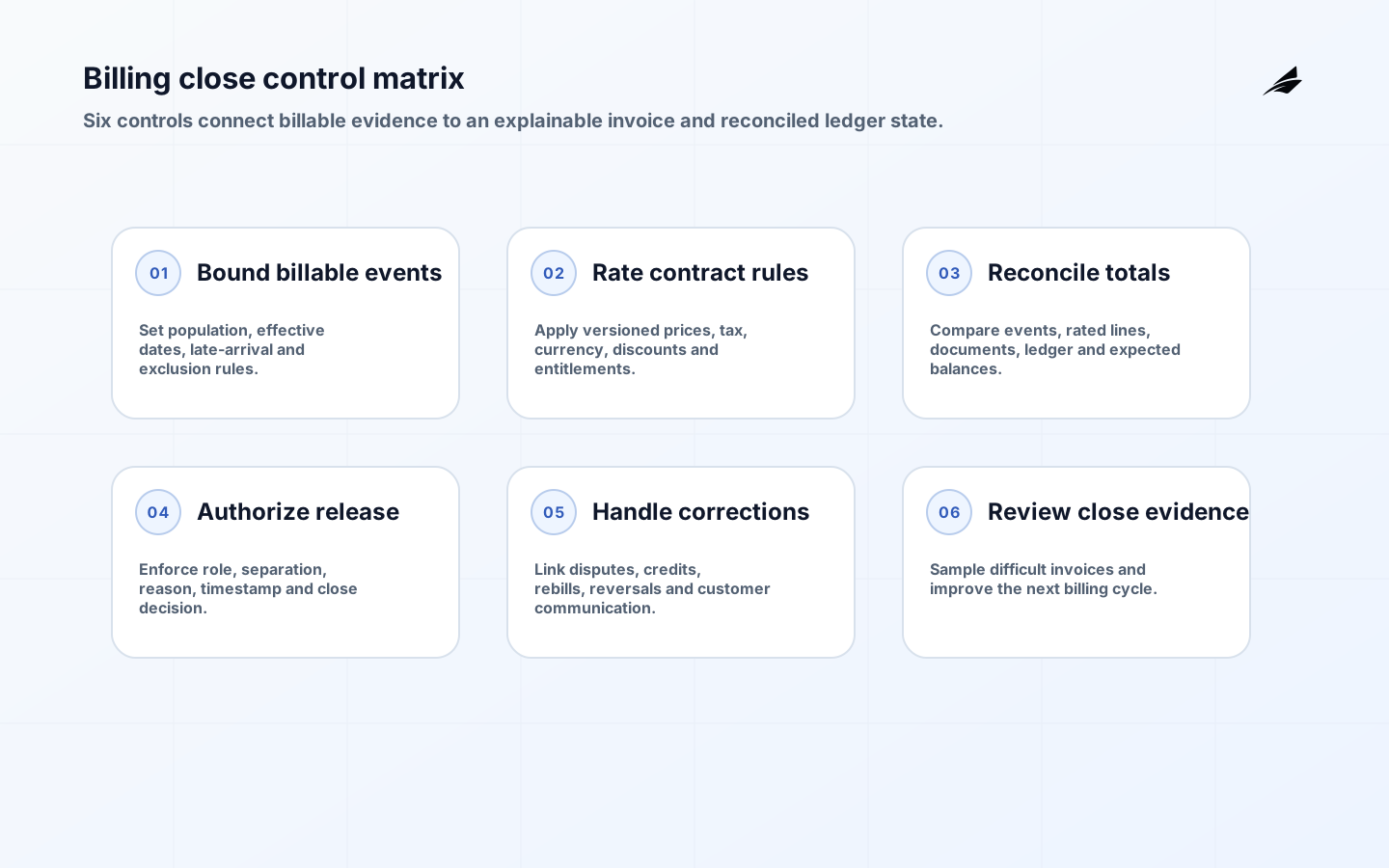
Billing operations need two independent proofs: that the amount was calculated from the right evidence and that the resulting invoice or credit was issued under the right authority. Reconcile event counts, rated lines, tax treatment, currency, discounts, and totals before a close. Then reconcile the issued document and ledger state to the approved run. Keep a correction path that can explain whether the error came from source usage, pricing, tax, identity, or a late contract change.
| Control point | Question | Evidence |
|---|---|---|
| Usage intake | Was the billable population complete and bounded? | Watermark, exclusions and late-event report |
| Rating | Which price and contract version applied? | Versioned rule, currency and test case |
| Approval | Who could release or override the run? | Role, reason, timestamp and approval record |
| Correction | Can the customer and ledger be made whole? | Credit/rebill link and reconciled balance |
Consider a subscription customer whose seat count falls on the last day of the month. The system may receive the change after the rating window closes, while the contract may define an effective date earlier than receipt. Do not hide this in a manual spreadsheet adjustment. Record the effective date, received date, rule applied, approver, and customer communication, then make the next run consume that durable correction. PCI Security Standards Council material is relevant where payment data is in scope, but billing control also depends on privacy minimization and provenance for non-card evidence.
A useful close review asks for three random invoices, one disputed invoice, one credit, and one late usage correction. Trace each to source records, contract terms, approval, document, ledger, and customer-facing explanation. If any step requires an analyst's memory, add a captured link or narrow the process. That discipline makes a small billing operation credible before it takes on more plans, geographies, currencies, or tax rules.
For billing controls, for related Edilec context, compare the finance systems field guide, ERP integration field guide, and inventory systems field guide. Each examines a neighboring source of financial truth that billing must reconcile rather than silently overwrite.
Billing operating decisions
Keep invoice presentation separate from close evidence, but make the relationship navigable. A customer-facing invoice should be clear and minimal; an internal evidence bundle can retain the event sample, rule version, approval, reconciliation, tax calculation and correction history. Link the two through a durable invoice or run identifier. This separation reduces exposure while preserving an answer when a customer, auditor or finance lead asks why an amount changed.
Choose explicit stop conditions for the first billing release: unresolved usage exceptions above a threshold, an unreconciled ledger total, an unavailable tax service, or a price-rule change without approval. A stop is not failure if it prevents an unexplainable invoice. Record who can resume, what evidence they must inspect, and how affected customers will be informed. That discipline is more valuable than silently maximizing the number of invoices emitted.