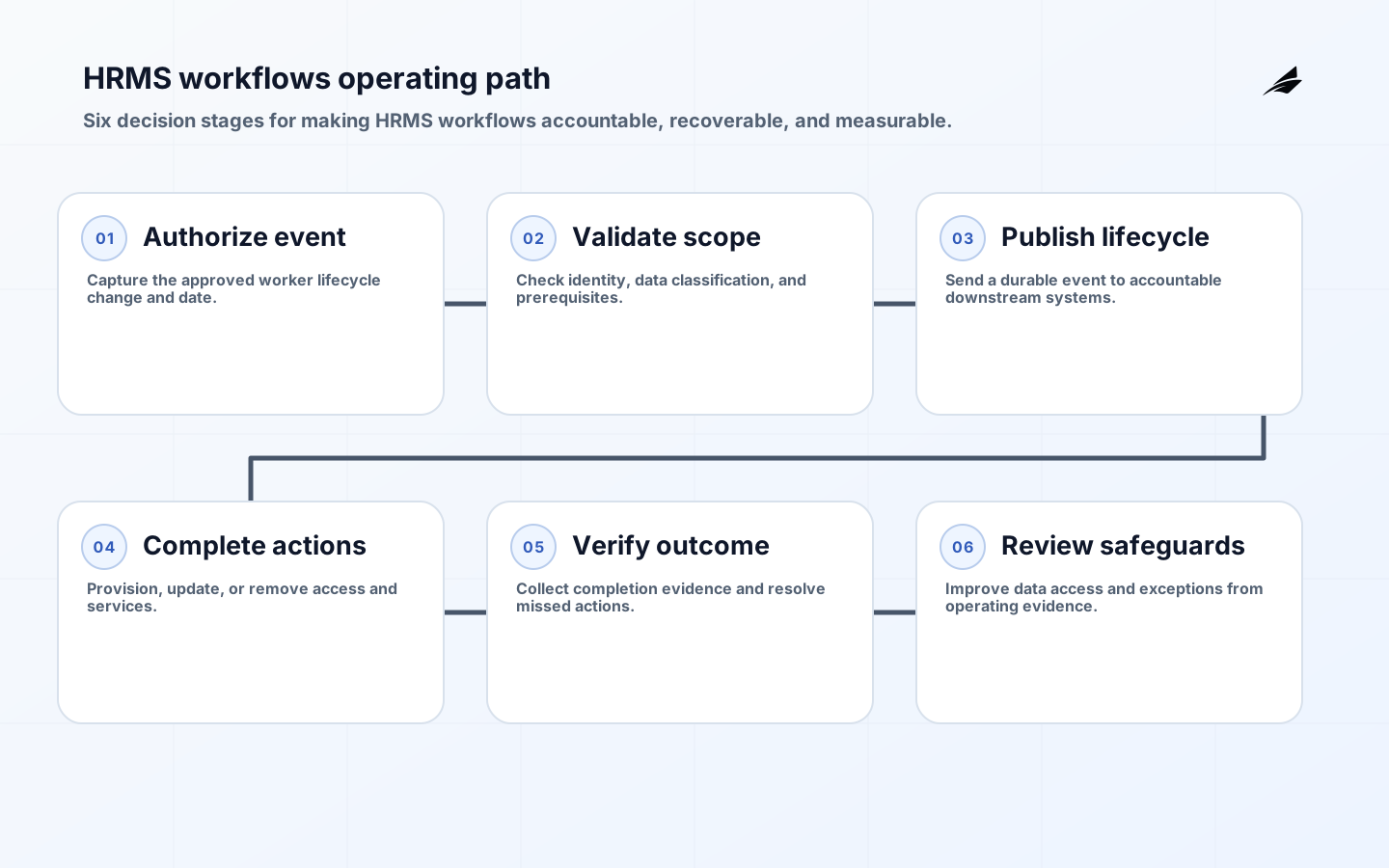
HRMS workflows carry facts that change access, pay, reporting lines, benefits, and a person’s day-to-day experience. Before automating onboarding, transfer, leave, or offboarding, decide which event is authoritative, when it takes effect, which personal data is necessary, and who must confirm that downstream actions are complete. A workflow that is fast but leaves access active after a departure is not a successful automation.
Set the decision boundary for HRMS workflows
Choose one lifecycle event and follow it from authorized request to verified outcome. A new hire, manager change, location transfer, or termination has an effective date, data sources, approvals, and downstream systems with different lead times. Define the authoritative event, the required evidence, the exception owner, and the completion criteria. Do not treat a status field change as proof that equipment, payroll, access, and communication work are done.
| Design concern | Decision to make | Evidence to retain |
|---|---|---|
| Lifecycle event | Hire, transfer, leave, return, or departure | Worker ID, effective date, and authorized source |
| Data scope | Role, manager, location, pay, or identity attributes | Classification and field-level access rule |
| Downstream action | Account, payroll, benefit, equipment, or notification task | Consumer acknowledgement and completion evidence |
| Exception | Urgent, corrected, or failed action | Owner, reason, and resolution deadline |
Keep records that explain the outcome
Maintain a stable worker identifier, employment status and effective dates, organizational relationship, source event, approver, data classification, and completion evidence for downstream actions. Preserve history where it matters for payroll, access, or reporting rather than overwriting a prior manager or location. An effective-dated model lets consumers understand whether a change is planned, current, or corrected.
Design HRMS workflows as an accountable flow
Separate employee master data, workflow orchestration, identity provisioning, payroll or benefits interfaces, and manager notifications. Deliver discrete lifecycle events with sufficient scope and an idempotency key. Consumers should acknowledge processing and expose exceptions so HR does not assume a downstream account was created or removed just because the source workflow closed.

| Operating stage | Control to design | Signal to review |
|---|---|---|
| Event intake | Effective-date and identity validation | Rejected event and duplicate suppression |
| Provisioning | Idempotent creation or change action | Completion latency and failed consumer action |
| Deprovisioning | Access removal and asset recovery checks | Stale access and unverified departure count |
| Governance review | Access, correction, and exception analysis | Manual workaround and aged case trend |
Put authority and evidence into the controls
Apply data minimization and role-based access from the start. HR data often combines personal, compensation, and organizational information that should not be visible to every manager or integration operator. Use time-bound access for administrators, protect exports, log access and lifecycle changes, and require a controlled exception path for urgent hires or departures.
For HRMS workflows, NIST's Cybersecurity Framework offers a disciplined way to protect worker-data processes while preparing for operational exceptions. SP 800-53, SP 800-34, and SP 800-92 are relevant to role-based access, resilient lifecycle processing, and evidence of consequential changes.
Release with exceptions in view
Pilot one geography or worker category with HR, IT, payroll, and facilities owners present. Exercise a future-dated hire, a same-day departure, a rescinded offer, a manager transfer, and a failed provisioning event. Reconcile the source HR record against downstream completion evidence. The people affected should have a clear support path, not a maze of teams each claiming the workflow is finished.
Measure operating reliability, not activity alone
Track completion by lifecycle event and downstream system, time to provision and deprovision, exception age, manual correction count, stale access findings, and data-quality rejects. Review metrics by event type; a smooth onboarding flow can conceal a risky termination process. The most important outcome is timely, verified completion with only the necessary people able to view the record.
Pre-build decision register
- For HRMS workflows, confirm authoritative worker identity and employment-status source; write the rule, named owner, effective time, audit evidence, failure signal, and recovery action into the build decision record before release.
- For HRMS workflows, test authoritative worker identity and employment-status source with normal, delayed, corrected, and failed inputs; retain the result so the operating team can explain and safely repeat the decision.
- For HRMS workflows, confirm effective dates for planned lifecycle changes; write the rule, named owner, effective time, audit evidence, failure signal, and recovery action into the build decision record before release.
- For HRMS workflows, test effective dates for planned lifecycle changes with normal, delayed, corrected, and failed inputs; retain the result so the operating team can explain and safely repeat the decision.
- For HRMS workflows, confirm minimum data sent to each downstream system; write the rule, named owner, effective time, audit evidence, failure signal, and recovery action into the build decision record before release.
- For HRMS workflows, test minimum data sent to each downstream system with normal, delayed, corrected, and failed inputs; retain the result so the operating team can explain and safely repeat the decision.
- For HRMS workflows, confirm classification of sensitive worker attributes; write the rule, named owner, effective time, audit evidence, failure signal, and recovery action into the build decision record before release.
- For HRMS workflows, test classification of sensitive worker attributes with normal, delayed, corrected, and failed inputs; retain the result so the operating team can explain and safely repeat the decision.
- For HRMS workflows, confirm authorization for urgent exceptions; write the rule, named owner, effective time, audit evidence, failure signal, and recovery action into the build decision record before release.
- For HRMS workflows, test authorization for urgent exceptions with normal, delayed, corrected, and failed inputs; retain the result so the operating team can explain and safely repeat the decision.
- For HRMS workflows, confirm idempotent lifecycle-event delivery; write the rule, named owner, effective time, audit evidence, failure signal, and recovery action into the build decision record before release.
- For HRMS workflows, test idempotent lifecycle-event delivery with normal, delayed, corrected, and failed inputs; retain the result so the operating team can explain and safely repeat the decision.
- For HRMS workflows, confirm acknowledgement from provisioning consumers; write the rule, named owner, effective time, audit evidence, failure signal, and recovery action into the build decision record before release.
- For HRMS workflows, test acknowledgement from provisioning consumers with normal, delayed, corrected, and failed inputs; retain the result so the operating team can explain and safely repeat the decision.
- For HRMS workflows, confirm completion evidence for access removal; write the rule, named owner, effective time, audit evidence, failure signal, and recovery action into the build decision record before release.
- For HRMS workflows, test completion evidence for access removal with normal, delayed, corrected, and failed inputs; retain the result so the operating team can explain and safely repeat the decision.
- For HRMS workflows, confirm manager-change rules and notification scope; write the rule, named owner, effective time, audit evidence, failure signal, and recovery action into the build decision record before release.
- For HRMS workflows, test manager-change rules and notification scope with normal, delayed, corrected, and failed inputs; retain the result so the operating team can explain and safely repeat the decision.
- For HRMS workflows, confirm rescinded-offer and correction handling; write the rule, named owner, effective time, audit evidence, failure signal, and recovery action into the build decision record before release.
- For HRMS workflows, test rescinded-offer and correction handling with normal, delayed, corrected, and failed inputs; retain the result so the operating team can explain and safely repeat the decision.
- For HRMS workflows, confirm time-bound administrator access to HR data; write the rule, named owner, effective time, audit evidence, failure signal, and recovery action into the build decision record before release.
- For HRMS workflows, test time-bound administrator access to HR data with normal, delayed, corrected, and failed inputs; retain the result so the operating team can explain and safely repeat the decision.
- For HRMS workflows, confirm review of stale access after departures; write the rule, named owner, effective time, audit evidence, failure signal, and recovery action into the build decision record before release.
- For HRMS workflows, test review of stale access after departures with normal, delayed, corrected, and failed inputs; retain the result so the operating team can explain and safely repeat the decision.
Key takeaways for HRMS workflows
- Model HR changes as effective-dated lifecycle events with accountable completion evidence.
- Keep HR master data and downstream provisioning distinct but correlated.
- Minimize access to sensitive worker data and log consequential changes.
- Test urgent departures and failed downstream actions as seriously as onboarding.
Frequently asked questions
What is the source of truth for an HRMS workflow?
Define it by data domain: the HR system may own employment status while identity and payroll systems own the evidence of their completed actions.
Why are effective dates important?
They distinguish a planned change from a current one and support correct processing when dates are corrected or events arrive early.
How should an urgent termination be handled?
Use an authorized exception path that prioritizes verified deprovisioning, preserves evidence, and notifies the appropriate owners without broadening data access.
Conclusion
A dependable HRMS workflows implementation is a system of explicit choices: what is authoritative, who can decide, which state is real, how an exception is recovered, and how the team verifies the result. Build the smallest flow that proves those choices with real evidence, then extend it deliberately. Related reading: HRMS workflows in production, role-based operations, customer portals.