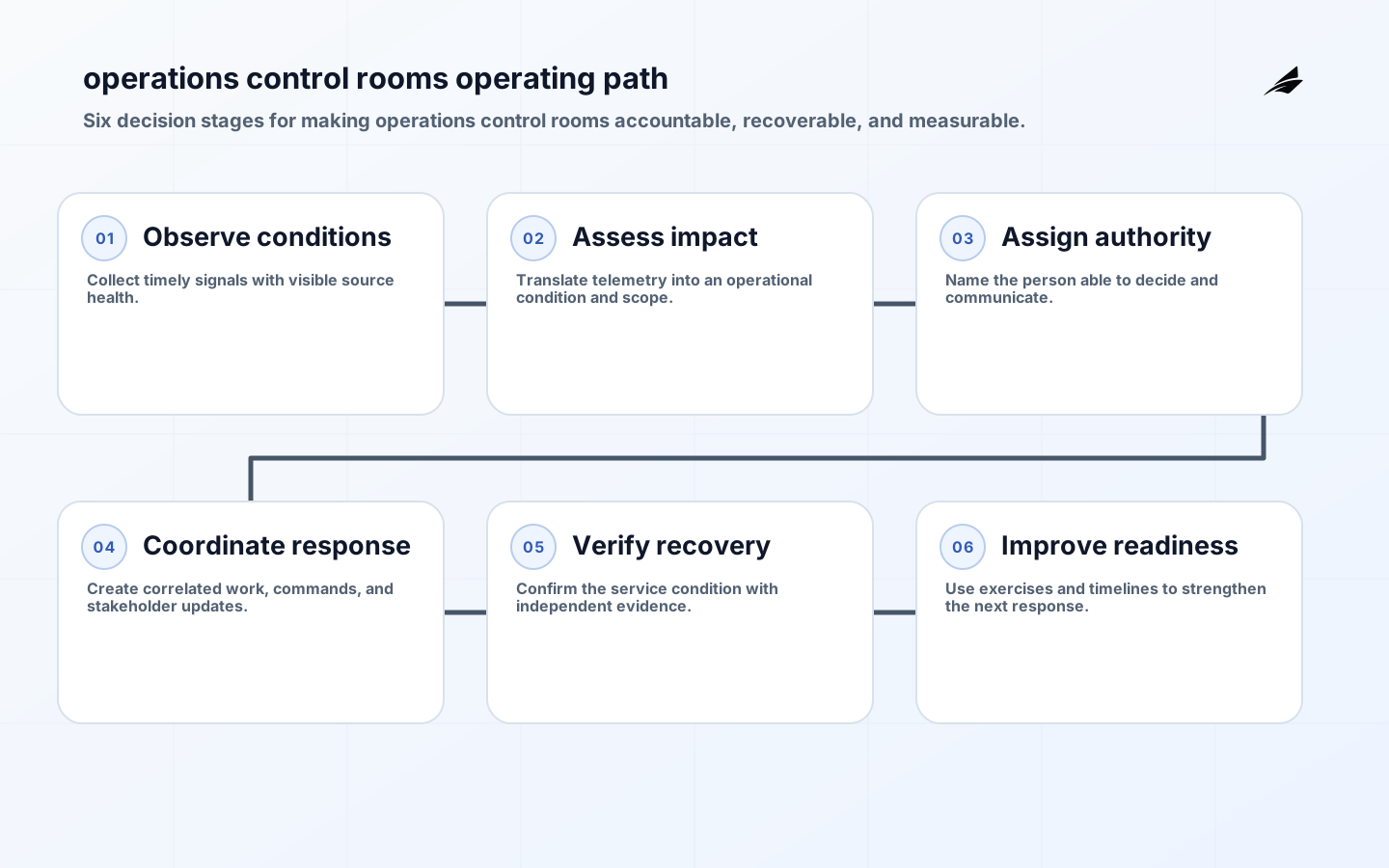
An operations control room is not a wall of charts. It is the decision environment used when a service, process, or physical operation needs rapid coordination under uncertainty. It becomes production-critical when people use it to decide whether to continue, contain, escalate, communicate, or recover. The design task is to make current conditions and authority visible without burying the operator in telemetry.
Set the decision boundary for operations control rooms
Define the control room around decisions and operating horizons. For each service or operation, state what condition is normal, who owns the signal, what threshold requires attention, who can declare an incident, and what action is permitted. A dashboard can show a threshold breach, but a control room also needs an agreed response and a named person who can accept the consequence of acting.
| Design concern | Decision to make | Evidence to retain |
|---|---|---|
| Condition | Normal, degraded, contained, or recovering | Threshold, confidence, and affected scope |
| Decision | Continue, investigate, escalate, or recover | Accountable role and decision time |
| Command | Automated or human-initiated action | Authorization, confirmation, and result |
| Narrative | Observed facts and response history | Correlated alerts, tickets, and timestamps |
Keep records that explain the outcome
A high-value timeline records the observation, assessed impact, decisions made, commands issued, acknowledgements, and recovery evidence. Keep references to source metrics or alerts rather than copying values by hand. This turns the record into a usable incident narrative and helps a later reviewer distinguish a sensor problem from a decision that was made with incomplete information.
Design operations control rooms as an accountable flow
Separate raw telemetry, interpreted operational state, and the command or work system. Raw signals can be noisy; the state layer should express what operators must decide, such as degraded, contained, or recovering. Commands require their own authorization and audit trail. When the room integrates with ticketing or automation, carry a correlation identifier so teams can traverse from alert to decision to work item.

| Operating stage | Control to design | Signal to review |
|---|---|---|
| Signal intake | Source health and timestamp validation | Stale feed and missing data duration |
| State assessment | Rule or operator interpretation | False escalation and missed-condition review |
| Command execution | Privilege and confirmation checks | Command failure and rollback outcome |
| Shift review | Handover and exercise evidence | Unowned conditions and recovery verification |
Put authority and evidence into the controls
Design for degraded visibility. If a monitoring feed is late, label it stale rather than presenting an apparently current green status. Restrict high-impact commands, require confirmation for irreversible actions, and log the authority used. NIST control and contingency guidance supports this emphasis on least privilege, accountable action, and rehearsed recovery rather than a reliance on screens alone.
For operations control rooms, NIST's Cybersecurity Framework helps distinguish detection, response, and recovery responsibilities instead of treating every alert as a dashboard problem. SP 800-53, SP 800-34, and SP 800-92 are relevant to controlled commands, rehearsed contingencies, and timeline evidence.
Release with exceptions in view
Run scenario exercises before treating the room as a source of truth. Include conflicting signals, loss of a primary telemetry feed, an operator handover, and a command that must be stopped. Review whether the room showed the required owner, decision deadline, and safe fallback. A polished visualization is irrelevant if no one can tell who is allowed to respond.
Measure operating reliability, not activity alone
Track alert-to-assessment time, acknowledgement latency, command success, stale-data exposure, handover completeness, and time to a verified recovery state. Pair speed metrics with false escalation and missed-condition reviews. A faster room that repeatedly dispatches the wrong response is not becoming more reliable; it is merely creating work sooner.
Pre-build decision register
- For operations control rooms, confirm normal and degraded conditions for each decision; write the rule, named owner, effective time, audit evidence, failure signal, and recovery action into the build decision record before release.
- For operations control rooms, test normal and degraded conditions for each decision with normal, delayed, corrected, and failed inputs; retain the result so the operating team can explain and safely repeat the decision.
- For operations control rooms, confirm freshness thresholds for every operational signal; write the rule, named owner, effective time, audit evidence, failure signal, and recovery action into the build decision record before release.
- For operations control rooms, test freshness thresholds for every operational signal with normal, delayed, corrected, and failed inputs; retain the result so the operating team can explain and safely repeat the decision.
- For operations control rooms, confirm confidence labels for incomplete telemetry; write the rule, named owner, effective time, audit evidence, failure signal, and recovery action into the build decision record before release.
- For operations control rooms, test confidence labels for incomplete telemetry with normal, delayed, corrected, and failed inputs; retain the result so the operating team can explain and safely repeat the decision.
- For operations control rooms, confirm roles authorized to declare an incident; write the rule, named owner, effective time, audit evidence, failure signal, and recovery action into the build decision record before release.
- For operations control rooms, test roles authorized to declare an incident with normal, delayed, corrected, and failed inputs; retain the result so the operating team can explain and safely repeat the decision.
- For operations control rooms, confirm commands that require a second confirmation; write the rule, named owner, effective time, audit evidence, failure signal, and recovery action into the build decision record before release.
- For operations control rooms, test commands that require a second confirmation with normal, delayed, corrected, and failed inputs; retain the result so the operating team can explain and safely repeat the decision.
- For operations control rooms, confirm correlation between alerts, tickets, and actions; write the rule, named owner, effective time, audit evidence, failure signal, and recovery action into the build decision record before release.
- For operations control rooms, test correlation between alerts, tickets, and actions with normal, delayed, corrected, and failed inputs; retain the result so the operating team can explain and safely repeat the decision.
- For operations control rooms, confirm handover evidence between operating shifts; write the rule, named owner, effective time, audit evidence, failure signal, and recovery action into the build decision record before release.
- For operations control rooms, test handover evidence between operating shifts with normal, delayed, corrected, and failed inputs; retain the result so the operating team can explain and safely repeat the decision.
- For operations control rooms, confirm stakeholder communication thresholds and owners; write the rule, named owner, effective time, audit evidence, failure signal, and recovery action into the build decision record before release.
- For operations control rooms, test stakeholder communication thresholds and owners with normal, delayed, corrected, and failed inputs; retain the result so the operating team can explain and safely repeat the decision.
- For operations control rooms, confirm fallback procedures when a primary feed is lost; write the rule, named owner, effective time, audit evidence, failure signal, and recovery action into the build decision record before release.
- For operations control rooms, test fallback procedures when a primary feed is lost with normal, delayed, corrected, and failed inputs; retain the result so the operating team can explain and safely repeat the decision.
- For operations control rooms, confirm independent evidence for a recovered condition; write the rule, named owner, effective time, audit evidence, failure signal, and recovery action into the build decision record before release.
- For operations control rooms, test independent evidence for a recovered condition with normal, delayed, corrected, and failed inputs; retain the result so the operating team can explain and safely repeat the decision.
- For operations control rooms, confirm exercise scenarios for conflicting observations; write the rule, named owner, effective time, audit evidence, failure signal, and recovery action into the build decision record before release.
- For operations control rooms, test exercise scenarios for conflicting observations with normal, delayed, corrected, and failed inputs; retain the result so the operating team can explain and safely repeat the decision.
- For operations control rooms, confirm post-event review of missed or false escalation; write the rule, named owner, effective time, audit evidence, failure signal, and recovery action into the build decision record before release.
- For operations control rooms, test post-event review of missed or false escalation with normal, delayed, corrected, and failed inputs; retain the result so the operating team can explain and safely repeat the decision.
Key takeaways for operations control rooms
- Build the room around decisions, authority, and recovery options rather than visual density.
- Label stale or uncertain data explicitly so operators can calibrate their trust.
- Keep telemetry, operational state, and commands as separate accountable layers.
- Exercise handovers and degraded visibility before relying on the room during an incident.
Frequently asked questions
What belongs on a control-room screen?
Only signals that inform a real decision, plus ownership, freshness, impact, and a route to the underlying evidence.
How should stale data be shown?
Mark the time of the last successful update and downgrade confidence; do not display stale readings as current.
Can automation issue commands directly?
Only within defined authority and safeguards. High-impact or irreversible actions should have explicit confirmation and auditable ownership.
Conclusion
A dependable operations control rooms implementation is a system of explicit choices: what is authoritative, who can decide, which state is real, how an exception is recovered, and how the team verifies the result. Build the smallest flow that proves those choices with real evidence, then extend it deliberately. Related reading: operations control rooms practical guide, workflow exceptions, business process automation.