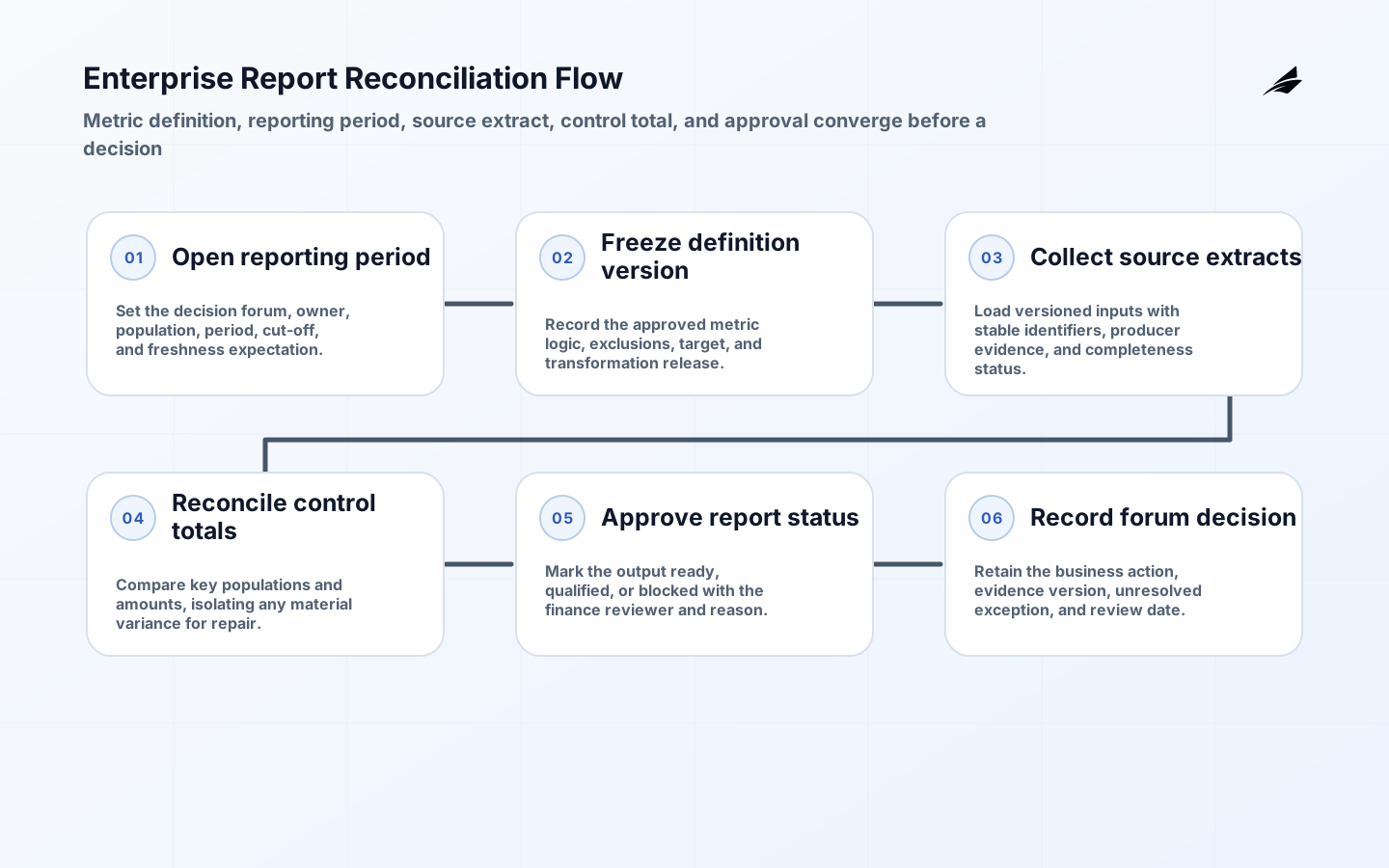
Enterprise reporting is valuable when it changes a real operating outcome: a report leads to a repeatable decision because its metric definitions, sources, freshness, and review status are visible. For founders, finance leaders, and analytics teams, the first design question is not which screen to build. It is which business event starts the work, which metric definition, reporting period, source extract, transformation version, control total, and approval status are authoritative, and who can make the next decision. A credible first release makes the normal path, delayed path, and disputed path understandable to people doing the work. It also avoids a familiar trap: a polished interface that merely hides emails, spreadsheets, or judgment calls that still determine the result. This guide treats enterprise reporting as an operating capability with explicit ownership, evidence, controls, and review.
Why enterprise reporting needs an operating model
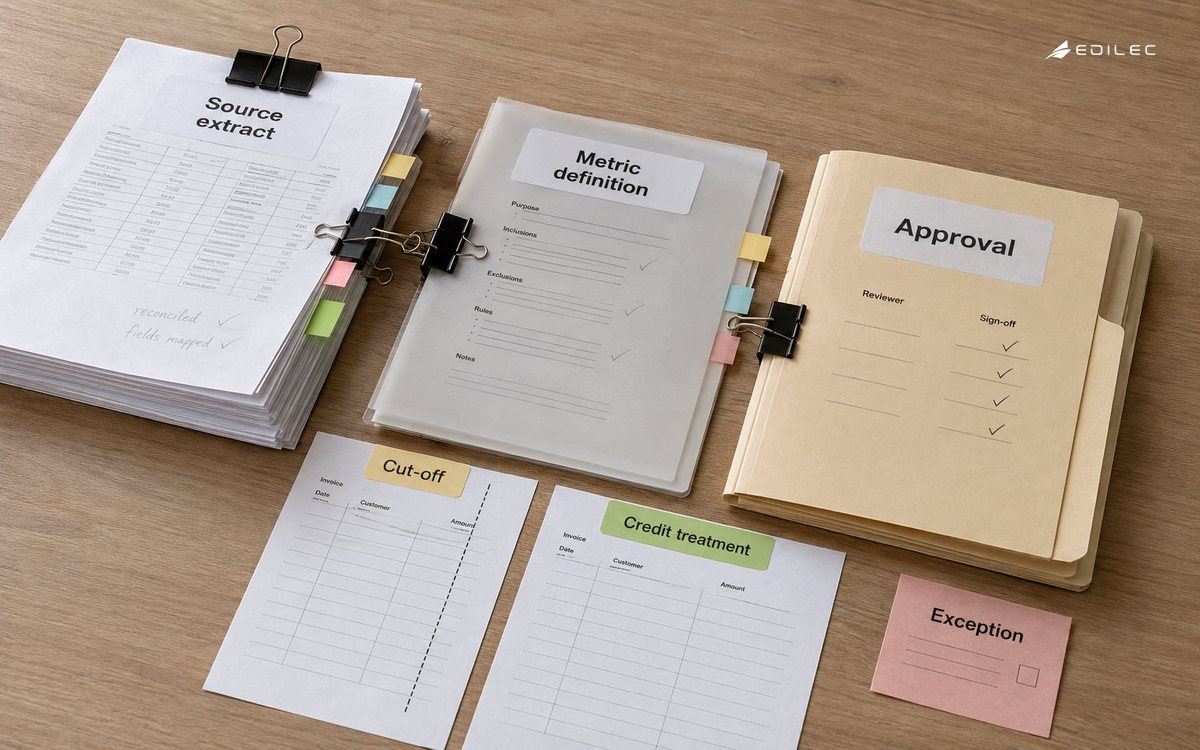
The useful boundary for this work is a small set of recurring decisions and their evidence chain, not a dashboard for every available field. Within that boundary, the outcome is observable and the people involved can test the design against actual cases. Report owner, data producer, finance reviewer, business reader, and data engineer need different views of the same journey, but they should not have to reconstruct its history from messages. Start by collecting ten recent examples, including one that went well, one that waited, one that was corrected, and one that should never have proceeded. The practical example is this: monthly revenue can be useful only when currency, legal entity, invoice status, credit treatment, and close cut-off are understood by every reader. That example exposes the data, authority, timing, and exception questions that a feature list usually misses.
Build the enterprise reporting operating model
Write the workflow as a sequence of business facts rather than a sequence of screens. At each handoff, state the current owner, required evidence, permitted actions, next service target, and the event that proves completion. The key decision is which measure is fit for a decision, what period and population it covers, and whether it has been reconciled. A system should make that decision with the narrowest reliable inputs and retain the explanation after the case moves on. Use stable identifiers to join activity across services; use effective dates when a policy, entitlement, or source record can change; and distinguish a request from an approved instruction. This is also where related operating guide can help a team compare its boundary with adjacent systems without pretending they share the same source of truth.
| Design question | Practical answer | Evidence to retain |
|---|---|---|
| What begins the work? | A named event tied to metric definition, reporting period, source extract, transformation version, control total, and approval status. | Source identifier, timestamp, and submitter or producer. |
| Who decides? | report owner, data producer, finance reviewer, business reader, and data engineer have separate responsibilities. | Role, context, rule version, and decision reason. |
| What proves completion? | The outcome that makes a report leads to a repeatable decision because its metric definitions, sources, freshness, and review status are visible. | Completion event, result, and any customer or reviewer confirmation. |
| What happens when facts conflict? | Stop the normal path and use mark the report status, isolate the affected measure, reconcile against a control total, and publish a corrected version with a clear change note. | Original value, correction, owner, and resolution rationale. |
Design controls at enterprise reporting handoffs
A handoff is a promise between people or services. Validate inputs before a consequential action, authorize the action on the server or service that owns it, and log material changes in a way a resolver can use. The NIST Cybersecurity Framework 2.0 is a useful organizing reference because it keeps governance, protection, detection, response, and recovery connected rather than treating security as a final review. For enterprise reporting, the material failures are dashboards that mix reporting dates, unpublished metric changes, and drill-downs that do not agree with accountable totals. Controls should reduce those risks without turning every routine item into a manual queue. That means scoped permissions, explicit approval or policy rules where needed, and a visible state transition rather than an implied “done.”
Make enterprise reporting exceptions recoverable
An exception is not proof that the design failed; it is information about a condition the normal path could not settle safely. The dangerous response is to erase the failed state or to let an untracked workaround become policy. Instead, capture the failed step, source context, rule or integration version, business impact, and the person allowed to repair it. In this domain, dashboards that mix reporting dates, unpublished metric changes, and drill-downs that do not agree with accountable totals are the patterns worth rehearsing before launch. The recovery route should be mark the report status, isolate the affected measure, reconcile against a control total, and publish a corrected version with a clear change note. A retry is appropriate only when its operation is demonstrably safe; a new decision is needed whenever the business fact, authority, or external side effect could have changed.
- Create reason codes that distinguish missing information, policy conflict, dependency delay, duplicate risk, and disputed data in enterprise reporting.
- Give each exception a named owner and a time target that reflects the harm of waiting, not merely queue volume.
- Show the original evidence and previous actions so a resolver does not reconstruct the case from separate systems.
- Restrict repair actions: correction, override, reversal, and replay should have different authority and audit evidence.
- Review repeated exceptions with the process owner; a growing queue is often a data or policy problem, not a staffing problem.
Deliver enterprise reporting in a controlled first release
For enterprise reporting, Start with a thin but complete journey: input, validation, decision, result, status, exception, and review. Do not begin by migrating every historical record or by connecting every adjacent platform. Decide which facts must be read live, which can be copied with a freshness promise, and which need reconciliation. Test normal cases alongside late updates, an unauthorized request, a duplicate, a dependency timeout, and a human correction. The OWASP Logging Cheat Sheet is particularly helpful here: logs should support investigation without becoming an unbounded store of sensitive content. Release to a group whose managers and support staff can actually own the queue, then expand only after the result is measurable.
| Release checkpoint | Question to answer | Go/no-go signal |
|---|---|---|
| Data readiness | Are metric definition, reporting period, source extract, transformation version, control total, and approval status complete, identifiable, and current enough for the decision? | Known gaps have a controlled fallback and owner. |
| Authority | Can report owner, data producer, finance reviewer, business reader, and data engineer act only within their legitimate context? | Normal and adverse authorization tests pass. |
| Recovery | Can the team perform mark the report status, isolate the affected measure, reconcile against a control total, and publish a corrected version with a clear change note? | A rehearsal leaves a complete, understandable history. |
| Operations | Can the owner explain the queue and service target? | Support, alerts, and escalation are ready before expansion. |
Measure the result of enterprise reporting
Choose a compact scorecard before release and define the population, exclusions, calculation owner, and review rhythm. Good measures for this subject include freshness attainment, reconciliation variance, report adoption by decision forum, data-quality incident rate, and time to resolve a disputed number. Pair aggregate metrics with a monthly sample of completed, delayed, rejected, and repaired cases. Sampling catches the case where a dashboard looks healthy because work has shifted into an inbox, a shared spreadsheet, or a back channel. A metric matters only when a named owner can use it to change a rule, improve source data, alter capacity, train a role, or retire an unnecessary step. Keep throughput and quality together: closing more items is not progress if evidence, access, or the underlying customer commitment becomes weaker.
Key takeaways
- Enterprise reporting should begin with a bounded outcome, named owner, and examples from real work.
- Authoritative metric definition, reporting period, source extract, transformation version, control total, and approval status and stable identifiers are prerequisites for trustworthy automation and reporting.
- Every handoff needs evidence, authorization, a visible state, and a route for delayed or disputed work.
- Exceptions require controlled repair actions and recurring review, not informal workarounds.
- Use freshness attainment, reconciliation variance, report adoption by decision forum, data-quality incident rate, and time to resolve a disputed number to judge both speed and quality after release.
FAQ: Where should a first enterprise reporting release start?
For a first enterprise reporting release, Start with one frequent journey that contains a meaningful decision and can be observed end to end. It should be small enough that the team can collect representative cases, name the authoritative records, and rehearse a recovery route. Do not pick it simply because it has the most screens or the loudest complaints. The strongest candidate has a clear business outcome, a willing operational owner, and a manageable set of integrations. Include the unhappy path in release one. That is how the team finds out whether the promised control works under real pressure rather than only in a demonstration.
FAQ: What should remain human in enterprise reporting?
In enterprise reporting, Keep an accountable person in the loop when evidence is uncertain, a decision changes money, access, employment, a customer commitment, or a material record, or policy requires judgment. Automation can collect facts, validate completeness, calculate a threshold, route work, and prepare a decision view. It should not silently elevate authority or make an irreversible correction just because an integration returned success. The OWASP Authorization Cheat Sheet reinforces the broader principle: authorization is enforced on every request, and access should be denied by default. In practice, make the decision boundary visible to both the reviewer and the person affected by it.
Conclusion
Enterprise reporting becomes dependable when it is treated as an operating model rather than a bundle of forms and integrations. Define the bounded outcome, establish the authoritative facts, make decision rights and handoffs explicit, rehearse recovery, and keep evidence usable to the people who must operate the system. Begin with the real case described here, measure both the outcome and the exception pattern, and earn expansion through observed results. That approach is deliberately practical: it creates a system that can be explained, supported, and improved after the original project team has moved on.