Metric layers are not a purchase decision or a document that can be completed once. For founders, they keep the measures used in company decisions consistent as reporting tools and teams multiply. The useful starting point is a reusable decision metric: a bounded thing with a named owner, a clear promise to its reader, and evidence for when it should or should not be trusted. Monthly recurring revenue can differ when credits, trial conversions, foreign exchange, and account hierarchy are handled in different reports. The layer should expose those choices rather than hide them. This guide keeps the discussion practical by connecting metric layers to a related data-operations guide, a useful planning reference, and a companion implementation article. For metric layers, the W3C PROV overview helps frame result provenance, and OpenLineage facets connect it to operational metadata.
What metric layers mean in practice: data service reliability
Plain language matters because teams often give a metric layer a broad label and then make incompatible assumptions about its job. Here, metric layers mean a reusable decision metric designed to serve a known decision or operational need. Its accountable owner is the business owner for the measure and an engineering steward for its implementation. Its working inputs are business question, entity grain, formula, dimensions, eligibility rules, and test cases. That definition is deliberately narrower than “all available data.” It gives a team something it can review, test, and improve Shipping a central calculation that appears consistent but silently changes when a dimension, join, or default filter is applied. The dbt Semantic Layer documentation provides useful implementation context, while dbt data tests documentation helps frame provenance, accessibility, or contract evidence that readers may need.
Limit the first release to a measurable cohort under a recovery drill
A small boundary makes the trade-offs visible. For metric layers, the essential components are canonical measures, dimensional constraints, executable tests, consumer documentation, and release governance.
| Boundary question | Concrete answer to record | Why it changes decisions |
|---|---|---|
| Reader and action | Which founders member uses a metric layer, and what action follows? | Prevents a general-purpose artifact from becoming an unowned report. |
| Meaning and grain | What does one record, value, or result represent? | Record the grain, join rule, and example that define the measure. |
| Timing promise | What cut-off, lateness window, or release cadence applies? | Lets readers distinguish current signals from settled results. |
| Failure route | Who investigates an unexpected, late, or unavailable result? | Turns uncertainty into a controlled operational response. |
Put Metric Meaning Beside the Real Workflow
Design choices should make correct use easier than accidental misuse. The. W3C PROV overview is a useful reference for recording lineage and operational context; the. OpenLineage documentation provides a control-oriented lens for access, change, and recovery.
| Design choice | Good operational behavior | Failure it avoids |
|---|---|---|
| Explicit status | Show the stated timing promise for a reusable decision metric. | A reader mistakes an in-progress result for a final one. |
| Named ownership | Display or link to the business owner for the measure and an engineering steward for its implementation. | A question waits while teams debate who should respond. |
| Traceable change | Link release, source, or transformation evidence. | A changed number becomes impossible to explain after the fact. |
| Proportionate access | Give each role only the detail required for its decision. | Sensitive data spreads through convenient exports or broad workspaces. |
Verify the Checklist through a Real Consumer
For Metric Layers: Implementation Checklist, prove the promised behavior on one representative path before expanding coverage, then exercise its first credible failure. Hold out a small set of signed-off examples, then test the metric through every supported consumption path.

Keep the Metric Contract Alive after Release
After release, use real operating evidence to decide what deserves improvement. Treat a changed definition as a product change with a named approver, effective date, and consumer notice.
Founders should ask for a short decision record whenever a canonical metric changes: what decision the earlier definition served, what business reality changed, when the new definition becomes effective, and which historical comparisons should be revisited. This avoids a false choice between freezing metrics forever and silently rewriting the past. A metric layer is valuable when it makes those choices legible and repeatable.
Use One Release Window to Expose Gaps
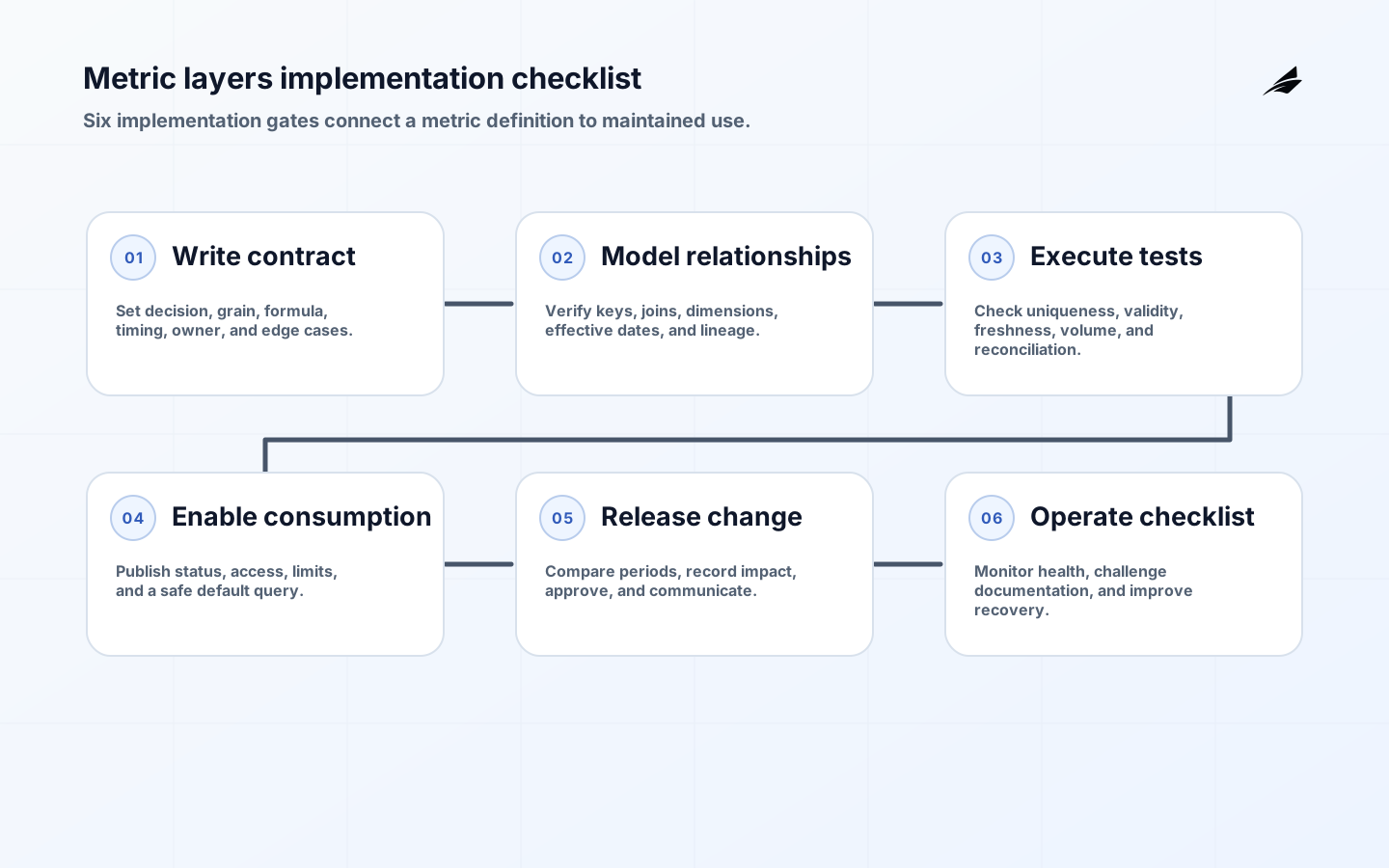
A checklist earns its place when it changes a release decision. Use one metric that a real team depends on and run the checks in the order a reader experiences the result. First confirm the decision, grain, formula, and supported dimensions. Then execute model and relationship tests, inspect lineage and access, publish a known-good example, and ask the consumer to interpret a stale or provisional state. A green build that never reaches a reader does not prove safe consumption.
For a retention metric, the release window might include a late cancellation, a plan change effective mid-month, a deleted account, and a backfilled source partition. Record the expected output for each case before running the pipeline. Dbt’s data-test documentation describes assertions as queries that return failing records; use that discipline for business exceptions as well as generic null, uniqueness, and relationship checks. W3C PROV and. OpenLineage provide complementary ways to retain provenance and job context, but the acceptance decision remains local: can an owner explain what the reader should do with the result?
Close the window with a signed release note. State which checks passed, which limitations remain, who approved the meaning, when the definition takes effect, and how a consumer reports a challenge. If a check fails, label the metric appropriately and preserve the evidence rather than substituting a familiar number. This turns the checklist into a maintained operating control instead of a one-time implementation ceremony.
| Gate | Release evidence | Decision if absent |
|---|---|---|
| Meaning | Signed definition and example at the intended grain. | Do not publish to a wider audience. |
| Quality | Executable tests and a visible status. | Publish provisional or hold the result. |
| Change | Impact note, effective date, and approval. | Keep the previous contract until reviewed. |
| Recovery | Owner, correction path, and retained run evidence. | Limit scope and schedule the missing drill. |
Run the exercise with a consumer outside the data team. Ask that person to find the definition, choose the right grain, interpret a late state, and identify who can approve a correction. The answers show whether the implementation is merely technically complete or actually usable by the people whose decisions give the metric its value.
Repeat the drill after a material source, join, or access change. The checklist is doing its job when it reveals a missing decision or evidence before a reader discovers the problem in a planning meeting or customer conversation. Keep the result with the release record so the next reviewer can see what changed.
Key takeaways for metric layers
- Metric layers earns trust through a clear decision boundary, not through volume or visual polish.
Implementation choices can be grounded in the dbt Semantic Layer and dbt data tests, alongside the provenance and lineage references already linked in this checklist.
An implementation checklist should leave behind executable evidence, not only completed boxes. For every metric, retain the signed definition, grain example, source snapshot, test result, status rule, access decision, and release note. Link those artifacts to the consumer path that depends on them. When a check fails, record whether publication is blocked, marked provisional, or allowed with a stated limitation. That decision makes the checklist useful during an incident because the responder can see the intended behavior without reconstructing it from a historical ticket.
Treat the first consumer as a test participant. Ask that person to find the metric, explain its formula, reproduce a known example, interpret a late or corrected result, and locate the owner for a disputed value. Record the points of confusion and convert them into a fixture, documentation change, or control. After release, repeat the exercise when the source grain, join logic, permission model, or definition changes. The checklist then becomes a maintained operating contract that can survive team turnover and tool migration.
Keep the acceptance evidence close to the definition and make the effective date visible. A later reviewer should be able to distinguish a changed business rule from a changed source, then choose whether to restate history, annotate it, or preserve the prior contract.
Frequently asked questions about metric layers
When is metric layers ready for wider use? Wider use is justified when a reader can explain the metric’s purpose, scope, timing, owner, and action route, and the team has exercised a credible failure case. Does a tool create metric layers by itself? No.
Conclusion: make metric layers dependable
The durable version of metric layers is a maintained agreement between people, data, and a decision.
A simple maintenance habit keeps the checklist alive: every quarter, select one metric at random and ask a new consumer to find its definition, reproduce an example, interpret a stale state, and identify the owner for a change. Record where the process fails. If the definition is hard to find, improve navigation; if examples are missing, add fixtures; if the status is unclear, improve the consumer surface. Metric layers remain dependable when the organization rehearses use and correction, not merely when the initial implementation passes review.
A checklist is complete only when it changes a release decision. Keep the signed definition, executable evidence, consumer status, approval, and recovery route together; then repeat the drill after a material source, join, or access change. The value is not a green box but a reader who can use the metric safely and an operator who can correct it without hiding uncertainty.