What Changes When Stream Processing Moves into Production
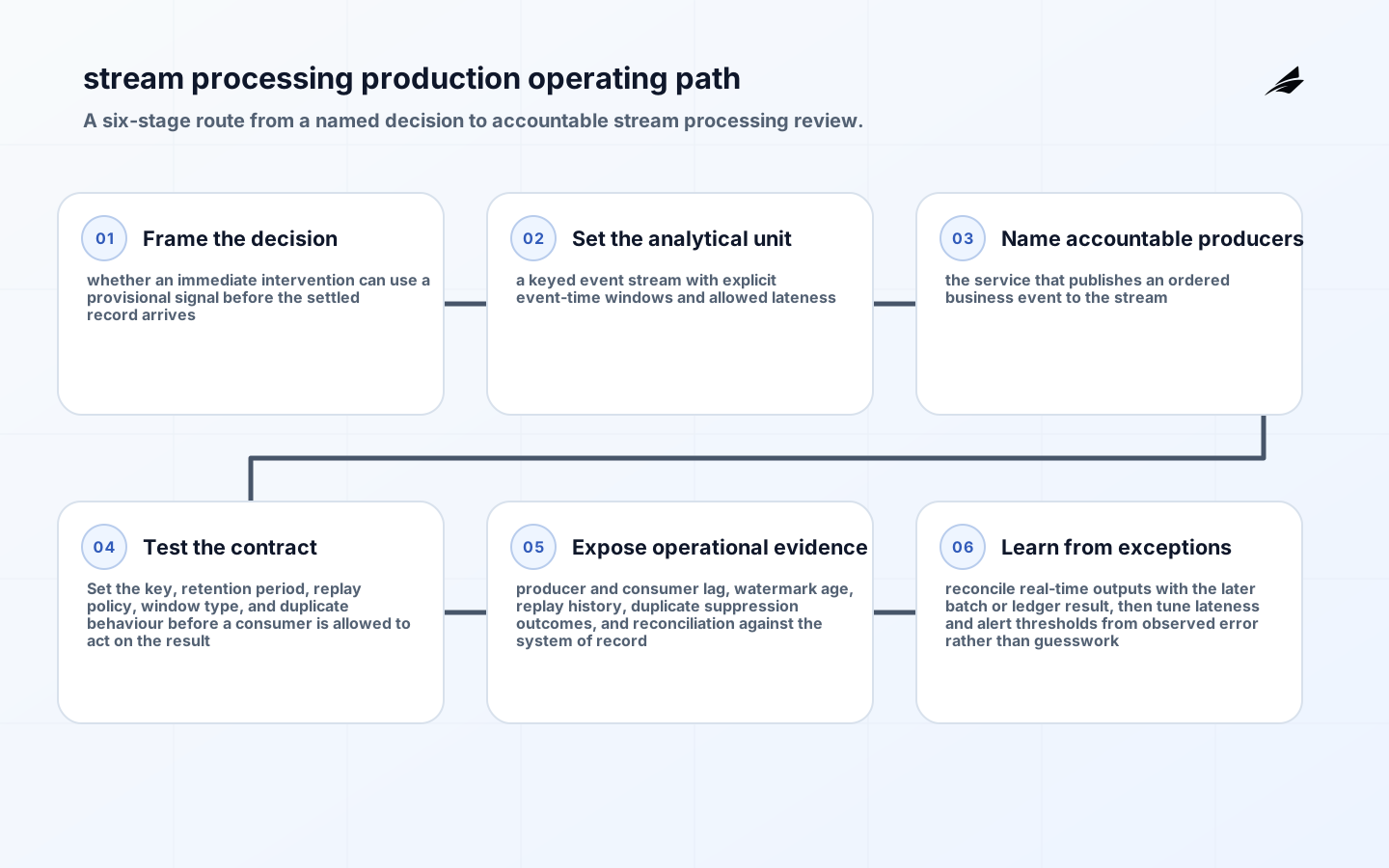
Stream Processing In Production is not a project milestone; it is an operating commitment. It matters when whether an immediate intervention can use a provisional signal before the settled record arrives. For IT managers, the production question is whether the result keeps its meaning when sources arrive late, definitions change, people correct records, and a real decision cannot wait. Begin with one decision and one accountable owner. That narrower start gives the team a boundary it can test, explain, and improve instead of a broad platform promise that cannot be verified in the next review.
Set the stream processing production boundary
A useful boundary names a keyed event stream with explicit event-time windows and allowed lateness. It also states the decision cadence, population included, acceptable delay, and consequence of error. The W3C PROV overview is a useful framing reference because it connects an output to the entities, activities, and responsible agents that produced it. In practical terms, a reader should be able to ask where the number came from, what changed it, and who can resolve a challenge without opening a ticket archaeology exercise.
For this work, the primary producer is the service that publishes an ordered business event to the stream. Name that responsibility explicitly, alongside the decision owner and technical steward. Define how to handle consumer lag, a replay, an out-of-order event, or a state-store recovery; a silent substitution is usually more dangerous than a visible delay. Production readiness is not the absence of every defect. It is the ability to show the current state, contain the affected output, and make a proportionate decision while the owner investigates.
| Boundary element | What to specify | Why it matters |
|---|---|---|
| Decision | whether an immediate intervention can use a provisional signal before the settled record arrives | It keeps the work tied to a real action. |
| Analytical unit | a keyed event stream with explicit event-time windows and allowed lateness | It prevents misleading aggregation or comparison. |
| Accountability | Decision owner, steward, and the service that publishes an ordered business event to the stream | Questions and exceptions have a route to resolution. |
| Cut-off | Refresh expectation, correction policy, and provisional status | Readers do not mistake a fast result for a settled one. |
Define a contract for stream processing
Set the key, retention period, replay policy, window type, and duplicate behaviour before a consumer is allowed to act on the result. The design must say which outputs are provisional and when they become settled; otherwise a fast number is easily mistaken for a final one. Use a versioned, reviewable contract rather than a collection of assumptions in dashboards and code. dbt data tests offer a concrete example of expressing assertions close to a model. The lasting practice is not a particular tool: turn each material assumption into a named check, then make failure visible to the people who rely on the result.
- State the grain, identifiers, time basis, and inclusion rule for a keyed event stream with explicit event-time windows and allowed lateness.
- Separate a confirmed result from an estimate, forecast, or provisional signal.
- Version changes that alter historical comparison or reader interpretation.
- Keep the exception owner and correction path visible with the published output.
- Limit collection, access, and retention to what the stated decision requires.
Build the stream processing operating path
Run failure drills with delayed partitions and repeated messages. Operators need to see lag, watermark movement, dead-letter volume, and the age of the oldest unprocessed record rather than a single success flag. Make the first release small enough to exercise with the people who will use it. This is where teams discover the assumptions a design review misses: a source resets its clock, a new release changes a field, an approver is unavailable at the cut-off, or an event means something different in a particular channel. Capture those cases as explicit policy, not as folklore held by the person who happened to debug the first incident.
Shared names improve investigation across a distributed system. The OpenTelemetry semantic conventions illustrate why consistent attributes and meanings make telemetry easier to correlate; the same discipline helps analytical operations. Preserve identifiers, timestamps, version, source, and outcome where they explain a material result. Avoid uncontrolled labels and sensitive detail that do not help the decision. A lean record with stable meaning is more useful than a wide table whose fields cannot be interpreted consistently. For stream processing in production, this means treating shared labels as part of the delivery contract, not as a cosmetic naming exercise.
| Operating step | Control | Evidence to retain |
|---|---|---|
| Create or ingest | Validate material identity, timing, and required values | Source timestamp and contract version |
| Transform or evaluate | Test material rules and reconcile meaningful totals | Run identifier, test result, and affected scope |
| Publish or act | Expose freshness, status, and reader context | Version, owner, and approval where needed |
| Correct or replay | Retain the reason and downstream impact | Exception record and notice to affected readers |
Make evidence operational
Monitor evidence that can change an action, not a wall of undifferentiated technical telemetry. For stream processing, the useful signals are producer and consumer lag, watermark age, replay history, duplicate suppression outcomes, and reconciliation against the system of record. Review the signal with the stated service level and decision cut-off in view. A threshold should route someone to a specific question or intervention. The Google SRE Workbook guidance on monitoring makes a compatible point: monitoring is valuable when it supports an informed response, not simply because a system can emit more measurements.
Access and privacy controls belong in the same operating design. The NIST Privacy Framework describes a risk-management approach that is helpful when a dataset can identify or affect people. Apply least privilege to both raw inputs and published views, retain an audit trail for sensitive corrections, and revisit access when the decision purpose changes. This limits the damage of an error and makes the evidence more credible to the people asked to rely on it. In this case, access decisions should be reviewed against what changes when stream processing moves into production, its stated audience, and the action it can influence.
Handle exceptions without hiding them
The most common failure mode is claiming exactly-once business effects without defining idempotency at the actual destination where the effect occurs. Define a response before the alert fires: who decides whether to pause, annotate, or continue; which readers must be told; how the affected period is identified; and what proof closes the incident. A visible exception state is not an admission of defeat. It keeps people from acting on a number whose boundary has quietly moved and gives engineering, operations, and governance a shared record of what happened.
Review stream processing as an operating capability
Set a regular review that includes the decision owner, the technical maintainer, and a representative reader. Reconcile real-time outputs with the later batch or ledger result, then tune lateness and alert thresholds from observed error rather than guesswork. Review whether the published result was understandable at the moment it was needed, not only whether the scheduled job succeeded. This closes the loop between delivery evidence and business usefulness, and it prevents a control from becoming ritual after the underlying workflow has changed.
- Ask whether the current output made an immediate intervention easier, faster, or safer before the settled record arrived.
- Inspect exceptions by cause, materiality, and time to resolution.
- Check that version changes were communicated to downstream readers.
- Retire checks and fields that do not protect a real decision.
- Use related work on real-time analytics decisions and stream processing guide to extend the practice without losing the initial boundary.
Stream Processing takeaways
- Stream Processing In Production starts with a named decision, not a tool selection.
- A small, testable contract is more durable than undocumented institutional memory.
- Freshness, status, ownership, and correction evidence should travel with the result.
- Exception handling is part of reader trust, especially when the output changes an action.
- Recurring review should measure decision usefulness as well as technical reliability.
Stream Processing FAQ
What is the smallest useful release? Start with one decision, a keyed event stream with explicit event-time windows and allowed lateness, a named owner, and an exception path that readers can understand. Who owns it? The decision owner owns whether the output is useful, while the steward or delivery team owns the contract and evidence; both responsibilities are necessary. When should scope expand? Expand only after the initial boundary has survived ordinary change and correction, then use ELT workflows guide to assess the next dependency or operating need.
Sources
- Apache Kafka documentation
- Apache Flink time and event processing concepts
- OpenTelemetry semantic conventions
- Google SRE Workbook: Monitoring
Conclusion: make stream processing dependable in use
The meaningful change in stream processing in production is accountability under real operating conditions. Define the decision and unit, make ownership and evidence visible, and treat exceptions as information that readers need before they act. That gives IT managers a result they can interrogate rather than merely consume. For the next design conversation, begin with real-time analytics decisions and preserve the same discipline as the scope grows.