Real-time Analytics Decisions That Matter before the First Build
Real-time analytics is not the act of installing a tool or publishing a technical asset. For CTOs, it is the discipline of making a particular decision dependable at a known moment, with evidence a colleague can inspect. The value is timely intervention where a delayed answer loses its value. For this real-time analytics case, start by writing down the decision, who takes it, what changes it, and what happens when available evidence is incomplete. A delivery control room sees a route exception after the intervention window has closed. The system can be fast in processing time yet operationally late if device upload delay, event time, and alert routing are not part of the design. For this real-time analytics case, that practical boundary keeps the work focused on behavior and consequences rather than a long inventory of features.
Write the Decision’s Time Budget
For this real-time analytics case, before committing a team, describe the recurring decision in one sentence: “At this cadence, this person decides this action using these measures.” Then collect real cases, including an uncomfortable exception. For real-time analytics, the useful scope is often narrower than the requested platform: one planning meeting, operational handoff, or governed dataset. The deliverable is a latency budget separating event time, ingestion time, processing time, publication time, and the human response window. For this real-time analytics case, a named owner must accept the definition, request a change, and decide whether an exception blocks the result or merely qualifies it. That makes accountability testable before implementation expands.
| Question | Decision to make | Evidence to keep |
|---|---|---|
| Who acts? | Name the accountable user and decision. | Decision statement and cadence. |
| What must be true? | Specify records, definitions, and uncertainty. | Examples, source IDs, acceptance criteria. |
| When does real-time analytics create enough value to justify its operating cost? | Set a business freshness or response expectation. | Timestamp, cutoff policy, exception state. |
| Who responds? | Assign correction and communication ownership. | Escalation route and incident record. |
Set the operating promise and boundary at the access boundary
For this real-time analytics case, a useful definition prevents technology from becoming a vague cure for every reporting problem. Real-time analytics should make one kind of evidence easier to produce, understand, reuse, or act on; it does not remove judgment about policy, incentives, or changing business conditions. For this real-time analytics case, the important work is semantic: what does an identifier represent, which time applies, which exclusions are intended, and which audience can see the result. Put those answers where a reviewer can find them. Ambiguity in Real-Time Analytics: Decisions Before the First Build is reduced by clarifying the decision, evidence, and owner rather than adding another surface.
The caution is concrete: a duplicate or late event that sends an alert twice or changes a KPI after a supervisor has already acted. Treat that as a design test. For this real-time analytics case, ask a domain expert to walk through the example, then make expected handling executable where feasible and visible where automation would be unsafe. For this real-time analytics case, W3C PROV explains why provenance matters, while the W3C Data Quality Vocabulary frames quality characteristics in context. For this real-time analytics case, both are useful anchors when a team must explain what it knows and why.
Trace Events to a Decision
Break the Latency Budget Into Observable Stops

For implementation detail, compare the Apache Beam Programming Guide for triggers and allowed lateness with OpenLineage facets for run, input, and output context. They support the article’s distinction between a timely answer and an answer that can still be explained after correction.
A claim such as “the dashboard is real time” hides several clocks. A delivery intervention may require the device to record an event within 20 seconds, the producer to transmit it within 10 seconds, the stream job to update state within 5 seconds, and the alert to reach a dispatcher while 60 seconds of decision value remains. Write those stops separately and measure each one. If device upload is late, increasing processor parallelism cannot recover the lost response window. If publication is fast but reconciliation is slow, show the live result as provisional rather than silently replacing the settled history later. Apache Flink streaming analytics documentation distinguishes event time, ingestion time, and processing time; the local design should expose those meanings in the evidence packet and reader experience.
Use an event trace to test the architecture. Select one order or delivery exception and record its event identifier, event timestamp, source partition, ingest timestamp, state transition, output revision, and action recipient. Repeat with a duplicate and an event that arrives after the watermark. The expected result is not necessarily to reject every imperfect record; it is to make the chosen behavior predictable. A duplicate may be ignored by an idempotent key, a late event may revise a window, and an untrusted source may be quarantined. Each choice needs a visible status and an owner who can explain its consequence.
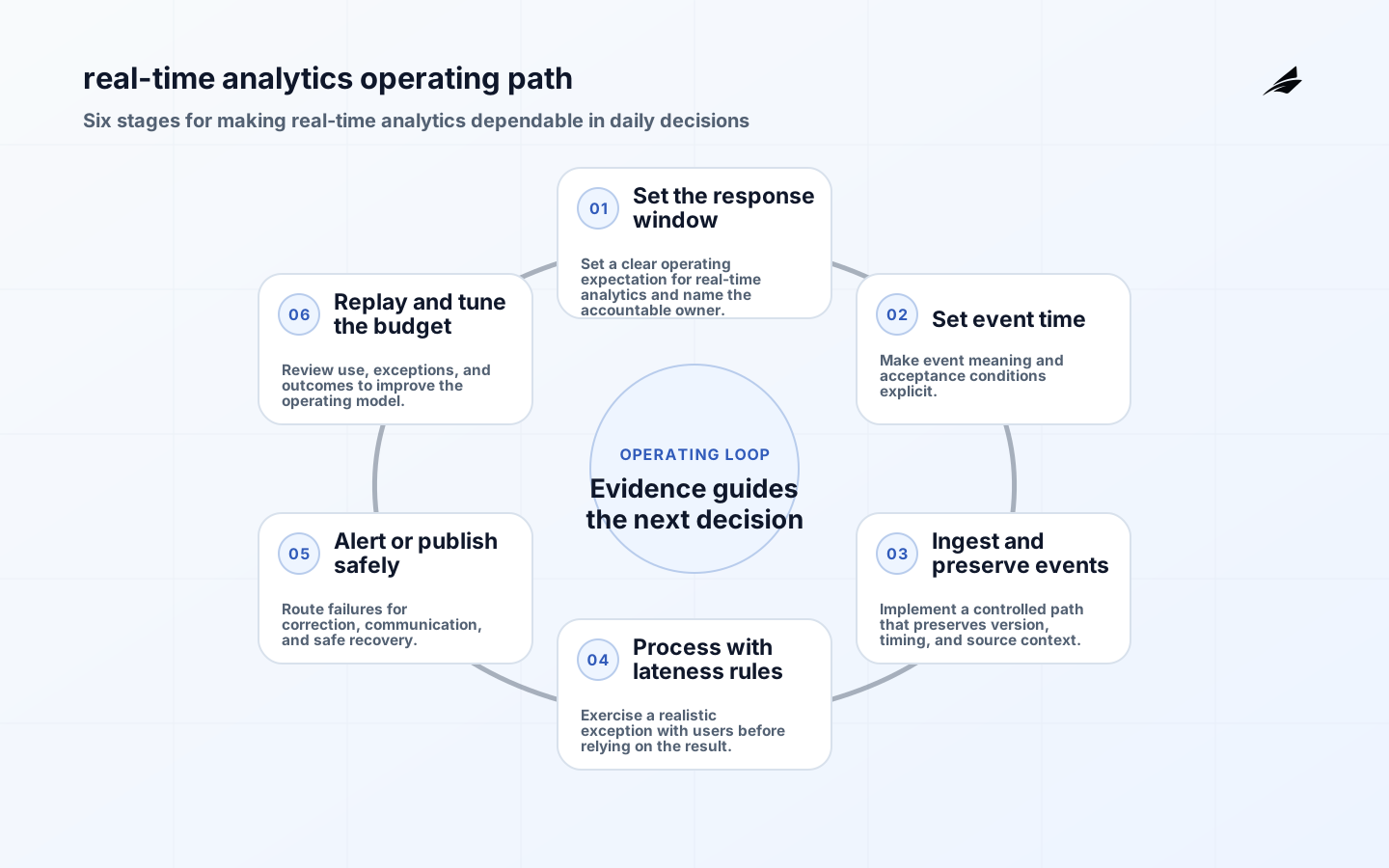
The architecture should make claims traceable. For this topic, that means durable event intake, an explicit event-time policy, stateful processing with checkpoints, idempotent actions, a replay route, and observability for lag and late events. For this real-time analytics case, keep authoritative evidence separate from presentation, and retain the version, time, and owner behind consequential outputs. For this real-time analytics case, design each boundary for a real operating question: can the team identify a missing input, distinguish delayed from absent data, understand a change's blast radius, and recover without inventing a second source of truth. For this real-time analytics case, a simple path that is observable and recoverable is more valuable than an elaborate design that only works in the happy case.
| Layer | Responsibility | Failure signal |
|---|---|---|
| Evidence | Preserve source identity, time, and relevant context. | Missing keys, unusual volume, unavailable source. |
| Controlled logic | Apply approved rules with versioned change history. | Test failure, reconciliation gap, incompatible change. |
| Published result | Expose scope, freshness, limitations, and definition route. | Stale output, unexplained shift, access mismatch. |
| Operations | Monitor, communicate, repair, and learn. | Unowned alert, repeated workaround, slow recovery. |
Prove the Smallest Useful Path
For this real-time analytics case, a first release should prove the decision path, not standardize every adjacent workflow. For this real-time analytics case, build from representative data and real users; include the unhappy path before calling work complete. For this real-time analytics case, exercise an input delay, a definition change, a permission problem, and unexpected volume. Review the result with the decision owner, not only implementers. For real-time analytics, release criteria include a working explanation, a support owner, and evidence that the result can be checked against a known case. For this real-time analytics case, this is how capability becomes repeatable rather than dependent on one expert.
- Write the minimum contract and decision statement for real-time analytics before building broad surfaces.
- Choose one owner for meaning and one technical owner for operation.
- Show freshness, version, or exception state wherever a user may act.
- Reconcile known cases with people closest to the source process.
- Rehearse correction, rollback, or replay before the first important cycle.
Operate From Timing and Correction Evidence
After launch, measure end-to-end decision latency, late-event rate, duplicate rate, consumer lag, replay duration, and alerts acknowledged in time. For this real-time analytics case, these are not universal targets; their purpose is to make trade-offs discussable and surface whether the service remains fit for its decision. For this real-time analytics case, review recent examples on a cadence: a normal run, an exception, a change request, and a user question. For this real-time analytics case, record what was learned, who owns the next action, and whether the definition, control, or training needs revision. For this real-time analytics case, this closes the loop between what the team designed and how work actually happens, without pretending a successful deployment ends operational responsibility.
With real-time analytics, set a lateness policy in the language of the operation. Decide whether a late event updates history only, changes an active alert, is shown as a correction, or is sent to review. Also state how duplicate events are detected and which actions must be idempotent. These choices cannot be left to the streaming framework alone because their meaning depends on the cost of a false intervention, a missed intervention, and a revised record.
A mature real-time analytics practice should make routine change safer as well as make today’s result useful. For this real-time analytics case, review the boundaries in the architecture when a source, owner, policy, or business question changes, and record which published outputs depend on the old assumption. The design risk remains: a duplicate or late event that sends an alert twice or changes a KPI after a supervisor has already acted. For this real-time analytics case, this gives the team a concrete scenario for release review, support training, and recovery rehearsal. For this real-time analytics case, operational decisions become more dependable when people can see the limitation before it becomes an incident, rather than reconstructing intent from a result after it has already been used.
One practical test for real-time analytics is decision reversibility. For this real-time analytics case, before relying on a result, ask what evidence a reviewer would need to challenge it, correct it, or explain a different outcome tomorrow. For this real-time analytics case, preserve that evidence with the output: the relevant period, scope, definition version, source state, and accountable owner. Real-time analytics does not need to make every decision automatic. For this real-time analytics case, it needs to make appropriate human judgment faster and better informed, especially when the facts are incomplete or an exception has material consequences.
Key Takeaways
- Real-time analytics succeeds when it supports a named decision and accountable user.
- For this real-time analytics case, definitions, time boundaries, and exceptions are product behavior, not after-the-fact paperwork.
- For this real-time analytics case, the first build should preserve evidence and make recovery possible before it reaches every audience.
- For this real-time analytics case, usage matters, but effective use means people can explain the result and act appropriately.
- For this real-time analytics case, reviewing real failures is the quickest way to improve ownership, controls, and scope.
Frequently Asked Questions
Do we need a large platform first for real-time analytics? No. For this real-time analytics case, begin with the smallest decision needing dependable evidence and make its path observable. Who owns it? For real-time analytics, an operational owner owns meaning and decision fit; a technical owner operates the data path. How do we know it is ready? For real-time analytics, test named cases, show freshness and limitations, assign support, and have intended users complete real work. What should change first after launch? For real-time analytics, fix repeated ambiguity, unowned exceptions, and evidence gaps before adding surface area.
Before approving a larger architecture, write a one-page evidence packet: decision and owner, event contract, timing promise, failure examples, quality checks, access model, cost estimate, and recovery sequence. Review it with the people who will consume and support the result. This packet gives a buyer or CTO a concrete way to compare designs and makes later incidents easier to investigate. If a proposed feature cannot improve the action, the timing promise, or the control evidence, it probably belongs outside the first build.
Conclusion
Real-time analytics is worth building when it makes an important decision more explainable, timely, and recoverable. For this real-time analytics case, keep the first commitment concrete: one decision, one owner, constrained evidence, and a review loop containing real exceptions related data guide, related data guide, related data guide provide adjacent data practices that strengthen this work. For technical grounding, consult Apache Kafka documentation, Google Cloud Dataflow overview, W3C Data Quality Vocabulary, W3C PROV data model. For this real-time analytics case, these authoritative references do not replace local judgment, but they help teams make definitions, lineage, controls, and operating responsibilities explicit.
Real-time analytics should earn its latency through a decision that loses value on a known clock. Define event and publication timing, preserve provenance, expose provisional states, and test a late or duplicate event before expanding the architecture. A useful review shows whether the reader acted with the right evidence and whether the team can replay, correct, and explain the result after the decision.