Event Analytics Decisions That Matter before the First Build
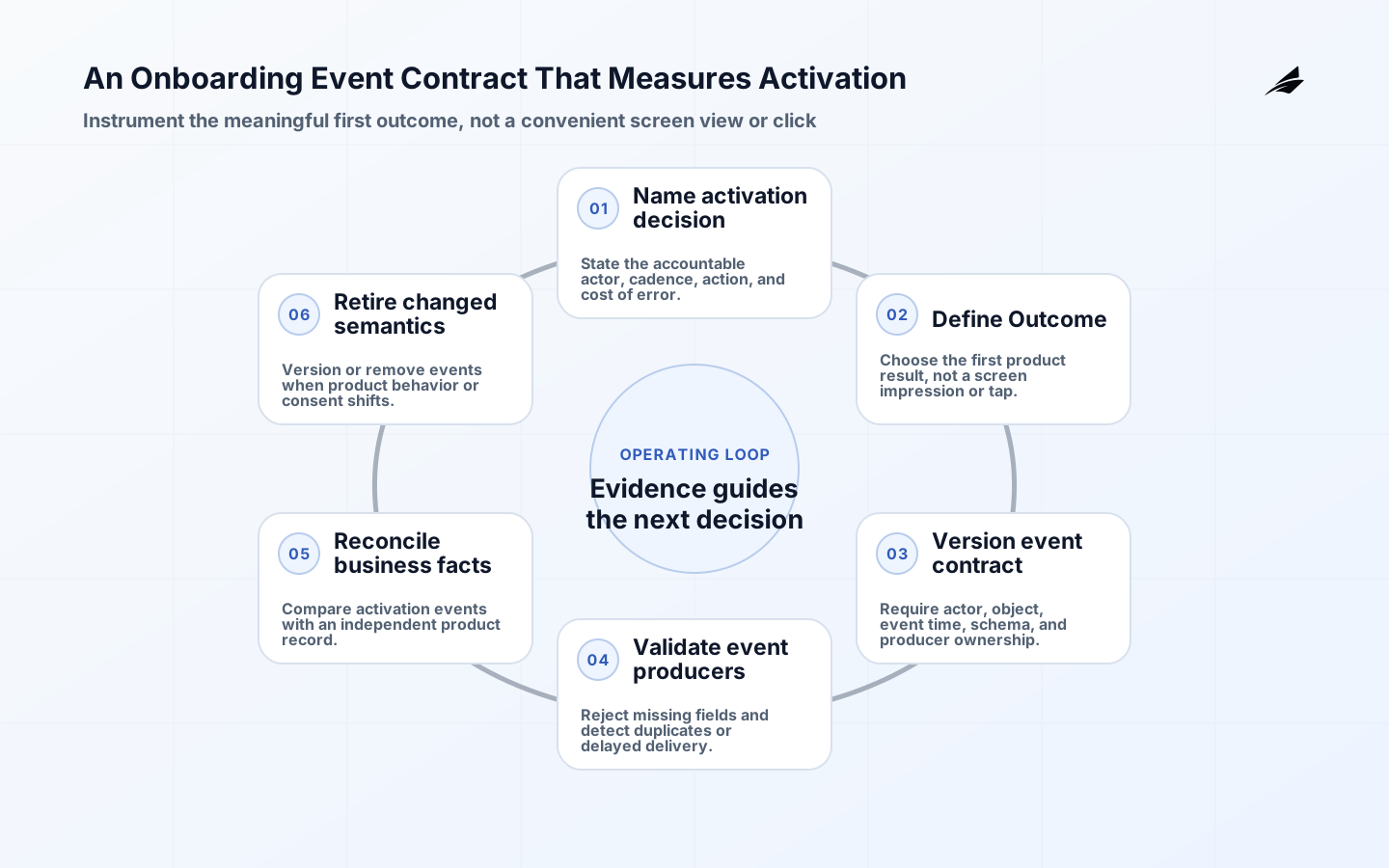
Event analytics should answer a product question, not merely prove that software can emit messages. Consider an onboarding change. A product team may need to know whether new users reach a meaningful first outcome, not whether they saw a screen or pressed a button. That distinction determines the event contract: what business occurrence happened, who or what performed it, which object changed, when it happened, and which version of the producer created the record. It also determines which events can be joined safely and which missing or duplicate records invalidate an activation metric. Start by writing the decision alongside a few real user journeys, including retries and abandoned sessions. The resulting model gives engineers an implementable contract and gives analysts a basis for saying when a chart is informative, provisional, or wrong.
Take a mobile client sends signup_completed before the account is actually created. In event analytics, that is not a minor edge case; it is the point at which assumptions about identity, timing, and meaning become visible. The team should decide in advance whether the record is rejected, quarantined, corrected, or reported with a qualification. An event must describe a business occurrence, not an implementation detail that changes every sprint. Making the boundary explicit prevents the common pattern in which people discover an ambiguity only after an executive meeting, customer interaction, or operational escalation.
Start with the decision boundary for event analytics
A decision statement gives event analytics a testable purpose. Name the decision, the accountable actor, the cadence, and the cost of being wrong or late. Then capture the minimum evidence that must accompany the result: an event name, actor and object identifiers, event time, schema version, and a clear producer contract. This is more precise than collecting a broad list of desirable fields. It tells delivery teams which conditions are material and gives business owners a way to review trade-offs. A metric may be accurate enough for weekly planning and unsuitable for customer-facing automation; the boundary should say so.
| Question before build | Practical choice | Evidence to retain |
|---|---|---|
| Who takes action? | Name the owner who decides whether a new onboarding flow is improving activation rather than merely generating clicks. | Decision log and operating cadence. |
| What can change the answer? | List the material inputs and exclusions. | Definition, schema, and sample cases. |
| How current must it be? | Set a freshness or event-time expectation. | Last successful run and delayed-data policy. |
| What happens when it fails? | Choose block, qualify, or route for repair. | Alert owner, incident note, and correction record. |
Architecture and controls for event analytics
The architecture should separate evidence capture, controlled calculation, publication, and observation. In practice, start with a small event taxonomy tied to decisions, then validate payloads at the producer and warehouse boundary. Keep raw or source-shaped evidence accessible to authorized investigators; make the published layer small enough that a user can understand its grain, timing, and exclusions; and record the version of the logic that produced a consequential result. This division makes correction possible without pretending that every anomaly can be resolved automatically.
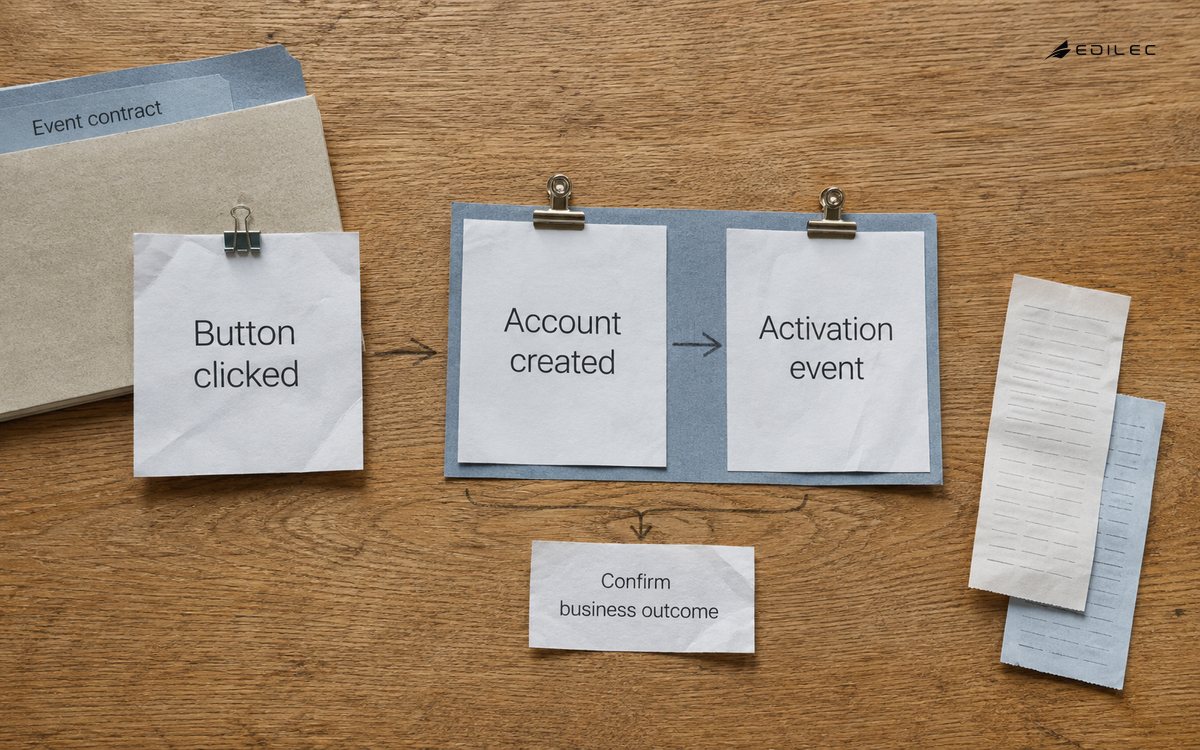
Ownership matters as much as the data path. The business owner approves meaning and prioritizes remediation; the technical owner operates collection, transformation, access, and recovery; consumers report confusing or surprising results through a visible route. For event analytics, a review should use recent exceptions rather than slideware: inspect a failed rule, an unexpected trend, a delayed input, and one corrected record. That routine exposes whether the stated control actually works in daily use.
| Layer | Responsibility in this design | Failure signal |
|---|---|---|
| Evidence | Capture the identifiers, time, and source context needed to verify a case. | Missing key, late input, or unexpected volume. |
| Controlled logic | Apply approved rules and preserve calculation version. | Test failure, reconciliation gap, or schema change. |
| Published result | Show the answer, freshness, scope, and exception state. | Stale output, unexplained shift, or blocked access. |
| Operations | Route alerts, repair data, and communicate material changes. | Unowned incident or repeated manual workaround. |
A phased rollout for event analytics
Begin with one critical journey, representative clients, and a reconciliation against an independent business record. Use historical examples plus a small live sample, including incomplete, late, and corrected cases. Compare the new result with the current method and investigate differences before declaring one system authoritative. A good pilot produces a named baseline, acceptance criteria, support contact, and recovery exercise. It also produces a decision: extend the scope, revise the definition, or stop. That is a much stronger outcome than a technically successful demonstration with no evidence that the workflow can be operated.
- Write a one-sentence decision statement for event analytics and have the action owner approve it.
- Select the smallest source-to-decision path and document the material fields, definitions, and exclusions.
- Create checks for the failure modes that would change whether a new onboarding flow is improving activation rather than merely generating clicks, including the case where a mobile client sends
signup_completedbefore the account is actually created. - Make freshness, scope, and exceptions visible to users rather than keeping them in an engineering runbook.
- Run the pilot alongside the existing process and retain explanations for material differences.
- Expand only after the owner can explain detection, communication, correction, and recovery.
Measures that show whether event analytics is working
Measure behavior and reliability together. For event analytics, track schema conformance, duplicate rate, missing identifiers, late arrivals, and the share of key events with an owner. Pair these operational signals with a direct question for users: which decision changed because this evidence was available, and could they explain why they trusted it? Raw usage, query volume, or job-success counts are useful context, but none demonstrates that the result improved work. A temporary increase in questions can be healthy when it reveals definitions that were assumed instead of agreed.
Sources used for this event analytics guide
Apache Kafka documentation explains the log, partition, consumer, and retention concepts behind many event-collection architectures; it does not make a producer contract optional. OpenTelemetry semantic conventions reinforces the value of shared names and attributes when instrumenting services. W3C PROV-DM supports keeping enough context to trace an aggregate back to the producing activity, and dbt data tests documentation provides a concrete model for checking downstream assumptions. Event names, versioning, and identity rules remain product decisions that a team must document and review.
Review event analytics before wider release
Before a wider release, review one changed input, one failed or delayed run, and one user decision that depended on the result. Ask whether an event name, actor and object identifiers, event time, schema version, and a clear producer contract still describe the real workflow and whether a person outside the delivery team can trace the answer without informal help. For event analytics, the release record should identify the logic version, effective date, owner, and any known limitations. This review is deliberately modest. Its purpose is to catch a change that would alter whether a new onboarding flow is improving activation rather than merely generating clicks before it becomes embedded in a recurring meeting, automation, or customer process. Keep a versioned event dictionary beside the release record, with examples of valid and invalid payloads, so client teams can distinguish a deliberate analytical change from accidental instrumentation drift.
Use exception samples, not only aggregate success rates, to judge readiness. Reconstruct the treatment of the case where a mobile client sends signup_completed before the account is actually created; then verify that the published result, alert, or report would make the uncertainty visible to the intended user. Compare that exercise with schema conformance, duplicate rate, missing identifiers, late arrivals, and the share of key events with an owner. If the team cannot explain a discrepancy, pause expansion and fix the definition, source contract, or recovery route. A narrow, explainable capability earns more trust than a broad event analytics implementation whose assumptions are available only to its builders.
Key takeaways
- Event analytics should begin with a consequential decision and named action owner.
- Treat definition, timing, provenance, and correction as visible parts of the product.
- Use a narrow pilot with real exceptions to test the operating model, not just the data path.
- Scale only when users can investigate a surprising answer and the team can recover a failed interval.
Frequently asked questions about event analytics
What is the first useful milestone for event analytics?
The first milestone is a supervised decision path, not a broad platform rollout. A named user should be able to obtain the result, see whether it is current and in scope, follow an exception to a responsible owner, and compare the answer with enough evidence to explain it. For event analytics, keep this first path deliberately small. It should include the uncomfortable cases, because those reveal the controls and definitions that ordinary happy-path examples hide.
Do we need a new tool before implementing event analytics?
Usually, no. First establish whether the existing stack can capture the necessary evidence, apply the agreed rules, restrict access where needed, expose timing and exceptions, and retain a correction path. A new tool is justified when it removes a demonstrated reliability, scale, security, or maintainability limit. Tool selection should follow the decision boundary for event analytics; it cannot substitute for ownership, definitions, or a release and recovery practice.
Conclusion
The durable version of event analytics is not a collection of reports, events, or jobs. It is an operating capability that helps product, engineering, and growth teams decide whether a new onboarding flow is improving activation rather than merely generating clicks with appropriate confidence. Start with the decision, state the evidence boundary, design for exceptions, and prove the workflow in a supervised pilot. That sequence keeps the build honest: it makes value visible early while preserving the controls needed to explain, correct, and improve the result over time.