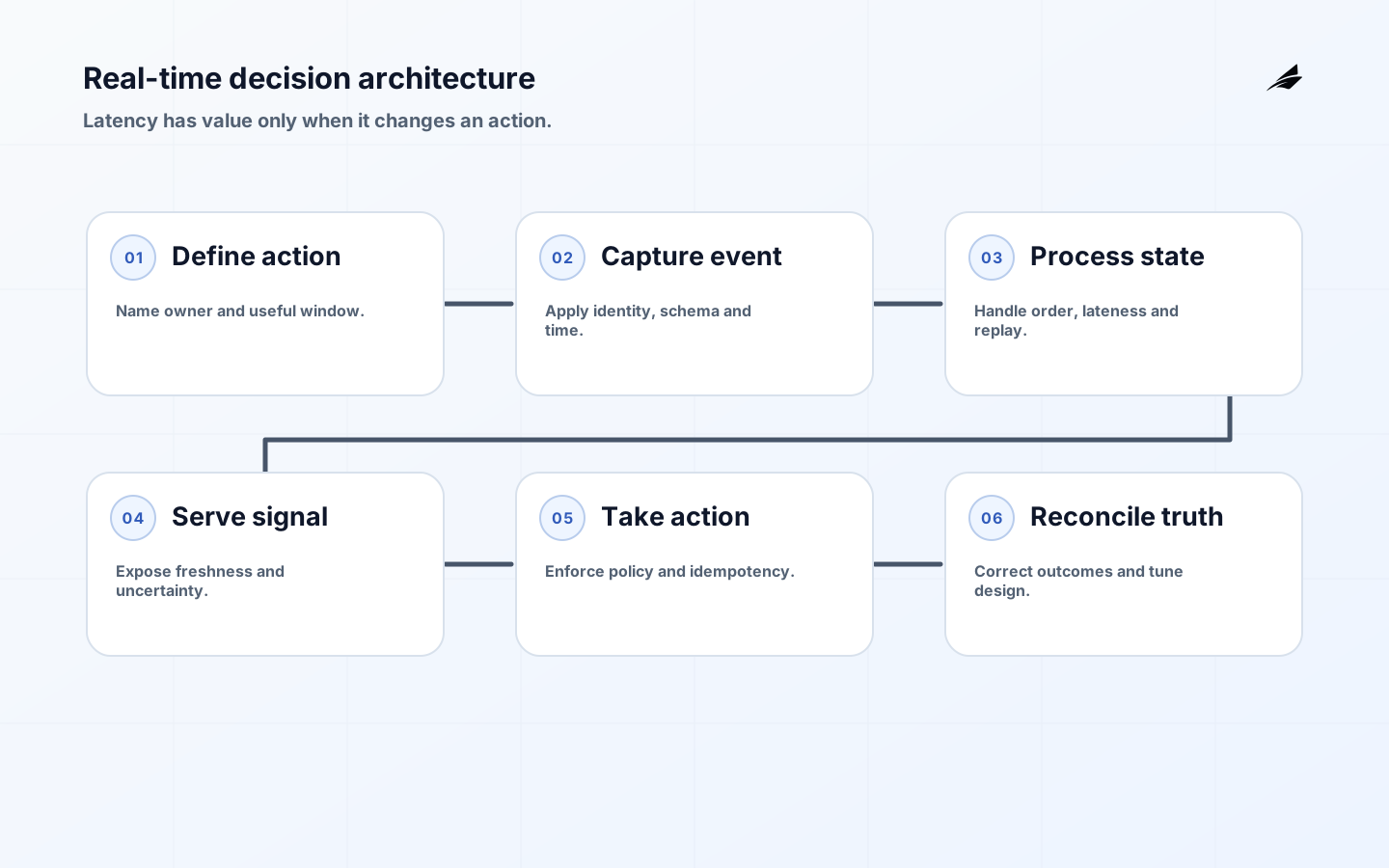
Real-time analytics for CTOs is a decision architecture, not a dashboard refresh setting. It reduces the interval between an event and an action, while accepting higher engineering and operating obligations for continuous ingestion, state, ordering, recovery, monitoring and reconciliation. Fraud review, capacity protection, dispatch and incident detection can justify seconds or minutes. A planning report reviewed next week usually cannot. The CTO's first question is therefore not 'Which streaming platform?' but 'What action becomes materially better before this signal expires, and what happens when the fast signal is incomplete or wrong?'
This guide explains the architecture and investment decisions behind that question. The event analytics engineering notes cover event design, while the stream processing buyer guide goes deeper on platform capability. Here the focus is the executive technical contract: latency value, correctness semantics, operating evidence, staged adoption and total cost. 'Real time' should always be replaced by a measurable window and a named response.
1. Prove that lower latency changes an action
Write the current and proposed decision windows, response owner, expected benefit and cost of false action. A five-minute warehouse signal is useful only if a supervisor can intervene before dispatch. A subsecond recommendation may be unnecessary when stock changes hourly. Include human attention and downstream actuation; a fast alert waiting in an unstaffed queue is not an operational capability. Compare scheduled batch, micro-batch, change-data capture and continuous stream processing and choose the least complex design that meets the window.

Define a latency service-level indicator from event occurrence to usable decision, not broker arrival to processor output. Segment by source and critical cohort. Google SRE SLO guidance emphasizes indicators tied to user concern and explicit measurement. Add quality and availability to the objective so teams cannot meet latency by dropping late data or emitting unstable results. State the fallback when the objective is at risk.
| Use case | Useful window | Decision and fallback |
|---|---|---|
| Payment risk review | Seconds to minutes | Hold or route; continue with bounded rules if stream degrades |
| Fulfilment exception | Minutes | Reassign work; show last reliable state when delayed |
| Service protection | Seconds | Throttle or fail over; use local safeguards |
| Product experimentation | Minutes to hours | Pause exposure; reconcile complete sessions later |
| Financial reporting | Hours to days | Use provisional operations view; close from accountable records |
| Strategic planning | Days or longer | Prefer simpler governed batch outputs |
2. Treat event time and lateness as business policy
Event time is when the business event occurred; processing time is when a machine handled it. Devices disconnect, partners retry, clocks drift and corrections arrive after dashboards update. Apache Flink's time-attribute guidance explains that event time and watermarks support consistent results with out-of-order data. A watermark is an estimate of progress, not a promise that no older event will appear. The business must decide whether a late event updates, compensates, quarantines or is ignored with evidence.
Define event identifiers, source, schema version, subject key, occurrence time and trace context. Choose ordering scope: a customer, account or device may need ordered events without imposing global order. Windows, joins and timeouts should reflect the decision. Label fast outputs provisional when later information can change them, and expose the correction. A number that silently moves after someone acted is not trustworthy analytics even if the final calculation is mathematically accurate.
3. Design replay and side effects explicitly
At-least-once delivery is common because retry avoids silent loss but can produce duplicates. Exactly-once claims have boundaries. Apache Kafka's delivery-semantics design explains that exactly-once support applies within specified transactional processing paths; external databases, emails, payments and device commands still require their own consistency design. Give every operation an idempotency key, record processed source positions where appropriate and make repeated execution harmless or detectable.
Retain an immutable or reconstructable event source according to need, privacy and cost. Replay must use versioned code, schemas and reference data or explain why results differ. Protect external side effects during backfill: separate analytical recomputation from operational command topics, use dry-run modes and require explicit authorization. Reconciliation compares fast outputs and effects with the accountable source of record and creates owned exceptions. Recovery is incomplete until business state is correct, not merely until consumers are running.
4. Separate transport, computation and decision
A durable architecture has producers with data contracts, a retained transport, stateful processing, a serving layer, a decision service and an action or review path. Separate concerns so changing a dashboard does not alter command authorization and replay does not resend notifications. Choose managed or self-operated components based on team skills, data constraints, scale, portability and failure ownership. The ELT workflow plan remains relevant because final analytics and dimensional models often belong in a simpler batch path.
Apache Beam's programming guide frames triggers as a balance among completeness, latency and cost and supports early and late firings. That tradeoff belongs in product requirements. A speculative result can be useful for operations if labeled and correctable; it may be unacceptable for settlement. Define how users distinguish early, on-time and corrected values, and whether updates replace, append or compensate previous results.
| Architecture concern | Design choice | Evidence to review |
|---|---|---|
| Partitioning | Key that preserves required local order | Hot-key and rebalance test |
| State | Retention, checkpoint and schema evolution | Restore and upgrade exercise |
| Lateness | Watermark and allowed correction policy | Late-event distribution by source |
| Delivery | Retry, transaction and idempotency boundary | Duplicate and crash test |
| Serving | Provisional versus final representation | User correction comprehension |
| Action | Policy, approval, rate limit and compensation | Replay cannot repeat harmful effects |
5. Operate from end-to-end freshness and correctness
Monitor event age, consumer lag, watermark delay, late and duplicate rate, failed deserialization, state growth, checkpoint health, backpressure, output correctness samples and action completion. OpenTelemetry signals can correlate traces, metrics and logs across producer, processor and consumer when context is propagated consistently. Infrastructure health alone misses stale business decisions. Page on actionable risk to the decision window, and expose degraded freshness directly to users and downstream systems.
Exercise producer outage, idle partition, poison message, state restore, schema incompatibility, slow sink and replay. Determine the last reliable output and how automation pauses. Run the drill during representative operating coverage, then reconcile results with the source of record. Track time to detect stale data, communicate impact, restore processing and restore correct business state separately. A streaming platform with no staffed response or tested fallback creates a faster route to uncertain decisions.
6. Stage adoption and govern cost
Estimate peak and average events, bytes, retention, partitions, state, checkpoints, queries, egress, environments, replay duration and on-call support. Include producers and downstream consumers, not just the stream processor. Unit cost can be per million validated events, per active entity or per decision within the useful window. Cost rises with low latency, long retention, wide state, cross-region movement and duplicate pipelines. Compare it with the value and frequency of the action, not an abstract modernization target.
Start with reliable event capture and a read-only operational view. Add exception routing, then automate only bounded actions after idempotency, fallback and reconciliation are proven. Keep final reporting in the data pipeline architecture or another accountable path where that is simpler. Review architecture when latency targets, event mix or action consequence changes. The goal is not streaming everywhere; it is the smallest continuously operated system that protects a valuable decision window.
Govern data contracts as products with producer and consumer owners. A change proposal should show compatibility, affected decisions, backfill needs and a deprecation window. Consumers must not infer undocumented meaning from nulls, ordering or topic names. Track which critical decisions depend on each event version so an incident can identify impact quickly. This discipline is especially important after acquisitions or vendor changes, when two sources may use the same business word for different states. Semantic alignment prevents a technically healthy pipeline from producing a confidently wrong operational view.
Set an architecture review trigger rather than a fixed streaming doctrine. Revisit the design when peak rate, lateness distribution, retention, number of consumers, regulatory scope or action consequence changes materially. Review whether the original platform still earns its operational cost and whether some outputs can return to batch. A real-time estate should be allowed to shrink. Removing a low-value continuous path reduces failure surface, on-call demand and duplicated truth while preserving capacity for decisions where seconds genuinely matter.
Key takeaways
- Fund real-time analytics only when lower latency changes a consequential action.
- Define event time, watermark, late-data and correction policy as business semantics.
- Treat exactly-once guarantees as bounded and protect every external side effect.
- Separate transport, computation, decision policy and action.
- Operate from end-to-end freshness, correctness, replay and reconciliation evidence.
- Stage automation and compare lifecycle cost with value inside the useful window.
Real-time analytics for CTOs FAQ
Is a streaming platform always required? No. Scheduled queries, micro-batches or change-data capture may meet the decision window with less state and on-call burden. Choose from the action backward.
Can exactly-once processing prevent every duplicate? No universal guarantee spans arbitrary external systems. Use platform transactions within their documented boundary plus idempotency, unique constraints, acknowledgements and reconciliation at side effects.
How should a live dashboard show late data? Display freshness, event-time coverage and provisional or corrected status. Users need to know when the view is delayed or can change, not just when the page last refreshed.
When should automation be added? After the signal has demonstrated quality, operators understand exceptions, and replay, fallback and compensation prevent repeated or unsafe action. Start with reversible, rate-limited decisions.
Conclusion
CTOs should treat real-time analytics as an operating commitment around a decision. Prove the window, define time and correction semantics, bound delivery guarantees and make the final record explicit. Then instrument the entire path, rehearse stale and replay conditions and stage action authority. A fast architecture is worthwhile when it gives people or systems enough trustworthy time to change the outcome. Without that contract, it only makes uncertain data arrive more frequently.