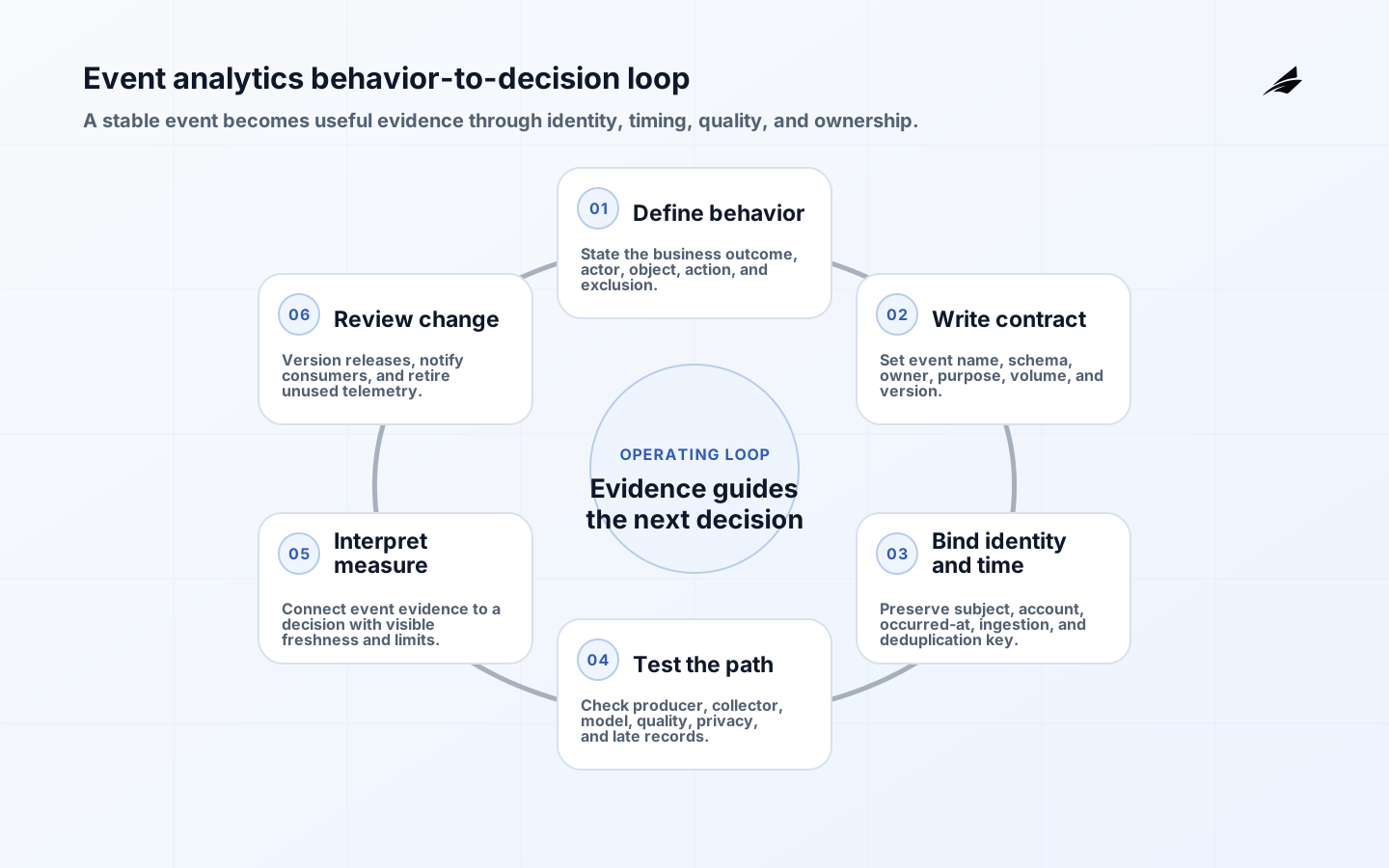
Event analytics engineering is the work of turning observed system behavior into evidence that can support a product or operating decision. An event is not automatically meaningful because it has a name and timestamp. A “checkout_completed” event needs a stable definition, actor and object context, event time, source, version, and policy for retries or corrections. Without that contract, analysts may count retries as purchases, compare client clocks across time zones, or infer a customer journey from a shared device. Reliable event analytics begins with behavior and contracts, then carries that discipline through collection, transformation, and use.
Define the behavior before naming the event
Start with the question the event must help answer. “Did a new account reach a meaningful activation step?” is more useful than “track every click.” Describe the actor, object, action, outcome, and timing in a tracking plan, then state the business rule for success. Some events are facts from the application; others are derived milestones. Keep that difference clear. A product action may be emitted by the client and repeated after a retry, while a completed payment should be confirmed from the payment system. The event contract should identify the authoritative producer and explain how duplicates, ordering, and late arrival are handled.
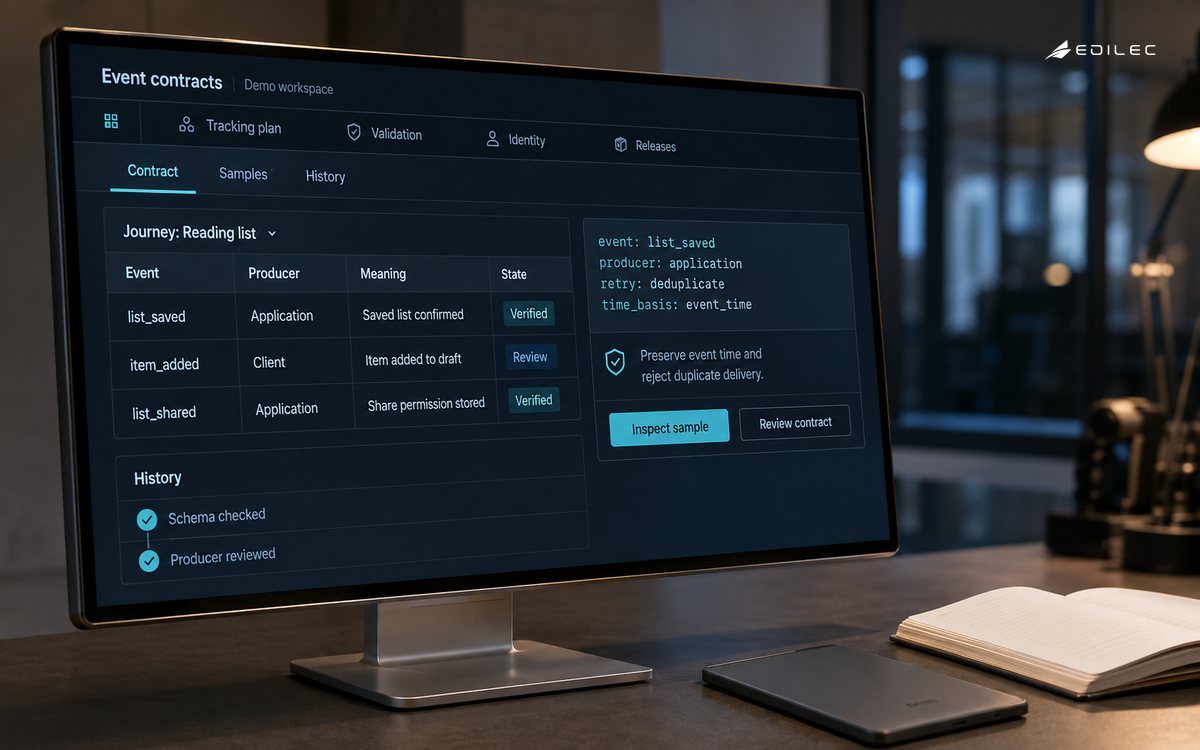
- Tie each event to a decision, journey step, or operational question.
- Define actor, object, action, outcome, event time, and producer.
- Use stable names and version fields when semantics can change.
- Specify idempotency keys and retry behavior for important actions.
- Document whether an event is raw evidence or a derived business milestone.
Design identity and time for real-world behavior
Identity and time make event data hard in practice. An anonymous visitor can later authenticate, one person can use multiple devices, and a workspace can contain several actors. Preserve the identifiers observed at event time and resolve relationships in a transparent model rather than overwriting history. Likewise, retain event time, ingestion time, and processing time because they answer different questions. Event time is usually appropriate for behavioral analysis; ingestion time exposes pipeline delay; processing time helps diagnose publication. These distinctions make a late mobile event visible instead of silently shifting a daily trend.
| Field | Purpose | Typical failure if omitted |
|---|---|---|
| Event ID | Identifies a unique observed occurrence. | Retries inflate counts. |
| Event time | Places behavior in the user journey. | Late arrivals distort period analysis. |
| Actor and object IDs | Connects action to the right context. | Shared devices or entities are misattributed. |
| Schema version | Explains changing event semantics. | Old and new payloads are mixed without warning. |
Test the event pipeline from producer to metric
Test events at more than the collector. Use representative application flows to confirm emission, inspect the raw payload, verify transformation, and reconcile the resulting metric with a known sample. Monitor volume, valid schema versions, required fields, duplicate rates, and delay between event and availability. dbt data tests can help assert model-level expectations after ingestion, while application and pipeline checks protect the earlier stages. A drop in volume might be a product change, a deployment defect, or a blocked client; the monitoring design should preserve enough context to distinguish them.
- Validate raw events against the contract before broad release.
- Track missing required properties and unexpected schema versions.
- Compare event counts with source-system facts for material outcomes.
- Measure ingestion and publication lag by producer and platform.
- Alert a named owner when quality thresholds fail or behavior changes unexpectedly.
Operate event analytics as a product
Treat the tracking plan, transformation models, and derived measures as a connected product with owners and release notes. When an interaction changes, decide whether the historical metric remains comparable, needs a version boundary, or needs a restatement. Provide a feedback route for analysts who discover a surprising payload and for product teams who need a new question answered. Analytics for service delivery shows how decision use should guide the final reporting surface. The NIST Privacy Framework offers a broader view of how collection, movement, storage, and consumption fit together.
| Operational signal | Interpretation question | Response |
|---|---|---|
| Volume drop | Did user behavior change or did a producer stop emitting? | Compare releases, platform slices, and source logs. |
| Late events | Are events delayed or is the clock incorrect? | Inspect event versus ingestion time and apply a stated window. |
| New schema | Is the meaning compatible with existing measures? | Version the contract and update transformations deliberately. |
| Metric dispute | Which raw events and rules produced the result? | Trace through the model and correct the source or logic. |
A practical event analytics example
Consider a team measuring whether a new user completes onboarding. The product decision is whether a change to the setup flow improves activation. Rather than counting every page view, define the activation milestone in business terms, such as successfully connecting a first data source and receiving a confirmed result. The contract can include an event ID, workspace ID, actor ID where appropriate, server-confirmed event time, application version, and outcome status. This lets analysts distinguish a displayed screen from a completed action, and lets engineers investigate changes by release or platform.
If the mobile client queues events offline, they may arrive after the daily report is published. A reliable implementation retains the original event time and ingestion time, then sets a policy for how long a daily cohort remains open to late arrivals. The dashboard can show a provisional recent day and update it as delayed events are accepted. This is more honest than silently rewriting the trend without explanation. It also helps teams diagnose whether apparent behavior change comes from users, a release, network conditions, or a collector problem.
Event names must evolve when the product changes. If an onboarding action gains a new completion condition, do not reuse the old event name as though the meaning never changed. Add a version or publish a new event contract, decide how historical comparison will work, and update the derived metric deliberately. Review the result with product and support teams who know the workflow. The process may feel careful for a small event, but it prevents the far more expensive situation where a quarterly trend combines two incompatible behaviors under one familiar label.
- Assign an owner for the behavioral definition and an owner for each event producer.
- Require stable event identifiers for actions that may retry or arrive more than once.
- Retain event, ingestion, and processing times where delay affects the analytical question.
- Version payloads and document compatibility whenever field meaning or event outcomes change.
- Validate events in representative client, server, and failure-path journeys before release.
- Monitor event volume, missing fields, schema versions, duplication, and end-to-end lag.
- Reconcile high-value outcomes with the accountable transactional system when possible.
- Define consent, purpose, retention, and access expectations before collecting new behavioral data.
- Publish how late events affect recent cohorts and provisional reporting periods.
- Use analyst and product feedback to retire noisy events or improve ambiguous contracts.
Operational ownership is clearest when a change breaks the contract. A product manager should be able to see that a new journey step needs an event definition; an engineer should know where to validate emission; and an analyst should know whether a revised payload changes a published measure. Put these responsibilities in the same change record rather than treating analytics as a task after the feature ships. This creates a dependable handoff: the product intent is explicit, the code change carries a testable contract, and the resulting trend can be interpreted without guessing which release altered the behavior.
Make Identity Stitching and Consent a Release Decision
Identity is not a cleanup step after collection. Decide before release whether the event is anonymous, authenticated, account-scoped, or intentionally unlinked, and state what happens when that state changes. Google’s User-ID guidance distinguishes a signed-in identifier from an event parameter and calls for clearing the identifier on sign-out; the broader lesson is to preserve the observed state instead of inventing a stable person key for every interaction. Keep the raw identifier, resolution decision, and policy version traceable so a downstream analyst can explain why two events were or were not joined.
Consent and purpose belong beside the event contract. A “supportchatopened” event may be useful for service design but inappropriate for a marketing audience, while a “payment_completed” event may need a transactional source rather than a browser callback. Define the approved use, retention window, role access, and deletion or correction route for each high-value event family. OpenTelemetry’s event conventions are useful for separating event identity and timing from local business meaning; the local contract still decides which fields can leave the product boundary.
Use a release fixture with three states: an anonymous session that later signs in, a signed-in user who signs out, and a shared account with two actors. Assert the expected subject, event time, consent state, and metric outcome after ingestion and transformation. If the result changes because a join rule changed, treat that as a contract release with an owner and consumer notice—not as a silent data repair.
| State change | Expected evidence | Review question |
|---|---|---|
| Anonymous to signed-in | Pre-login events remain distinct; later events use the approved user ID. | Was the join authorized and documented? |
| Signed-in to signed-out | Future events carry no stale user ID. | Can a reader prove where the identity boundary moved? |
| Shared account | Actor and account grain remain explicit. | Would an account-level metric misattribute a person’s action? |
The event dictionary should make a negative decision possible. If a proposed event cannot be tied to a decision, authoritative producer, permitted purpose, or correction path, reject it or narrow its scope. A smaller catalog with stable semantics is more useful than a large inventory that analysts must reinterpret after every release.
Keep the contract close to the code and the metric definition. A release reviewer should see the event schema change, affected consumers, sample payloads, and expected historical impact in one record. That is how instrumentation stays maintainable when several teams ship independently. Add the owner’s response window so a broken event is not left waiting for the next planning cycle.
Key takeaways for event analytics engineering
- Events need a behavioral definition and authoritative producer.
- Keep identity and multiple timestamps so context survives reality.
- Test the full path from emission to decision metric.
- Version semantics and explain comparability when product behavior changes.
The implementation also aligns with GA4 event guidance, NIST privacy guidance, OpenTelemetry event conventions, and GA4 user-ID guidance; each reference sharpens a different part of the event contract.
Frequently asked questions about event analytics
Should we track every user interaction? No. Collect events that support a defined question or necessary operational evidence, subject to privacy and retention rules. What is event time? It is the time the behavior occurred, distinct from when the pipeline received or processed it. How do we handle retries? Use a stable event identifier or deduplication rule and document its scope. Who owns a tracking plan? Product owns behavioral intent, engineering owns emission, and analytics owns transformation and measurement; all should review meaningful changes.
Conclusion: event data needs a contract to become evidence
Event analytics engineering is successful when a reader can connect a metric back to a well-defined behavior and a maintainer can explain how it traveled through the system. Define the decision and event contract first, retain identity and timing context, then test and monitor each handoff. With that foundation, events become useful evidence for product and operations rather than a noisy stream that produces attractive but fragile charts.
When the tracking plan is reviewed, compare it with the event analytics guide and the stream processing guide. The useful question is not whether every source uses the same vendor schema; it is whether product meaning, event identity, timing policy, and correction route remain consistent. Keep a small event dictionary with owners and examples, and retire events deliberately when their consumer list reaches zero. That keeps instrumentation understandable for new engineers and prevents a long tail of telemetry from becoming an accidental retention policy.
Event analytics becomes durable when each event can be traced from a named behavior to a decision, with identity, timing, consent, and correction evidence still attached. Keep that contract with the release record and retire signals that no longer answer a live question; a smaller trusted vocabulary is more useful than an ever-growing stream.