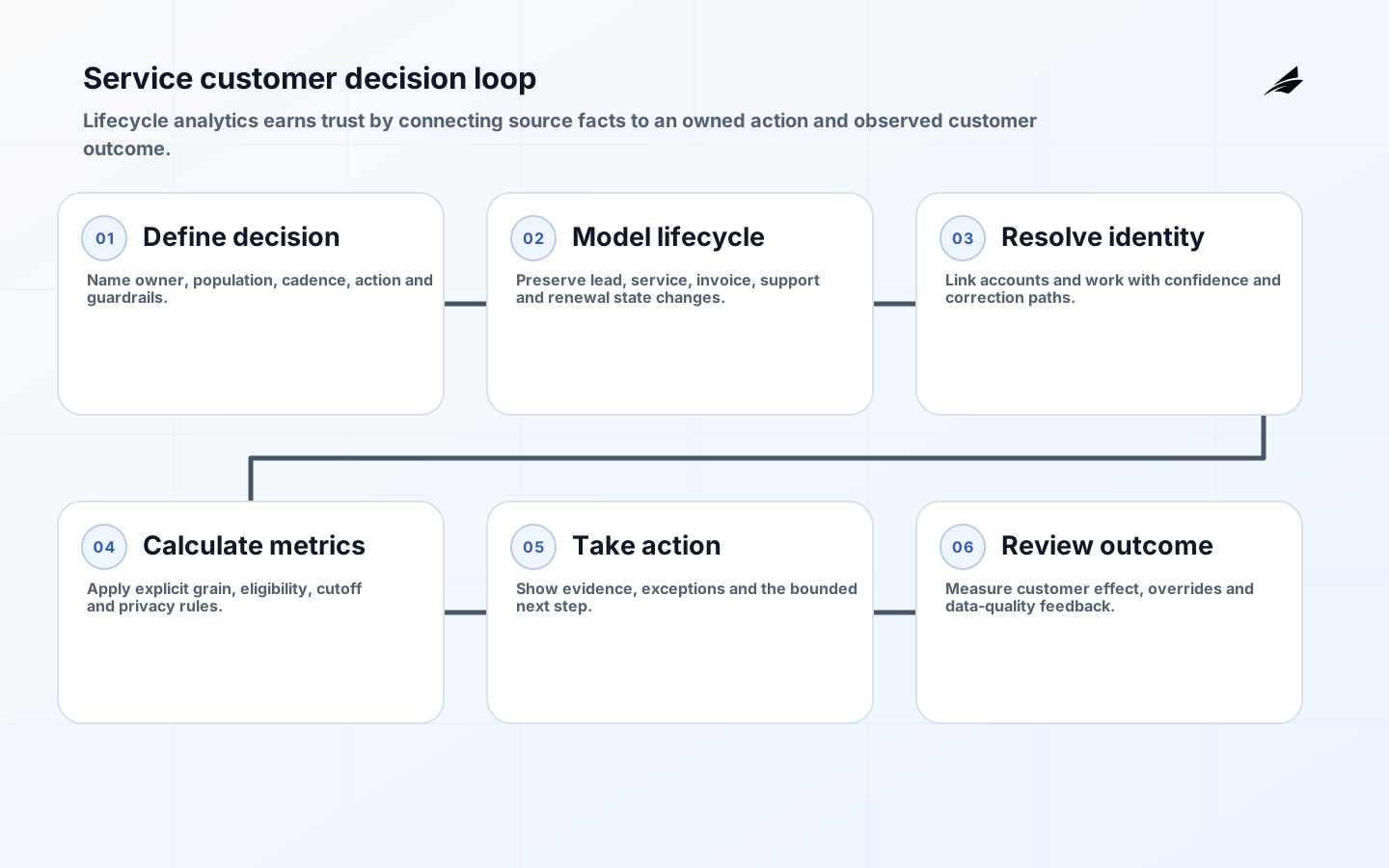
Customer analytics for service companies should explain the journey from first interest to a delivered, paid-for outcome. Website traffic alone cannot reveal whether a lead was qualified, an estimate was accepted, work started on time, a technician returned, an invoice was disputed or a customer renewed. The useful unit is therefore a governed customer and service lifecycle, joined across marketing, CRM, scheduling, delivery, billing and support.
This guide is for professional services, field services, agencies and recurring service businesses building that view. Pair it with data quality checks for SaaS products, finance reporting automation and a semantic layer for shared metrics. Start with one decision and one lifecycle segment, not a universal customer dashboard.
Define the customer decisions before the dashboard
Interview the people who act: marketing chooses channels, sales prioritizes leads, operations allocates capacity, account managers protect relationships and finance manages margin and cash. For each decision, name cadence, eligible population, action, owner and guardrail. “Which open estimates should receive follow-up today?” is implementable; “understand customer behavior” is not. Record the present decision process and its baseline delay or error.
Choose measures that expose both outcome and mechanism. Conversion rate without response time can hide operational delay. Revenue without delivery cost can reward unprofitable work. Retention without service mix can conceal a shift toward smaller accounts. Create a compact decision brief containing the primary outcome, diagnostic measures, quality guardrails, segments and the event or state that makes the measure current.
| Decision | Primary measure | Diagnostic and guardrail |
|---|---|---|
| Prioritize new leads | Qualified lead rate and expected value | First-response time, source, service fit and disqualification reason |
| Plan delivery capacity | Confirmed workload by skill and date | Backlog age, cancellation risk and travel or handoff load |
| Improve service quality | First-time successful completion | Rework, wait time, complaint severity and safety exception |
| Protect margin | Contribution by customer and service | Unbilled work, discounts, utilization and collection delay |
| Manage retention | Renewal or repeat-service rate | Outcome achieved, support burden and relationship coverage |
Model the service customer lifecycle as durable states
Define lifecycle states in business language: inquiry, qualified, proposal, accepted, scheduled, in progress, completed, accepted by customer, invoiced, paid, renewed or lost. Keep state changes as timestamped facts rather than overwriting one current field. Store reason codes for disqualification, delay, cancellation, rework and loss. This history supports funnels, duration analysis and honest reconstruction after definitions change.
Google’s current recommended lead-generation events include generating, qualifying, working, disqualifying and converting a lead. They provide a useful acquisition vocabulary, but operational systems remain authoritative for contractual, delivery and payment states. Map analytics events to those records instead of letting a browser event declare revenue or completion. Preserve source event time, ingestion time and correction time.
Join customer records without manufacturing false certainty
Assign stable identifiers for account, contact, opportunity, engagement or work order, invoice and support case. Keep source identifiers and crosswalks; do not use a mutable email address as the only customer key. Define household, branch, parent-company and payer relationships only where the decision needs them. Identity matching should produce a confidence and review path when names, domains or phone numbers conflict.
Document attribution separately from identity. A known customer can have several marketing touches, referrals and sales interactions; joining those facts does not prove which one caused the sale. Select an attribution rule for a declared purpose, show unattributed and ambiguous cases, and test sensitivity to alternatives. For service companies with offline conversion, reconcile CRM conversion and invoice evidence instead of optimizing solely to form submissions.
| Data product | Authoritative source | Critical quality test |
|---|---|---|
| Lead and opportunity | CRM with controlled stage history | No converted lead lacks account, owner or conversion time |
| Service delivery | Scheduling or work-management system | Completion, cancellation and rework states reconcile |
| Revenue and collection | Billing or accounting ledger | Invoice totals, credits, tax and payment status balance |
| Customer support | Case management platform | Severity, customer, service and resolution are linked |
| Digital interaction | Consented web or app event stream | Event names, identity scope and duplicate rate are monitored |
Build metrics from explicit grains and eligibility rules
Every metric needs a grain. Lead conversion may be one row per qualified lead; utilization may be one row per available person-day; repeat service may be one row per eligible customer-period. Define numerator, denominator, exclusions, time basis, currency treatment, status cutoff and late corrections. Keep the definition beside the model and assign both a business owner and technical steward.
For profitability, allocate only costs whose rules users can understand. Separate direct labor, subcontractor and travel costs from shared overhead; show unallocated amounts; and avoid presenting an approximate allocation as invoice-level truth. For lifetime value, declare whether the model is historical contribution, expected future contribution or a predictive estimate. Validate predictions by cohort and never use a score as an unexplained denial of service.
Minimize customer data and govern analytical access
Collect data for stated purposes and retain it only as long as needed for those purposes and obligations. The NIST Privacy Framework provides a risk-management structure, while the ICO’s guidance explains purpose limitation, minimization, accuracy, storage limitation and security principles. Applicability depends on jurisdiction. Maintain a processing inventory, lawful basis or equivalent justification, retention rule, deletion process and owner for each use.
Use role-based views and aggregated data where individual detail is unnecessary. Separate operational access from analytical access, protect exports, audit sensitive queries and test that tenant or branch restrictions survive joins. Avoid placing contact details or free-text notes in event streams and observability labels. A customer-health score should expose its factors, freshness and limitations to authorized users and offer a route to correct source data.
Implement one customer analytics decision end to end
- Choose a recurring customer decision, accountable owner, eligible population and baseline.
- Write lifecycle states, metric contracts, privacy purpose and action thresholds.
- Map source records, identifiers, event time, corrections and access boundaries.
- Build raw-to-curated transformations with reconciliation, freshness and duplicate tests.
- Release a decision view that shows cutoff, definitions, exceptions and drill-through evidence.
- Run parallel review against real cases and record disagreements before operational use.
- Assign response actions, monitor adoption and outcome guardrails, and retain decision history.
- Expand to another lifecycle segment only after the first path is trusted and supported.
Operate analytics as a feedback loop
Monitor source freshness, unmatched identities, invalid transitions, reconciliation differences and model-version adoption. Use consistent technical attributes where possible; OpenTelemetry semantic conventions illustrate the value of shared names for observable operations. Keep high-cardinality personal data out of telemetry. Route broken contracts to owners before stale numbers enter a customer meeting.
At the decision review, show the data cutoff, changed definitions, unresolved quality incidents and prior actions. Ask whether the analysis altered a decision and whether the resulting customer outcome improved. Record overrides with reason codes and study them as product feedback. Retire reports that do not change work, and keep metrics balanced so teams cannot improve response speed by lowering qualification quality or hiding difficult cases.
Example: build a weekly estimate follow-up view
A field-service company can begin with accepted and open estimates rather than a complete customer 360. Join the CRM estimate to account, service type, owner, creation time, promised response date and the latest customer interaction. Exclude withdrawn and duplicate records using controlled states. Show age bands, expected value and the reason no next action exists, with the reporting cutoff visible.
During the weekly review, sales and operations choose an action: contact, revise, schedule, close-lost or correct data. Capture the disposition and later compare conversion, response time and delivery capacity. Guard against aggressive follow-up by tracking complaints and disqualification quality. If users repeatedly correct service type or owner, fix the source workflow before adding predictive lead scoring. This narrow view proves identity, state and action design together.
Key takeaways
- Connect acquisition data to service delivery, billing, support and customer outcomes.
- Preserve timestamped lifecycle states and reason codes instead of overwriting history.
- Separate identity resolution from marketing attribution and expose ambiguous matches.
- Define every metric’s grain, eligibility, cutoff, owner and correction behavior.
- Treat privacy, access and exception review as part of the analytics product.
Frequently asked questions
Do service companies need a customer data platform?
Not necessarily. A governed warehouse or lakehouse plus reliable source identifiers may support the first decisions. A customer data platform can help with event collection, profiles and activation, but it does not resolve unclear lifecycle states, ownership or lawful use. Prove the decision path before buying breadth.
What belongs in a customer health score?
Only factors tied to a defined intervention: outcome attainment, usage or delivery cadence, unresolved severe cases, payment state and relationship signals may be relevant. Publish weights, freshness and exclusions; validate by segment; let account teams explain overrides; and monitor whether actions help customers rather than simply predicting departure.
How often should customer analytics refresh?
Match refresh to the decision window. Daily may be enough for lead follow-up and capacity; weekly may suit account reviews; monthly may suit profitability. Faster refresh adds value only when the source is timely, someone can act and corrections are controlled. Display event time and reporting cutoff explicitly.
Conclusion
Archive each metric definition and reporting cutoff with the decision record so later corrections do not erase what the team knew when it acted.
Customer analytics becomes useful when it follows the service promise through acquisition, delivery, outcome and payment. Define decisions first, preserve lifecycle facts, join identities carefully and make metric rules visible. A narrow, governed view that changes one operating decision is more valuable than a broad customer profile nobody can explain or safely act upon.