Data Contracts Checklist for Reliable Digital Operations approaches data contracts as an operating capability (inside the contract operating record). It begins with a producer-to-consumer dependency and needs a shared understanding of dataset meaning, structural guarantees, quality threshold, compatibility rule, and owner (for the contract owner). dbt model contracts and dbt data tests are useful primary references. Related implementation context is available in Data Pipeline Architecture: Contracts, Time, Quality, Lineage, and Recovery, Data Quality Engineering: Define Fitness, Detect Failure and Fix Causes, Data Contracts: Engineering Notes (through the migration path).
Set the data contracts decision: lineage change review

Start with a producer-to-consumer dependency. Name the person who acts, the time available to act, and the evidence that makes the decision defensible (against the release baseline). This prevents data contracts from becoming a generic platform project. A useful boundary is specific enough that a new operator can identify the protected outcome, the accountable owner, and the consequence of a late, wrong, or missing result (at the producer-consumer boundary).
| Design concern | Question to settle | Evidence to keep |
|---|---|---|
| Decision boundary | What use of data contracts must improve? | Named owner and workflow |
| Definition | What entity, measure, or event is represented? | Written grain, scope, and examples |
| Service expectation | How fresh, complete, or controlled must it be? | Threshold and visible status |
| Change rule | Who approves a revision? | Review record and effective date |
State the contract boundary before adding scale
Define dataset meaning, structural guarantees, quality threshold, compatibility rule, and owner before extending scope (for the contract owner). State the grain, time basis, permitted audience, expected freshness, and behaviour when an input is missing or late (inside the contract operating record). This work is not administrative polish. It determines whether two readers can reach the same conclusion from the same output and whether a response team can distinguish an ordinary delay from a material failure. Keep those promises beside the checks that enforce them.
Write the normal route and degraded route together. Identify the source of truth, the component that enforces the important rule, the moment a result becomes visible, and the authority allowed to mark it unsafe (inside the contract operating record). The exercise exposes manual steps, timing assumptions, and dependencies that are invisible in a happy-path diagram (inside the contract operating record). Record the exception route where the producer and consumer can both find it (inside the contract operating record).
Assign ownership for meaning, change, and recovery
Ownership for data contracts are not a title on a slide. A business owner decides whether the result remains useful; a technical owner maintains the implementation, access path, and evidence (for the contract owner). Changes need a proportionate review route, including an urgent path that records scope, reason, expiry, and follow-up (before a contract release). Access and distribution deserve the same care because a correct result can still cause harm when shown to the wrong audience (inside the contract operating record). Put the ownership map next to the contract's current release.
- Name the business decision owner and technical operator.
- Record definition, boundary, and acceptable failure state.
- Restrict change authority while keeping feedback available.
- Set approval routes for normal, urgent, and breaking changes.
- Keep access and distribution decisions visible beside delivery.
- Schedule a review that can retire an assumption.
Operate from evidence rather than confidence
Measure contract failures, rejected records, lateness, downstream breakage. A signal is useful only when someone can interpret it and take a defined action (by producer and consumer). PostgreSQL constraints and OpenLineage facets help make validation, dependencies, and change history visible (before a contract release). Validate the actual data, permissions, scale, and business rules in the environment where people rely on the output; an attractive design or passing isolated test does not prove that a decision is safe (inside the contract operating record).
| Signal or failure | What it reveals | Operating response |
|---|---|---|
| Health signal | contract failures, rejected records, lateness, downstream breakage | Review at the named operating cadence |
| Known risk | schema-only governance, unbounded exceptions, or unclear timestamps | Decide whether to stop, warn, repair, or rollback |
| Evidence path | Can a reader trace the result to its source? | Link lineage, tests, and change notes |
| Recovery check | What evidence shows that data contracts have returned to a safe operating state (against the release baseline)? | Practice and record the response |
Release one producer-consumer path first
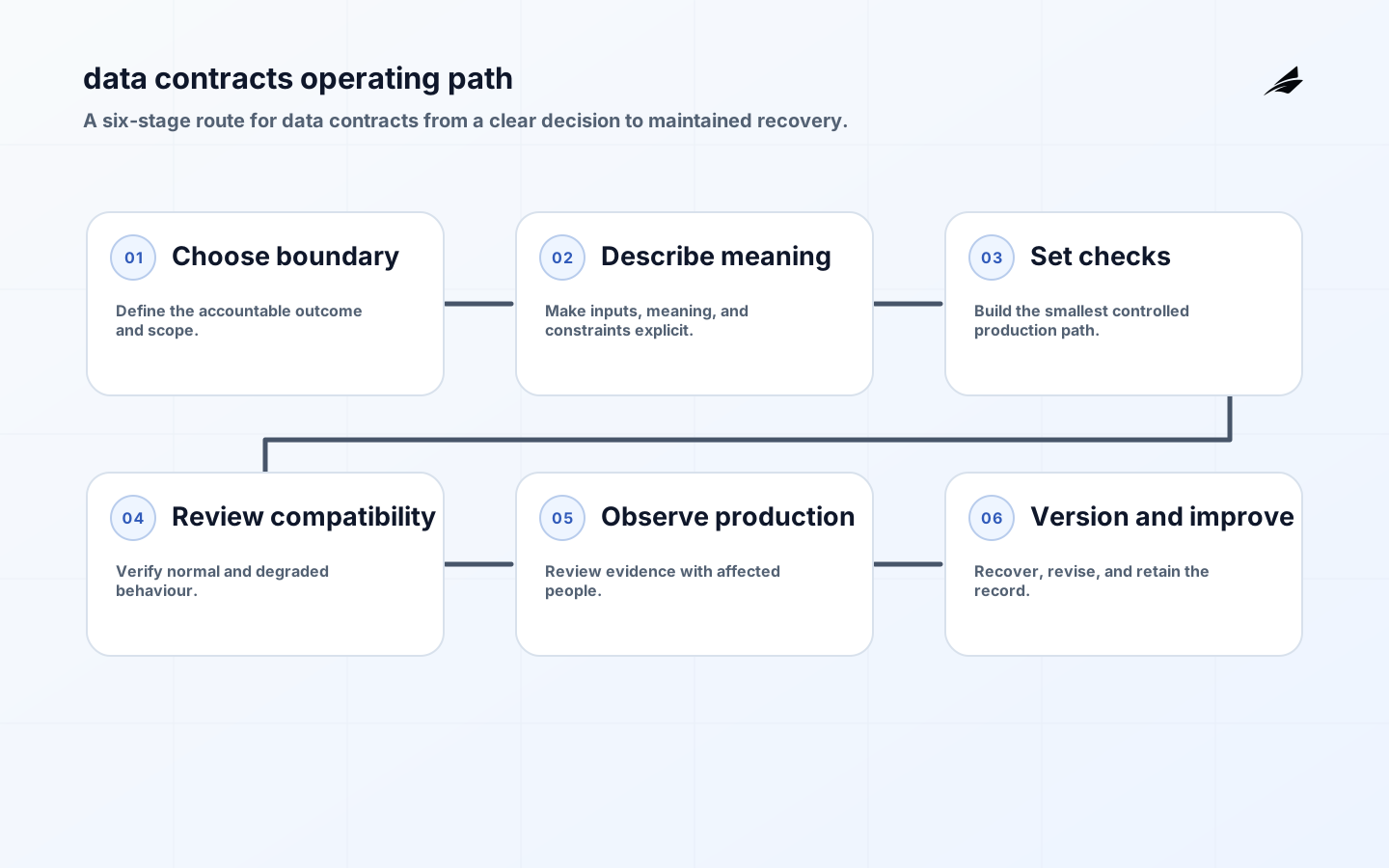
Release the smallest data-contract path that can produce real evidence. Preserve a baseline, test one normal route and one plausible failure with the people who will respond, then review results before widening use or automation (inside the contract operating record). A pilot succeeds when it reveals assumptions early and leaves a clearer operating record, not merely when it avoids an error message (inside the contract operating record). Keep the release record with the test evidence and recovery owner.
- 1. Choose boundary: make the decision, owner, and evidence explicit at this stage (at the producer-consumer boundary).
- 2. Describe meaning: make the decision, owner, and evidence explicit at this stage (for the contract owner).
- 3. Set checks: make the decision, owner, and evidence explicit at this stage (for the contract owner).
- 4. Review compatibility: make the decision, owner, and evidence explicit at this stage (for the contract owner).
- 5. Observe production: make the decision, owner, and evidence explicit at this stage (for the contract owner).
- 6. Version and improve: make the decision, owner, and evidence explicit at this stage (for the contract owner).
Catch the contract failures that erode trust
The most expensive data-contract failures are plausible outputs that should not have been trusted (inside the contract operating record). Watch for schema-only governance, unbounded exceptions, or unclear timestamps. Do not solve these conditions by adding more reports, documents, or approvals (inside the contract operating record). Make the assumption, owner, verification, and repair route concrete so a reviewer can see when the declared promise has stopped being true A visible stop condition is more useful than a reassuring status label (for the contract owner).
Recovery planning belongs in the design. Keep a current runbook, identify the authority to pause or publish a warning, and retain identifiers needed to trace an affected result (inside the contract operating record). Exercise a bounded response scenario. This turns a vague resilience claim into evidence that people can restore a safe state without widening harm or hiding uncertainty from users (against the release baseline). The recovery test should leave a dated lesson for the next release (through the migration path).
For data contracts, distinguish a producer outage from a producer change. An outage may call for a late-data warning or a controlled retry (at validation and enforcement). A change in meaning, allowed values, or timestamp semantics needs consumer review even when delivery remains technically healthy (before a contract release). Preserve examples of both cases in the contract repository. They give engineers and analysts a concrete basis for classifying the next change, and make an exception visible instead of silently turning it into a permanent behaviour (before a contract release).
A practical data contracts review should finish with an explicit decision log (inside the contract operating record). Record what was observed, which assumption was confirmed or challenged, the owner of the next action, and the date the action will be checked (for the contract owner). Link that record to the relevant definition, test result, incident, or change request (before a contract release). This modest discipline makes later review faster because it preserves why a choice was made, not only the configuration that happened to survive (inside the contract operating record). It also gives new contributors a concrete way to question a result without rebuilding the entire history from scattered conversations (inside the contract operating record).
Checklist takeaways: the contract must be usable
- Anchor work in a named decision and accountable owner.
- Make definitions, boundaries, and access expectations visible.
- Keep operational evidence close to the change that produced it.
- Test degraded conditions, not only the successful path.
- Retire obsolete or competing paths before ambiguity accumulates.
Questions before releasing a data contract
What is the first useful step? Select one high-value decision boundary and write the promise in observable terms: user, input, output, owner, timing, and safe failure behaviour (at the producer-consumer boundary). That gives the team something small enough to test and improve. How much governance is necessary? Use the smallest amount that makes a material change reviewable and recoverable (before a contract release). Ownership, definitions, access rules, tests, and a change record are usually more valuable than a large approval hierarchy (for the contract owner). What proves this is working? Look for the signals above, a successful adverse-path exercise, and evidence that the relevant owner can explain the result and act when it is degraded (for the contract owner). The technical references are dbt model contracts, dbt data tests, PostgreSQL constraints, and OpenLineage facets (inside the contract operating record).
Conclusion: make the agreement dependable
Reliable data contracts are neither a one-time configuration nor a document completed in isolation (inside the contract operating record). They are an owned decision with clear boundaries, proportionate controls, observable outcomes, and a practiced recovery route (at validation and enforcement). Begin with the narrowest valuable use case, retain the evidence it produces, and expand only when responsible people can operate the result confidently (against the release baseline). The agreement earns trust when its meaning and recovery route remain legible during change (through the migration path).
Use this checklist at the point where a data dependency can change a real operating decision (before a contract release). Confirm that the producer and consumer agree on meaning, timing, permitted change, quality evidence, and the person who responds when the promise fails (against the release baseline). Check a valid release and an invalid one; the second case is often more revealing because it shows whether the control stops harm or merely records it afterward (at validation and enforcement). Keep lineage and test results close to the contract so an operator can locate the cause without opening a separate investigation (inside the contract operating record). When a contract changes, communicate the migration window and the new acceptance evidence to both sides (against the release baseline). Reliability comes from this repeatable handoff: a team knows what is protected, what is allowed to move, and how to recover when the data no longer means what the consumer expects (inside the contract operating record).
A data contracts checklist should make change behavior explicit. Record the producer, consumer, grain, required fields, compatibility rule, deprecation period, test evidence, and owner for an exception (for the contract owner). Validate a normal payload and a breaking change, then confirm how consumers are notified and how a previous version is restored (before a contract release). The contract is valuable when it reduces surprise at the boundary, not when it merely documents a schema after the fact (at the producer-consumer boundary).