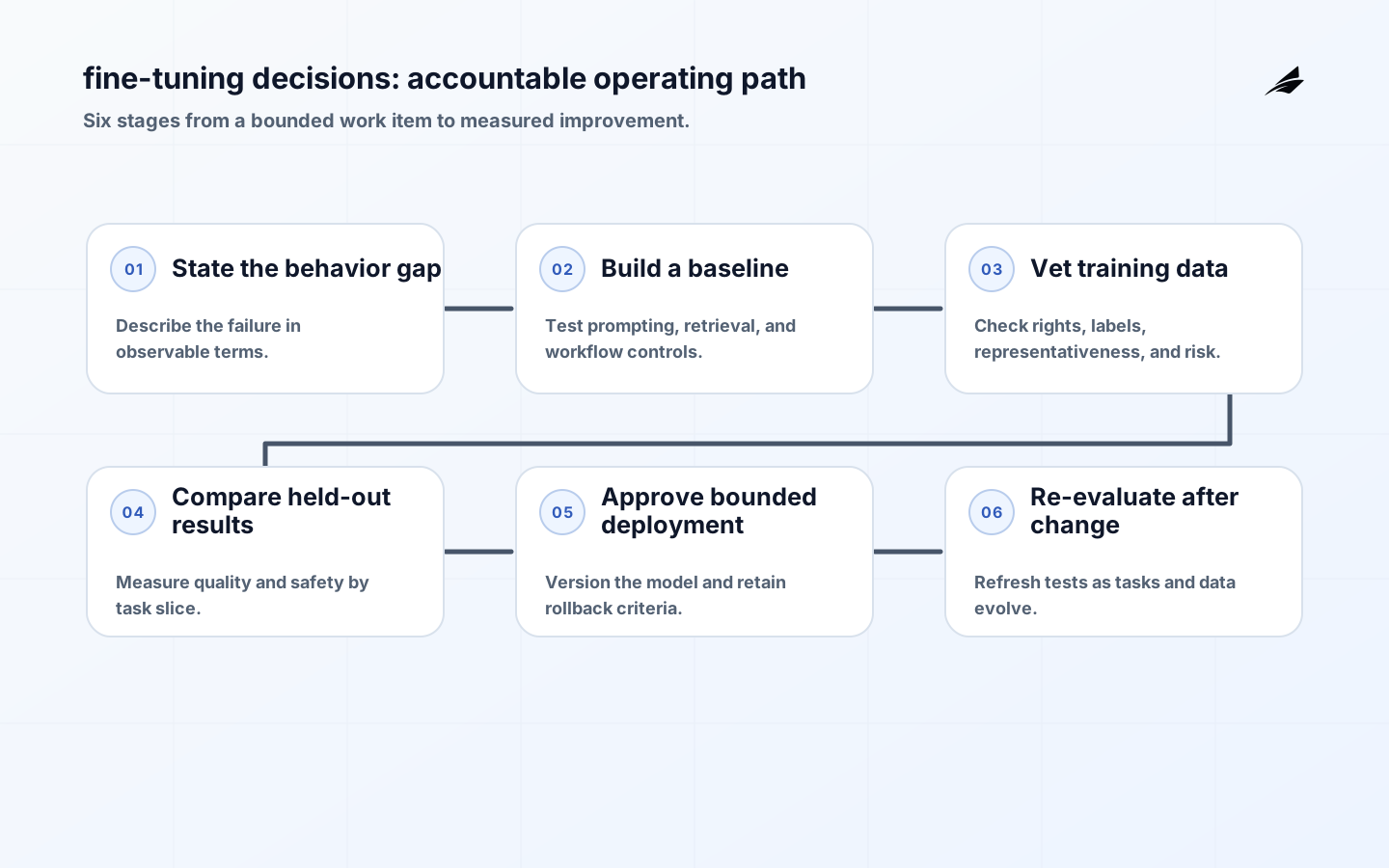
Fine-tuning decisions should be treated as a procurement and engineering choice about whether changing model weights is the most reliable way to improve a defined behavior, not as a free-standing model feature. A useful implementation starts with the work item that must improve, the person accountable for the result, and the evidence that proves the result is safe enough to use. That framing keeps design conversations concrete: which inputs are allowed, what the system may propose, what it must not decide, and how a user can see the basis for an output. It also makes room for operational reality. A system can sound capable in a demonstration yet create new queues, hidden data flows, and unreviewable exceptions when it is placed in routine work.
Define the fine-tuning decisions operating boundary
The first operating decision for fine-tuning decisions is the boundary. Teams should not use fine-tuning to compensate for missing facts, weak permissions, undefined policy, or an unmeasured workflow; those are system-design problems before they are training problems. Write this boundary as a short case contract that names the initiating event, permitted inputs, authoritative systems, expected output, prohibited action, human owner, and recovery route. The contract is not bureaucracy for its own sake. It gives engineers a testable behavior, operators a reason to stop a case, and reviewers a shared answer when a plausible-looking output conflicts with policy or source evidence. Change requests should update the contract before they expand permissions or scope.
| Control question | Practical decision | Evidence to keep |
|---|---|---|
| Outcome | Name the work result and its accountable owner. | Case contract, baseline, and success threshold. |
| Authority | State what the capability may recommend, read, or change. | Permission decision and approval rule. |
| Sources | Identify the records that can support an output. | Source owner, version, date, and access scope. |
| Exceptions | Define when to abstain, hold, or escalate. | Reason code, queue, and service target. |
| Recovery | Specify how to pause and reconcile a faulty path. | Incident record, affected cases, and restart approval. |
Make the training decision
A dependable design preserves the intended behavior, representative inputs and outputs, data rights, labeling guidance, base-model version, prompt baseline, evaluation slices, safety results, and deployment decision. The service should be able to reconstruct a completed case without relying on a person's memory or a chat transcript that has already scrolled away. In practice, that means stable identifiers, versioned configurations, timestamps, and an auditable connection between evidence, recommendation, approval, and outcome. Keep task instructions, retrieval, policy enforcement, and model selection separable so a trained model does not become an opaque substitute for controllable application logic. The NIST AI Risk Management Framework is useful here because it frames trustworthy AI as a lifecycle concern: governance, mapping, measurement, and management are activities to make visible in the work, not a compliance label added at the end.

Run the service with signals
Operations decide whether fine-tuning decisions remain useful after launch. Measure quality versus the baseline on held-out cases, calibration of abstentions, safety and policy failures, latency, training and inference cost, and drift after the data or task changes. These measures need owners and thresholds, not just a dashboard. A rising correction rate may indicate source drift, a changed user population, or a confusing interface; it does not automatically justify a model swap. Review results by meaningful slices such as task type, business unit, data source, impact level, and exception route. Pair quantitative signals with sampled case review so the team can distinguish a genuine service improvement from a metric that improved because difficult work was diverted elsewhere.
| Signal | What it can reveal | Operational response |
|---|---|---|
| Outcome quality | Whether useful work is actually improving. | Sample cases and compare with the baseline. |
| Exception pattern | Where policy, data, or model behavior is weak. | Route a named owner and add a durable test case. |
| Source or input freshness | Whether evidence remains fit for use. | Refresh, retire, or restrict the affected source. |
| Human intervention | Whether review capacity and authority are adequate. | Adjust routing, service targets, or staffing. |
| Cost and latency | Whether the service can scale responsibly. | Optimize the expensive path without lowering the quality gate. |
Roll out with a fallback
For rollout, run a short decision experiment: compare a strong prompt and retrieval baseline with a small, rights-cleared training set evaluated on production-like cases that neither approach saw during design. Establish a baseline before enabling the new capability, decide what result would pause expansion, and retain a reliable fallback. Start with a limited audience and a named support path. Releases should include a simple runbook: how to identify an affected case, how to inspect its trace, who can disable the capability, and how to reconcile downstream effects. This creates evidence for a real product decision rather than forcing the organization to infer quality from anecdote.
- Map normal cases, uncomfortable edge cases, and requests the service must decline.
- Name the business owner, technical owner, reviewer group, and incident contact.
- Version the configuration, sources, prompts, tools, and evaluation set used for each release.
- Set release criteria for quality, permissions, latency, cost, and support readiness.
- Give users a visible way to report an incorrect result or a missing source.
- Review the evidence after each expansion before granting broader data access or action authority.
Prevent predictable failures
The recurring failure is buying a fine-tuning project because a generic demonstration looked inconsistent, without isolating whether the actual issue is format discipline, domain knowledge, tool design, or data quality. This is why LLM evaluation for internal tools is a useful adjacent design problem: the interface is only one layer of a system that also needs ownership, access controls, evidence, and recovery. Use pre-mortems with operators and reviewers to identify the moment when a bad output could become a bad decision. Then convert that moment into a deterministic check, a review gate, an explicit abstention, or a compensation path. A model should never be the only place where a material control exists.
Improve with verified cases
Training data deserves the same product scrutiny as a user-facing requirement. It should represent the legitimate task, include difficult but lawful examples, separate instruction from target behavior, and have a clear owner who can explain its provenance. Remove examples that teach the model to infer information it will not be allowed to access at runtime. Split data by meaningful scenario, not random rows alone, so a strong score does not simply reflect near-duplicates of material the model already encountered.
After a tuning decision, keep the pre-tuning baseline deployable and visible in the evaluation report. Compare models on the same fixed cases, including refusal and escalation behavior, then monitor new production-like cases without feeding them straight into training. A model that performs well today can become the wrong choice when source systems, policies, user language, or supplier terms change. Version the data, training recipe, serving configuration, and rollback criteria so a buyer can understand the total lifecycle commitment.
A buyer should ask what will be harder after tuning, not just what gets better. Tuning can create a new release surface: data preparation, evaluation maintenance, supplier dependencies, model version compatibility, and a need to retest safety behavior after every change. It can also make a narrow behavior more consistent while making the product less adaptable to new instructions or content. Put a time limit on the initial decision. If the task cannot be expressed with rights-cleared examples and a reliable held-out evaluation, defer the investment and improve the surrounding workflow instead. That restraint often produces a clearer business case for training later.
Treat every substantial model or data update as a fresh release decision. Re-run the held-out set, examine the difficult slices, and confirm that rights, retention, and supplier assumptions remain valid. Fine-tuning remains manageable when it has a deliberate lifecycle rather than a one-time training event.
Key takeaways
- Fine-tuning decisions need a bounded job and a named accountable owner.
- Evidence, permissions, and approval should be inspectable outside model instructions.
- Measure quality and operational burden by meaningful case slices, not a single average.
- Keep a fallback, a pause authority, and a reconciliation procedure before scaling.
- Use verified failures and reviewer corrections to improve the workflow and its evaluation set.
Frequently asked questions
When is fine-tuning decisions ready for production? It is ready for a limited production release when the permitted task, source scope, evidence record, accountable owner, quality threshold, exception route, and rollback path are all explicit and exercised. What should be automated first? Choose a repeated, reversible step that reduces preparation work while preserving human authority over consequential decisions. How often should it be reviewed? Review after material changes to users, data, tools, policy, model configuration, or observed incident patterns, and set a regular operating cadence for the service.
Conclusion
Fine-tuning decisions earns trust when it improves one bounded task while leaving responsibility and evidence legible. Keep the first release narrow, measure the work rather than the novelty, and expand only after the team can explain what happened in normal cases, exceptions, and recovery. That is the practical path from an impressive capability to an operation people can rely on.
Sources and practice notes
Google Cloud's supervised tuning documentation is a concrete reference for the mechanics of tuning; organizational evidence, data governance, and release criteria remain the buyer's responsibility. The NIST Generative AI Profile and the OWASP Top 10 for LLM applications are complementary references: one helps structure lifecycle risk decisions, while the other keeps common application-level failure modes in view. Read them against the actual workflow and applicable obligations; neither replaces a careful assessment of local data, users, and consequences.