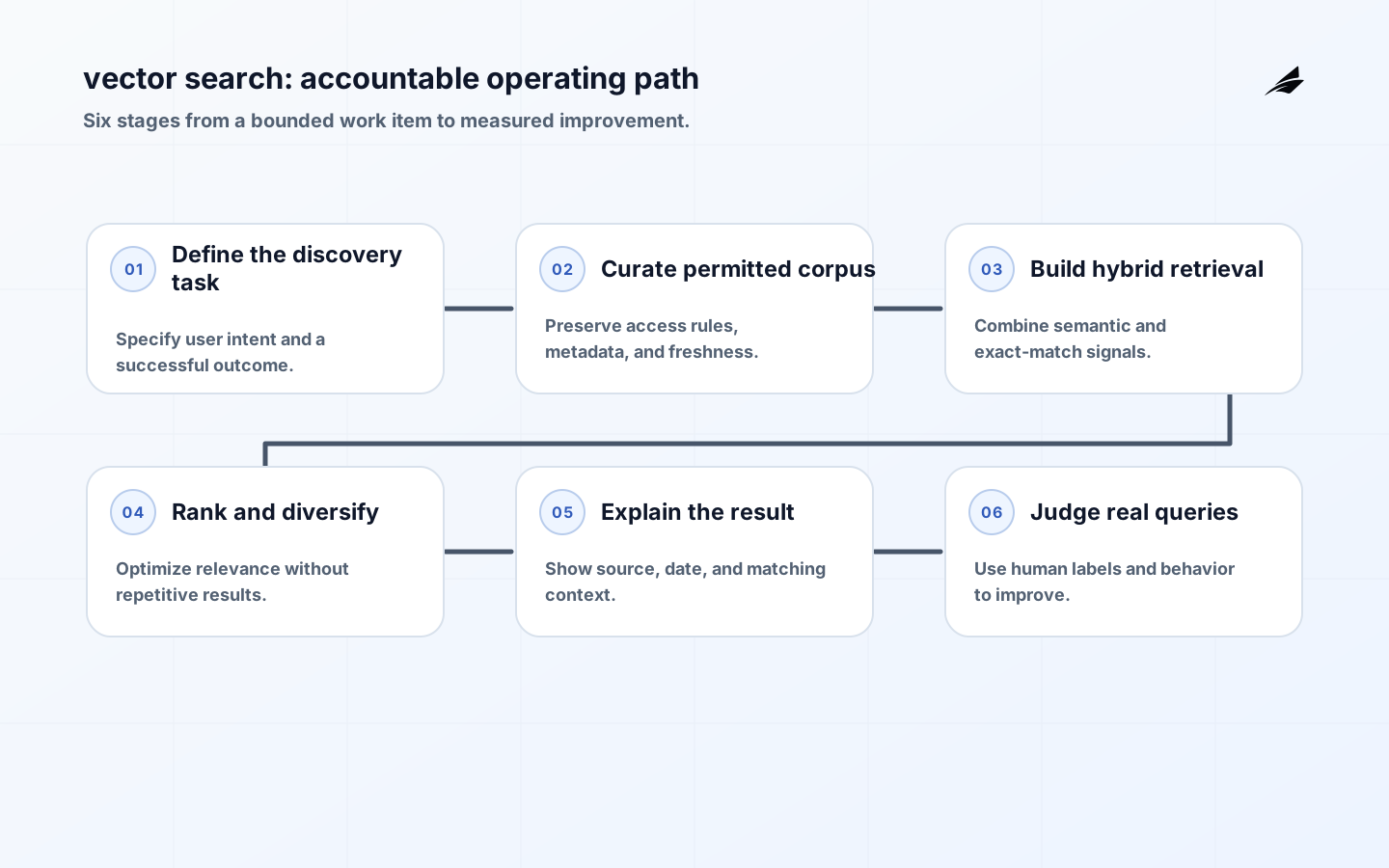
Vector search should be treated as nearest-neighbor retrieval over embedding vectors, used to find content whose meaning is related to a query even where exact wording differs, not as a free-standing model feature. A useful implementation starts with the work item that must improve, the person accountable for the result, and the evidence that proves the result is safe enough to use. That framing keeps design conversations concrete: which inputs are allowed, what the system may propose, what it must not decide, and how a user can see the basis for an output. It also makes room for operational reality. A system can sound capable in a demonstration yet create new queues, hidden data flows, and unreviewable exceptions when it is placed in routine work.
Define the vector search operating boundary
The first operating decision for vector search is the boundary. Teams should tie vector search to a user task and a permitted corpus; similarity should never bypass access checks, replace deterministic lookup for identifiers, or silently decide a consequential outcome. Write this boundary as a short case contract that names the initiating event, permitted inputs, authoritative systems, expected output, prohibited action, human owner, and recovery route. The contract is not bureaucracy for its own sake. It gives engineers a testable behavior, operators a reason to stop a case, and reviewers a shared answer when a plausible-looking output conflicts with policy or source evidence. Change requests should update the contract before they expand permissions or scope.
| Control question | Practical decision | Evidence to keep |
|---|---|---|
| Outcome | Name the work result and its accountable owner. | Case contract, baseline, and success threshold. |
| Authority | State what the capability may recommend, read, or change. | Permission decision and approval rule. |
| Sources | Identify the records that can support an output. | Source owner, version, date, and access scope. |
| Exceptions | Define when to abstain, hold, or escalate. | Reason code, queue, and service target. |
| Recovery | Specify how to pause and reconcile a faulty path. | Incident record, affected cases, and restart approval. |
Design the retrieval experience
A dependable design preserves the query and intent class, embedding and index version, metadata filter, candidate set, ranking and diversity settings, selected result, user feedback, and evaluation label. The service should be able to reconstruct a completed case without relying on a person's memory or a chat transcript that has already scrolled away. In practice, that means stable identifiers, versioned configurations, timestamps, and an auditable connection between evidence, recommendation, approval, and outcome. Choose embeddings and index settings after defining relevance, preserve metadata for filtering and explanation, support hybrid retrieval where exact terms matter, and monitor index freshness. The NIST AI Risk Management Framework is useful here because it frames trustworthy AI as a lifecycle concern: governance, mapping, measurement, and management are activities to make visible in the work, not a compliance label added at the end.

Run the service with signals
Operations decide whether vector search remains useful after launch. Measure relevance on judged queries, coverage across query cohorts, click or task-completion quality, lexical-versus-semantic failure patterns, filter correctness, diversity, latency, and index update lag. These measures need owners and thresholds, not just a dashboard. A rising correction rate may indicate source drift, a changed user population, or a confusing interface; it does not automatically justify a model swap. Review results by meaningful slices such as task type, business unit, data source, impact level, and exception route. Pair quantitative signals with sampled case review so the team can distinguish a genuine service improvement from a metric that improved because difficult work was diverted elsewhere.
| Signal | What it can reveal | Operational response |
|---|---|---|
| Outcome quality | Whether useful work is actually improving. | Sample cases and compare with the baseline. |
| Exception pattern | Where policy, data, or model behavior is weak. | Route a named owner and add a durable test case. |
| Source or input freshness | Whether evidence remains fit for use. | Refresh, retire, or restrict the affected source. |
| Human intervention | Whether review capacity and authority are adequate. | Adjust routing, service targets, or staffing. |
| Cost and latency | Whether the service can scale responsibly. | Optimize the expensive path without lowering the quality gate. |
Roll out with a fallback
For rollout, prototype one discovery task with a small corpus and human relevance judgments, then test synonyms, proper nouns, codes, short queries, multilingual requests, and deliberately restricted content. Establish a baseline before enabling the new capability, decide what result would pause expansion, and retain a reliable fallback. Start with a limited audience and a named support path. Releases should include a simple runbook: how to identify an affected case, how to inspect its trace, who can disable the capability, and how to reconcile downstream effects. This creates evidence for a real product decision rather than forcing the organization to infer quality from anecdote.
- Map normal cases, uncomfortable edge cases, and requests the service must decline.
- Name the business owner, technical owner, reviewer group, and incident contact.
- Version the configuration, sources, prompts, tools, and evaluation set used for each release.
- Set release criteria for quality, permissions, latency, cost, and support readiness.
- Give users a visible way to report an incorrect result or a missing source.
- Review the evidence after each expansion before granting broader data access or action authority.
Prevent predictable failures
The recurring failure is measuring vector search only by speed or a demo query, then shipping a ranking layer that returns repetitive, outdated, or unauthorized material for real user language. This is why AI search across company records is a useful adjacent design problem: the interface is only one layer of a system that also needs ownership, access controls, evidence, and recovery. Use pre-mortems with operators and reviewers to identify the moment when a bad output could become a bad decision. Then convert that moment into a deterministic check, a review gate, an explicit abstention, or a compensation path. A model should never be the only place where a material control exists.
Improve with verified cases
Treat relevance as a product judgment with disagreement built in. Recruit people who understand the discovery task to label candidate results, and preserve why a result is excellent, acceptable, misleading, or prohibited. Examine classes separately: exploratory questions, exact identifiers, short queries, multilingual requests, and searches where recency or a particular source authority matters. This prevents a single average relevance score from hiding a severe defect in a high-value path, such as failing to find a current policy while surfacing older similar material.
Index maintenance is a product responsibility. When records change, the index, metadata filters, and result presentation must change in a predictable order. Track update lag, deletion propagation, embedding-version migration, and the effect of index settings on latency and diversity. Run regression checks before a corpus expansion or ranking adjustment reaches all users. The goal is not a mathematically elegant neighbor list; it is a result page that helps a permitted user complete a real task with enough context to judge whether the result is current and applicable.
Vector search needs product guardrails around ambiguity. A user searching for a term with several meanings should be able to choose a domain or see why different results were returned, rather than receiving a single opaque similarity score. Consider result grouping, source labels, recency indicators, and stable filters as part of the retrieval experience. Do not ask users to solve every relevance problem with longer prompts. The team should also decide whether diversity is valuable: for research, varied sources may help; for an operational lookup, repeated close matches can obscure the one authoritative record. These choices belong in product requirements and evaluation labels before they become index parameters.
Review the query portfolio as product vocabulary changes. New terminology, catalog structure, and user groups can alter what relevance means long before index metrics reveal it. A small recurring set of judged real queries gives vector search a stable product compass through those changes.
Key takeaways
- Vector search needs a bounded job and a named accountable owner.
- Evidence, permissions, and approval should be inspectable outside model instructions.
- Measure quality and operational burden by meaningful case slices, not a single average.
- Keep a fallback, a pause authority, and a reconciliation procedure before scaling.
- Use verified failures and reviewer corrections to improve the workflow and its evaluation set.
Frequently asked questions
When is vector search ready for production? It is ready for a limited production release when the permitted task, source scope, evidence record, accountable owner, quality threshold, exception route, and rollback path are all explicit and exercised. What should be automated first? Choose a repeated, reversible step that reduces preparation work while preserving human authority over consequential decisions. How often should it be reviewed? Review after material changes to users, data, tools, policy, model configuration, or observed incident patterns, and set a regular operating cadence for the service.
Conclusion
Vector search earns trust when it improves one bounded task while leaving responsibility and evidence legible. Keep the first release narrow, measure the work rather than the novelty, and expand only after the team can explain what happened in normal cases, exceptions, and recovery. That is the practical path from an impressive capability to an operation people can rely on.
Sources and practice notes
The Vertex AI Vector Search documentation shows how filters and crowding constraints can shape nearest-neighbor results, supporting a product decision to balance access, relevance, and diversity. The NIST Generative AI Profile and the OWASP Top 10 for LLM applications are complementary references: one helps structure lifecycle risk decisions, while the other keeps common application-level failure modes in view. Read them against the actual workflow and applicable obligations; neither replaces a careful assessment of local data, users, and consequences.