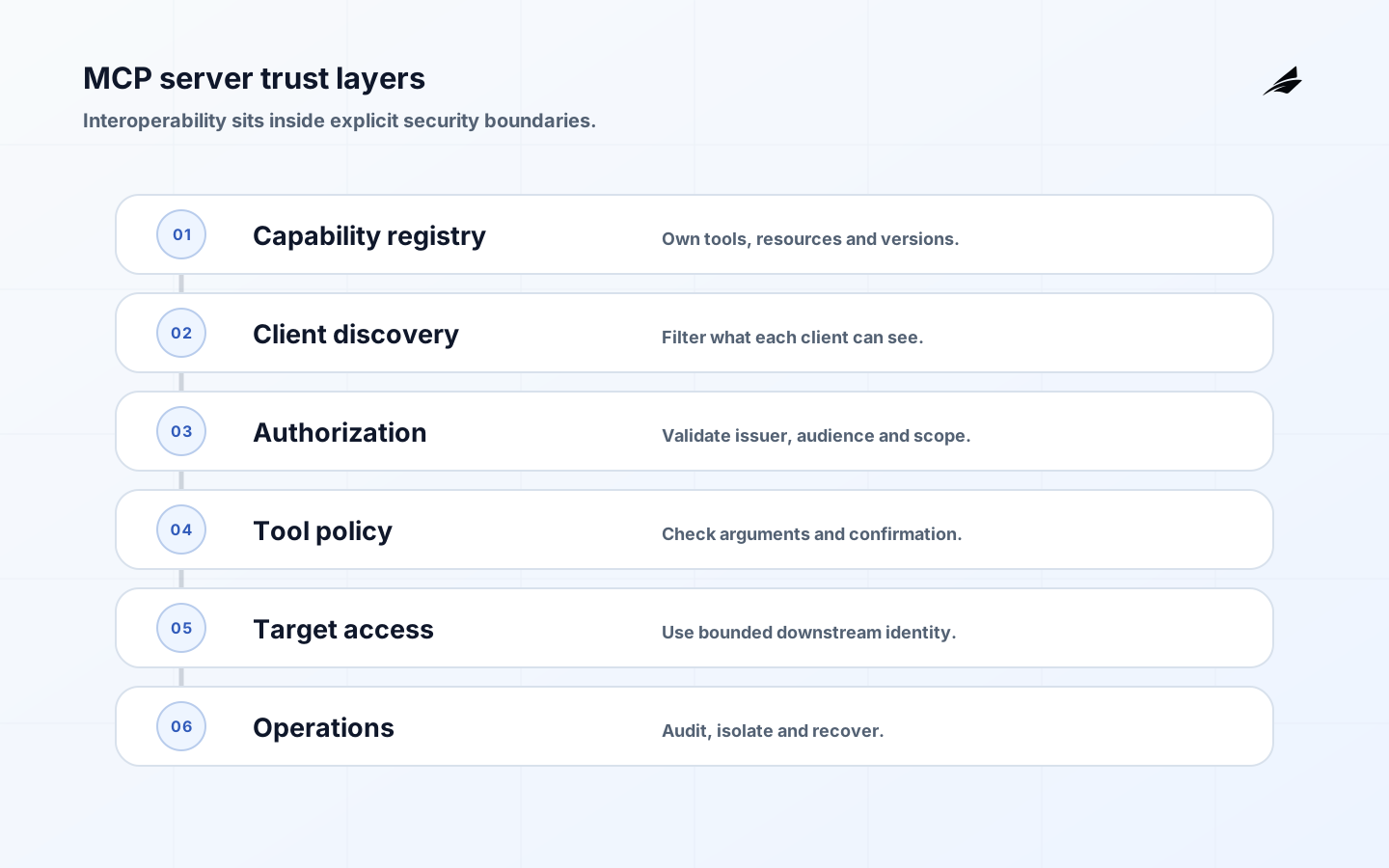
MCP servers give AI applications a standard way to discover tools, resources and prompts, but interoperability does not make every exposed capability trustworthy. For CTOs, the important boundary is where model-directed intent becomes an authenticated read or a side effect in a business system. Each server should be treated as a protected integration product with an owner, reviewed schemas, bounded credentials, isolation, audit evidence and an emergency disable path. The official MCP architecture documentation explains the host-client-server relationship; the stable protocol's authorization specification covers transport-level authorization for HTTP. Enterprise design must still decide which tools a user may discover and invoke, which arguments require confirmation and how downstream authorization is enforced.
Set the operating boundary for MCP servers
Start by describing the smallest valuable workflow. For example, consider an internal assistant answering contract-policy questions. Write down the user, the decision being supported, the system of record, the information that may be used, and the action the system may not take alone. A boundary prevents an apparently helpful feature from silently spreading into work with different risk, data, or approval requirements. It also gives reviewers a fixed test: does the observed behavior remain inside the agreed purpose? When the answer is no, the design should route the work to a person or an established process rather than improvising.
| Design question | Practical decision | Evidence to retain |
|---|---|---|
| Purpose | Name the specific user task and prohibited autonomous action. | A current workflow map and an accountable owner. |
| Inputs | Limit sources to records that are permitted and maintained. | document identity, permitted audience, source passage, retrieval version, and response outcome. |
| Outcome | Define a usable result and an explicit pending state. | A sample of normal, adverse, and incomplete cases. |
| Recovery | Decide who pauses the flow and how work continues. | withhold the answer, show the authoritative record, and route the question to its owner. |
Test MCP servers against real work
A test set should contain ordinary cases, uncomfortable edge cases, and examples where the correct response is to stop. In this domain, the material failures include stale guidance, cross-boundary disclosure, unsupported answers, and misleading citations. Collect examples from the people who complete the work today, remove or protect sensitive data appropriately, and label the expected result and acceptable uncertainty. Test after changes to prompts, models, source material, permissions, routing rules, or integrations. Sampling only easy inputs produces a misleading picture because the cases that consume review effort are usually the ones that reveal missing context or unsafe assumptions.
| Test slice | What to inspect | Decision |
|---|---|---|
| Routine cases | Usefulness, source match, and completion effort. | Release only if the result is consistently actionable. |
| Hard cases | Missing data, ambiguity, conflict, and policy triggers. | Require a safe pending or escalation route. |
| Adversarial input | Attempts to alter instructions or obtain restricted information. | Block the action and record the attempted path. |
| Changed conditions | New source, version, role, or downstream dependency. | Re-evaluate before continuing normal operation. |
Assign controls and ownership for MCP servers
Controls work when they are attached to a decision point rather than described in a policy that no one consults. The accountable roles here are knowledge owner, security lead, and service desk lead. Separate the person who defines the workflow from the person who approves a consequential outcome where that separation matters. Enforce authorization outside the model, validate structured outputs before a downstream system consumes them, and give reviewers the relevant source material rather than only a confidence score. The NIST AI RMF's Govern, Map, Measure, and Manage functions offer a practical way to keep these responsibilities visible throughout design and operation.
- Name one owner for the workflow and one owner for each authoritative data source used by MCP servers.
- Use least-privilege access for tools, records, and administrative changes.
- Make a pending state normal when evidence, policy, or authority is missing.
- Keep logs useful for investigation without turning protected traces into a new broadly accessible data store.
- Review the control design whenever the workflow scope, vendor, or connected system changes.
Measure live MCP servers behavior
Monitoring should connect technical events to a user or business consequence. Preserve document source, access decision, response, and user feedback. Review the results by workflow segment, source, and version so that an aggregate average cannot conceal a harmed group of cases. Search quality is not simply ranking quality when records have different owners and access rules. Good monitoring pairs a threshold with an owner and a pre-agreed response: investigate, restrict the capability, correct the record, or return to the manual path. Keep a baseline from before release; otherwise an apparent improvement may simply reflect a different workload or a change in how work was counted.
| Signal | Why it matters | Review response |
|---|---|---|
| citation coverage | Shows whether the bounded task is producing acceptable work. | Sample cases and identify a version or source pattern. |
| permission denials | Shows whether review is catching material problems. | Inspect evidence and adjust the decision boundary. |
| stale-content rate | Shows whether the fallback path has a real owner. | Escalate capacity or change the route. |
| and unresolved search sessions | Shows whether automation shifts burden downstream. | Compare against the manual baseline and recover if needed. |
Run and recover MCP servers safely
The recovery path must be rehearsed while the workflow is quiet. A reviewer should be able to find the relevant evidence, prevent a risky action, correct a record where appropriate, and explain the resolution to the next owner. For this topic, the practical fallback is to withhold the answer, show the authoritative record, and route the question to its owner. Protect the audit trail, but do not confuse retention with accountability: someone must be responsible for deciding whether an incident requires a fix to data, configuration, policy, training, or scope. Treat near misses as learning material, especially when a control worked just in time.
- Give front-line users a clear route to flag a questionable MCP servers result without needing technical access.
- Practice pausing the relevant capability while leaving unrelated work available.
- Reconcile any downstream changes against the system of record after an incident.
- Record the decision, affected scope, correction, and criteria for resuming normal operation.
- Bring repeated exceptions back to the workflow owner rather than asking individual reviewers to absorb the pattern.
Operational discipline also means distinguishing a defect from a changed business rule. A poor MCP servers result may reflect an outdated source, an ambiguous request, an integration failure, a permissions mismatch, or a decision that policy no longer permits. Classify the cause before changing the model or prompt. Then test the proposed correction against the same evidence set that exposed the issue, plus nearby cases that could be affected. This creates a useful change record: what changed, why it changed, who approved it, which cases were checked, and what signal will confirm the correction in live use. That record is more valuable than an isolated accuracy claim because it lets the next reviewer understand the operating history.
Release checklist
- The team can state the permitted purpose, prohibited action, owners, and fallback for MCP servers in plain language.
- Evaluation includes normal, incomplete, adverse, and changed-condition examples from the real workflow.
- Authorization, output validation, and escalation occur outside untrusted model text.
- Live signals have a baseline, review cadence, accountable owner, and documented action threshold.
- The recovery path has been tested from detection through reconciliation before scope expands.
Before expanding MCP servers, hold a short operating review with the people who own the source records, the workflow, and the affected service. Look at a small set of completed cases rather than a single aggregate chart. Ask whether each result had enough evidence, whether the intended person retained meaningful control, whether the exception path reached an accountable receiver, and whether the measured benefit remained after correction work. Include cases the system declined to handle; a well-designed refusal can be a success when it protects a customer, employee, or business record. Capture the decisions from this review as release criteria for the next scope increase. That keeps adoption connected to demonstrated capability instead of pressure to make an assistant appear more autonomous.
Review MCP servers as trust boundaries
Build a registry containing owner, deployment, protocol version, transport, tools, data classification, downstream systems, credential method, allowed clients, retention and review date. Tool descriptions influence model selection, so review them as a security-sensitive interface. Use specific verbs, narrow schemas and explicit side-effect descriptions. The tool-calling cost guide covers execution economics, the LLM observability guide covers workflow telemetry, and the vector search checklist helps when resources expose retrieval.
Do not pass a user or host token through to an unrelated downstream service. Current MCP security guidance calls out confused-deputy and token-passthrough risks, while authorization requires audience validation for protected resources. Prefer a resource-bound token for the MCP server, then make a deliberate downstream decision using a constrained service identity or delegated flow. High-impact tools should support dry-run output, concrete confirmation, idempotency and compensating action. Log the initiating user, client, server version, tool, sanitized arguments, authorization result, downstream reference, outcome and latency without recording secrets.
| MCP control point | Required decision | Evidence |
|---|---|---|
| Discovery | Which clients may see each capability? | Registry and filtered tool list |
| Authorization | Is the token intended for this server and scope? | Issuer, audience and scope result |
| Invocation | Does the user understand the side effect? | Confirmation or policy decision |
| Downstream access | Which identity reaches the target? | Delegation or service policy |
| Execution | Can retries duplicate an action? | Idempotency key and target reference |
| Operations | Can the capability be isolated quickly? | Kill switch and tested runbook |
Key takeaways
- MCP servers should improve a bounded task, not quietly claim broader authority.
- Evidence, permission, and recovery are product requirements alongside model quality.
- Evaluate the cases where the system should stop or seek review, not only the easy successes.
- Use operating signals to decide when to investigate, restrict, or expand the workflow.
Frequently asked questions
What should be automated first with MCP servers? Start with a repeated task that already has a stable source of truth, a named owner, and a safe manual fallback. How much human review is needed? Match review to consequence: low-impact drafting may need sampling, while decisions that change money, access, employment, safety, or legal position need explicit authority and evidence. Is a confidence score enough to decide whether to proceed? No. Confidence can be one signal, but it does not replace policy rules, source quality, permission checks, or a named receiver for exceptions. When can a team expand scope? Expand only after evaluation and live monitoring show that errors are understood, controls work under normal pressure, and the manual path can absorb a failure without hidden work.
Conclusion
A useful MCP program standardizes access without flattening trust boundaries. Register every server, keep schemas narrow, validate tokens for the intended resource, preserve downstream authorization and instrument the complete action. Start with read-only, low-consequence capabilities and expand from observed evidence. CTOs should be able to answer who invoked a tool, under whose authority, against which system and with what result; if the architecture cannot provide that answer, it is not ready for consequential actions.
The durable version of MCP servers is a controlled service embedded in real work. Define the boundary, test the failure cases, assign authority, preserve decision evidence, and practice recovery before adding reach. That approach is less theatrical than a broad demonstration, but it gives users a system they can rely on and operators a system they can improve.