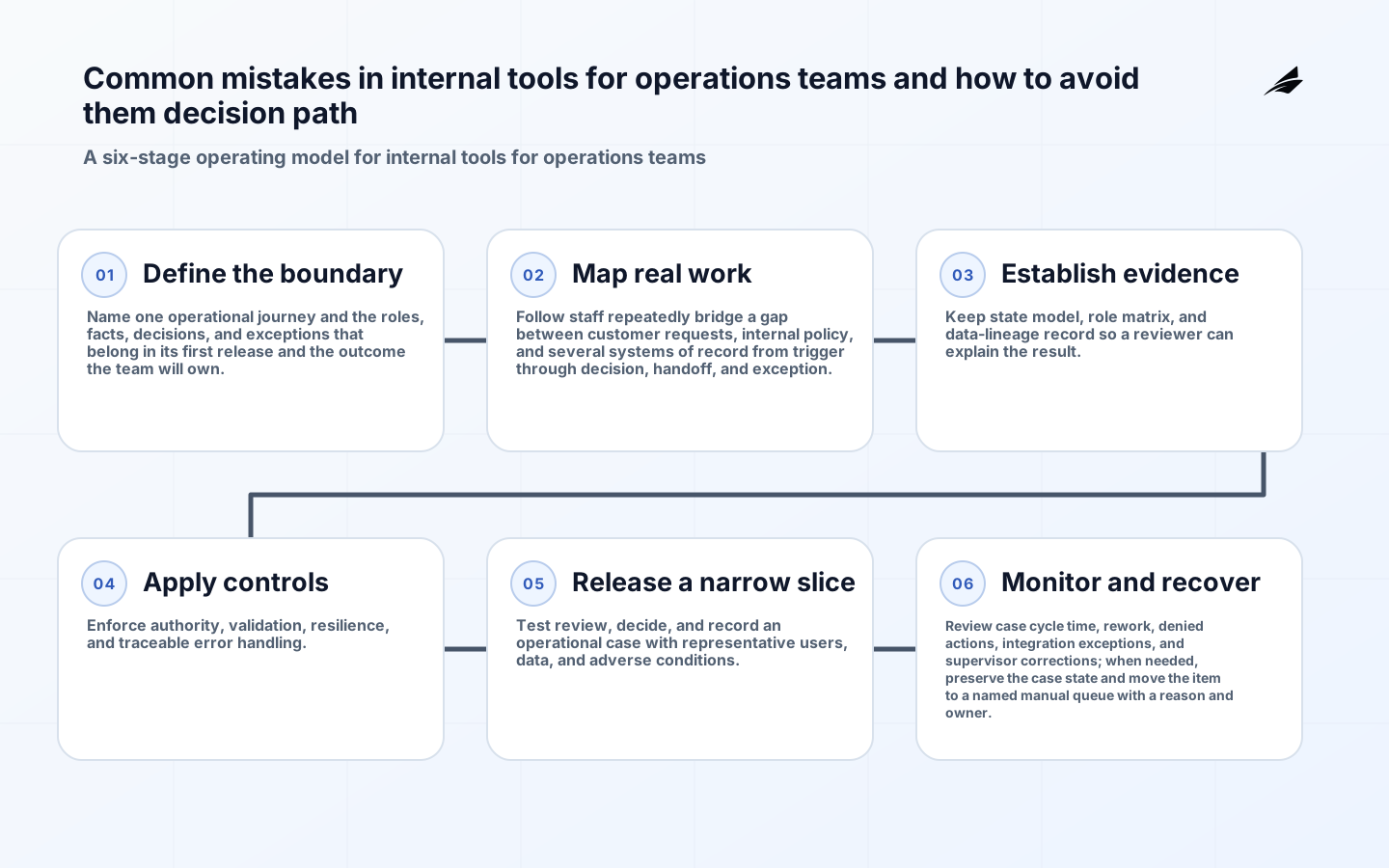
Internal tools for operations teams is a product and operating decision, not a document or technology purchase. For founders, the useful starting point is a named situation: staff repeatedly bridge a gap between customer requests, internal policy, and several systems of record. The desired outcome is that operators can make a routine decision with clear data ownership, permissions, and an auditable exception path. Work backward from that outcome through the people who act, the facts they need, the policy that constrains them, and the evidence needed when something goes wrong. This keeps a team from treating a polished interface or an early demonstration as proof of readiness. It also makes the hard questions visible while they are still cheap to answer: who owns the decision, what remains authoritative, and how will users continue when the normal path fails?
Key takeaways
- Treat internal tools for operations teams as a bounded operating capability with a named owner and a measurable outcome.
- Follow one representative case end to end, including the exception that current staff handle informally.
- Make the authoritative source, authorization rule, and recovery action explicit before committing to a wider release.
- Use release evidence and live signals to decide whether to correct, restrict, or expand the capability.
Set the internal tools for operations teams boundary
The first decision is scope. Define one operational journey and the roles, facts, decisions, and exceptions that belong in its first release. A boundary is not a promise that everything outside it is unimportant; it is a commitment to make the first promise dependable. Ask a practitioner to narrate a recent case from trigger to final outcome. Capture inputs, actor changes, state transitions, service expectations, and the moment when a case stops being ordinary. Then name the system that owns each important fact. If a field is copied for convenience, say how freshness is checked and which value wins in a conflict. This map exposes hidden work and gives engineering, operations, and leadership a shared object to review instead of three incompatible interpretations.
| Planning element | Question to answer | Evidence to keep |
|---|---|---|
| Workflow | Which decision is delayed or error-prone today? | A real case from trigger to completion. |
| Authority | Which system owns each important fact? | Field lineage and freshness expectation. |
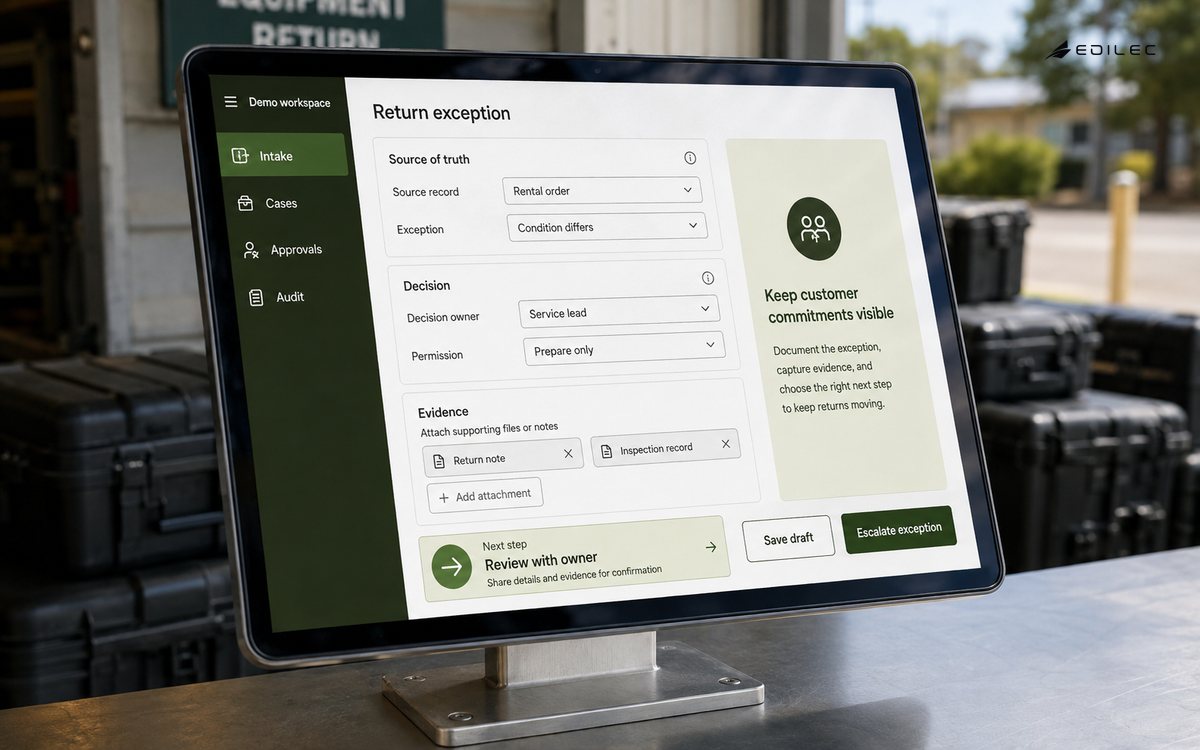
| Permission | Who may view, change, or override? | Server-enforced action and record scope. |
| Exception | Where does unusual work go? | A queue, timer, and accountable reviewer. |
Design the decision before the interface
A common mistake is to start with screens, endpoints, or a vendor shortlist. Start with the decision and its consequence. For this guide, the relevant action is to review, decide, and record an operational case. Describe what information must be present, who may act, what reason or approval is needed, and what state means “pending” rather than “complete.” The operating model should also state how a duplicate request, stale source record, or override that needs a reason is handled. That is where weak designs often create invisible risk: staff return to chat, edit a source record directly, or make an irreversible choice without a trace. A good design makes uncertainty visible and gives it an owner; it does not force users to invent a workaround to keep work moving.
Engineer controls and contracts
The technical design should make authority enforceable. In queues, records, role checks, integrations, audit history, and reporting, distinguish a request to act from a completed action, and validate both the user’s permission and the record scope on the server. Use stable identifiers for commands that may be retried, define error responses that callers can handle, and preserve enough context to investigate a result later. RFC 9457 provides a standard format for API problem details; consistency helps both users and support teams understand failed requests. The NIST Secure Software Development Framework is useful here because it treats secure design, verification, release integrity, and vulnerability response as routine engineering work rather than a late review.
| Control point | What to inspect | Practical response |
|---|---|---|
| Screen-first design | A set of pages without a state model. | Start with transitions, owners, and evidence. |
| Client-only access | A hidden button treated as authorization. | Test direct denied requests at the server. |
| Copied data | A stale local field drives a decision. | Display source ownership and reconcile changes. |
| Happy-path release | No route for an incomplete case. | Pilot the exception flow before widening scope. |
Deliver a verifiable first slice
Choose one narrow release that exercises the real boundary. It should produce state model, role matrix, and data-lineage record, not merely a demonstration. Include a representative user, the actual authoritative source where feasible, a realistic permission set, and the failure behavior. Build the acceptance conversation around observable questions: can the user understand the state, can an operator trace the decision, does a denied request remain denied when called directly, and can the team reverse the change? Accessibility belongs in this slice as well. WCAG 2.2 provides testable guidance for keyboard use, focus, input assistance, and other conditions that affect whether people can reliably finish a task. A release that is only usable under ideal conditions is not a dependable release.
Measure internal tools for operations teams in live use
Measurement should answer whether the capability is helping the work it was built for. Track case cycle time, rework, denied actions, integration exceptions, and supervisor corrections. Keep a baseline from the prior process and segment results by journey, role, version, and source where that changes interpretation. An average can conceal a failure concentrated in a high-consequence path. Connect each signal to an owner and a pre-agreed decision: investigate, repair data, reduce scope, add capacity, or return to the manual path. OpenTelemetry documentation is a practical reference for carrying traces, metrics, and logs across service boundaries. The aim is not indiscriminate collection; it is enough correlated evidence to explain a specific outcome without creating a new uncontrolled data store.
Operate, change, and recover
Every change needs an owner, a testable hypothesis, and a recovery route. Before widening internal tools for operations teams, rehearse what happens when preserve the case state and move the item to a named manual queue with a reason and owner. Verify that the affected work can be located, the capability can be limited without breaking unrelated work, and the final record can be reconciled. Record the cause, decision, affected scope, correction, and criteria for resuming normal operation. The OWASP Application Security Verification Standard is a useful checklist for checking that authentication, authorization, input handling, logging, and other application controls are considered in a consistent way. Near misses matter: they reveal whether a control works under pressure and often identify a design assumption that a routine test did not exercise.
- Assign one accountable owner for the outcome and named owners for the source data, operational policy, and technical service.
- Review production changes against the same representative cases used to establish the boundary.
- Keep a short decision record for overrides, unresolved risks, and conditions that would require a rollback.
- Retire temporary workarounds deliberately so they do not become an undocumented parallel process.
- Revisit access, data, and integration assumptions when the user group or connected system changes.
Avoid recurring mistakes
The recurring failure pattern is confusing activity with assurance. Teams can hold workshops, produce a roadmap, or ship a screen while leaving ownership and evidence vague. Counter that by asking the same practical questions at every review: what decision is being supported, which system is authoritative, who can act, what happens when the evidence is incomplete, and how will we know the result helped? The answers should appear in the work item, the design, the test cases, and the operating procedure. When they disagree, resolve the disagreement before expanding scope. This is slower than declaring a broad transformation complete, but it prevents the later cost of reconciling records, re-training users, and restoring trust after an avoidable incident. In internal tools for operations teams, founders should make the review concrete: inspect the decision record, the affected handoff, and the recovery proof before accepting a change as complete.
Frequently asked questions
What should a team do first? Select one repeatable journey with a clear owner, a known source of truth, and a manual fallback. How detailed should the initial design be? It needs enough detail to expose decisions, integrations, authority, and recovery; it does not need every future screen. When should a team automate an exception? Only after it understands why the exception exists, who is authorized to resolve it, and what evidence a reviewer needs. How can leaders judge progress? Look at completed representative cases, not only feature count or a single aggregate metric. When is it safe to expand? Expand after users can complete the bounded work, controls have been tested under adverse conditions, support can explain failures, and the operational owner accepts the evidence. If those conditions are not met, reduce scope or improve the path rather than adding another layer of automation. For internal tools for operations teams, the first review should also include the people who carry the exception work today; their evidence is often the quickest way to find a boundary the design has missed.
Conclusion
For adjacent decisions, see internal tools for operations teams and multi-role business applications. Those guides are useful companions because the surrounding workflow, interface, and operating model often determine whether this capability succeeds. The comparison is especially useful for internal tools for operations teams, where adjacent choices can alter the authority, data, and support burden of the proposed solution.
The durable form of internal tools for operations teams is a controlled service for real work. Define the boundary, make authority visible, test the difficult cases, collect only meaningful operating evidence, and practise recovery before reaching for scale. That discipline gives users a system they can rely on and gives the organisation a path to improve it without guessing.