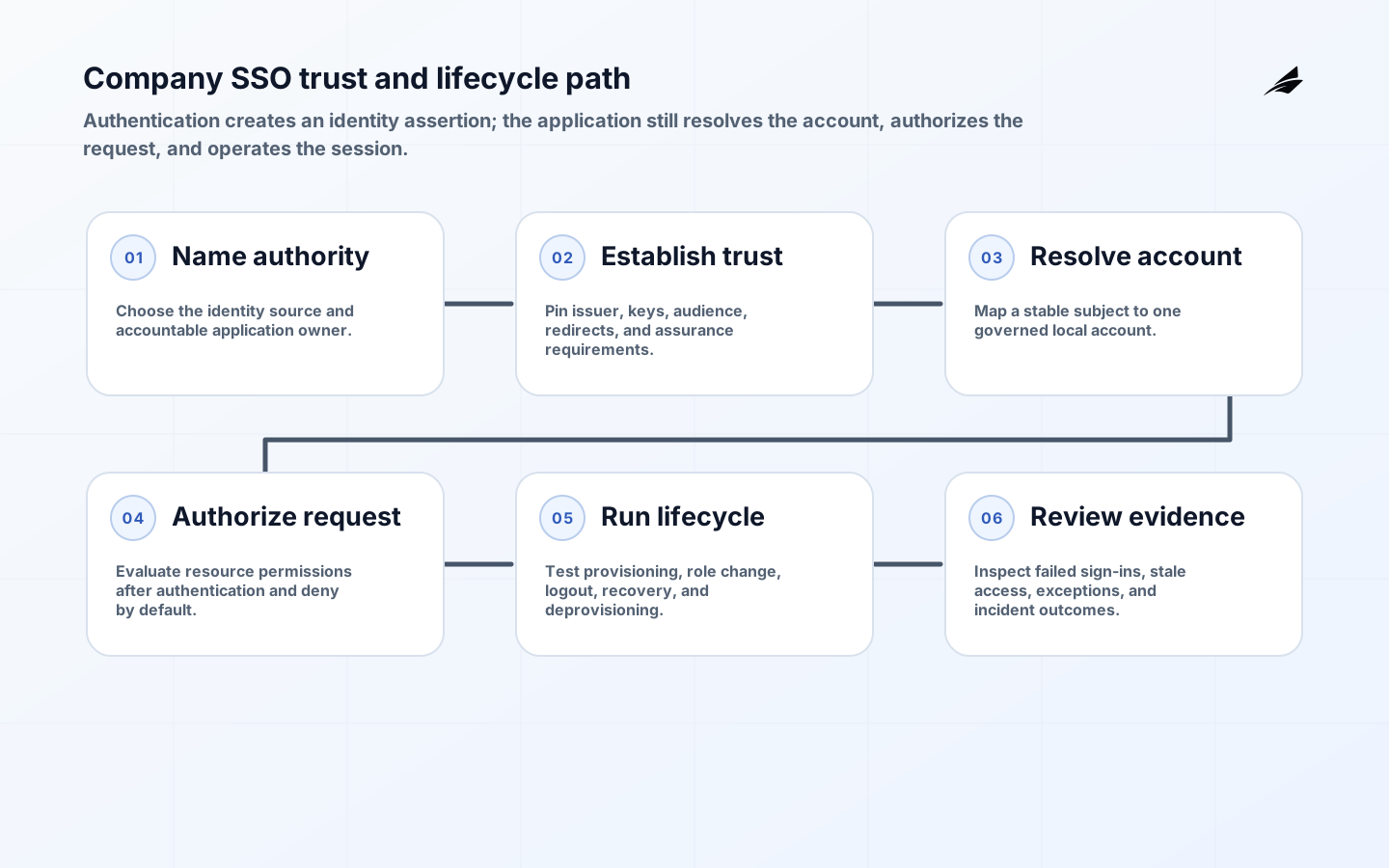
SSO meaning for companies is not “one password for every application.” Single sign-on is a federation arrangement in which a relying party accepts a verified assertion from an identity provider and then applies its own authorization rules. That distinction matters: the identity provider authenticates the person, while each application still owns resource access, local account state, session behavior, and business permissions. A sound SSO program therefore combines a trust agreement, a stable subject identifier, lifecycle events, tested logout and recovery, and evidence that a departing or reassigned worker no longer retains access.
Translate SSO into an identity operating model
Begin with the people and applications that create the most consequential access decisions. For each relying party, identify the authoritative identity source, accepted assurance level, required attributes, local account owner, and response when an assertion is missing or invalid. NIST SP 800-63C-4 explains the roles of the identity provider and relying party and requires assertions to be signed, audience-restricted, and associated with the intended subscriber account. OpenID Connect Core defines the ID Token and the validation work an OpenID relying party performs. These are trust controls, not just login-screen configuration.

Treat joiner, mover, and leaver events as product behavior. Decide whether provisioning is just-in-time or pre-provisioned, which immutable identifier links accounts, how role changes propagate, and which applications require deprovisioning confirmation. Session termination deserves a separate test because disabling an identity does not necessarily invalidate every relying-party session. The OpenID Foundation’s RP-Initiated Logout specification helps define logout interactions, while the OWASP Session Management Cheat Sheet provides practical session protections. A launch is credible only when the team can demonstrate normal sign-in, denied access, role change, logout, IdP outage, and emergency administration.
| Decision | Evidence before launch | Owner |
|---|---|---|
| Trust establishment | Issuer, keys, redirect URIs, audience, nonce and clock-skew checks are documented and tested. | Identity platform and application security |
| Account resolution | A stable subject maps to one local account without relying on a mutable email address. | Application owner |
| Authorization | Application permissions are evaluated after authentication and denied by default. | Product and security owners |
| Lifecycle and sessions | Role change, deprovisioning, logout and emergency-access tests have named outcomes. | Identity operations |
What SSO meaning for companies means in practice
SSO separates authentication from application authorisation. The identity provider verifies a user and issues an assertion or token with selected claims; the service provider validates that message and maps the recognised identity to local roles, memberships, or entitlements. Authentication success is not automatic permission to every feature. This distinction lets an organisation centralise sign-in safeguards while retaining resource-specific access policy. It also prevents a common failure: treating an email address alone as stable identity. Use durable subject identifiers, documented claim mappings, and a deliberate account-linking process. Protocol choice, such as SAML or OpenID Connect, should follow application and integration needs, but no protocol removes the need to govern identity data and access decisions.
Define scope, ownership, and the authoritative boundary
Start with a lifecycle map. Identify the authoritative HR, directory, customer, or partner source; inbound and outbound provisioning paths; contractors and shared devices; mergers or domain changes; emergency access; and applications that cannot yet federate. Decide the assurance level required for each application and the factors a user must present. Limit the first rollout to a sensible group of applications and users, but include deprovisioning, name changes, group changes, and support recovery. Write down which claims are necessary and avoid sending every available attribute. A trusted identity token carrying unneeded personal data can spread a privacy problem far beyond the original directory.
| Decision question | Decision-ready answer | Risk if omitted |
|---|---|---|
| What is the protected outcome? | A defined business result supported by SSO meaning for companies. | The build optimises a feature instead of the operating decision. |
| Who owns the rule? | A named business owner approves policy while technical owners operate the service. | Technical configuration silently becomes business policy. |
| Where is authority? | A documented source record or policy decision is authoritative; displays and copies are not. | Teams resolve disagreement by choosing the most convenient screen. |
| What proves completion? | An observable result, record, and exception route are agreed before release. | A successful request is confused with completed business work. |
| Who repairs failure? | A named queue and response expectation handle failed, disputed, or delayed work. | Staff rely on inboxes, spreadsheets, and undocumented overrides. |
Design the operating path and evidence
Establish a verified trust relationship between the identity provider and each application. Validate issuer, audience, signature, expiry, nonce or replay protections as applicable, and redirect destinations; do not accept a token simply because it looks well-formed. Use standard flows appropriate to the client type, protect client credentials, and keep metadata or configuration under change control. Map the stable subject to an application account and apply local authorisation from roles or entitlements that the application understands. Design sessions with expiry, renewal, revocation expectations, and sign-out behaviour. For machine access, use workload identities and scoped credentials rather than repurposing a human SSO session.
Build controls and exception handling into the work
Protect the identity provider as critical infrastructure. Require suitable multi-factor authentication, review privileged identity administration, monitor risky sign-ins and unusual assertion use, and make recovery resistant to social engineering. Restrict who can alter federation configuration, group mappings, or automated provisioning; those changes can grant access at scale. Use least privilege in application mappings and avoid broad default groups. Test account takeover, a terminated user, an invalid token, an application outage, certificate rotation, and a compromised administrator. Give help desk staff a documented verification process and a way to revoke or contain an account without needing an undocumented back door.
| Condition | Required response | Operating evidence |
|---|---|---|
| Required information is missing | Hold or decline the work with an actionable reason. | Validation result, source context, and named follow-up owner. |
| An automated step fails | Preserve context, apply a safe retry rule, and route unresolved work. | Correlation identifier, attempt history, and queue status. |
| Authority is unclear | Do not infer permission; escalate to the accountable owner. | Decision request, approver, and policy reference. |
| A material correction is needed | Correct through a governed path without obscuring the original state. | Reason, actor, effective time, and before-and-after record. |
| A control is bypassed | Contain impact, record the exception, and conduct follow-up review. | Exception evidence, expiry or remediation action, and outcome. |
Deliver a thin, operable first release
Roll out SSO by application cohort with clear fallback and support readiness. Reconcile a sample of users and group memberships before enforcing sign-in, then test ordinary login, first-time account linking, role change, account removal, and emergency access. Monitor failures by application and identity flow, but do not log credentials or full tokens. Communicate the changed user journey in context, especially for external partners who may not have the same managed device or identity provider. After launch, review provisioning lag, stale accounts, support resets, and exceptions. The healthy outcome is not a high login count; it is timely, correct access that can be explained and withdrawn.
Measure the operating result, then review it
Measure federation success and failure by application, time from lifecycle event to access change, stale account count, privileged-admin coverage by MFA, claim-mapping changes, emergency recovery use, and time to revoke access in a tested scenario. Interpret failures with user and support evidence. A lower failure rate achieved by permitting insecure fallback is not an improvement.
Use governance and procurement evidence to make the decision durable
An SSO rollout deserves a service-owner review because federation failures often appear as ordinary user-access problems. Before signing off, demonstrate a new starter, mover, leaver, partner, certificate rotation, invalid assertion, and identity-provider outage. Confirm which team owns each recovery decision and how support staff verify a person before assisting. Review application claim mappings with both security and the business owner: an apparently harmless group can grant broad privileges through several relying applications. Supplier and identity-provider agreements should cover service availability, incident notification, log access, configuration export, and termination assistance. The desired result is an identity service that reduces unmanaged accounts while keeping local application policy clear and supportable.
Plan federation changes as production changes. New applications, claim mappings, and certificates deserve tested rollout and rollback steps because a small configuration error can deny access widely or grant it incorrectly.
Key takeaways for SSO meaning for companies
- Name the authoritative source for each identity lifecycle event.
- Use durable subject identifiers and minimal, documented claims.
- Validate federation messages and configuration rigorously.
- Keep application authorisation separate from sign-in success.
- Plan deprovisioning, recovery, and certificate rotation early.
- Measure timely removal and correct access, not just login volume.
Frequently asked questions
Does SSO mean users have only one password?
Often it reduces separate passwords, but the essential design is federated authentication. Security still depends on the identity provider, factors, session controls, and each application’s authorisation.
Is SAML or OpenID Connect better?
Neither is universally better. Both are established standards; choose based on application type, ecosystem, client architecture, and security requirements, then implement the selected protocol correctly.
Can external partners use company SSO?
Yes, but partner identity, assurance, support, privacy, and offboarding rules should be explicitly designed. External access should not be treated as an employee-directory edge case.
Conclusion
SSO meaning for companies becomes a useful planning term when it is connected to a real decision, an accountable owner, a protected operating path, and evidence that a reviewer can understand. Do not begin with a vendor feature list or a generic architecture diagram. Start with the outcome that must be dependable, test the awkward cases with the people who will run the work, and make the first release small enough to observe. That approach gives a client team a clearer basis for investment and a service it can improve without losing control of the business facts that matter.