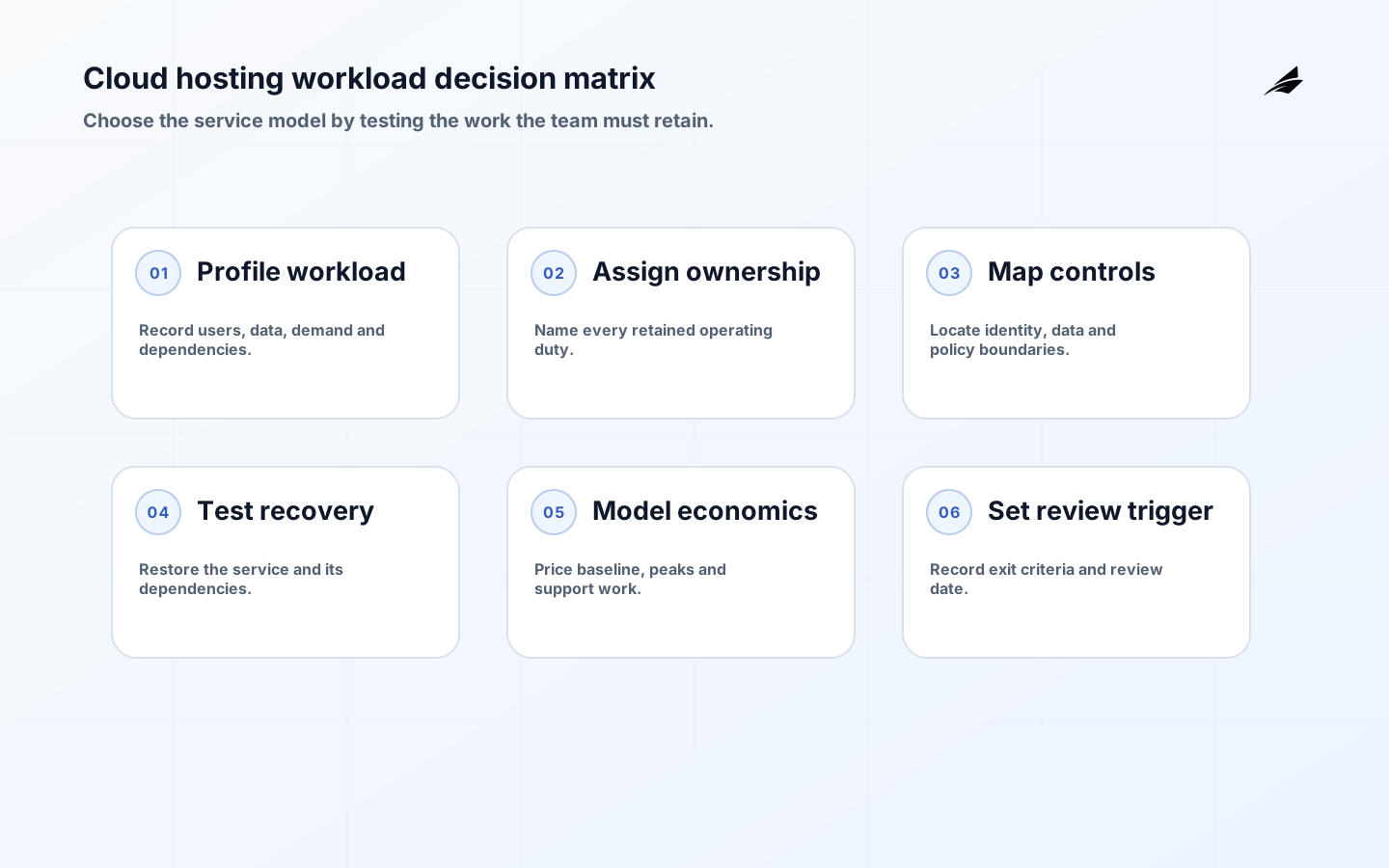
Cloud hosting decision basics should start with the workload, not a provider comparison table. Cloud computing offers on-demand access to configurable resources, but the value and risk of a service model depend on what the application does, what data it handles, how it fails, and who will operate it after launch. A managed platform can reduce certain operational tasks while introducing constraints around configuration, observability, location, integration, and exit. Before a migration or new build, map one workload’s users, dependencies, data classification, latency, availability expectation, deployment rhythm, recovery target, and financial model. That evidence gives an architecture team a decision it can defend when the attractive default service is not the right fit.
What cloud hosting decision basics means in practice
Cloud hosting is a spectrum of retained and delegated responsibilities. In an infrastructure model, the organisation controls more of the operating system and application stack; in a platform model, it delegates more runtime operations; in a software service, it consumes an application through a defined service boundary. None of these models transfer accountability for the business outcome. The customer still owns workload configuration, access choices, data handling, integration design, and the suitability of provider commitments for its obligations. A hosting decision must therefore name the service owner, platform owner, security responsibilities, support route, and evidence used to show that resilience, privacy, and continuity requirements are being met.
Define scope, ownership, and the authoritative boundary
Classify each workload independently. A public marketing site, internal analytics job, regulated transaction service, and low-latency edge process may have very different needs even if they share a technology stack. Record dependencies on identity, networking, data stores, third parties, and on-premises systems; a cloud migration that overlooks a legacy interface can create a hidden single point of failure. Decide where data may reside, how it is encrypted and accessed, what recovery point and recovery time objectives are needed, and what planned maintenance means to users. Include organisational readiness: operating a new cloud environment requires ownership of account structure, billing, monitoring, incidents, and change control, not only a deployment template.
| Decision question | Decision-ready answer | Risk if omitted |
|---|---|---|
| What is the protected outcome? | A defined business result supported by cloud hosting decision basics. | The build optimises a feature instead of the operating decision. |
| Who owns the rule? | A named business owner approves policy while technical owners operate the service. | Technical configuration silently becomes business policy. |
| Where is authority? | A documented source record or policy decision is authoritative; displays and copies are not. | Teams resolve disagreement by choosing the most convenient screen. |
| What proves completion? | An observable result, record, and exception route are agreed before release. | A successful request is confused with completed business work. |
| Who repairs failure? | A named queue and response expectation handle failed, disputed, or delayed work. | Staff rely on inboxes, spreadsheets, and undocumented overrides. |
Design the operating path and evidence
Create a governed foundation before hosting production workloads. A landing zone should establish account or subscription boundaries, identity federation, network controls, logging, policy enforcement, key management, tags, and financial ownership. Use infrastructure as code with reviewable changes so that environments can be reproduced and assessed. Separate development, test, and production according to risk, and avoid sharing high-privilege credentials across them. Build workloads with explicit dependencies, health checks, backup and restore design, and managed-service limits in mind. The provider’s regional durability claim does not automatically protect an application from deletion, bad deployment, corrupt input, or a failed integration; resilience has to be designed at the workload level.
Build controls and exception handling into the work
Apply shared responsibility in concrete controls. Define who configures identity, network exposure, encryption, patching, vulnerability response, backups, incident communications, and compliance evidence for each service. Restrict privileged cloud access, use workload identities and short-lived credentials where possible, protect management APIs, and collect logs centrally with retention and review rules. Enforce guardrails that prevent common high-impact mistakes, but include a documented exception process so urgent work does not bypass all governance. Test restoration, access revocation, key rotation, service quotas, regional or dependency outage, and compromised credentials. Cost controls also need ownership: unexpected scale can be both a financial and an availability signal.
| Condition | Required response | Operating evidence |
|---|---|---|
| Required information is missing | Hold or decline the work with an actionable reason. | Validation result, source context, and named follow-up owner. |
| An automated step fails | Preserve context, apply a safe retry rule, and route unresolved work. | Correlation identifier, attempt history, and queue status. |
| Authority is unclear | Do not infer permission; escalate to the accountable owner. | Decision request, approver, and policy reference. |
| A material correction is needed | Correct through a governed path without obscuring the original state. | Reason, actor, effective time, and before-and-after record. |
| A control is bypassed | Contain impact, record the exception, and conduct follow-up review. | Exception evidence, expiry or remediation action, and outcome. |
Deliver a thin, operable first release
Migrate or launch in phases. Baseline the workload, build and test the landing-zone controls, move a noncritical slice or read-only replica, then rehearse cutover and recovery before changing the primary path. Use measurable acceptance criteria such as verified restore, known identity boundary, acceptable latency, documented support ownership, and reconciled data. Maintain a rollback or coexistence approach until the new path is proven under realistic load and failure. After launch, run operating reviews across engineering, security, finance, and service owners. Revisit the decision when demand, regulations, provider features, or dependency concentration changes; cloud is a continuing operating choice, not a one-time destination.
Measure the operating result, then review it
Track service availability against the customer-facing objective, restore-test success, backup coverage, identity-policy violations, configuration drift, deployment failure, dependency latency, spend against forecast, reserved-capacity assumptions, and time to investigate incidents. Provider invoices and provider status pages are inputs, not complete evidence of workload health.
Use governance and procurement evidence to make the decision durable
A cloud hosting decision should result in an operating commitment, not only an architecture diagram. Before approval, ask the team to show the account or subscription boundary, identity path, deployment method, central logs, backup location, restore test, cost owner, and current dependency map. Translate provider assurances into application-level obligations: who receives an outage alert, who can make a configuration change, what recovery target is tested, and what data can leave the chosen region. Commercial review should include support tiers, service limits, data egress, price-change exposure, configuration export, and exit assistance. This gives executives a basis for choosing a managed service that fits the workload instead of discovering critical retained responsibilities after migration.
Keep a current workload runbook with ownership, dependencies, recovery commands, and communication paths. It should be exercised after material architecture changes, because an old recovery document can create more delay than an unavailable platform service.
Test the hosting decision against a real workload
A hosting comparison becomes useful when it is tied to one workload and one operating day. Record the users, data sensitivity, request pattern, recovery objective, deployment frequency, dependencies and support hours. Then compare how infrastructure as a service, managed platform services and software as a service change the work retained by the customer. The NIST cloud definition distinguishes service models by the capabilities supplied and managed; it does not imply that a more managed option removes accountability for identities, data use, configuration or business continuity. A team should therefore score the work it must perform, not only the components a provider supplies.
| Decision test | Evidence to collect | Reason to reject an option |
|---|---|---|
| Operating ownership | Named owner for patching, deployment, backup, monitoring and support | A critical duty has no team, budget or response time |
| Failure recovery | Measured restore test and dependency recovery order | Recovery depends on an untested console procedure or one person |
| Security boundary | Data classes, identities, network paths and customer-managed settings | The shared-responsibility boundary cannot be explained |
| Economic fit | Baseline, burst and idle cost tied to a business unit | The estimate excludes support, transfer, observability or migration work |
Run the comparison as a short proof, not a slide-deck exercise. Deploy a representative slice, restore it from backup, rotate an identity, inspect its logs and estimate a month with normal and peak demand. NIST’s public-cloud security guidance stresses governance and risk assessment around the service relationship, while the Cloud Security Alliance Cloud Controls Matrix can help map controls to responsible parties. Teams planning the application itself should also read Edilec’s guides to cloud hosting for enterprise teams, platform engineering for small teams and multi-tenant SaaS boundaries. The final decision record should name assumptions, accepted constraints, an exit trigger and the next date at which cost or reliability evidence will be reviewed.
Key takeaways for cloud hosting decision basics
- Choose hosting from workload requirements and retained responsibilities.
- Establish a governed landing zone before production deployment.
- Treat identity, logging, tags, and cost ownership as architecture.
- Design recovery for application failure, not only provider failure.
- Use infrastructure as code and review configuration changes.
- Reassess portability, dependencies, and cost as the workload evolves.
Frequently asked questions
Is cloud hosting always cheaper?
Not automatically. Consumption pricing can fit variable demand, but architecture, data transfer, managed services, commitments, and operating practice determine the actual cost.
Should every workload use the same cloud service model?
No. Standardise guardrails where useful, then choose a service model that matches each workload’s control, scale, and operational needs.
What is the first resilience test?
A documented restore of representative data and configuration into a usable service is a strong first test because it checks ownership, tooling, access, and recovery timing together.
Conclusion
Cloud hosting becomes easier to plan when it is connected to a real decision, an accountable owner, a protected operating path, and evidence that a reviewer can understand. Do not begin with a vendor feature list or a generic architecture diagram. Start with the outcome that must be dependable, test the awkward cases with the people who will run the work, and make the first release small enough to observe. That approach gives a client team a clearer basis for investment and a service it can improve without losing control of the business facts that matter.
Rehearse the runbook with the accountable operators every quarter.