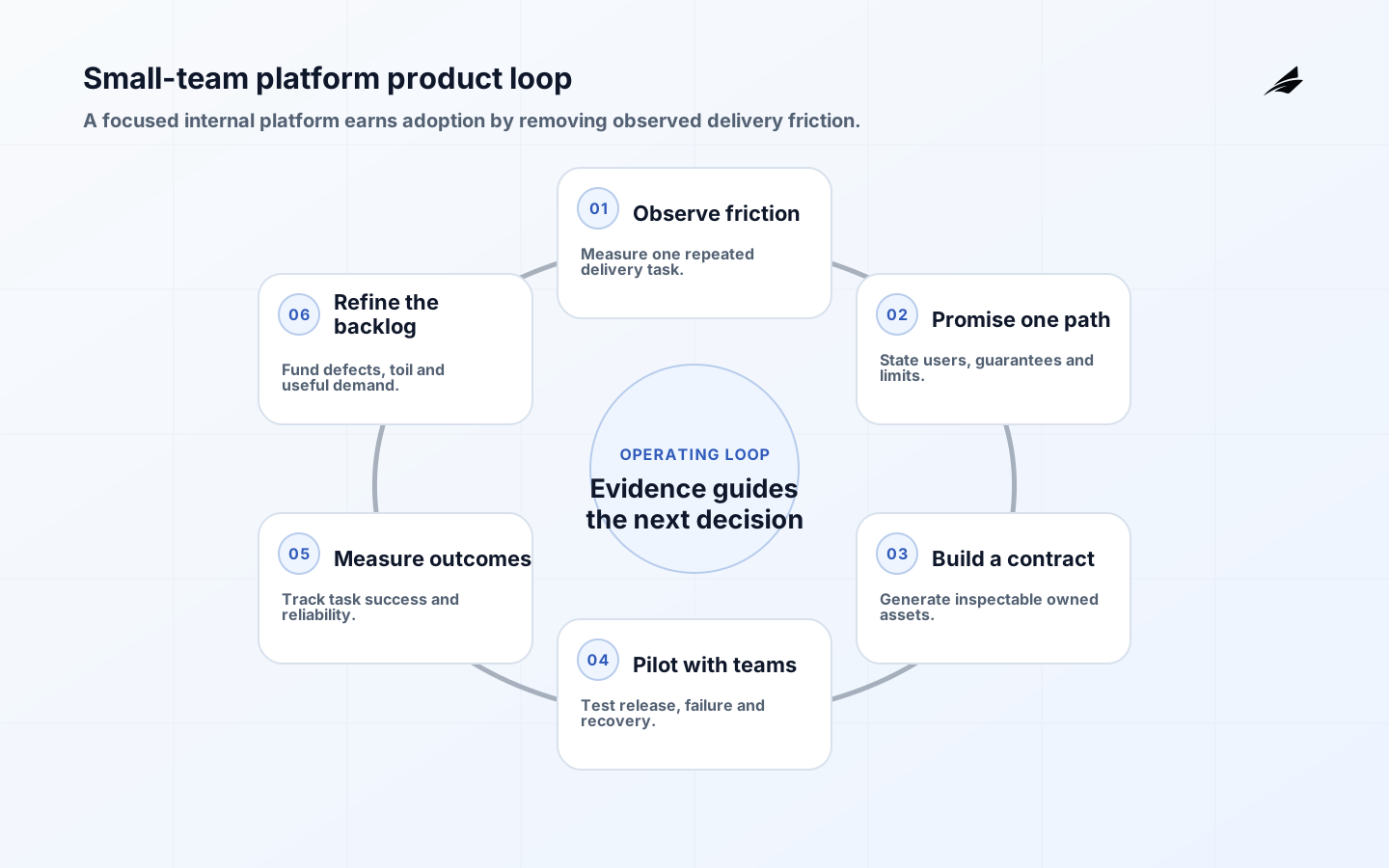
Platform engineering for small teams should remove a repeated obstacle from software delivery, not recreate a large-company portal. The first platform may be a supported repository template, deployment workflow, runtime baseline and concise documentation. Its value comes from making a safe path easier to use and easier to improve across several teams while preserving clear application ownership.
This checklist complements Edilec's minimum viable platform guide, platform planning guide and staging environment design guide. Use it to keep the platform grounded in observed developer work rather than a catalogue of tools.
Key takeaways
- Select one frequent, costly developer journey and baseline it before building.
- Offer a thin supported path with explicit guarantees, ownership and escape hatches.
- Automate policy feedback in the normal workflow instead of adding a distant approval queue.
- Pilot with two different teams and real operational conditions.
- Prioritize the platform backlog from adoption, task success, incidents and user research.
Choose the first problem from delivery evidence
Interview developers and follow recent changes from repository creation to production support. Measure waiting time, repeated setup, failed deployments, security review effort, environment drift and time spent discovering ownership. Good first problems occur across teams, have a clear outcome and can be improved without centralizing every decision. Examples include creating a service with ownership metadata, shipping an HTTP workload, or provisioning a database with backups and access controls.
The CNCF Platform Engineering Maturity Model stresses that higher maturity demands more funding and time, and that the highest level is not a goal by itself. For a small organization, documentation for approved third-party services can be a valid platform capability. Write the user, job, baseline and expected improvement before selecting a portal or orchestrator.
| Candidate journey | Evidence of friction | First platform promise | Do not include yet |
|---|---|---|---|
| Create a service | Repeated repository and pipeline setup | Runnable template with owner | General-purpose catalogue |
| Deploy a web API | Inconsistent runtime and alerts | One supported deployment path | Every runtime type |
| Request a database | Manual tickets and weak backups | Automated approved configuration | Full data platform |
| Investigate an incident | No service or runbook context | Linked ownership and telemetry | Universal observability UI |
Define the platform as a product and a service
Name a platform product owner and an engineering owner, even when both roles are part-time. Define supported users, service levels, maintenance windows, security boundary, cost allocation and escalation. Publish what the path guarantees and what the application team still owns. Keep a visible backlog shaped by user research. A collection of scripts maintained by whoever remembers them is not a dependable product.
Build self-service around a typed contract. Inputs should have explanations, validation and safe defaults. Outputs should include repository, ownership record, deployment status, telemetry links, runbook and cost identity. Provide a documented escape hatch for needs the path cannot support, with review proportional to risk. Teams should be able to inspect generated configuration and propose improvements.
Build one thin golden path
A useful path connects source control, build, security checks, artifact provenance, environment configuration, deployment, observability and rollback. Reuse the organization's existing reliable services. Avoid hiding every detail behind a portal; developers need enough understanding to diagnose production behavior. Backstage Software Templates illustrate how templates can create components and publish them to source control, but the supported workflow around a template is more important than the interface.

Keep documentation beside the capability and test examples as part of release. Backstage TechDocs demonstrates a docs-as-code pattern that associates documentation with catalogued software. Whatever tool is used, document the happy path, common failures, responsibility split, change history and support route. Include one ten-minute onboarding task and one incident task in acceptance testing.
| Platform contract | Platform owns | Application team owns | Acceptance test |
|---|---|---|---|
| Repository | Template and baseline checks | Business code and review | Fresh service builds |
| Deployment | Pipeline and runtime policy | Release decision and configuration | Canary and rollback exercise |
| Observability | Collection and common fields | Service objectives and useful signals | Trace a failed request |
| Security | Guardrails and feedback | Threat model and remediation | Denied unsafe change |
| Support | Path documentation and escalation | Runbook and on-call response | Incident handoff drill |
Put controls in the developer workflow
Encode high-confidence checks close to the change: dependency policy, secret scanning, artifact integrity, required ownership, infrastructure validation and deployment health. Explain failures and provide a remediation example. Reserve human approval for consequence that automation cannot evaluate. Every exception needs scope, owner and expiry. A platform that turns every deployment into a central ticket can improve consistency while making delivery worse.
The DORA continuous delivery capability connects safe on-demand release with practices such as version control, test automation, deployment automation, observability and database change management. Use those capabilities as outcomes for the path. Do not measure success by portal logins or number of templates if teams still cannot release and recover during normal working hours.
Pilot with contrasting teams and production conditions
Choose one team with a conventional service and another with a meaningful variation. Let developers use the path while platform engineers observe rather than operate it for them. Exercise initialization, first release, configuration change, dependency failure, alert investigation and rollback. Track where users leave the path, ask for help or copy undocumented commands. Fix the contract before adding features.
Release the platform itself with versioning, change notes, compatibility policy and rollback. Avoid forcing every team to migrate simultaneously. Deprecate capabilities only after identifying consumers and providing an alternative. Instrument common steps using vendor-neutral telemetry where possible; OpenTelemetry can support traces, metrics and logs across the path and workloads.
Measure adoption, task success and delivery outcomes
Measure successful onboarding time, deployment lead time, failed deployment recovery, help requests, path retention, task completion and developer satisfaction. Segment by team and journey. Pair speed with reliability, security and cognitive load. DORA's platform engineering capability recommends a balanced scorecard spanning software delivery performance, developer satisfaction, adoption and task success. Use qualitative interviews to explain movement in the numbers.
Review the backlog monthly. Prioritize defects and repeated support work before adding new service types. Retire features that have no users or owner. Chargeback may be unnecessary for a small team, but show workload cost to product owners. If operating the platform consumes more effort than it removes, reduce scope, use a managed capability or return to clear documentation until demand justifies automation.
Protect a small platform team's operating capacity
Set an explicit support model before adoption grows. Define an intake route, severity, response hours and the information needed for diagnosis. Rotate support among the people who maintain the path so recurring friction reaches the backlog. Publish service status and known issues. Avoid private direct messages as the normal support channel because they hide demand and create dependence on one engineer. Track time spent on incidents, questions, upgrades and bespoke requests; that operating cost is part of the platform's product evidence.
Reserve capacity for maintenance and security work. Templates, base images, build services and runtime integrations accumulate dependency updates and provider changes even when no new capability is planned. Give every shared component an owner and review date. Automate updates only when compatibility tests and rollback exist. For urgent vulnerabilities, define how the platform can notify application owners, update the supported path and identify teams that have diverged.
Use a contribution model that does not turn the platform team into a review bottleneck. Application teams can propose a template change or new capability through source control, but the platform owner decides whether the organization can support the resulting promise. Require tests, documentation, migration and an identified maintainer. Keep experimental extensions outside the supported contract until more than one team demonstrates demand.
When demand exceeds capacity, narrow the service visibly. Support fewer runtime combinations, pause new templates or document a self-managed route rather than leaving every request half-owned. A small team earns trust by making a limited promise and meeting it. Expansion should follow evidence that the current path is reliable, maintainable and reducing total delivery effort. Review the supported matrix quarterly and remove combinations that lack users, tests or operational competence. Announce retirement with a migration route and enough observation time to catch workload-specific behavior.
Document one continuity plan for the platform itself. Application teams should know how to release or recover when the portal, template service or shared pipeline is unavailable. Keep essential runbooks and deployment artifacts reachable through an independent path, and test that path without privileged help. A platform reduces cognitive load only when its own failure does not leave every product team unable to act.
Small-team platform release checklist
- The first journey is backed by observed multi-team friction and a baseline.
- The supported path states guarantees, responsibilities, cost and escalation.
- Templates produce inspectable source, ownership, telemetry and recovery assets.
- Controls provide fast feedback and exceptions expire.
- Two teams completed onboarding, release and incident tasks without hidden help.
- The backlog is governed by task success, reliability, adoption and interviews.
Frequently asked questions
Does a small team need a developer portal?
Not initially. A repository template, automation and good documentation may solve the first journey. Add a portal when discovery and coordination problems justify its operating cost.
How many people form a platform team?
There is no universal number. Start with named capacity sufficient to own the promise and support users. If nobody has time to maintain the path, reduce scope.
Should the golden path be mandatory?
Mandate only necessary controls. Earn adoption for the wider experience through usefulness. A documented exception path keeps unusual workloads visible without forcing unsafe workarounds.
Conclusion
Platform engineering for small teams works when it makes one important delivery journey predictably easier. Offer a thin, owned path; integrate fast controls; test it under real release and incident conditions; and improve it from developer evidence. A modest platform that teams trust is more valuable than an elaborate portal the organization cannot support.