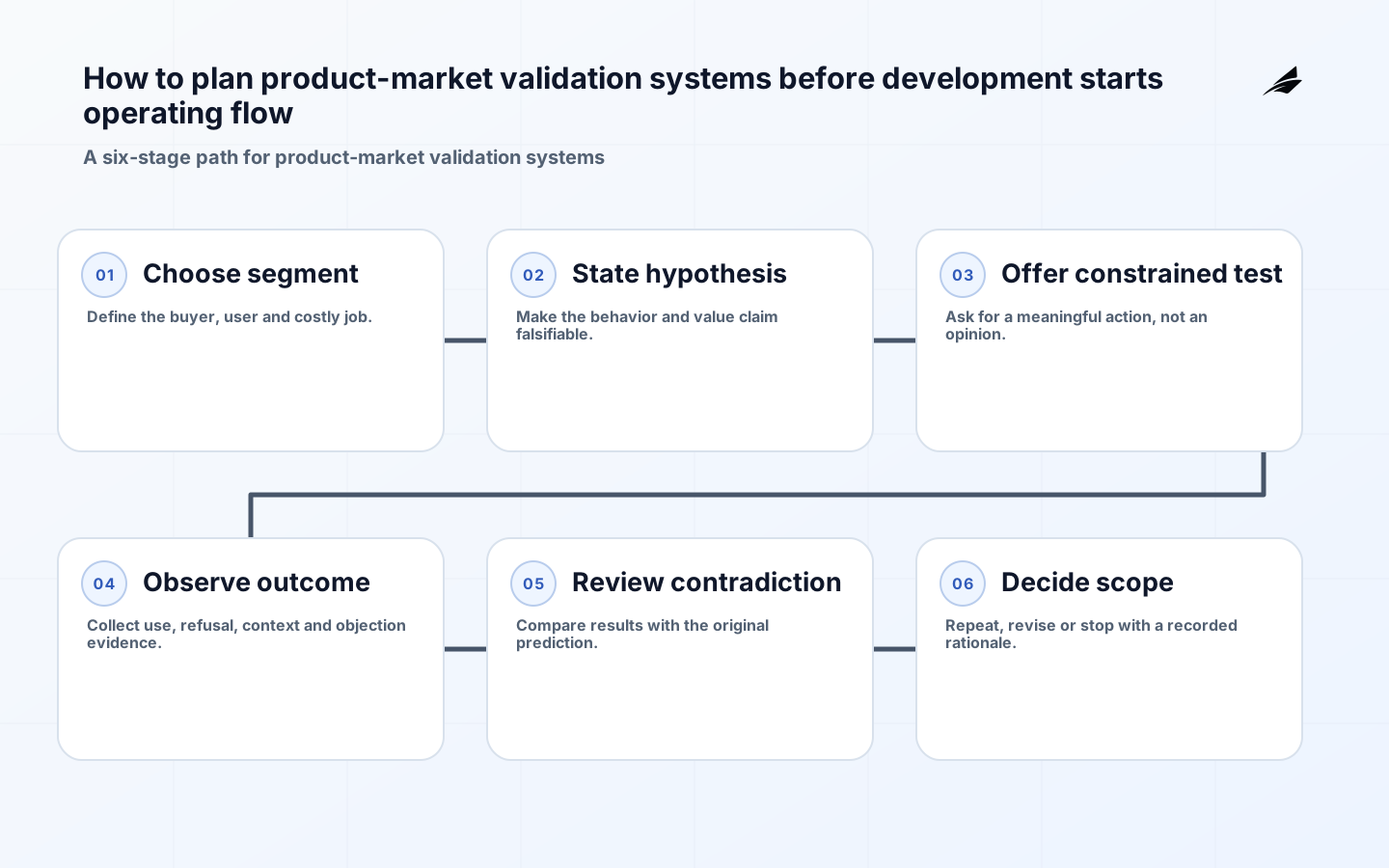
Product-market validation systems should be planned as an operating commitment, not a collection of screens or integrations. The useful first question is whether a service business can decide whether a specific buyer has a costly problem and will change behavior for a credible solution. Follow one buyer problem from its initial evidence through a constrained offer, use and decision review to the customer-visible or operator-visible result. Include the people who supply evidence, the service that applies a rule, the person who can make an exception, and the record that settles a disagreement. That walk-through exposes details that a feature list hides: stale data, missing authority, handoffs outside the product, and moments when an apparently simple decision can create a costly obligation. This guide gives product, engineering, support and commercial leaders a practical way to set the boundary before development starts, so a first release is understandable, recoverable and worth expanding.
Define the validation hypothesis
Write the boundary in one testable sentence: the team tests one segment, one job and one proposed outcome with evidence that could disconfirm the investment case. That sentence prevents the team from measuring activity instead of completion. Name the accountable business owner, the technical owner, the user who experiences the outcome and the escalation owner. Then collect recent examples: a normal case, a delayed case, a disputed case and a case that was resolved through a spreadsheet or chat. The aim is not to preserve every legacy variation; it is to discover which variation changes authority, money, access, customer trust or a regulated record. For product-market validation systems, define what is intentionally outside release one as carefully as what is inside. A narrow boundary lets the team test a complete route rather than release a polished fragment that creates more manual work.

| Planning question | Decision to record | Release evidence |
|---|---|---|
| Business outcome | a service business can decide whether a specific buyer has a costly problem and will change behavior for a credible solution | A before-and-after case showing rate of target buyers completing the meaningful test action. |
| Authoritative fact | the segment definition, observed problem, hypothesis, test offer, result and decision rationale | Owner, identifier, freshness expectation and correction path are documented. |
| Decision authority | a product or business owner who can change scope, price or stop the test | Approved policy and an auditable override route exist. |
| Failure boundary | a positive conversation is treated as demand, a pilot becomes an unpriced commitment or results are generalized beyond the segment | A named person can see, correct and explain the exception. |
Design a learning test that can change a decision
Design the decisions before the interface. For each transition, state the triggering fact, permitted actor, policy version, resulting state and notification. Treat the segment definition, observed problem, hypothesis, test offer, result and decision rationale as a business fact with a source and a history, rather than a field that any connected system can silently overwrite. A request should carry stable identifiers that let support reconstruct what happened without exposing unnecessary customer data. Make the ordinary route quick, but do not bypass the evidence that makes it safe. Ask for behavior that costs something: time, access to a current workflow, a pilot agreement, a changed process or payment. Separate what customers say they want from what they do when an alternative is available. Where automation evaluates a rule, store enough context to answer what it evaluated, when it did so and why the result changed. That is especially important when the first release later becomes a dependency for finance, sales or customer success.
- Describe the smallest complete buyer problem from interview or observed work through a constrained offer, use and decision review that proves a service business can decide whether a specific buyer has a costly problem and will change behavior for a credible solution.
- Give each state a plain-language meaning, owner and maximum age before attention is required.
- Keep customer research rules in a reviewable policy or configuration surface rather than scattered browser checks.
- Log an override with the actor, reason, before-and-after value and follow-up owner.
- Decide what a user sees when evidence is missing, a dependency is late or an action is denied.
Prove customer behavior, not interest
The delivery plan must prove behavior under ordinary pressure, not merely pass a demonstration. Build examples from real but safely handled records, including duplicates, retries, revoked authority, concurrent changes and a downstream timeout. Use a correlation identifier through the path so an operator can join the customer report, application event and corrective action. Use a consistent interview guide and test protocol, then preserve counter-evidence, refusals and the context that made a result non-comparable. Separate a reversible change from an irreversible commitment: a staged configuration, internal cohort or read-only result can reveal flaws before the system changes a customer entitlement, invoice, account boundary or public promise. The release owner should know the pause condition in advance and have a specific rollback or containment action, not just a generic instruction to investigate.
| Test condition | Expected behavior | Owner if it fails |
|---|---|---|
| Normal path | A defined buyer receives the test offer, performs the intended action and gives contextual outcome evidence. | Prototype delivery lead |
| Late or duplicate input | Repeated contact is linked to one research participant record and does not inflate demand. | Prototype delivery lead |
| Policy exception | A regulated or sensitive workflow is reviewed before any pilot uses real customer data. | Product discovery owner |
| Dependency loss | A missing implementation dependency narrows the test or delays it rather than changing the hypothesis silently. | Commercial or compliance owner |
Control research bias and premature commitment
Validation fails when teams reward encouraging signals and discard disconfirming evidence. It also fails when a bespoke pilot masks the repeatable product work that a future customer would need. Start with controls that improve the work itself: least-privilege access for operational tools, clear confirmation before consequential actions, bounded retention, and an exception queue with a service target. Avoid treating a dashboard as a control. A dashboard is useful only when a person knows which signal means harm, what authority they have to act and how the decision is recorded. For product-market validation systems, review the workflow with the people who handle support, billing, implementation or account changes. They will often identify the hidden dependency or ambiguous rule that a design review misses. The practical standard is simple: a trained colleague should be able to tell what happened, choose the next action and leave a defensible record.
- Limit sensitive problem evidence data to the roles that need it for the declared task.
- Make asynchronous processing visible; a pending state is safer than pretending completion.
- Exercise a positive conversation is treated as demand, a pilot becomes an unpriced commitment or results are generalized beyond the segment before launch with the owners who will take the call.
- Review policy changes as product changes, with a reason, approver and effective time.
- Remove temporary access, test data and dormant configuration once the rollout closes.
Measure validation strength
Measure the outcome and the cost of achieving it. Track the rate of target buyers completing the meaningful test action alongside conversion to a paid or renewed commitment and contradiction rate; speed without correctness can simply move the burden to customers or support. Define the numerator, denominator, time window, segment and exclusions before the first report. Pair aggregate telemetry with a small weekly review of completed and failed cases. The case review supplies the causal detail: an unclear policy, missing input, poor handoff or inappropriate automation. Use the findings to make a bounded decision: continue the cohort, repair one rule, add a review step, narrow the audience or retire a feature. That rhythm keeps product-market validation systems connected to a real operating result instead of a permanently growing backlog.
Key takeaways
- Product-market validation systems start with an accountable outcome and one complete journey, not a broad platform promise.
- Authoritative records, explicit states and visible exceptions make correction possible.
- A staged release needs a pause condition, a named owner and a rehearsed recovery action.
- Operational signals matter only when they are defined and connected to a decision.
- Expand after the first workflow can be explained and operated reliably by the teams who own it.
Frequently asked questions
What belongs in the first product-market validation systems release?
Include one complete, valuable route: buyer problem from interview or observed work through a constrained offer, use and decision review, its ordinary result, one meaningful exception and the support or administrator view needed to correct it. Include the minimum evidence that makes the result explainable, plus the monitoring and ownership required to pause safely. Exclude adjacent processes that use different authority, a different customer promise or a record whose owner is unsettled. A smaller release is not a weaker commitment; it is a way to learn whether the operating model is sound before multiplying its effects.
Which decisions should remain under human control?
For product-market validation systems, keep a named reviewer when the decision changes a contractual commitment, price, access, sensitive data, legal position or other hard-to-reverse outcome. Human review is also appropriate when inputs conflict, a policy has no explicit rule, or the request comes from outside the expected trust boundary. Automate detection, preparation and routine routing where the conditions are clear; make the person responsible for the final exception visible to the customer and to the team that must support it.
How soon can a team judge whether product-market validation systems are working?
Judge it after enough real cases exist to compare the normal path with the exception path, not after a launch-day demonstration. Set a review cadence before rollout and inspect a representative sample by customer segment and complexity. Look for a sustained improvement in rate of target buyers completing the meaningful test action without deterioration in conversion to a paid or renewed commitment and contradiction rate, plus evidence that people can resolve failure without an engineering rescue. When the measure and the case review disagree, investigate the cases; they usually reveal what the metric definition failed to capture.
Conclusion
Product-market validation systems earn trust when the team can follow one buyer problem from interview or observed work through a constrained offer, use, and decision review, with a correct, explainable outcome and a recoverable exception. Start with the boundary, record the decision rules, test unhappy paths and release with real ownership. Then use the rate of target buyers completing the meaningful test action, together with conversion to a paid or renewed commitment and the contradiction rate, to decide whether to expand. That approach creates a useful product capability: one that holds up when customers, operators and commercial commitments make the simple case less simple.