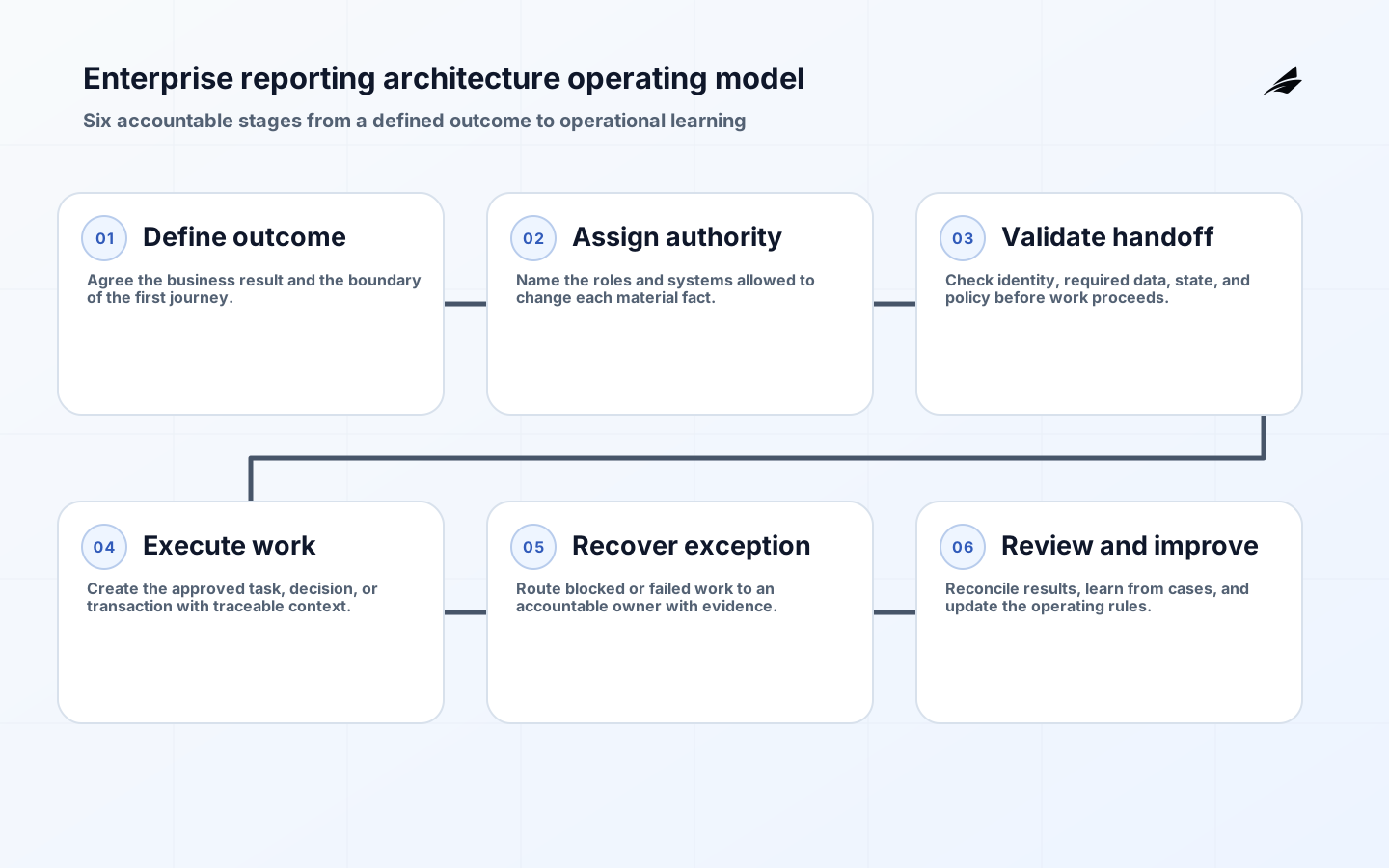
Enterprise reporting architecture is not a software-shopping exercise. It is the discipline of making sure a product or operating decision can be traced from a dashboard number to an agreed definition, authoritative source records, visible transformations, and a clear reporting period. Teams often first notice the need through a stalled handoff, a spreadsheet that has become a shadow system, or a report nobody can explain. The useful response is to model the work before configuring tools: name the customer or internal outcome, the people who make decisions, the records that prove progress, and the route when normal work cannot continue. A product leader reviewing activation should be able to distinguish an event that occurred from an account that became eligible, and should see which definition the trend uses before acting on it. The record ownership models guide is a useful companion when this work also depends on a durable definition of who owns a shared fact.
Define the operating outcome for enterprise reporting architecture
Begin with a bounded journey and describe its finish in language a person doing the work would recognise. For this subject, success means a product or operating decision can be traced from a dashboard number to an agreed definition, authoritative source records, visible transformations, and a clear reporting period. That statement is stronger than a requirement to “implement a platform” because it makes timing, evidence, and unresolved work observable. Interview product leader, data steward, analyst, system owner, finance partner, privacy or security reviewer, and report consumer with real examples from the last month. Ask what starts the journey, what information must be true, what can change after the start, who may approve the next step, and what a customer or colleague sees while the work is pending. Include an ordinary case and at least three difficult cases. The result should be a short operating narrative that the process owner can accept before any integration or automation design begins.
| Decision area | Working rule | Evidence to retain |
|---|---|---|
| Outcome boundary | State when enterprise reporting architecture begins, what completion means, and what remains outside the first release. | Named owner, representative cases, and acceptance criteria. |
| Participants | List the product leader, data steward, analyst, system owner, finance partner, privacy or security reviewer, and report consumer and the decision each role is permitted to make. | Role map and delegation limits. |
| Business records | Define authority and change rules for metric definition, reporting period, source dataset, transformation version, data-quality result, access policy, and published report. | Identifier, source, effective date, and status history. |
| Failure route | Describe how to handle a late source feed changes a daily metric, two teams use different definitions of an active customer, or a dashboard exposes a measure to an unauthorised audience. | Queue owner, service target, and closure decision. |
Map normal work and the edge cases
A process map is useful only when it captures decisions and waiting states, not just boxes labelled with systems. Follow one real item through the work. Mark the trigger, validations, handoffs, approvals, customer communications, and evidence created at each point. Then map the edge case: a late source feed changes a daily metric, two teams use different definitions of an active customer, or a dashboard exposes a measure to an unauthorised audience. A good map says whether the work may wait, proceed under a permitted contingency, be corrected, or be cancelled. It also separates an automated notification from a business decision. That distinction matters because a message can be delivered while the underlying record is invalid, duplicated, or unauthorised. Use stable identifiers from the first step so support staff can connect a question to the exact request, change, and outcome.
Do not assume that the current sequence is the desired design. Some steps exist only because a system cannot see a necessary fact, while others are controls that must remain. Test every step with two questions: what risk or value does it address, and where is that decision evidenced? Removing needless re-entry is worthwhile; quietly removing a review of sensitive data, money, or a customer commitment is not. This is where enterprise reporting architecture becomes operational design rather than a collection of forms. A small first journey gives the team a shared object for discussing policy, staffing, capacity, and integration behaviour.
Assign record authority and change rights
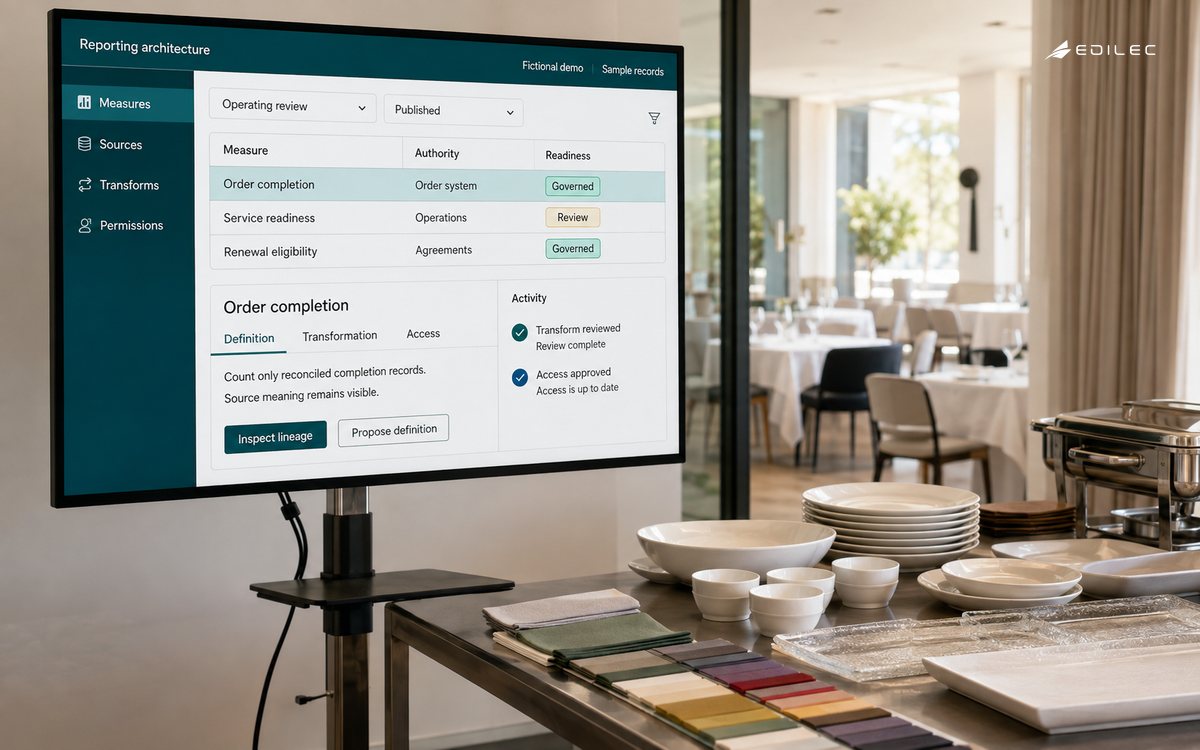
Trust breaks down when several applications appear to own the same fact. Create a register for metric definition, reporting period, source dataset, transformation version, data-quality result, access policy, and published report. For each, name the authoritative system or process, the person accountable for the definition, the identifier used across boundaries, the allowed changes, and the effectivity rule. A receiving system may keep a local projection for speed, search, or work management, but a copy should not silently become an authority. Preserve the original source reference and the time of observation. This approach aligns with the provenance concepts in the W3C PROV-O model: an organisation can explain what information informed a result and what activity produced it, without treating a report as the original transaction.
Design handoffs, permissions, and controls together
Every handoff needs a contract that a process owner and an engineer can both inspect. Specify the trigger, required values, allowed states, source reference, duplicate behaviour, expected acknowledgement, and response to rejection. For enterprise reporting architecture, a receiver should never have to infer whether a message represents a new instruction, a correction, or a replay. Pair that contract with access rules: verify the identity and context of the actor or service, allow only the action required, and log material decisions. NIST SP 800-47 is especially relevant when systems are interconnected because it frames security as part of the agreement and lifecycle, rather than a late check after connectivity is built.
| Condition | Expected behaviour | Accountable owner |
|---|---|---|
| Incomplete input | Reject or hold the work with a reason that the originating team can act on. | Source process owner |
| Duplicate or replayed delivery | Recognise the prior business action and avoid creating a second commitment. | Receiving system owner |
| Dependency unavailable | Use a monitored recovery route only where delayed processing is acceptable. | Operations or integration owner |
| Sensitive or high-impact action | Require the defined role, approval, and audit event before completion. | Business control owner |
Build enterprise reporting architecture for exceptions, not only completion
An exception queue is part of the product, not an afterthought for technical support. Each case should expose the failed step, reason, priority, source context, current owner, permitted next actions, and a clear way to close the loop. In this domain, a representative exception is a late source feed changes a daily metric, two teams use different definitions of an active customer, or a dashboard exposes a measure to an unauthorised audience. Classify patterns so the team can distinguish a temporary dependency failure from a policy decision, bad data, or a process design gap. Do not grant background jobs unrestricted repair powers: a retry or compensation can affect money, access, inventory, or a customer promise. NIST's incident-response guidance reinforces a useful operating habit here: prepare, detect, respond, recover, and learn. Apply that loop proportionately to business-process failures as well as security events.
Measure work in a way operators can improve
Choose a small scorecard before release, define each measure's population and exclusions, and review it with representative cases. For enterprise reporting architecture, track share of priority metrics with an owner and documented definition, freshness against the promised update time, reconciliation differences, and decisions deferred because evidence was unclear. A number without a definition invites argument, so retain the source, calculation version, reporting period, and owner. Pair quantitative review with a sample of completed and repaired work. That combination reveals misleading green dashboards, such as a low technical error rate while work sits unassigned or customers wait for an update. Avoid measuring activity alone. More routed tasks, more messages, or more dashboard views do not demonstrate a better outcome unless they reduce delay, rework, avoidable risk, or ambiguity for the people affected.
Release in stages and rehearse recovery
Start enterprise reporting architecture with the smallest journey that contains the important control and recovery decisions. Use realistic records, including changes, missing information, duplicate requests, late events, unauthorised attempts, and a cancellation. Agree who can pause or roll back the release, who watches the queue, and how users get help. Provide short role-specific practice using the actual terms and states people will see. After release, compare the expected result with real cases and revise the workflow, policy, or data definition with an owner and date. A staged approach does not mean postponing hard questions; it means answering them clearly for one journey before multiplying them across every department.
Key takeaways
- Define enterprise reporting architecture by the business outcome it must make dependable, not by a feature list.
- Map normal work with a late source feed changes a daily metric, two teams use different definitions of an active customer, or a dashboard exposes a measure to an unauthorised audience before choosing automation or integration scope.
- Assign authority, identifiers, and change rights for metric definition, reporting period, source dataset, transformation version, data-quality result, access policy, and published report.
- Make handoff contracts explicit about validation, duplicates, delay, rejection, and acknowledgement.
- Give exceptions a visible owner, enough context to decide safely, and an evidence trail.
- Review share of priority metrics with an owner and documented definition, freshness against the promised update time, reconciliation differences, and decisions deferred because evidence was unclear with real cases and assign improvements to people who can make them.
Frequently asked questions
Where should a first enterprise reporting architecture release start? Start with a journey that is important, repeated, and currently hard to explain: one that crosses at least two roles but is small enough to observe end to end. Baseline the current case volume, waiting points, and repair work. The aim is not to pick the most visible screen; it is to learn whether record authority, decision rights, and recovery are workable before broadening the change.
Can every step in enterprise reporting architecture be automated? No. Automate predictable collection, validation, routing, and reminders where the inputs and policy are sufficiently clear. Keep human authority where judgement, customer impact, regulated decisions, material financial consequences, or uncertain evidence are involved. Automation should make the relevant context and rule version visible to the person who must decide, rather than presenting an unexplained outcome.
How do we know whether the design is working? Look for a complete and explainable result: people can find the current owner, understand the next allowed action, and trace a completed or repaired case to its source facts and decision. Then compare the agreed measures with real cases. enterprise reporting architecture guide offers a related deeper treatment of the same operating pattern.
Conclusion: make enterprise reporting architecture accountable
Enterprise reporting architecture becomes valuable when it turns an important journey into work that is visible, controlled, and recoverable. Begin with a product or operating decision can be traced from a dashboard number to an agreed definition, authoritative source records, visible transformations, and a clear reporting period; make the records, decisions, and exceptions concrete; and release only after the team can test both the result and the evidence behind it. That keeps the programme grounded in service and operations rather than software motion. Once the first journey has stable ownership and a credible review rhythm, extend the same discipline to the next one.