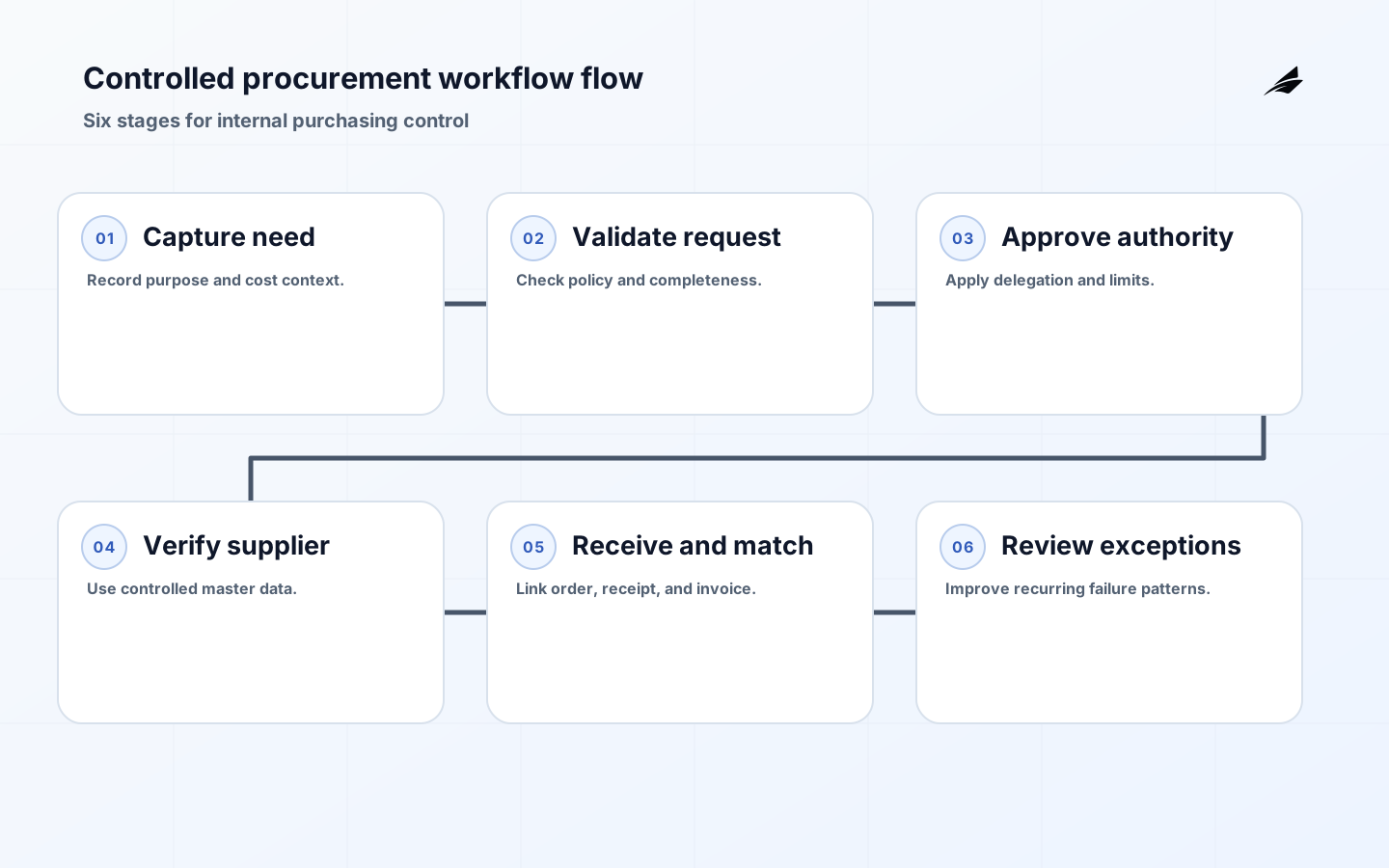
A procurement workflow software checklist for internal operations should begin with the purchase decision, not a catalogue screen. Follow a recent request from a business need through budget review, supplier selection, approval, purchase order, receipt, invoice, and close. Identify where people email documents, split a request to avoid a threshold, create a supplier without verification, or approve their own purchase. These are workflow design facts. The system should make legitimate work easier while preserving evidence for commitments, funds, goods, and exceptions. A good first scope is one buying category with a known owner and a manageable set of approval and receiving rules.
Define the procurement policy as executable decisions
Translate policy into decisions a requester and approver can understand. State which purchases require a request, competitive sourcing, budget check, security or privacy review, contract review, and delegated approval. Include thresholds, currencies, emergency rules, and conflict-of-interest handling. Keep the policy owner responsible for the rule while the system owner implements it. Avoid a single 'approved' state that hides whether a request is waiting for budget, manager, procurement, legal, or a supplier correction. Clear states reduce chasing and provide a fair record when a requester asks why work has paused.
| Control point | Workflow decision | Evidence retained |
|---|---|---|
| Need | Is the request complete and in scope? | Business justification and cost centre. |
| Authority | Who may approve this amount and category? | Delegation rule and decision record. |
| Supplier | Is the supplier verified and eligible? | Master-data review and due-diligence status. |
| Receipt | Did goods or services arrive as committed? | Receiver confirmation and discrepancy detail. |
Build request and approval states that match the work
Use a stable request identifier and preserve the requester, purpose, cost centre, amount, supporting evidence, requested date, and linked supplier or contract. Route based on attributes that policy actually recognizes, not informal seniority. A manager may verify need, finance may verify funds, procurement may verify source, and a specialist may assess security or legal risk. Show each approver the information needed for that decision and prevent silent reassignment. When a request changes materially after approval, decide whether to reapprove and make that rule visible. This is more reliable than asking people to remember when an email thread became outdated.
Govern supplier and financial data at the source
Supplier records deserve controlled creation and change because a bad bank detail, duplicate supplier, or ambiguous tax record can become a payment and fraud risk. Separate the person requesting a supplier from the person validating sensitive supplier changes. Match supplier identifiers across purchasing and finance systems, and retain effective dates and verification evidence. Limit access to payment details and exports. For catalogue items and contracts, identify the owner, validity period, negotiated terms, and approved substitutes. Procurement workflow software works best when it publishes dependable master data instead of letting each requester recreate the supplier context.
| Exception | Immediate route | Preventive response |
|---|---|---|
| Urgent purchase | Use a documented emergency path with after-the-fact review. | Track reason and tighten recurring emergency causes. |
| Price differs from order | Hold matching and assign buyer or requester review. | Update catalogue, contract, or receiving practice. |
| Goods not received | Keep invoice payment blocked or explicitly approved. | Investigate delivery evidence and supplier performance. |
| Supplier bank change | Require independent verification before release. | Monitor changes and review access rights. |
Link receiving, invoice, and exception work
The workflow should not end at approval. Define what counts as receipt for physical goods, subscriptions, professional services, and staged deliverables. Link the receipt to the purchase order and invoice so mismatches become visible work rather than accounting cleanup. Set tolerance rules deliberately, including who may accept a price or quantity difference. For a dispute, preserve the original request, approval, order, receipt, invoice, and communications under one correlation identifier. This lets finance close a period with evidence and gives procurement a usable picture of supplier and process performance.

Operate and improve the workflow
Measure cycle time by state, approval rework, emergency-path use, catalogue adoption, unmatched invoices, supplier duplicates, and aged exceptions. Pair these with a sample review: a fast approval may still be poor if it bypassed essential information. Run a regular review with policy owners, requesters, buyers, finance, and system administrators. Use it to decide which bottleneck is a legitimate control and which is an avoidable handoff. Change workflow rules through a controlled release process and test threshold boundaries, delegation changes, and failure routes before publishing them.
Implementation checklist
- Map the request-to-payment journey with the people who perform it.
- Make approval authority and state transitions explicit.
- Control supplier creation, sensitive changes, and financial-data access.
- Connect receipt and invoice matching to the original commitment.
- Route emergencies and mismatches to owned, visible exceptions.
- Review rework, delays, and control bypasses as operating evidence.
Frequently asked questions
Should low-value purchases skip approval? They may use a lighter path, but the rule should still identify the buyer, category, budget context, and evidence required. A low value does not remove supplier, security, or conflict-of-interest considerations. Design a proportional workflow rather than one universal form.
Can an approver delegate during leave? Yes, through a recorded delegation with scope and dates. Do not solve absence by sharing accounts or forwarding approval links. Temporary authority should be visible to requesters and available for later review.
Implementation evidence worksheet
- Procurement workflow checkpoint 1: Write the business outcome in one sentence and name the person who can accept that outcome on behalf of the organization.
- Procurement workflow checkpoint 2: List every material state, its entry condition, its permitted next states, and the evidence that proves a change is legitimate.
- Procurement workflow checkpoint 3: Create a field register for identifiers, effective dates, owner, sensitivity, source, consumer, and correction route before configuring automation.
- Procurement workflow checkpoint 4: Run a normal case and a deliberately incomplete case with the people who will operate the process; capture every manual step and undocumented decision.
- Procurement workflow checkpoint 5: For every handoff, state what the sender guarantees, what the receiver validates, how duplicate delivery is handled, and who owns a rejection.
- Procurement workflow checkpoint 6: Define a customer-safe or requester-safe status for each delay so frontline staff can explain progress without exposing internal notes or speculation.
- Procurement workflow checkpoint 7: Prepare a reconciliation that compares counts, material values, state, and age between the initiating record and the resulting operational record.
- Procurement workflow checkpoint 8: Choose thresholds that open owned work rather than merely sending alerts; record the queue, service target, escalation point, and recovery authority.
- Procurement workflow checkpoint 9: Test a failed dependency, an out-of-order update, an unauthorized action, and a correction after downstream work has begun; retain the resulting evidence.
- Procurement workflow checkpoint 10: Document which roles may read, change, approve, export, administer, or override the process, including temporary access and delegated authority.
- Procurement workflow checkpoint 11: Keep original context when a fact is corrected: prior value, source, time, actor or process, reason, approving authority, and correlation identifier.
- Procurement workflow checkpoint 12: Publish the smallest useful contract for each interface or report: purpose, scope, required inputs, freshness expectation, limits, owner, and support route.
- Procurement workflow checkpoint 13: Rehearse a support conversation around a confusing or delayed case so the communication path is as deliberate as the technical recovery path.
- Procurement workflow checkpoint 14: Inspect a sample of completed cases for evidence quality, not only elapsed time; a quick result that cannot be explained is not an operational success.
- Procurement workflow checkpoint 15: Set a release decision with explicit go, hold, and rollback criteria, and identify who can make each decision when information is incomplete.
- Procurement workflow checkpoint 16: Use a short post-release review cadence that pairs operational measures with a few real cases and records a single accountable improvement for each finding.
- Procurement workflow checkpoint 17: Version rules, definitions, mappings, and approval thresholds. Explain historical comparison breaks rather than silently replacing prior meaning.
- Procurement workflow checkpoint 18: Minimize the data carried into the workflow or view, and review access, retention, sharing, and export behavior against the stated business purpose.
- Procurement workflow checkpoint 19: Identify the workaround that experienced staff use today, then decide whether the target design should formalize, retire, or replace it with an owned exception.
- Procurement workflow checkpoint 20: Give every exception a stable identifier, severity, current state, next action, accountable owner, and a link to the business record it affects.
- Procurement workflow checkpoint 21: Confirm training with hands-on completion of a real task and an exception, rather than attendance alone; update the runbook from what the exercise reveals.
- Procurement workflow checkpoint 22: Review recurring overrides and repeated corrections as design evidence. They often signal unclear policy, bad data, missing capacity, or a brittle integration.
- Procurement workflow checkpoint 23: Protect audit and operating evidence from routine cleanup. Retention and retrieval instructions should let a future reviewer reconstruct a material decision.
- Procurement workflow checkpoint 24: End the implementation review by deciding what evidence would prove the next expansion is safe, useful, and supportable for the people doing the work.
Key takeaways
- Procurement systems should model commitments from request through receipt and invoice.
- Approval rules need policy owners, clear states, and recorded delegation.
- Supplier master data is a financial and operational control surface.
- Exceptions reveal where policy or workflow needs improvement.
Conclusion
Procurement workflow software strengthens internal operations when it makes buying legitimate work, authority, and evidence visible from need to payment. Start with a bounded category, make exceptions owned, and connect approvals to actual receipt. That produces a process people can use quickly without turning important control decisions into invisible email traffic.