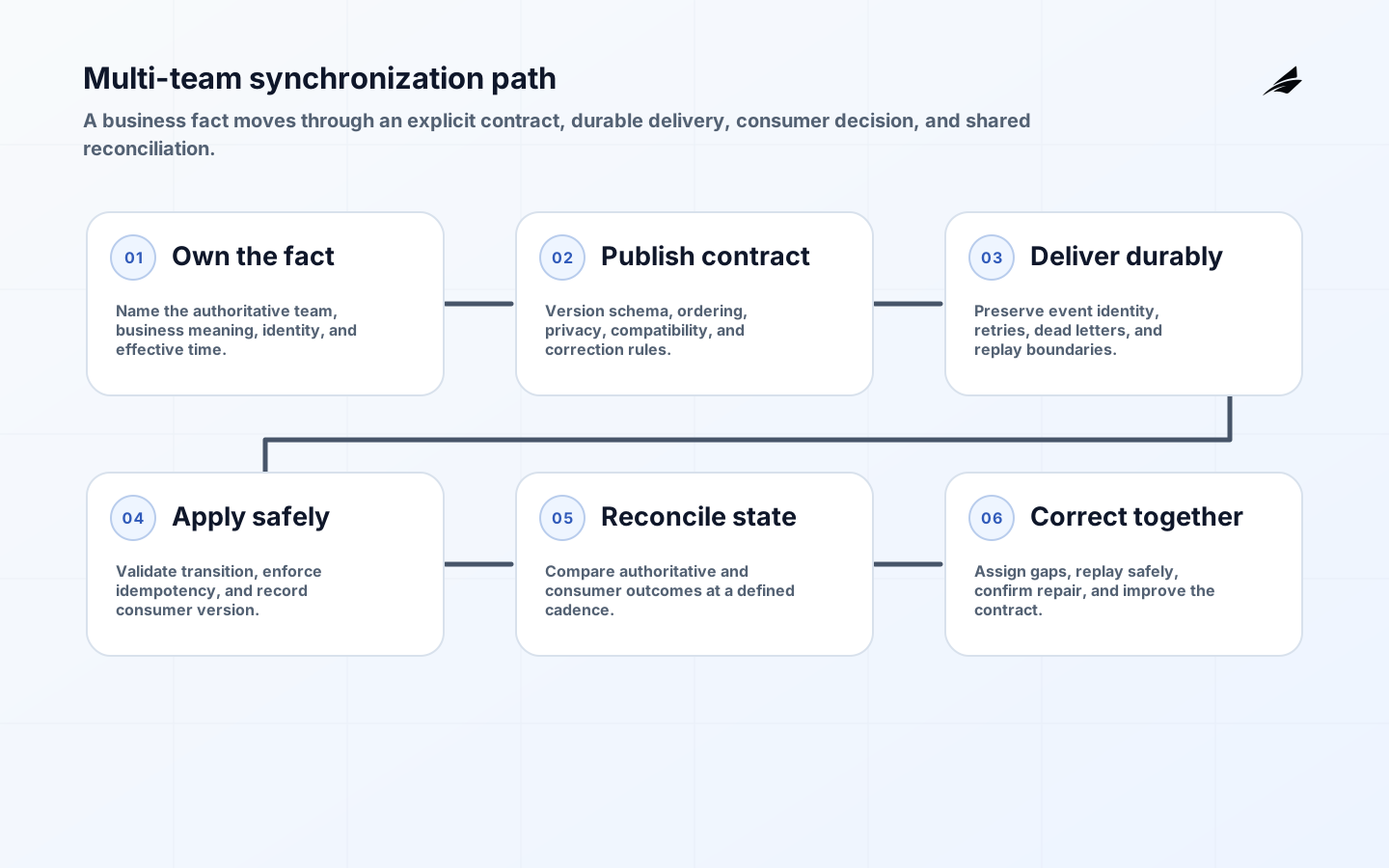
A data synchronization between teams checklist for multi-team delivery begins by naming the business commitment that crosses the boundary. It may be a customer entitlement, product availability, delivery status, employee change, or approved purchase. Follow a recent example through the people and systems that create, publish, consume, correct, and report it. Ask which version a receiving team may rely on, how quickly, and who notices when it does not arrive. This grounds integration work in accountable operations rather than an abstract goal of keeping databases identical.
Name the facts, states, and authority
Give each shared fact a stable identifier, owner, source, permitted editors, effective time, and meaningful state model. A source-of-truth statement should be specific enough to resolve a disagreement: one system may own a product definition while another owns availability, and both may be needed to sell. Separate proposed, accepted, fulfilled, cancelled, and corrected states. Avoid a generic pending label that hides whether work lacks information, an external confirmation, or a policy decision. Ownership includes the authority to correct and the responsibility to explain the rule, not merely the ability to update a field.

| Contract item | Question | Evidence |
|---|---|---|
| Business event | What causes publication? | Event name and initiating state. |
| Payload | What minimum fields are needed? | Schema, identifier, and classification. |
| Delivery | When is receipt complete? | Acknowledgement and freshness target. |
| Recovery | Who owns rejection or conflict? | Exception queue and response target. |
Publish an event contract with failure behavior
Specify event version, required and optional values, allowed states, ordering assumptions, duplicate handling, authorization, and receiver behavior. Use correlation and idempotency identifiers so retries do not create a second entitlement or request. Send only the data required for the receiving purpose. A synchronous check can be appropriate when a user needs an immediate decision, but an asynchronous flow still needs durable acceptance and visible status. Include what happens when a receiver rejects a change, cannot process it, or is unavailable. Failure behavior is the part of the contract that makes multi-team delivery safe.
Reconcile shared outcomes instead of assuming delivery
Design reconciliation from the first release. Compare counts, material values, states, and age between source and destination for a clear time window. Classify differences: not yet due, delayed, duplicate, rejected, manually corrected, or unexplained. Assign each unexplained difference to an owner with sufficient context to act. Preserve original payload, attempts, receiving response, and relevant source history. Reconciliation is not a sign that an integration failed; it is the normal control that proves a distributed workflow is still producing the intended business outcome.
| Difference | Immediate action | Learning signal |
|---|---|---|
| Duplicate event | Apply idempotent processing and retain attempt history. | Producer retry or key design issue. |
| Stale destination | Expose freshness and route delayed work. | Capacity or dependency constraint. |
| Rejected record | Keep source fact and open repair work. | Contract or data-quality gap. |
| Conflicting correction | Protect authority and escalate decision. | Unclear ownership or policy. |
Operate across team boundaries
Use a joint operating rhythm for high-value flows. Review delivery lag, rejection rate, reconciliation backlog, manual corrections, and business impact with both source and receiving owners. Do not make one team file opaque tickets into another. An exception should name the fact, source, destination, state, correlation identifier, severity, and accountable next action. Test a dependency outage, an out-of-order event, a replay, a schema change, and an unauthorized request before expanding scope. These tests establish trust between teams because they demonstrate how the shared system behaves when ordinary conditions are imperfect.
Delivery checklist
- Define the business fact, state model, owner, and correction authority.
- Publish a versioned contract with duplicate, delay, rejection, and authorization behavior.
- Use stable correlation and idempotency identifiers across handoffs.
- Reconcile counts, states, values, and age on an agreed cadence.
- Route unexplained differences to named owners with full context.
- Review cross-team failure patterns and improve the contract together.
Frequently asked questions
Must every shared fact update in real time? No. Set freshness based on the decision and customer consequence. Some reporting can tolerate a daily view, while an entitlement used at checkout may require a much tighter target. State the target and show users when it is not being met.
Who owns an integration incident? Technical teams own the health of their components, but the business owner remains accountable for the customer or operational consequence. A useful incident process brings both roles together and gives the receiving team an explicit status rather than leaving them to infer it.
Implementation evidence worksheet
- Team data synchronization checkpoint 1: Write the business outcome in one sentence and name the person who can accept that outcome on behalf of the organization.
- Team data synchronization checkpoint 2: List every material state, its entry condition, its permitted next states, and the evidence that proves a change is legitimate.
- Team data synchronization checkpoint 3: Create a field register for identifiers, effective dates, owner, sensitivity, source, consumer, and correction route before configuring automation.
- Team data synchronization checkpoint 4: Run a normal case and a deliberately incomplete case with the people who will operate the process; capture every manual step and undocumented decision.
- Team data synchronization checkpoint 5: For every handoff, state what the sender guarantees, what the receiver validates, how duplicate delivery is handled, and who owns a rejection.
- Team data synchronization checkpoint 6: Define a customer-safe or requester-safe status for each delay so frontline staff can explain progress without exposing internal notes or speculation.
- Team data synchronization checkpoint 7: Prepare a reconciliation that compares counts, material values, state, and age between the initiating record and the resulting operational record.
- Team data synchronization checkpoint 8: Choose thresholds that open owned work rather than merely sending alerts; record the queue, service target, escalation point, and recovery authority.
- Team data synchronization checkpoint 9: Test a failed dependency, an out-of-order update, an unauthorized action, and a correction after downstream work has begun; retain the resulting evidence.
- Team data synchronization checkpoint 10: Document which roles may read, change, approve, export, administer, or override the process, including temporary access and delegated authority.
- Team data synchronization checkpoint 11: Keep original context when a fact is corrected: prior value, source, time, actor or process, reason, approving authority, and correlation identifier.
- Team data synchronization checkpoint 12: Publish the smallest useful contract for each interface or report: purpose, scope, required inputs, freshness expectation, limits, owner, and support route.
- Team data synchronization checkpoint 13: Rehearse a support conversation around a confusing or delayed case so the communication path is as deliberate as the technical recovery path.
- Team data synchronization checkpoint 14: Inspect a sample of completed cases for evidence quality, not only elapsed time; a quick result that cannot be explained is not an operational success.
- Team data synchronization checkpoint 15: Set a release decision with explicit go, hold, and rollback criteria, and identify who can make each decision when information is incomplete.
- Team data synchronization checkpoint 16: Use a short post-release review cadence that pairs operational measures with a few real cases and records a single accountable improvement for each finding.
- Team data synchronization checkpoint 17: Version rules, definitions, mappings, and approval thresholds. Explain historical comparison breaks rather than silently replacing prior meaning.
- Team data synchronization checkpoint 18: Minimize the data carried into the workflow or view, and review access, retention, sharing, and export behavior against the stated business purpose.
- Team data synchronization checkpoint 19: Identify the workaround that experienced staff use today, then decide whether the target design should formalize, retire, or replace it with an owned exception.
- Team data synchronization checkpoint 20: Give every exception a stable identifier, severity, current state, next action, accountable owner, and a link to the business record it affects.
- Team data synchronization checkpoint 21: Confirm training with hands-on completion of a real task and an exception, rather than attendance alone; update the runbook from what the exercise reveals.
- Team data synchronization checkpoint 22: Review recurring overrides and repeated corrections as design evidence. They often signal unclear policy, bad data, missing capacity, or a brittle integration.
- Team data synchronization checkpoint 23: Protect audit and operating evidence from routine cleanup. Retention and retrieval instructions should let a future reviewer reconstruct a material decision.
- Team data synchronization checkpoint 24: End the implementation review by deciding what evidence would prove the next expansion is safe, useful, and supportable for the people doing the work.
Make time, order, and correction explicit
Synchronization contracts need at least three kinds of time: when the business fact became effective, when the source recorded it, and when the integration published it. A consumer may receive a correct event late, receive retries out of order, or rebuild from a snapshot created at another time. Include a stable event identity, business-object identity, schema version, source, effective time, recorded time, and sequence or version where the domain supports one. Consumers should reject impossible transitions and preserve evidence needed to explain their current state.
| Delivery condition | Consumer behavior | Cross-team evidence |
|---|---|---|
| Duplicate event | Apply idempotently and retain the original business result | Event identity, consumer decision, and resulting record version |
| Out-of-order update | Compare effective version or sequence before applying | Received order, accepted order, and conflict rule |
| Missing predecessor | Pause or request recovery instead of inventing state | Gap identity, retry or replay request, and owner |
| Schema change | Accept a compatible version or route to a visible failure path | Producer version, consumer support window, and migration plan |
| Correction or deletion | Propagate the governed correction while preserving required lineage | Authority, effective time, affected consumers, and acknowledgement |
A standard envelope can reduce transport ambiguity but cannot define business meaning. CloudEvents specifies common event metadata, and AsyncAPI supports machine-readable asynchronous interface contracts. Teams still need to agree what happened, who may assert it, whether it is a fact or command, what consumers may infer, and how corrections work. The W3C PROV-O recommendation offers useful concepts for describing entities, activities, agents, and provenance.
Use Edilec guides to enterprise event bus architecture, data synchronization planning, and the multi-team synchronization operating guide. These resources help producers and consumers define one recovery model rather than accumulating private retry scripts.
Security and privacy requirements travel with synchronized facts. The NIST Cybersecurity Framework 2.0 can help teams assign governance, protection, detection, response, and recovery outcomes across producers and consumers. The NIST Privacy Framework is useful when event payloads expose personal data, derived attributes, or deletion obligations. Minimize payloads, restrict subscriptions, define retention, and ensure replay tooling cannot become an ungoverned bulk export path.
Key takeaways
- Synchronize accountable business facts, not indiscriminate database copies.
- A contract needs failure behavior as well as a happy path.
- Reconciliation provides proof that distributed work remains aligned.
- Joint reviews turn cross-team incidents into design improvements.
Conclusion
Data synchronization between teams works when authority, delivery evidence, and recovery are clear to everyone who depends on the fact. Start with one consequential commitment, publish the contract, reconcile the result, and operate exceptions together. That is the foundation for faster multi-team delivery without hidden data debt.