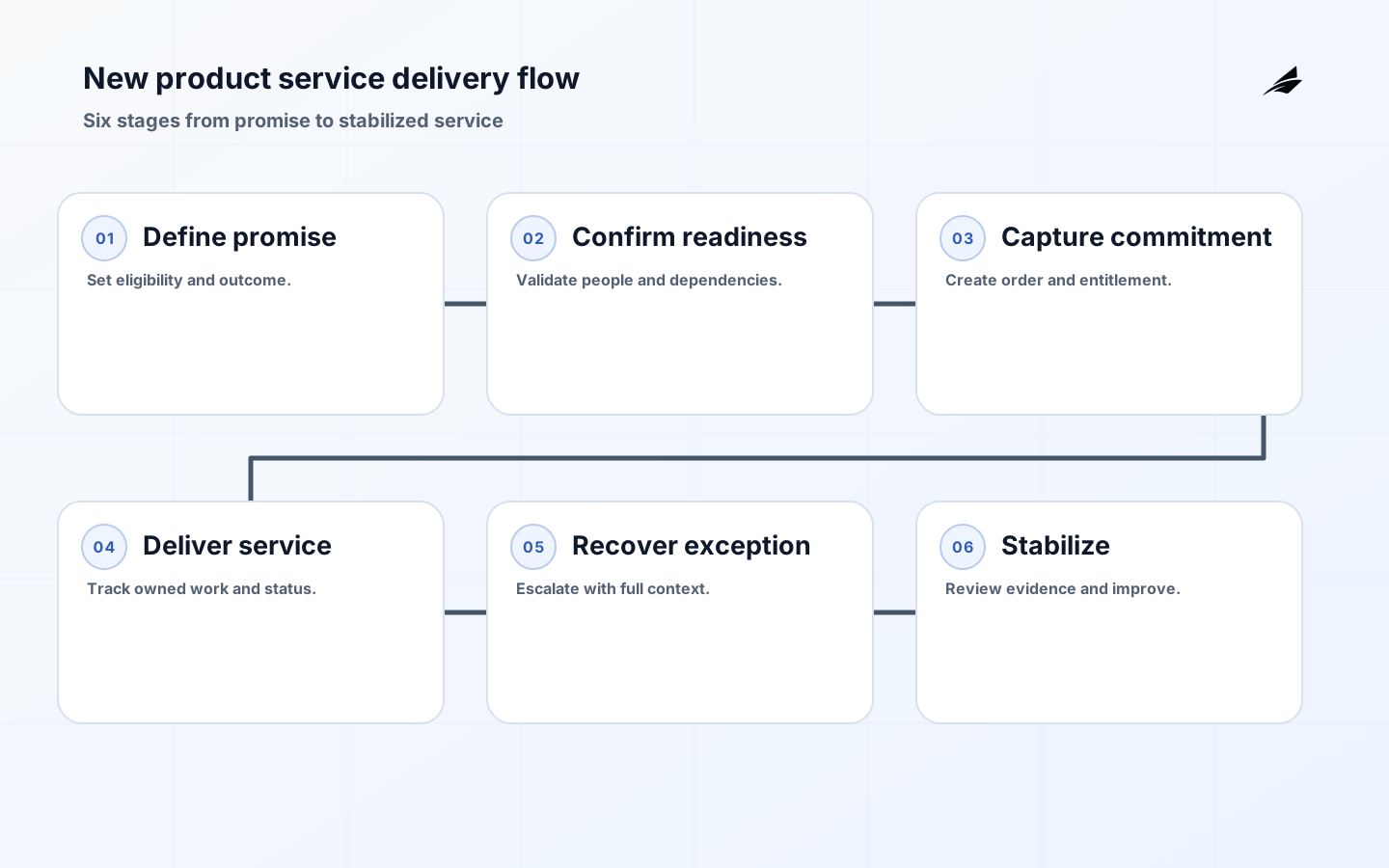
A service delivery management systems checklist for a new product launch protects the moment when a commercial promise becomes real customer work. Product launches often reach sales enablement before service teams know what qualifies for delivery, who owns an exception, or what a customer should see when a dependency slips. Begin with a single sell-to-serve journey: quote or order, entitlement, onboarding or fulfilment, ongoing service, and closure. Ask the teams doing the work to identify the inputs they need, the decisions they may make, and the evidence that proves the promise was met. This is the launch system, regardless of how many applications support it.
Define the service promise in operational terms
Translate product language into observable commitments. State the eligible customer, included outcome, exclusions, target time, prerequisites, handoff points, and customer communications. A phrase such as 'priority onboarding' is not operable until it specifies the starting event, the responsible queue, and what happens when information is incomplete. Give the service owner authority to accept or pause work under documented conditions. This prevents sales, product, and delivery from each carrying a different version of the launch. The first release should target a bounded customer segment and a service path the organization can monitor end to end.
| Launch fact | Decision needed | Evidence |
|---|---|---|
| Offer eligibility | Which customer and contract qualify? | Approved rule, effective date, and identifier. |
| Delivery start | What event starts the service clock? | Order, entitlement, and prerequisite check. |
| Completion | What proves the promised outcome occurred? | Confirmed milestone and customer notice. |
| Exception | Who can vary the promise or compensate? | Delegated approval and case history. |
Build readiness across the delivery chain
List the people, records, tools, and external dependencies needed for a normal case. Then test whether they are ready together. Service agents need training and a route to product expertise; implementation staff need capacity and validated inputs; finance needs a clear billing trigger; security or privacy reviewers need to know what customer data changes; and engineering needs monitored interfaces. Publish a concise runbook that links the service promise to the workflow. Avoid hiding requirements in slide decks. The frontline team should be able to see a case state, its next action, and the owner when a prerequisite fails.
Make commercial and service handoffs observable
Use stable customer, order, product, and entitlement identifiers across systems. At each handoff, record sender, receiver, time, accepted state, rejection reason, and correlation identifier. Define whether the receiving team must acknowledge immediately or may accept asynchronous delivery. A handoff is not complete when a message leaves an application; it is complete when the receiver has the information and authority required to begin. Reconcile daily during launch between sold, entitled, started, completed, cancelled, and exception cases. This catches the uncomfortable gaps where a customer was promised something no delivery queue can see.

| Launch failure | Immediate handling | Longer-term fix |
|---|---|---|
| Order lacks prerequisite | Hold with a customer-safe explanation and owner. | Improve sales validation and order guidance. |
| Entitlement not created | Open a high-priority reconciliation case. | Repair contract and integration controls. |
| Capacity is exhausted | Apply an approved waitlist or escalation policy. | Revise forecast and eligibility controls. |
| Customer disputes outcome | Preserve evidence and route to accountable review. | Update service definition or training if pattern recurs. |
Rehearse launch day and the first exception
Run a tabletop and a hands-on rehearsal using realistic customer cases. Include an eligible customer, an ineligible request, a delayed dependency, a duplicate order, a sensitive-data concern, and an urgent escalation. Confirm that teams can find the same authoritative status, contact the correct decision maker, and communicate without inventing policy in the moment. Decide in advance who can pause new intake and who may authorize a workaround. A rehearsal is successful when it reveals missing ownership early, not when every participant reads their expected line.
Learn during stabilization rather than declaring launch complete
For the first operating period, hold a short cross-functional review at a predictable cadence. Inspect volume, time to start, time to completion, aged work, rework, exception categories, customer contacts, and material overrides. Pair the measures with case narratives so a good average does not conceal a harmed customer segment. Each observation should result in an owner and a change hypothesis. Gradually move from launch command rhythms to normal service governance once the team can reconcile commitments and resolve exceptions without special coordination.
Launch checklist
- Write the service promise with eligibility, completion, exclusions, and authority.
- Validate people, capacity, data, tools, and dependencies as one delivery chain.
- Record commercial-to-service handoffs with identifiers and rejection behavior.
- Rehearse routine and consequential exception cases with frontline teams.
- Reconcile sold, entitled, started, and completed work during launch.
- Use stabilization reviews to turn evidence into owned improvements.
Frequently asked questions
Should service operations join product planning before the launch date is fixed? Yes. Service feasibility can change the honest launch scope, especially when a product requires new expertise, external coordination, or a sensitive customer-data flow. Bringing delivery owners in early does not slow product work; it lets the team define a promise that can actually be kept.
What is the smallest useful launch dashboard? Show the count and age of commitments at each state, the top exception types, service capacity, and customer-impacting failures. Make sure every signal has an owner who can act. A launch dashboard should help a team decide, not provide an impressive retrospective.
Implementation evidence worksheet
- Service launch checkpoint 1: Write the business outcome in one sentence and name the person who can accept that outcome on behalf of the organization.
- Service launch checkpoint 2: List every material state, its entry condition, its permitted next states, and the evidence that proves a change is legitimate.
- Service launch checkpoint 3: Create a field register for identifiers, effective dates, owner, sensitivity, source, consumer, and correction route before configuring automation.
- Service launch checkpoint 4: Run a normal case and a deliberately incomplete case with the people who will operate the process; capture every manual step and undocumented decision.
- Service launch checkpoint 5: For every handoff, state what the sender guarantees, what the receiver validates, how duplicate delivery is handled, and who owns a rejection.
- Service launch checkpoint 6: Define a customer-safe or requester-safe status for each delay so frontline staff can explain progress without exposing internal notes or speculation.
- Service launch checkpoint 7: Prepare a reconciliation that compares counts, material values, state, and age between the initiating record and the resulting operational record.
- Service launch checkpoint 8: Choose thresholds that open owned work rather than merely sending alerts; record the queue, service target, escalation point, and recovery authority.
- Service launch checkpoint 9: Test a failed dependency, an out-of-order update, an unauthorized action, and a correction after downstream work has begun; retain the resulting evidence.
- Service launch checkpoint 10: Document which roles may read, change, approve, export, administer, or override the process, including temporary access and delegated authority.
- Service launch checkpoint 11: Keep original context when a fact is corrected: prior value, source, time, actor or process, reason, approving authority, and correlation identifier.
- Service launch checkpoint 12: Publish the smallest useful contract for each interface or report: purpose, scope, required inputs, freshness expectation, limits, owner, and support route.
- Service launch checkpoint 13: Rehearse a support conversation around a confusing or delayed case so the communication path is as deliberate as the technical recovery path.
- Service launch checkpoint 14: Inspect a sample of completed cases for evidence quality, not only elapsed time; a quick result that cannot be explained is not an operational success.
- Service launch checkpoint 15: Set a release decision with explicit go, hold, and rollback criteria, and identify who can make each decision when information is incomplete.
- Service launch checkpoint 16: Use a short post-release review cadence that pairs operational measures with a few real cases and records a single accountable improvement for each finding.
- Service launch checkpoint 17: Version rules, definitions, mappings, and approval thresholds. Explain historical comparison breaks rather than silently replacing prior meaning.
- Service launch checkpoint 18: Minimize the data carried into the workflow or view, and review access, retention, sharing, and export behavior against the stated business purpose.
- Service launch checkpoint 19: Identify the workaround that experienced staff use today, then decide whether the target design should formalize, retire, or replace it with an owned exception.
- Service launch checkpoint 20: Give every exception a stable identifier, severity, current state, next action, accountable owner, and a link to the business record it affects.
- Service launch checkpoint 21: Confirm training with hands-on completion of a real task and an exception, rather than attendance alone; update the runbook from what the exercise reveals.
- Service launch checkpoint 22: Review recurring overrides and repeated corrections as design evidence. They often signal unclear policy, bad data, missing capacity, or a brittle integration.
- Service launch checkpoint 23: Protect audit and operating evidence from routine cleanup. Retention and retrieval instructions should let a future reviewer reconstruct a material decision.
- Service launch checkpoint 24: End the implementation review by deciding what evidence would prove the next expansion is safe, useful, and supportable for the people doing the work.
Key takeaways
- A launch is complete only when a customer promise can be delivered and evidenced.
- Handoffs need accepted-state evidence, not just message delivery.
- Rehearsing exceptions reveals readiness better than a presentation review.
- Stabilization reviews should convert launch evidence into service improvements.
Conclusion
Service delivery management systems make a new product launch dependable by connecting the promise, the operational handoffs, and the people authorized to recover when reality differs from plan. Start with one bounded journey, make each state observable, and operate the first weeks as a learning loop. That gives growth a safer foundation than an enthusiastic launch date alone.