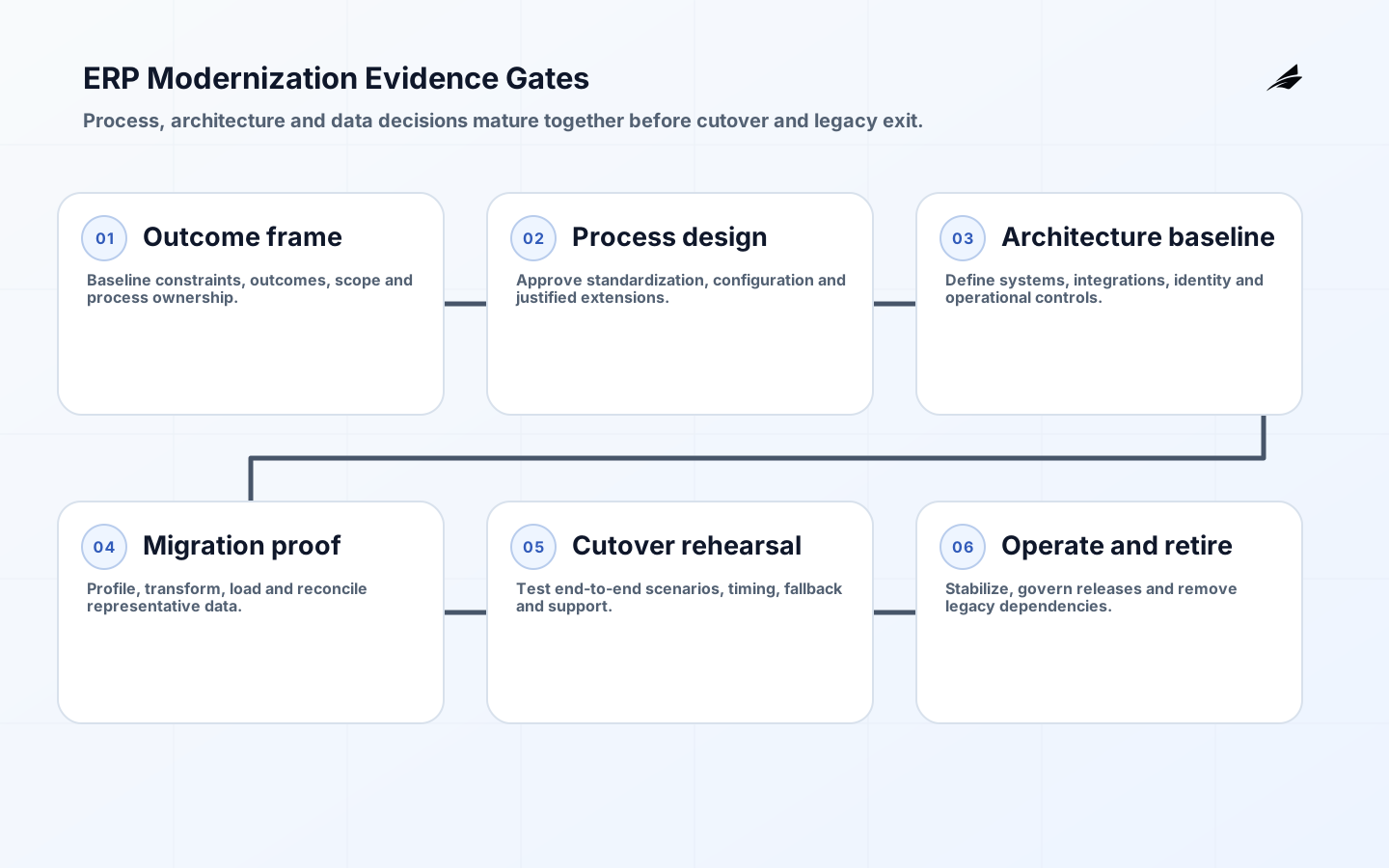
ERP modernization changes the operating rules of finance, procurement, inventory, projects, people or fulfillment. Treating it as a technical upgrade misses the work that determines success: deciding which processes become standard, which differences remain valuable, which records move, how integrations change, and how the organization closes business during cutover. Planning should make these choices visible before configuration and migration activity create momentum that is expensive to reverse.
This guide treats erp modernization planning: a practical guide to process, data and cutover decisions as a set of decisions that can be reviewed and tested. The aim is not to prescribe one vendor or promise a universal result. It is to help business and technical owners define boundaries, preserve evidence, expose failure behavior and decide when the work is ready to expand.
Frame modernization as an operating outcome
List the limitations that materially affect business control, service, reporting, security or change lead time. Separate mandatory drivers such as support expiry or regulation from optional improvements so scope can be prioritized honestly.
Define target outcomes per process and name accountable executives. Include explicit non-goals and constraints such as statutory retention, close calendars, plant shutdown windows and contractual interfaces.
| Planning domain | Decision to approve | Evidence |
|---|---|---|
| Process | Standardize, configure, extend, retain or retire | Scenario map and signed exception rationale |
| Data | Migrate, archive, transform or exclude | Profile, mapping, reconciliation and owner |
| Integration | API, event, file or temporary coexistence | Contract, security, monitoring and retirement date |
| Security | Roles, approvals and segregation | Access model and negative test results |
| Cutover | Sequence, freeze, fallback and reconciliation | Timed rehearsal and go/no-go criteria |
Baseline cycle times, exception volumes, reconciliations, custom-code dependencies and support burden using current evidence. Benefits should be testable without promising universal percentages.
Turn "Frame modernization as an operating outcome" into a working control by naming one accountable owner, one maintained artifact and one review forum. The exit standard for this part of erp modernization planning: a practical guide to process, data and cutover decisions is concrete: Baseline cycle times, exception volumes, reconciliations, custom-code dependencies and support burden using current evidence. Benefits should be testable without promising universal percentages. For this decision boundary, name the accountable owner, supporting evidence, exception route, and next measurable check.
Choose standardization and differentiation deliberately
Map end-to-end processes across organizational boundaries, including approvals, reversals, period close and unusual cases. Challenge local variations, but preserve those that satisfy a real legal or competitive need.
For each variation, choose adopt standard, configure, extend outside the core, retain temporarily or retire. Record owner, rationale, data effect and upgrade consequence so custom work does not enter through informal workshops.
Use scenario walkthroughs with real documents and edge cases. Process acceptance requires business owners to demonstrate the future path, not only approve diagrams.
Turn "Choose standardization and differentiation deliberately" into a working control by naming one accountable owner, one maintained artifact and one review forum. The exit standard for this part of erp modernization planning: a practical guide to process, data and cutover decisions is concrete: Use scenario walkthroughs with real documents and edge cases. Process acceptance requires business owners to demonstrate the future path, not only approve diagrams. Within this part of the system, name the accountable owner, supporting evidence, exception route, and next measurable check.
Define a clean target architecture and integration boundary
Place ERP responsibilities, identity, master data, analytics, document storage and surrounding applications on one map. Prefer supported APIs and events where they fit, and make temporary coexistence interfaces explicit.
Classify extensions by necessity, ownership and lifecycle. Keep core modifications limited, version contracts, protect credentials, and decide how failures are queued, reconciled and observed across system boundaries.
Turn "Define a clean target architecture and integration boundary" into a working control by naming one accountable owner, one maintained artifact and one review forum. The exit standard for this part of erp modernization planning: a practical guide to process, data and cutover decisions is concrete: Architecture evidence includes interface contracts, data ownership, volume assumptions, security design, operational alerts and decommission conditions for transitional links. When implementing this data handoff, name the accountable owner, supporting evidence, exception route, and next measurable check.
Treat migration as a business reconciliation
Profile source records before mapping. Decide what is active master data, open transactional data, required history or archive-only material. Cleansing ownership belongs with the business roles that understand meaning.
Define transformation rules, identifiers, duplicate treatment, opening balances, attachments, retention and rejection handling. Run repeatable mock migrations rather than correcting the final load by hand.
Reconcile counts, control totals, balances and sampled records at each rehearsal. Business owners sign the meaning of migrated data; technical completion alone does not make a ledger or inventory position correct.
Turn "Treat migration as a business reconciliation" into a working control by naming one accountable owner, one maintained artifact and one review forum. The exit standard for this part of erp modernization planning: a practical guide to process, data and cutover decisions is concrete: Reconcile counts, control totals, balances and sampled records at each rehearsal. Business owners sign the meaning of migrated data; technical completion alone does not make a ledger or inventory position correct. Before releasing this part of the system, name the accountable owner, supporting evidence, exception route, and next measurable check.
Rehearse integrated work and cutover
Testing should follow complete business scenarios across roles and systems, including negative permissions, reversals, batch jobs, reports, integrations and period boundaries. Automate stable checks while preserving business-led scenario evidence.
Build a timed cutover plan with entry criteria, owners, dependencies, communication, freeze rules, fallback conditions and reconciliation. Rehearse with production-like volume and the people who will perform the work.
Go-live approval depends on unresolved defect risk, migration results, support readiness, user access and a credible rollback or contingency path, not the calendar alone.
Turn "Rehearse integrated work and cutover" into a working control by naming one accountable owner, one maintained artifact and one review forum. The exit standard for this part of erp modernization planning: a practical guide to process, data and cutover decisions is concrete: Go-live approval depends on unresolved defect risk, migration results, support readiness, user access and a credible rollback or contingency path, not the calendar alone. While operating this part of the system, name the accountable owner, supporting evidence, exception route, and next measurable check.
| Wave gate | Minimum evidence | Decision owner |
|---|---|---|
| Design ready | Future process and target architecture approved | Process and architecture owners |
| Build ready | Configuration, extensions and contracts baselined | Program design authority |
| Migration ready | Repeatable load and reconciliation within tolerance | Data and finance owners |
| Go-live ready | Integrated tests, cutover rehearsal and support staffed | Executive steering group |
| Legacy exit | Retention met and dependencies removed | System and records owners |
Prepare people and continuous operations
Role changes, controls and exception handling need training built around tasks. Identify local champions, but do not use them as a substitute for staffed support, documentation and accountable process ownership.
Cloud ERP introduces recurring releases and configuration changes. Establish regression scope, release review, segregation-of-duties monitoring, integration ownership, environment management and a controlled improvement backlog.
Measure support demand, transaction exceptions, close or fulfillment performance, access conflicts, interface failures and adoption of the intended process after stabilization.
Turn "Prepare people and continuous operations" into a working control by naming one accountable owner, one maintained artifact and one review forum. The exit standard for this part of erp modernization planning: a practical guide to process, data and cutover decisions is concrete: Measure support demand, transaction exceptions, close or fulfillment performance, access conflicts, interface failures and adoption of the intended process after stabilization. When changing this part of the system, name the accountable owner, supporting evidence, exception route, and next measurable check.
Sequence the roadmap by dependency and evidence
Choose big-bang or phased deployment based on process coupling, data dependencies, coexistence cost, organizational readiness and rollback feasibility. A phased plan is not automatically safer if duplicate masters and interfaces become unmanageable.

Create waves with entry and exit evidence: process decisions, configured scenarios, migration rehearsal, security review, cutover rehearsal and receiver-led operations. Protect time for decommissioning legacy components.
At each gate, revisit scope and risk using current findings. Modernization planning remains a decision system throughout delivery rather than a document frozen at kickoff.
Turn "Sequence the roadmap by dependency and evidence" into a working control by naming one accountable owner, one maintained artifact and one review forum. The exit standard for this part of erp modernization planning: a practical guide to process, data and cutover decisions is concrete: At each gate, revisit scope and risk using current findings. Modernization planning remains a decision system throughout delivery rather than a document frozen at kickoff. During support for this evaluation, name the accountable owner, supporting evidence, exception route, and next measurable check.
Key takeaways
- Treat ERP modernization as operating-model change supported by technology.
- Approve each process variation instead of carrying customization forward by default.
- Make data migration a repeatable business reconciliation with named owners.
- Rehearse integrated scenarios and cutover at representative scale.
- Plan continuous release, support and legacy retirement before go-live.
Frequently asked questions
Should an ERP modernization use a big-bang or phased rollout?
Choose from process coupling, data consistency, coexistence complexity, readiness and recovery options. Phasing can reduce immediate scope but may add interfaces and duplicate masters; a single cutover concentrates risk and rehearsal demands.
How much historical data should move?
Move what operations, reporting and legal obligations require. Keep other history in a governed archive with usable access. The answer should come from record purpose and retention, not a default number of years.
When is customization justified?
When a requirement is genuinely differentiating or mandatory and cannot be met responsibly through standard configuration. Record value, owner, security, test burden, upgrade effect and eventual retirement path.
What proves migration quality?
Use reconciled counts and control totals, business-approved samples, exception resolution and repeatable execution. A successful import job proves transport, not the correctness or usability of the resulting records.
Conclusion
ERP modernization becomes manageable when process, data, architecture, cutover and operations are reviewed as one connected system. The plan should expose choices, assign ownership and demand evidence before each wave. That discipline reduces accidental customization and late migration surprises while leaving room for justified business differences. Go-live is one gate; dependable operation and deliberate legacy retirement finish the work.