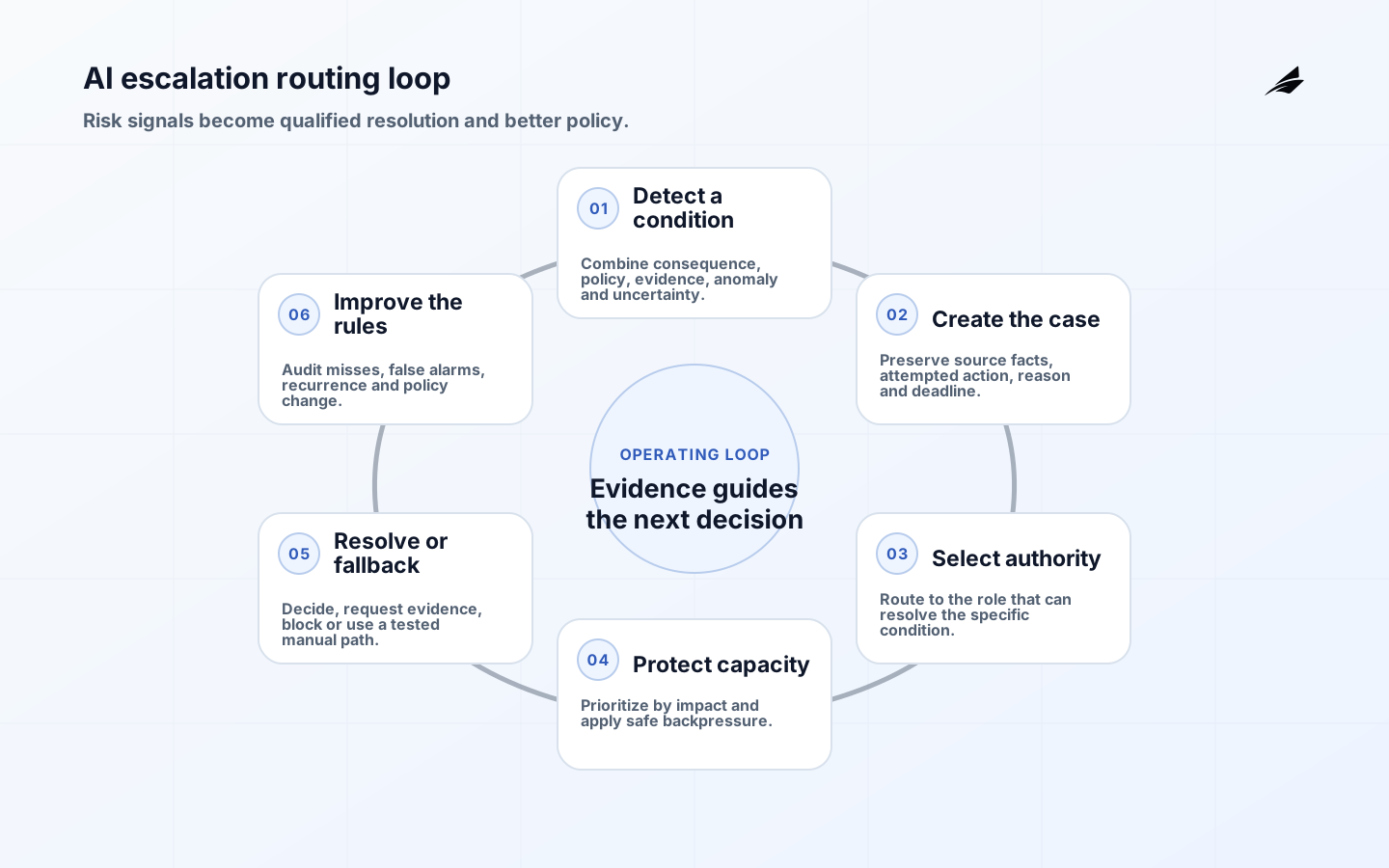
AI workflow escalation rules decide when automation must stop, seek evidence, transfer to a person or move to a specialist queue. Poor rules either let risky cases proceed or flood reviewers until they rubber-stamp work. Good escalation is a service design problem: detect a meaningful condition, preserve context, select an authorized destination, meet a deadline and learn from the resolution.
Do not begin with one confidence threshold. Start with the harm a wrong action could cause, the evidence available to detect it and the person or control capable of resolving it. The NIST AI RMF Core treats risk management as continuous governance, mapping, measurement and management. Escalation belongs inside that lifecycle, not as a catch-all after deployment.
Edilec's business approval agent guide, support RAG operations guide, and agent permission checklist cover related authority, evidence and tool-boundary choices.
Key takeaways
- Route on consequence, policy, missing evidence and anomaly, not confidence alone.
- Give every destination explicit authority, service level and fallback.
- Preserve the source evidence, attempted action and reason for escalation.
- Design queue capacity before expanding automated volume.
- Use resolved cases to evaluate detection, routing and policy coverage.
Mistake 1: using one confidence threshold
A model score is conditional on a model, input distribution and task. It may be poorly calibrated, unavailable for some outputs or unrelated to the consequence of acting. A high-confidence extraction can still reference the wrong customer; a low-confidence optional field may not matter. One global cutoff mixes these cases and creates false reassurance.
Use a policy composed of field criticality, confidence where validated, missing evidence, cross-record consistency, transaction value, user impact, novelty and explicit prohibitions. Test each signal independently and in combination. Recalibrate from held-out and production cases after model or document changes. Never present the threshold as a guarantee; it is a routing parameter whose misses and false alarms need measurement.
Mistake 2: ignoring consequence and reversibility
The same uncertainty should produce different handling for a suggested email subject and a refund. Classify actions by financial, legal, privacy, security, safety and service impact; add reversibility and time sensitivity. Low-impact work may proceed with user editing. Material but reversible work may require confirmation and monitoring. Irreversible or rights-affecting work may require qualified review or a hard prohibition.
Regulation can impose specific oversight and information duties in applicable contexts. Use the official EU AI Act text and competent counsel for EU applicability, and relevant supervisory guidance such as the UK ICO's AI and data protection guidance where personal data is involved. Product routing must reflect the actual jurisdiction and use case.
| Escalation signal | Example | Destination | Fallback if unavailable |
|---|---|---|---|
| Missing required evidence | Contract page absent | Intake correction queue | Request resubmission and block action |
| Policy conflict | Refund exceeds agent authority | Authorized supervisor | Hold transaction until coverage resumes |
| Identity mismatch | Invoice supplier differs from master data | Fraud or vendor-control team | Quarantine case and prevent payment |
| Potential rights impact | Employment recommendation | Qualified accountable decision-maker | Keep process manual |
| Security anomaly | Tool request targets new domain | Security response | Revoke tool session and isolate evidence |
| Service degradation | Error budget exhausted | Operations incident lead | Switch to tested manual or read-only mode |
Mistake 3: routing everything to a generic queue
A generic review queue hides authority and expertise. The first person to open a case may be unable to decide, causing reassignment and delay. Define destinations by decision right: document correction, policy exception, customer verification, security investigation or service incident. Show queue owners, coverage hours, maximum age and transfer rules. Cases should not disappear into an inbox.
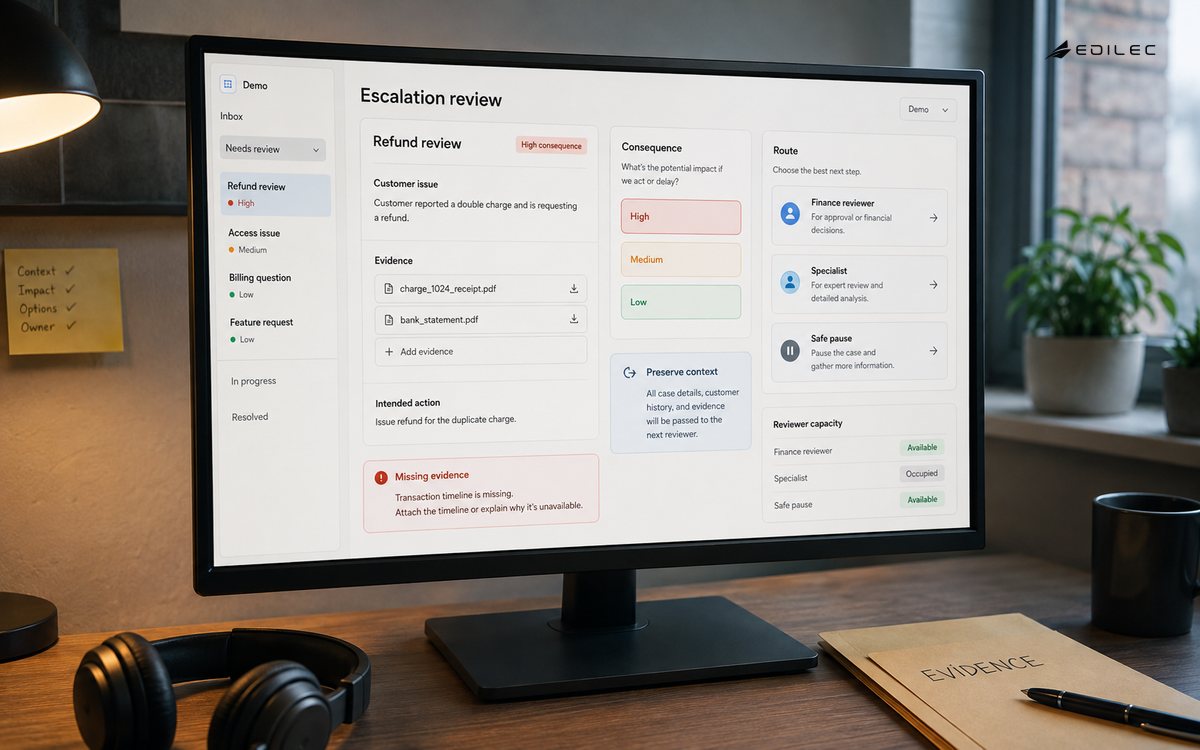
Route with the minimum sensitive context needed by the destination. Preserve a case identifier and evidence lineage while applying access controls. A support reviewer should not gain payroll data because both workflows use the same platform. Monitor transfers and bounces; repeated rerouting indicates an unclear taxonomy, missing authority or poor evidence packet rather than individual reviewer failure.
Mistake 4: losing context at handoff
An escalation should carry the original request, authenticated subject, source records, model and prompt or policy versions where relevant, attempted tools, intermediate results, detected condition, proposed next step and deadline. Mark model-generated statements distinctly from source facts. Link to the exact document span or record version. Requiring the reviewer to reconstruct the case increases handling time and encourages reliance on the summary.
Keep a chain of custody for changes. If a customer uploads a replacement document after escalation, show the difference and re-run affected checks. If the model produced an unsafe tool call, retain enough structured evidence for investigation without broadly exposing secrets or personal content. NIST's Generative AI Profile provides a current cross-sector risk frame for governance, testing and incident learning.
Mistake 5: designing rules without capacity
A rule that escalates 20 percent of 50 daily cases is different from one applied to 50,000. Forecast volume by trigger, arrival pattern, handling time, specialist availability and deadline. Reserve capacity for incidents and model changes. Use backpressure: when queues exceed a safe limit, narrow automated intake, disable risky actions or move the workflow to a tested manual path rather than accumulating silent delay.
Prioritize by consequence and deadline, not confidence alone. An approaching payroll cutoff can outrank an older low-impact content review. Prevent starvation with age thresholds. The queue interface should expose why a case is prioritized and allow incident leaders to change policy transparently. Review staffing and rule changes together; reducing false positives may be safer than demanding faster clicks.
| Measure | What it reveals | Useful slice | Action threshold |
|---|---|---|---|
| Escalation rate | Rule selectivity and input shift | Trigger, model, customer segment | Unexpected step change |
| Precision | Share of escalations that needed intervention | Rule and consequence class | Sustained reviewer waste |
| Miss rate | Material errors not escalated | Audited representative sample | Any severe miss or adverse trend |
| Time to qualified owner | Routing effectiveness | Destination and coverage window | Threatens business deadline |
| Resolution time | Evidence and authority adequacy | Reason and outcome | Backlog exceeds staffed capacity |
| Repeat condition | Unfixed product or policy defect | Root cause and version | Same cause recurs above limit |
Mistake 6: omitting failure and fallback
Escalation infrastructure can fail. Test an unavailable queue, identity provider, notification service, evidence store and downstream action system. Define whether the workflow blocks, degrades to read-only, asks the user to retry or transfers to a documented manual route. Fail closed for actions whose unauthorized completion is worse than delay; make that business decision explicit.
Use durable case creation and idempotent retries. Alert on cases created without notification and notifications sent without a retrievable case. Preserve deadline timers across outages. Manual fallback requires current contact paths, access, forms and reconciliation, not a line in a runbook. Exercise it with the people who would use it during a peak period.
Mistake 7: closing cases without learning
Capture structured resolution: valid escalation, false alarm, missed evidence, policy gap, data-quality defect, model defect, malicious input, integration failure or user correction. Record the final action and material harm avoided or caused. Feed reviewed examples into evaluation sets only under appropriate privacy and use controls. Do not automatically train on every reviewer action; reviewers can be inconsistent or wrong.
Hold a regular review with product, operations, risk and engineering. Retire rules that no longer add value, split overloaded reasons and add hard controls where escalation repeatedly catches the same prohibited action. The NIST AI RMF Playbook can help teams connect findings to governance and management activities rather than treating them as isolated support tickets.
Example: customer refund routing
An assistant may propose refunds under a bounded policy. Requests below a modest value with verified identity, matching order, supported reason and no abuse signal can be presented for customer confirmation and executed reversibly. A missing delivery scan routes to logistics research. A changed payout method routes to fraud review. A value above agent authority routes to a supervisor with order evidence and policy limits.
The system never routes a suspected account takeover to the ordinary refund queue, and it never lets queue backlog silently extend a statutory or contractual deadline. Audits sample both escalated and non-escalated refunds. Resolved cases show whether identity signals, policy rules and staffing worked together, giving the team specific improvements instead of a vague demand for a better model.
Escalation rule review checklist
- Name the harm or policy condition each rule detects.
- Document inputs, calibration evidence and known blind spots.
- Assign an authorized destination, coverage window and service level.
- Include source evidence, attempted action, reason and deadline in the case.
- Forecast volume and establish backpressure behavior.
- Test unavailable services, duplicate delivery and stale evidence.
- Audit escalated and bypassed cases for precision and misses.
- Turn recurring resolutions into product, data or policy changes.
Control rule changes
Version escalation policy, test it against historical and adversarial cases, and estimate destination volume before release. Use shadow routing to compare a new rule without changing outcomes. Record who approved the change, its intended risk reduction and rollback condition. During an incident, temporary routing overrides should expire automatically and receive a retrospective review; otherwise emergency configuration quietly becomes normal policy.
AI escalation rules FAQ
What is a good escalation rate?
There is no universal percentage. The right rate follows risk, model performance, evidence quality and reviewer capacity. Optimize for harmful misses and useful intervention, not a cosmetically low number.
Who should own escalation rules?
A business risk or process owner should be accountable, with operations, product, engineering and legal or compliance contributors as appropriate. Engineering should not infer policy alone.
Should every false positive trigger model retraining?
No. The cause may be a policy rule, missing source data, poor calibration, interface design or an acceptable safety tradeoff. Diagnose the root cause before changing the model.
Conclusion
Effective AI workflow escalation rules connect risk detection to capable, timely resolution. Replace one-dimensional thresholds with consequence-aware policy, preserve evidence, engineer queue capacity and rehearse fallback. Then audit both escalations and misses so every resolved case can strengthen the workflow rather than merely leave the queue.