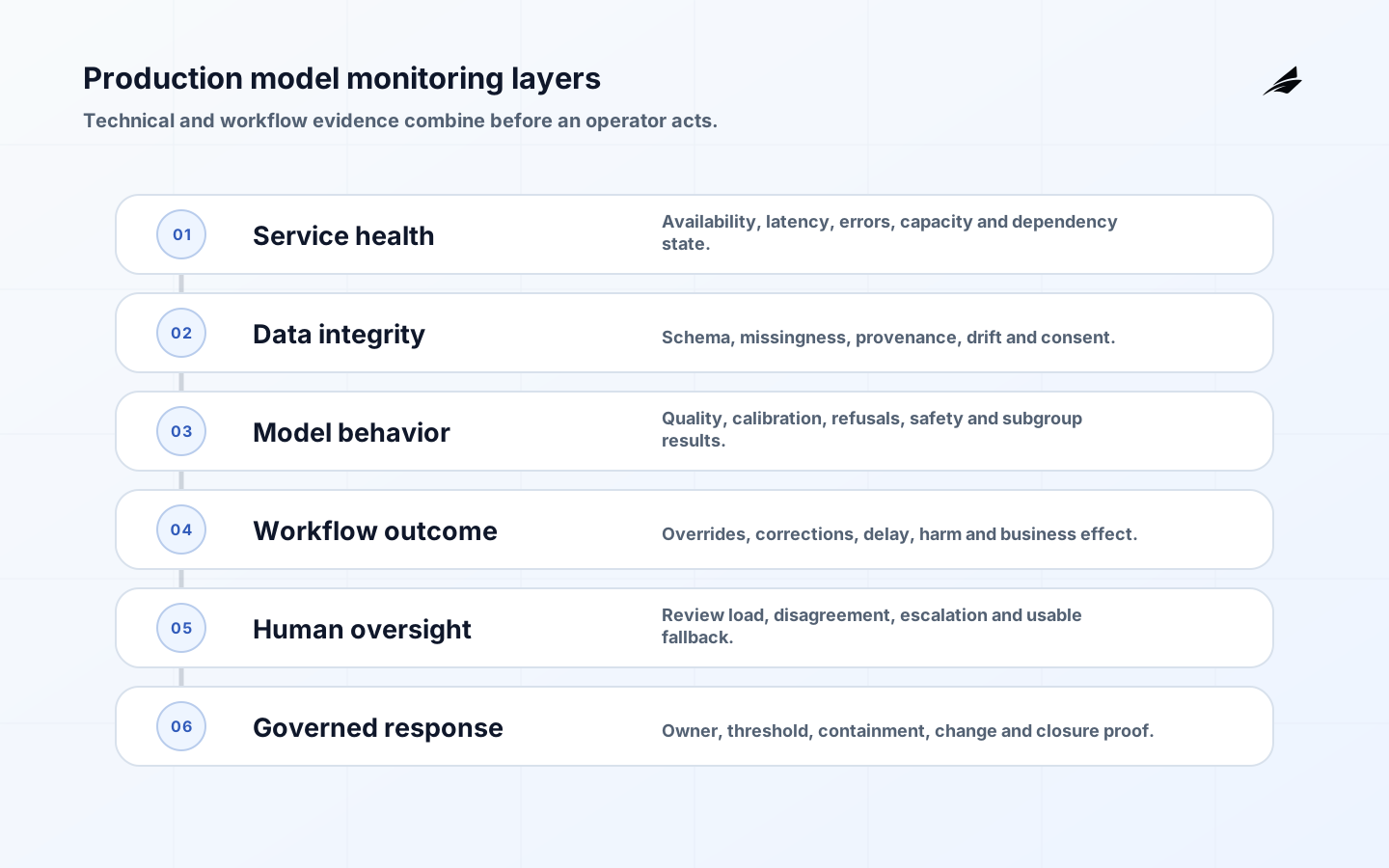
Production model monitoring must answer a practical question: is the model-enabled workflow still operating within its approved purpose and risk limits? Infrastructure uptime and aggregate accuracy cannot reveal every harmful failure, especially when inputs, users, policies, or downstream actions change. This guide connects to Edilec’s regulated LLM evaluation checklist, AI search mistakes guide, and safe employee assistant guide.
Set the operating boundary for model monitoring for production workflows
Define monitoring from the production decision the model influences. For a warranty-claim classifier, specify the eligible product lines, input fields, possible queues, abstention behavior, and the fact that final entitlement remains with an authorized claims specialist. State acceptable latency and availability, the manual route, and the harms of a misroute: delayed repair, exposure of customer data, missed fraud review, or an incorrect denial. Record the baseline volume, class distribution, service time, and correction pattern before release. This boundary determines which events must be observable and prevents a routing model from quietly becoming a decision engine. It also tells responders when to restrict automation: an unsupported language, new claim type, missing product identifier, or unavailable downstream queue should produce a declared fallback rather than a confident-looking guess.
| Design question | Practical decision | Evidence to retain |
|---|---|---|
| Purpose | Name the specific user task and prohibited autonomous action. | A current workflow map and an accountable owner. |
| Inputs | Limit sources to records that are permitted and maintained. | route and final resolution, with model version and reviewer intervention. |
| Outcome | Define a usable result and an explicit pending state. | A sample of normal, adverse, and incomplete cases. |
| Recovery | Decide who pauses the flow and how work continues. | pause the automated route and return cases to the manual queue. |
Test model monitoring for production workflows against real work
Build evaluation data around operational consequences, not only aggregate accuracy. Include common claims, rare but costly classes, ambiguous descriptions, missing fields, new products, language variation, duplicate submissions, and cases that should abstain. Label the correct queue and, where disagreement is legitimate, the acceptable alternatives and required reviewer. Report per-class precision and recall, confusion between high-consequence routes, calibration or threshold behavior, latency, and coverage after abstention. Slice results by product family, channel, language, geography, and customer cohort where those segments affect use. Keep a time-based holdout to expose changes that random sampling can hide. Re-run the suite when model weights, features, preprocessing, thresholds, queue definitions, or upstream forms change. Production reviewers should examine representative errors because a one-point average improvement may still increase the specific misroute that creates the greatest delay or harm.
| Test slice | What to inspect | Decision |
|---|---|---|
| Routine cases | Usefulness, source match, and completion effort. | Release only if the result is consistently actionable. |
| Hard cases | Missing data, ambiguity, conflict, and policy triggers. | Require a safe pending or escalation route. |
| Adversarial input | Attempts to alter instructions or obtain restricted information. | Block the action and record the attempted path. |
| Changed conditions | New source, version, role, or downstream dependency. | Re-evaluate before continuing normal operation. |
Assign controls and ownership for model monitoring for production workflows
Give every production signal an interpreter and an authorized response. The model owner maintains evaluation, feature, threshold, and version evidence; the service owner owns availability, event capture, rollback, and queue delivery; claims operations defines routing meaning, correction procedures, and customer impact; risk or compliance sets escalation for consequential classes. A monitoring engineer may detect distribution change but should not redefine acceptable claim outcomes alone. Validate model output against the current queue catalogue and policy rules before dispatch, log abstention as a supported outcome, and require a person for final entitlement decisions. Maintain a model and data change register so owners know which revision produced each event. The NIST AI RMF’s Govern, Map, Measure, and Manage functions provide a durable way to connect context, evaluation, accountability, and mitigation rather than treating a dashboard as the control.
- Name one owner for the workflow and one owner for each authoritative data source used by model monitoring for production workflows.
- Use least-privilege access for tools, records, and administrative changes.
- Make a pending state normal when evidence, policy, or authority is missing.
- Keep logs useful for investigation without turning protected traces into a new broadly accessible data store.
- Review the control design whenever the workflow scope, vendor, or connected system changes.
Measure live model monitoring for production workflows behavior
Instrument the path from input arrival to final claim resolution. Capture schema validity, missing-feature rates, category and score distributions, abstentions, latency, model revision, assigned queue, downstream acceptance, human reassignment, resolution time, and confirmed outcome when it becomes available. Compare production inputs with the evaluation reference using features the team can interpret, but do not equate statistical drift with degraded service; verify its effect on labelled samples and operations. Watch delayed ground truth carefully, because routing problems may appear first as transfers, ageing, or customer contact rather than accuracy. Segment by channel, product, language, and model version, and monitor data freshness and pipeline failures independently from prediction quality. Set distinct thresholds for investigation, traffic reduction, rollback, and incident declaration. Each alert must reach an owner who can perform that action and include enough version and cohort detail to locate affected cases.
| Signal | Why it matters | Review response |
|---|---|---|
| wrong-queue rate | Shows whether the bounded task is producing acceptable work. | Sample cases and identify a version or source pattern. |
| reviewer overrides | Shows whether review is catching material problems. | Inspect evidence and adjust the decision boundary. |
| unresolved incident age | Shows whether the fallback path has a real owner. | Escalate capacity or change the route. |
| and service-level delay | Shows whether automation shifts burden downstream. | Compare against the manual baseline and recover if needed. |
Run and recover model monitoring for production workflows safely
Prepare a fallback that preserves service when prediction quality is uncertain. The routing layer should be able to stop automated dispatch for a model version, input source, product family, or score band and send those claims to a staffed triage queue. Retain original inputs, proposed route, revision, and reason for fallback so reviewers can correct cases without recreating evidence. Rehearse rollback to the prior verified model and separately rehearse failure of the feature pipeline, event logger, and destination queue. Recovery includes finding claims already misrouted, moving them safely, restoring service-level clocks where policy permits, and notifying operational owners of customer impact. Define who may trigger containment and who approves return to automated routing. A successful rollback is not enough if the team cannot reconcile in-flight cases or confirm that monitoring resumed with the restored version.
- Give front-line users a clear route to flag a questionable model monitoring for production workflows result without needing technical access.
- Practice pausing the relevant capability while leaving unrelated work available.
- Reconcile any downstream changes against the system of record after an incident.
- Record the decision, affected scope, correction, and criteria for resuming normal operation.
- Bring repeated exceptions back to the workflow owner rather than asking individual reviewers to absorb the pattern.
Triage an adverse signal before retraining. First verify telemetry and labels: a queue rename, delayed resolution feed, form change, or broken feature can imitate model degradation. Next determine scope by model version, deployment window, source, and affected class. Review actual cases to distinguish concept drift, data-quality failure, threshold error, integration defect, policy change, or normal variation. Choose the corresponding remedy—repair the feed, update a mapping, adjust operations, restrict a cohort, recalibrate, or train a candidate model—and test it against the incident set plus the frozen benchmark and high-consequence slices. Record the detection signal, impact assessment, containment, root cause, change approval, offline evidence, rollout plan, and post-release confirmation. This disciplined chain prevents an unexplained retrain from erasing useful evidence or introducing a broader regression in response to a narrow operational problem.
Release checklist
- The team can state the permitted purpose, prohibited action, owners, and fallback for model monitoring for production workflows in plain language.
- Evaluation includes normal, incomplete, adverse, and changed-condition examples from the real workflow.
- Authorization, output validation, and escalation occur outside untrusted model text.
- Live signals have a baseline, review cadence, accountable owner, and documented action threshold.
- The recovery path has been tested from detection through reconciliation before scope expands.
Require a production-readiness review before increasing automated traffic or adding claim categories. Present the model card or equivalent scope record, evaluation by critical slice, threshold and abstention rationale, data-contract checks, event lineage, alert ownership, manual-queue capacity, rollback result, and an exercise that reconciles in-flight cases. Examine real pilot examples from correct routes, reassignments, abstentions, slow predictions, and customer-impacting errors. Operations should confirm that labels match current queues and that the manual path can absorb containment; service owners should prove version traceability and telemetry completeness; risk owners should accept residual consequences. Convert open findings into explicit launch limits and stop criteria. Expansion can proceed cohort by cohort only when the current release meets both model-quality and service-behaviour thresholds. This review keeps monitoring tied to decisions the organization is actually prepared to make.
Worked example: monitor an invoice exception model
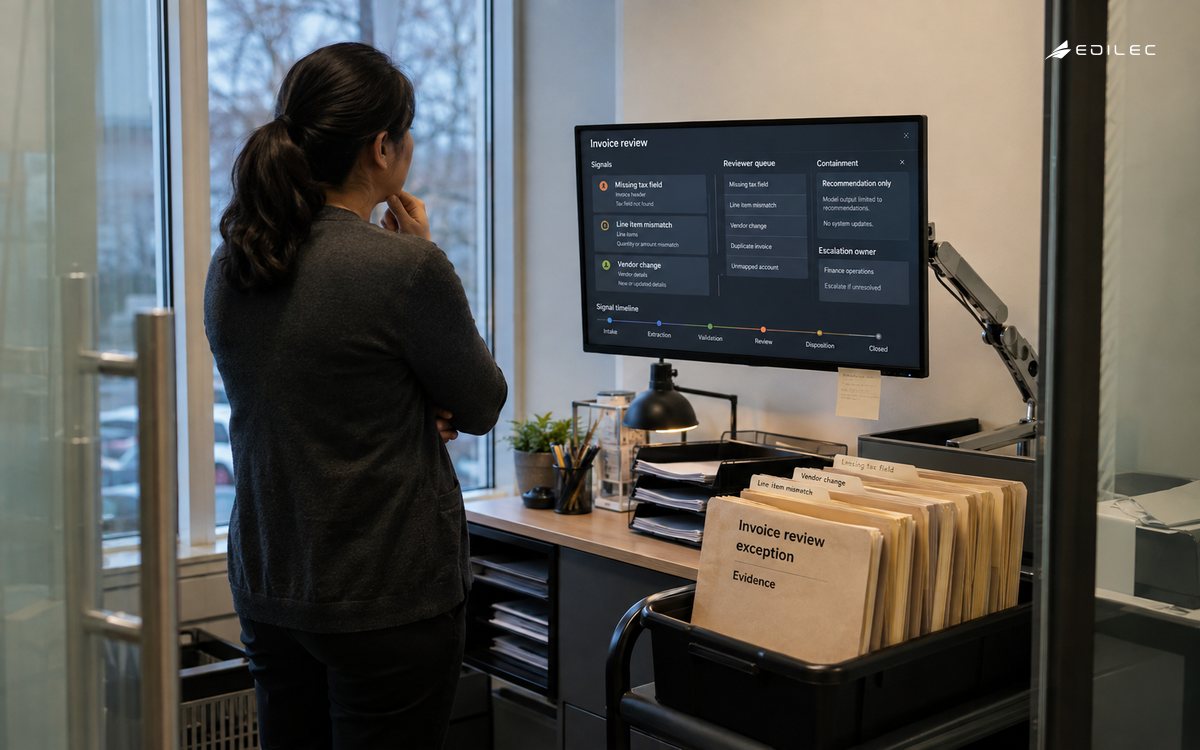
An invoice model that recommends straight-through processing should be monitored at the decision boundary. Join model version, features, score, threshold, recommendation, reviewer disposition, payment outcome, supplier segment, amount band, and later correction. Protect sensitive fields and keep an auditable link rather than copying unnecessary business data into telemetry. Track automation rate only beside false release, false hold, override, delayed-label coverage, queue time, and financial impact.
Define responses before alerts fire. A rise in missing tax fields may route affected invoices to review and trigger an upstream data investigation. A severe false-release event may disable automation while leaving recommendation mode available. Segment shifts may require evaluation before any threshold change. Every alert needs an owner, investigation query, decision deadline, containment option, and closure evidence. Review alert precision itself; a monitor that repeatedly pages without useful action will be ignored when a real change arrives.
Key takeaways
- Model monitoring for production workflows should improve a bounded task, not quietly claim broader authority.
- Evidence, permission, and recovery are product requirements alongside model quality.
- Evaluate the cases where the system should stop or seek review, not only the easy successes.
- Use operating signals to decide when to investigate, restrict, or expand the workflow.
Frequently asked questions
What belongs on the first production dashboard? Include input validity, volume and class mix, latency, abstention, score or output distribution, delivery failures, human corrections, service time, and revision identifiers; add business outcomes when reliable labels arrive. Does drift prove the model is wrong? No. Drift is an investigation signal whose effect must be checked with labelled cases and operational evidence. How often should teams retrain? When a diagnosed change and comparative evaluation justify it, not on an arbitrary calendar alone. What if ground truth is delayed? Use leading indicators such as transfers and ageing, then reconcile them with later outcomes. When should automation pause? Pause the affected scope when telemetry is missing, data contracts break, high-consequence errors cross an agreed threshold, or staff cannot safely correct cases.
Conclusion
Production model monitoring must reveal whether a specific revision is still producing acceptable service outcomes for the population it handles. Combine data-contract checks, sliced evaluation, delayed human outcomes, operational queue signals, and rehearsed containment. When every threshold has an owner and every prediction can be traced, corrected, and reconciled, monitoring becomes an active control rather than a collection of attractive charts.