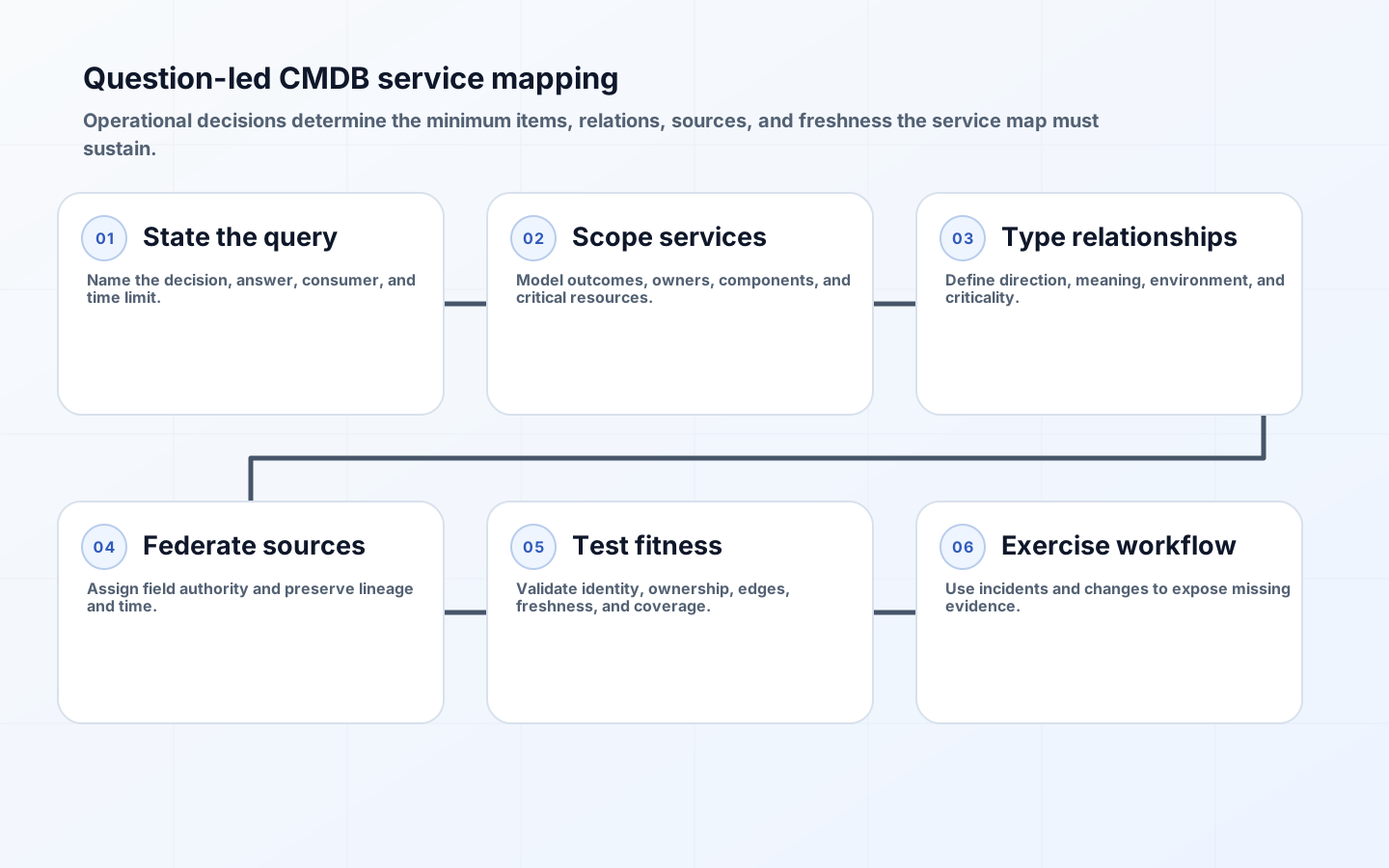
CMDB service mapping should improve a decision: what is affected by this incident, which services depend on a changing component, who owns restoration, or which recovery plan applies. Programs fail when they reverse that logic and begin by collecting every discoverable asset. The result can be a large database with weak identities, stale relationships, and little confidence at the moment of use. More configuration items do not compensate for unclear operational purpose.
A commercially sound approach defines priority questions, models the minimum configuration items and relationships needed to answer them, assigns field-level authority, and tests freshness against real workflows. Tool selection then evaluates whether a product can sustain that contract across the organization's sources and operating scale. The CMDB becomes a governed federation and decision interface, not an attempted physical copy of the entire technology estate.
Define the operational queries first
Gather incident commanders, change managers, service owners, continuity leads, security, and support teams. Ask each group to name decisions delayed by missing configuration knowledge. Convert each need into a testable query with a time constraint. For example: given a failed database cluster, list affected business services, customer journeys, accountable teams, active changes, and recovery procedures within two minutes. That statement is more useful for scope and procurement than a requirement to provide discovery and dashboards.
| Operational question | Minimum nodes | Minimum relationships | Freshness need |
|---|---|---|---|
| What services may this incident affect? | Service, component, resource | runs on, depends on, provides | Near real time for active topology |
| Who approves and restores? | Service, team, support route | owned by, supported by | Current organization and on-call state |
| What could this change break? | Change target, consumers, contracts | uses, calls, publishes to | At release or contract change |
| Can this service meet continuity needs? | Service, data store, region, recovery plan | stores in, replicated to, recovered by | On architecture or plan revision |
| What should be retired together? | Service, component, license, consumers | part of, depends on, funded by | At lifecycle transition |
Model business services before infrastructure detail
Start with a business or technical service whose outcome and owner are understood. Decompose it into logical components, APIs, data stores, platforms, and critical external services only as far as the selected queries require. Preserve the difference between a service, a deployable component, and a runtime instance. Without that layering, an incident on one host either appears unrelated to the customer service or creates an unreadable graph of every transient object.
Use stable identifiers independent of display names and discovery tools. OpenTelemetry service conventions can help align runtime telemetry with logical service name, namespace, version, and instance attributes. Map cloud and infrastructure identifiers to those logical IDs. When a resource is replaced, the service history should remain continuous; when a service is split, create explicit successor relationships instead of reusing an old identity with new meaning.
Give every relationship operational semantics
A graph is useful only when edge direction and meaning are consistent. Define a controlled relationship vocabulary such as consumes API, publishes event, reads data, runs on platform, protected by control, and supported by team. State source and target types, cardinality, criticality, environment, effective period, and provenance. DMTF's Common Information Model provides a conceptual model for interrelated systems and managed elements, but each organization still needs a practical subset tied to its questions.
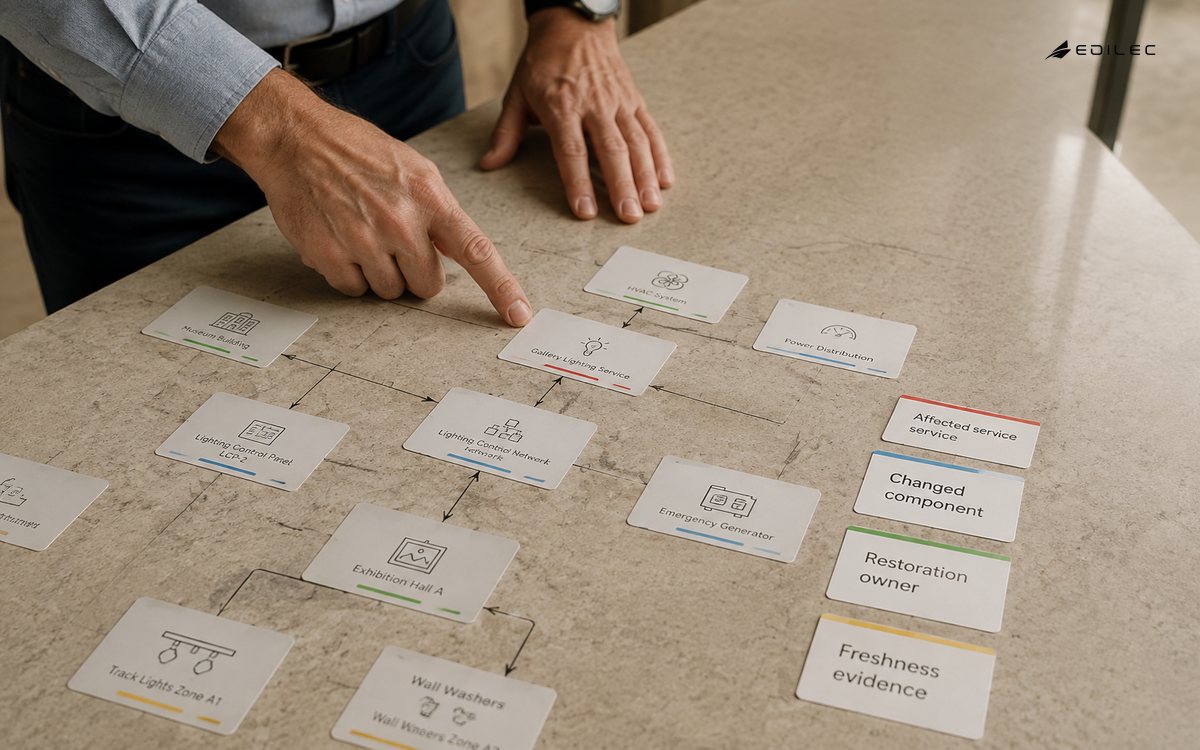
Keep declared design, discovered topology, and observed communication as separate evidence layers. Discovery may see a connection but not know whether it is critical. A design record may include a recovery dependency that produces no routine traffic. Store confidence and observation time, reconcile mismatches, and let operators filter by evidence type. Do not let a noisy scan continuously replace owner-approved service relationships without review.
Federate authoritative sources instead of copying blindly
DMTF's CMDB Federation material recognizes that management data lives in heterogeneous repositories and that forcing all information into one model or one repository is neither practical nor desirable. Assign authority per attribute: identity systems own teams, cloud APIs own current resources, deployment systems own versions, repositories own component declarations, service management owns incidents and changes, and continuity repositories own approved recovery plans. The CMDB assembles references and normalized views.
For every source, document collection mode, latency, deletion behavior, access rights, and failure response. A successful import timestamp does not prove that the source itself is current. Preserve lineage from displayed value back to source record and transformation. W3C PROV-O provides concepts for entities, activities, and agents that can inform this provenance model. Operators should be able to see why a value is trusted and who can correct it.
Measure fitness for a question, not generic completeness
| Quality dimension | Operational test | Example threshold | Remediation owner |
|---|---|---|---|
| Identity | Can records join without ambiguity? | No duplicate active service IDs | Configuration platform |
| Ownership | Does the team resolve and accept work? | All tier-one services have active groups | Service owner |
| Relationship validity | Do targets exist and types make sense? | No dangling critical edges | Model steward |
| Freshness | Is the value recent enough for its query? | Runtime topology within agreed latency | Source operator |
| Coverage | Can the selected question be answered end to end? | All pilot journeys pass query tests | Process owner |
| Provenance | Can a user trace the displayed fact? | Every automated field names source and time | Integration owner |
Weight defects by consequence. A missing rack location may be irrelevant for a serverless service, while a stale owner or missing payment dependency can invalidate impact analysis. Create quality rules from the operational queries and run them continuously. Send defects to the team able to correct the authoritative source rather than building a permanent central data-cleaning queue. Track defect age, recurrence, and whether bad data changed a decision.
Design reconciliation and exception workflows
Conflicts are inevitable when multiple sources describe the same environment. Define matching rules, confidence, precedence, and review states. Exact cloud resource IDs can reconcile automatically; a similar hostname should not be enough to merge records. When two sources disagree on owner or lifecycle, create an exception with both values, provenance, business impact, and due date. Preserve the last trusted value while clearly marking uncertainty.
Deletion needs equal care. A missing discovery record may mean retirement, a collection outage, or a temporary resource. Apply tombstone and grace policies appropriate to the item type. Do not erase historical relationships needed to explain an incident or change. Use effective dates so current queries stay clean while past-state analysis remains possible. Explicit lifecycle transitions should drive service retirement, access removal, consumer notification, and archival.
Evaluate products with outcome-based scenarios
A proof of concept should use representative services, messy identities, multiple discovery sources, dynamic cloud resources, and at least one external dependency. Ask each vendor to implement priority queries, show provenance, process a conflict, handle a deleted source item, enforce access, and measure freshness. Score time to a trustworthy answer and operating effort, not the polish of a preloaded topology. Confirm API access, export, model extensibility, event handling, and audit support.
Model total operating cost: discovery infrastructure, connectors, normalization, licensing basis, nonproduction environments, data retention, implementation services, stewardship, quality remediation, upgrades, and training. Agent-based discovery can increase infrastructure coverage but adds deployment and security obligations. SaaS integrations can reduce maintenance but may have rate, regional, or data residency constraints. Contract for data portability and usable identifiers so the service model does not become trapped in one user interface.
Implement one decision path end to end
Select a high-value service journey and one incident or change query. Establish identifiers and ownership, ingest minimum components and resources, create typed relations, link operational records, and run tabletop exercises. Record wrong, missing, and slow answers. Automate the highest-value corrections, then add the next query. This vertical approach validates collection, model, quality, access, and workflow together instead of completing a long asset import before any operator benefits.
Govern the model through a small design authority with service, platform, data, security, and service-management representation. Approve new CI classes and relations only when they support a named use case. Publish stewardship and freshness rules, version transformations, and review quality trends. ISO/IEC 20000-1 sets service-management-system requirements, but certification language should not substitute for demonstrating that the organization's actual incident, change, and continuity decisions have better evidence.
Key takeaways
- Define time-bounded incident, change, ownership, and continuity queries before collecting configuration items.
- Model logical services and stable identifiers, then add infrastructure depth only where a query requires it.
- Use typed, directed, provenanced relationships and keep declared, discovered, and observed evidence distinct.
- Federate authoritative sources by field and route quality defects back to the source owner.
- Buy against realistic operational scenarios, data portability, ongoing stewardship, and total operating cost.
Frequently asked questions
How much of the estate must be in the CMDB? Enough to answer the agreed operational questions for in-scope services with known confidence. Expanding coverage is useful only when identity, ownership, relationships, and freshness remain fit for those decisions.
Can discovery create business service maps automatically? It can propose runtime topology and resource relationships. Owners still need to define customer outcomes, criticality, dormant dependencies, support responsibility, and the meaning of ambiguous connections.
Should the CMDB be the single source of truth? Usually it should be a governed integration and query layer. Each field can remain authoritative in the system that creates and maintains it, with provenance and reconciliation presented through the CMDB.
Conclusion
CMDB value is not proportional to asset volume. It comes from trusted identities, meaningful relationships, accountable sources, and freshness matched to consequential questions. Starting with those questions produces a smaller and more defensible service map, a sharper procurement process, and an implementation whose usefulness can be tested in the operational moments that matter.