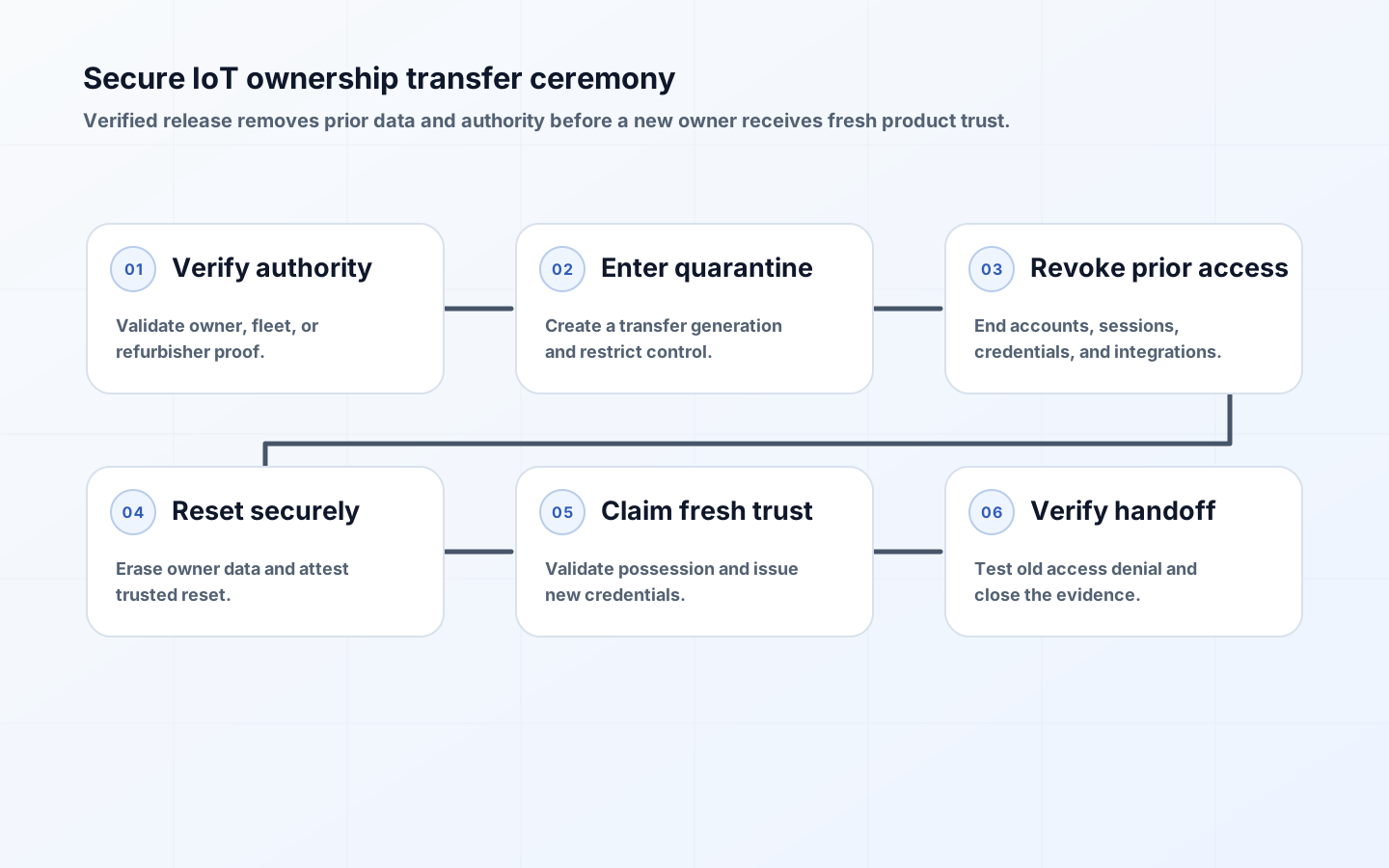
IoT device ownership transfer is a security and support ceremony, not merely a local factory reset. Products are resold, returned, refurbished, leased to another customer, reassigned between sites, or transferred after an account owner leaves. The transition must remove the prior owner's data and authority, preserve device integrity, establish the next owner's trust, and avoid turning a stolen product into an easily claimed asset.
Design the lifecycle across device, cloud, mobile app, identity provider, support tooling, reseller or refurbisher, and documentation. A successful transfer ends prior sessions and integrations, rotates credentials, handles retained and backed-up data, clears local configuration, re-enrolls under authorized proof, and records enough evidence to resolve disputes. Safety-critical or regulated products may also require professional decommissioning, calibration, or site acceptance.
Classify the transfer scenario and authority
Distinguish voluntary owner-to-owner transfer, enterprise reassignment, lease return, retailer return, manufacturer refurbishment, inheritance, account recovery, and loss or theft. They have different proofs and fraud risks. A signed-in current owner can initiate a clean handoff. A refurbisher needs chain-of-custody authorization. A buyer with physical possession but no release from the prior account needs a recovery process that protects both parties rather than an immediate claim button.
Define roles precisely: legal owner, cloud-account administrator, daily user, installer, service technician, fleet operator, and data subject may be different people. State which role can release, wipe, export data, preserve records, approve reassignment, and enroll. Apply separation of duties for enterprise or safety-sensitive devices. Support staff should not bypass proof requirements merely because the caller knows a serial number printed on the product.
| Scenario | Initiating proof | Additional control | Blocked condition |
|---|---|---|---|
| Voluntary consumer resale | Authenticated current owner plus device confirmation | Recovery code and buyer handoff window | Device reported lost, financed, or under hold |
| Enterprise reassignment | Fleet administrator with scoped role | Asset record and site or user acceptance | Open incident, legal hold, or safety maintenance |
| Authorized refurbishment | Return authorization and chain of custody | Diagnostic wipe evidence and firmware integrity check | Unknown provenance or tamper indication |
| Prior owner unavailable | Purchase and possession evidence through recovery review | Cooling-off period and prior-account notification | Credible theft or ownership dispute |
| Stolen device | Verified owner report | Revoke service and preserve investigation evidence | No transfer until authorized resolution |
Model transfer as an explicit device lifecycle state
Use states such as active, transfer requested, release authorized, quarantine, reset pending, unowned, claim pending, enrolled, disputed, and retired. Each transition has an actor, proof, deadline, and allowed device capabilities. While transfer is pending, prevent configuration changes that would add persistence or new delegates. During unowned state, permit only minimal secure onboarding and safety functions, not prior cloud commands or unrestricted local service.
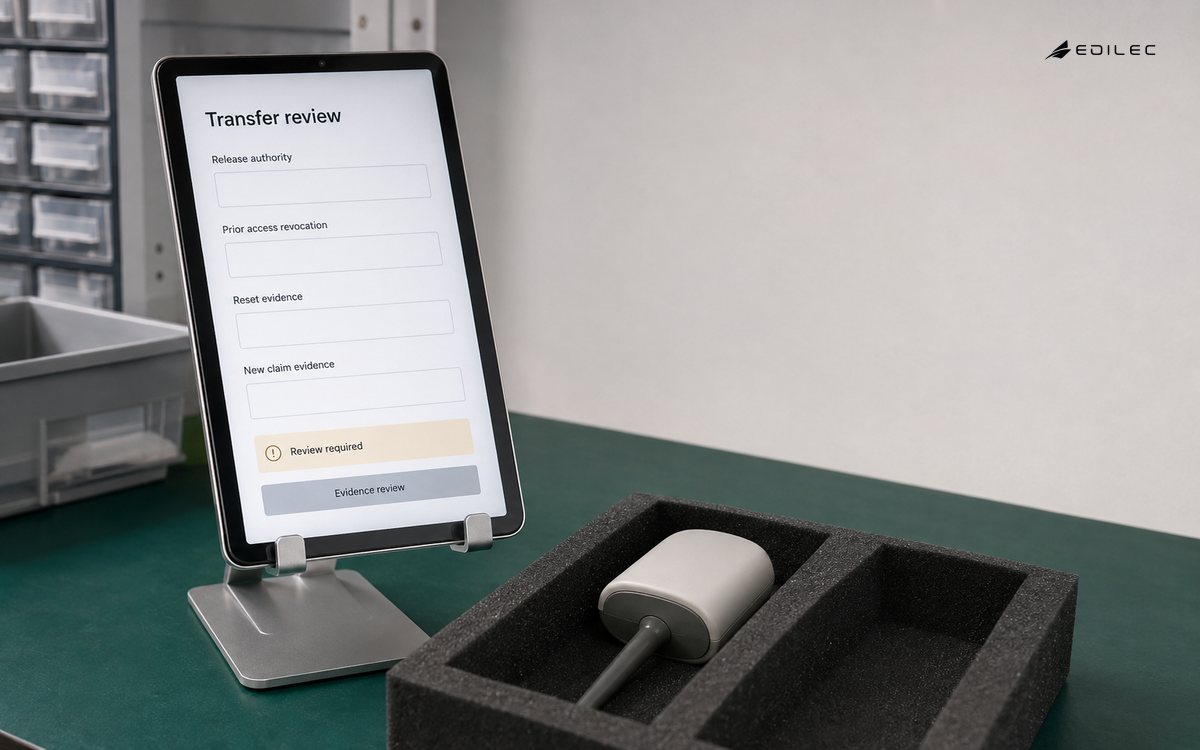
Make requests idempotent and time-bound. One transfer ID correlates device, current account, prospective claim, reset evidence, and support case. Expire incomplete handoffs and return to a safe known state. If device and cloud lose contact during transfer, neither should independently assume completion. Reconcile using monotonic transfer generation, signed receipts, and current cloud status when connectivity returns. Do not let an old cached release token claim a device after a newer ownership event.
Inventory data, authority, and external bindings
Map local data: network credentials, user identifiers, recordings, sensor history, location, schedules, access codes, tokens, certificates, logs, caches, crash dumps, removable media, secure-element objects, and application settings. Map cloud data and authority: accounts, delegates, sessions, API tokens, retained messages, device shadows, automations, webhooks, voice assistants, third-party integrations, notifications, warranties, subscriptions, and support history.
For every item, define delete, anonymize, transfer with consent, retain for legal or safety reason, or keep as manufacturer telemetry under disclosed policy. NIST's IoT cybersecurity catalogs include device identification, configuration, data protection, logical access, software update, and state awareness, plus manufacturer documentation. The catalog's manufacturer guidance specifically includes documenting how to irreversibly delete device data. Use that capability inventory to test the whole product, not only flash storage.
Revoke prior authority across every control plane
Invalidate prior user sessions, refresh tokens, delegated users, API keys, mobile push registrations, integration grants, local PINs, pairing bonds, Wi-Fi credentials, management certificates, support tunnels, and queued commands. Rotate device credentials rather than merely unlinking the serial number from an account. Delete persistent broker sessions and expire retained commands that could reach the next owner. Remove the device from prior groups, scenes, geofences, and automation rules.
A hardware root identity may remain stable for anti-counterfeit, warranty, or fleet records, while operational credentials and ownership-bound identifiers rotate. Separate manufacturer identity from owner authority. RFC 9711 notes that semipermanent entity identifiers may change at lifecycle events including ownership change, factory reset, and onboarding. Whether using attestation tokens or another mechanism, disclose which identifiers persist and prevent them from enabling old access.
| Asset | Transfer action | Verification | Residual risk |
|---|---|---|---|
| Owner account binding | Close binding and delegates | Prior account no longer lists or controls device | Cached third-party integration may persist |
| Operational device credential | Revoke and generate new credential in trusted flow | Old credential denied; new identity attested | Cloned credential may signal attempted access |
| Local user data | Cryptographic erase or verified overwrite by storage design | Post-reset inspection and data-key destruction evidence | Unmanaged removable media needs separate handling |
| Queued and retained cloud state | Purge commands, sessions, shadows as policy requires | Reconnect receives only new-owner generation | Cross-region or backup copies follow retention schedule |
| External integration | Revoke grant and webhook or assistant link | Provider confirms unlink where API supports it | Third-party retained data follows its own policy |
Implement secure reset as a verifiable operation
A secure reset should remove owner data and configuration, revoke or destroy owner-bound secrets, clear pairing and network state, remove downloaded credentials, and restore a known supported firmware and policy baseline without erasing manufacturer trust anchors required for authentic onboarding. Cryptographic erase can be effective when all sensitive storage is encrypted under keys that are securely destroyed. Account for logs, secondary partitions, removable media, coprocessors, and failed updates.
Protect reset initiation. Offer an authenticated remote release and a physical device procedure, but add anti-theft controls such as current-owner approval, a recovery secret, proof review, waiting period, or online activation lock according to product risk. Ensure safety functions remain available where required. Make reset power-loss resilient using transactional state, then run a post-reset self-test and produce a signed or cloud-verifiable result containing device identity, transfer generation, firmware state, and completion status.
Re-provision the next owner through fresh trust
The next owner claims a device only when cloud state is unowned or explicitly transferable and the device proves possession and integrity through the supported onboarding flow. Use a one-time claim secret, proximity action, QR or serial material protected against casual copying, hardware-backed attestation, or an installer ceremony appropriate to threat. Bind the claim to transfer ID and generation so captured old enrollment traffic cannot be replayed.
Issue new operational credentials, policies, encryption keys, and owner-scoped identifiers. Require the next owner to set authentication and recovery factors rather than inherit defaults. Apply current supported firmware before normal operation where feasible, but design for interrupted connectivity and safe rollback. Rebuild desired configuration from new-owner choices instead of restoring prior schedules or location automatically. Confirm time, region, safety constraints, consent, and notification destinations.
Handle data portability and support communication explicitly
Before release, let the current owner export eligible data and explain what will be deleted, retained, transferred, or remain in backups. Do not bundle personal history into the asset sale by default. Enterprise transfers may preserve operational records under organizational ownership while changing user access; document that distinction. Apply legal holds and regulated retention before wiping, and minimize retained identifiers in manufacturer support systems after transfer.
Provide clear checklists for seller, buyer, fleet administrator, reseller, and support agent. Show transfer state without exposing the prior owner's identity. Notify the prior account when release, claim, and recovery actions occur, with a dispute route. Tell the next owner the current support window, firmware status, subscription needs, known limitations, and whether ownership transfer changes warranty or service. NIST IR 8259 Rev. 1, finalized in April 2026, emphasizes manufacturer activities and customer information throughout product support.
Design dispute, offline, and failed-transfer recovery
Plan for a device that resets but cloud revocation fails, cloud release succeeds but the device remains offline, a buyer claims the wrong serial, a credential is cloned, or ownership is disputed after sale. Quarantine inconsistent states: block privileged commands, preserve evidence, and provide only minimal recovery interfaces. Use support tools that display each transition and proof without allowing agents to jump directly from active to enrolled.
A recovery override should require stronger proof, dual approval for high-impact products, a reason, a cooling-off period where appropriate, and notification to affected accounts. Never solve lockout by issuing a universal reset code. For devices with safety, medical, access-control, or industrial functions, define on-site technician and operational continuity procedures. If transfer cannot be completed securely, support decommissioning and disposal rather than weakening enrollment.
Test lifecycle security and measure transfer completion
Test every hardware revision and supported firmware: local and remote reset, interrupted power, offline release, stale token replay, old credential use, delegate removal, third-party unlink, data remanence, persistent MQTT state, backup retention, stolen-device claim, wrong-device scan, support override, and repeated requests. After transfer, attempt access from every prior role and integration. Inspect storage and cloud records using a documented verification protocol.
Measure requested, completed, expired, disputed, and failed transfers; time in each state; reset failures by hardware and firmware; stale-credential attempts; orphaned cloud bindings; support interventions; third-party unlink failures; and post-transfer privacy or access incidents. Sample completed devices for residual data and old authority. Feed failures into firmware, cloud, documentation, and reseller training. A low support-call rate is not proof if owners unknowingly leave access behind.
Key takeaways
- Classify transfer scenarios and roles so physical possession alone never becomes universal proof of ownership.
- Use an explicit, generation-bound lifecycle that reconciles device and cloud state through interruption and replay.
- Inventory and revoke account, credential, session, retained-message, integration, local-data, and support authority together.
- Secure reset should erase owner state while preserving manufacturer trust needed for authentic fresh enrollment.
- Test old access after transfer and provide documented recovery, dispute, data, support, and decommissioning paths.
Frequently asked questions
Is factory reset enough to transfer an IoT device? Usually not. It may clear local settings while cloud sessions, account bindings, integrations, retained commands, backups, or operational credentials remain. Transfer must cover the full product and verify prior access is denied.
Should the hardware device identity change? A manufacturer root identity may remain stable for authenticity and support, while ownership-bound credentials and identifiers rotate. Separate persistent product identity from authorization and disclose any identifiers that remain linkable.
What if the prior owner is unavailable? Use a documented recovery process with purchase and possession evidence, prior-account notification, a delay, fraud review, and dispute handling proportionate to risk. A printed serial number alone should not defeat an activation lock.
Conclusion
A secure second-owner lifecycle protects both continuity and trust. By verifying authority, revoking the old control plane, erasing data, resetting through a resilient state machine, and issuing fresh credentials only after a valid claim, manufacturers can support resale and reassignment without exposing prior owners or bricking useful products. Ownership transfer should be engineered and tested from the product's first release, not improvised at return time.