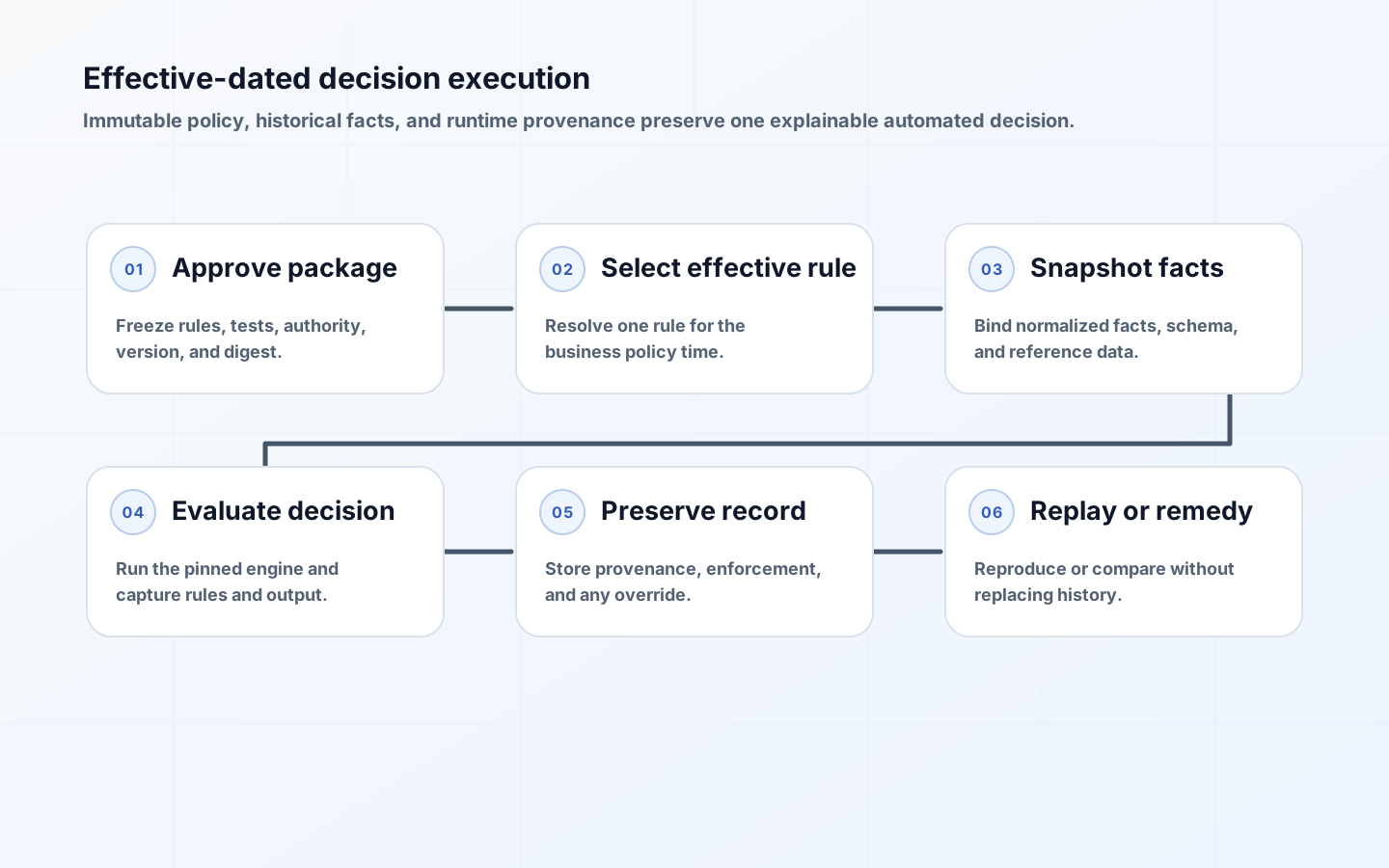
Business rules versioning allows an automated decision to be explained and reproduced with the policy that applied to that case. The current rule is often the wrong rule for a historical event: tax, eligibility, pricing, approval limits, and service entitlements change over time. Without immutable versions and effective dates, replay silently applies today's policy to yesterday's facts and produces misleading audit evidence.
The reliable design treats a rule release as a governed artifact and a decision as a durable record. Each evaluation binds a rule-set version, an effective instant, normalized inputs, reference-data versions, execution semantics, output, and trace. This is not only a compliance feature. It supports incident analysis, safe rollback, impact testing, dispute handling, and controlled migration from one policy to another.
Separate policy meaning from executable implementation
Write the business decision contract before encoding a table. Name the decision, owner, authority, inputs, output type, permitted outcomes, applicability, and downstream consequence. Define terms in a controlled vocabulary so customer status, annual income, active employee, or business day has one governed meaning. SBVR addresses business vocabulary and rules, while DMN provides a standard notation for decisions and decision tables; either can help keep policy readable beyond one engine.
Keep implementation details traceable to a policy clause or approved decision requirement. One release can contain several artifacts: vocabulary, decision requirements, tables, functions, reference data, tests, and release metadata. Assign the package one immutable identifier and content digest. Do not overwrite version 3.2 in place. If an editorial correction changes executable meaning or evidence, publish a new version even when the business label remains familiar.
| Artifact | Version independently? | Reason | Decision record reference |
|---|---|---|---|
| Rule package | Yes, immutable release | Defines executable policy as a coherent unit | Package ID, semantic version, digest |
| Vocabulary or schema | Yes when meaning or type changes | Inputs must be interpreted consistently | Schema and vocabulary version |
| Reference data | Yes or snapshot by effective period | Rates, regions, and classifications affect output | Dataset version or snapshot digest |
| Engine/runtime | Pin for reproducibility | Expression semantics and defects can change | Engine name and build version |
| Test suite | Version with release | Shows expected policy examples and boundaries | Test artifact ID and result |
Model effective dates as non-overlapping policy intervals
Give each approved release a valid-from instant and optional valid-to instant in a declared time zone. Define whether the boundary is inclusive and use a half-open interval such as start inclusive, end exclusive to avoid double matches. The decision's policy time might be application received, transaction occurred, service delivered, or adjudication date. It is not automatically the server clock at evaluation. Store the chosen policy instant with the case.
Validate release schedules so two versions cannot both be effective for the same scope and no unintended gap exists. Future-dated versions may be approved and deployed without becoming active. A retroactive policy requires explicit authority and a recalculation plan; never edit the prior interval silently. Some decisions use more than time, such as jurisdiction, product, channel, and customer segment. Treat those dimensions as a deterministic release-selection key with conflict checks.
Capture a complete decision record
At evaluation, persist a decision ID, case and correlation IDs, rule package and digest, selected effective instant, input schema, normalized input or immutable snapshot reference, reference-data versions, engine version, output, matched rule identifiers, execution timestamp, and caller. Record whether the result was advisory or directly enforced. If a person later overrides it, preserve the automated result and append the override rather than replacing history.
Protect sensitive inputs. A full snapshot improves replay but may violate minimization or retention requirements. Store only decision-relevant normalized facts, tokenize identifiers, encrypt restricted fields, and keep access narrower than ordinary application logs. OPA decision logs demonstrate useful provenance fields such as decision ID, policy path, bundle revision, input, and result, while also warning that inputs may require masking. Design evidence and privacy together.
Use a controlled rule release workflow
A proposed change should include policy authority, rationale, affected decisions, effective period, examples, expected population impact, and rollback conditions. Reviewers examine both business meaning and executable behavior. Build an immutable package, verify its digest, run unit and decision-table completeness tests, compare it with the current version over representative historical cases, and promote the same artifact through environments. Separate author, approver, and production release roles where consequences warrant it.
Version aliases such as current or production are convenient routing pointers, not evidence. Red Hat's Decision Manager documentation describes packaged KJAR artifacts identified by group, artifact, and version; the general lesson is to address deployments by immutable coordinates. A decision record must capture the resolved artifact, not only the alias. Sign or attest packages in higher-risk environments and reject an artifact whose digest differs from approval evidence.
| Change class | Example | Required analysis | Release approach |
|---|---|---|---|
| Editorial only | Description wording with identical executable digest | Confirm no semantic or trace change | Metadata revision under controlled process |
| Boundary change | Income threshold moves from 40,000 to 42,000 | Boundary tests and affected-case comparison | New effective-dated package |
| New input | Add residency duration | Schema compatibility, missing-data path, privacy review | Dual-read or staged migration |
| Reference-data update | New region classification | Dataset diff and population impact | Versioned data release tied to package |
| Defect correction | Rule matched excluded applicants | Incident scope, historical replay, remediation authority | Urgent new version; never overwrite old artifact |
Test decisions at boundaries and over real populations
Unit tests should cover every outcome, decision-table hit policy, null and invalid input, exact thresholds, dates at effective boundaries, and conflicting or missing reference data. A table with every cell exercised can still implement the wrong policy, so policy owners provide signed examples and counterexamples. Run conformance tests against the packaged artifact and the production engine version, not only an editor preview.
Before activation, evaluate old and proposed versions against a representative, privacy-appropriate historical dataset. Report counts of unchanged, newly eligible, newly ineligible, changed reason, and evaluation error, segmented by relevant business categories. This is an impact estimate, not proof of fairness or future outcomes. Investigate unexplained differences and approve expected ones. Store the comparison query, dataset snapshot, both digests, and result summary with the release.
Replay historically without rewriting history
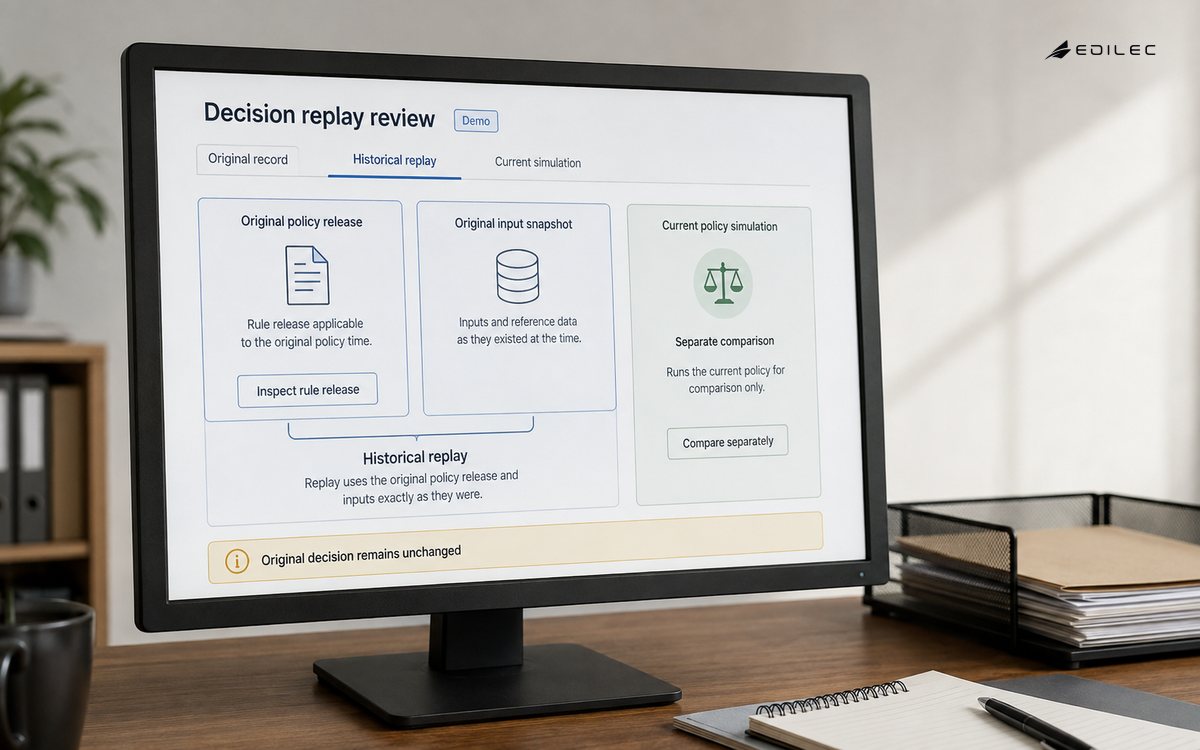
A reproducibility replay uses the original package, input snapshot, reference data, engine semantics, and policy instant. It should return the recorded result or reveal corruption or nondeterminism. A counterfactual replay intentionally applies another version to the historical inputs to measure impact. Label these modes clearly. Never replace the original decision with a counterfactual output, because that destroys evidence about what actually governed the case.
When a defective rule affected cases, identify the population using the recorded package and matched rule IDs. Re-evaluate under an authorized correction, then create remediation actions such as review, refund, notification, or record adjustment. Whether corrected policy may be applied retroactively is a legal and business decision, not an engine default. Link each remediation to the original decision, new evaluation, authority, communication, and final disposition.
Roll back routing while preserving both releases
Rollback should change which immutable package receives new decisions; it should not delete the bad release or mutate its effective interval without a governed record. Predefine rollback triggers such as evaluation errors, unexpected population shifts, latency, or downstream rejection. Confirm the old version remains compatible with current input schema and reference data. If not, a forward fix or compatibility adapter may be safer than routing backward.
Monitor evaluation volume, error and no-match rates, outcome distribution, matched-rule distribution, latency, input missingness, override rate, and package digest by instance. Alert when an unapproved digest evaluates decisions or more than one version is active for the same scope. Reconcile the runtime inventory to the release registry. Operational dashboards may use aliases for readability, but drill-down must show immutable version and decision IDs.
Key takeaways
- Publish immutable rule packages with version, digest, effective interval, policy authority, tests, and reference-data dependencies.
- Select policy by a stored business-effective instant and deterministic scope, not by whatever version is current during replay.
- Capture normalized inputs, resolved package, engine, matched rules, output, and override history in a protected decision record.
- Distinguish reproducibility replay from counterfactual analysis and preserve the original decision in both cases.
- Rollback changes routing for future evaluations; defect remediation is a separate authorized business process.
Frequently asked questions
Should rules use semantic versions? Semantic labels can communicate compatibility, but they do not replace a content digest, effective period, or release ID. Define what major, minor, and patch mean for decision contracts, and publish a new immutable artifact for every executable change.
Can only the input be stored for replay? No. Replay also needs the resolved rule package, reference data, expression semantics or engine version, and effective-time selection. Without those dependencies, the same input can legitimately produce a different answer.
Does a human override erase the automated decision? It should not. Append the override with actor, authority, reason, evidence, and resulting action. Keeping both outcomes distinguishes model or rule behavior from the organization's final accountable decision.
Conclusion
Versioned rules make automated decisions governable over time. By binding every result to immutable policy, effective context, decision facts, and runtime provenance, teams can explain old cases, test new policy, roll back safely, and remediate defects without rewriting history. That evidence turns a mutable rule engine into a dependable decision system.