Business transaction monitoring across integrations answers a question that connector health cannot: did the order, employee change, invoice, claim, or shipment reach the required business outcome? A green API gateway can precede a rejected ERP posting. A queue can drain while a subscriber writes the wrong customer. A nightly job can succeed after silently excluding one company code. Enterprise observability must connect technical execution to durable state across SaaS applications, brokers, managed file transfer, integration platforms, batch jobs, and legacy databases.
Distributed tracing is useful but insufficient on its own. W3C Trace Context standardizes traceparent and tracestate propagation, and OpenTelemetry defines common attributes and messaging relationships. Many enterprise hops cannot carry trace context, traces are sampled, and a trace usually ends before a human approval or next-day batch. Durable transaction identity and business checkpoints must complement technical spans. The result is an evidence model that survives protocol, tool, and time boundaries.
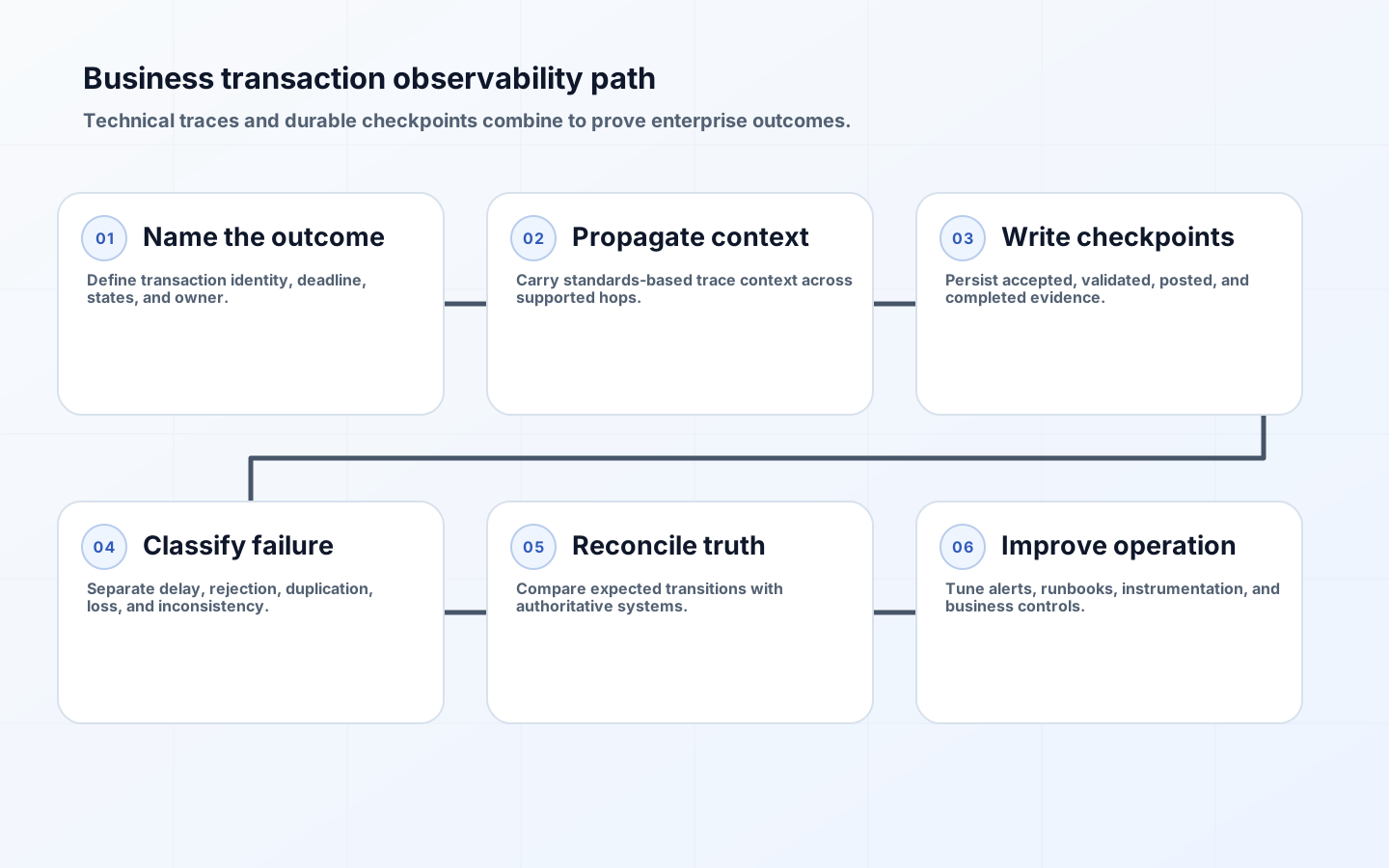
Define the business transaction and outcome contract
For each transaction type, name the business identity, initiating event, authoritative systems, expected states, deadline, completion evidence, value or risk class, owner, and allowed terminal outcomes. An order might be received, validated, accepted, allocated, shipped, invoiced, rejected, canceled, or unresolved. Define which transitions are mandatory for each variant. Avoid one global success flag. A canceled order may be correctly completed; an accepted order still waiting beyond its promise may be operationally failed.

Separate identifiers by purpose. A business transaction ID remains stable across retries and channels. A message ID identifies one envelope or event. A trace ID connects one technical execution graph. A source record and target record ID support reconciliation. A batch run ID groups work. Store their relationships in a transaction journal. Do not place confidential account numbers or email addresses in trace IDs, metric labels, or log keys. Use opaque identifiers with controlled lookup to business context.
| Evidence type | Question answered | Retention tendency | Known limitation |
|---|---|---|---|
| Trace span | Where did this execution spend time or fail? | Short to medium | Sampling and propagation gaps |
| Structured log | What did one component decide? | Policy dependent | Inconsistent schemas and sensitive payload risk |
| Metric | How is a population behaving? | Aggregated long term | High-cardinality transaction detail is unsuitable |
| Business checkpoint | What durable state was reached? | Business or audit policy | Requires deliberate instrumentation |
| Reconciliation result | Does expected state match authority? | Control evidence | Usually delayed rather than real time |
Propagate technical context without confusing it with identity
Adopt W3C Trace Context for HTTP where libraries and intermediaries support it. Instrument producer, send, receive, process, and settle operations using the applicable OpenTelemetry messaging conventions. The current messaging guidance favors span links for producer-to-consumer correlation because batches and fan-out do not fit a single parent. Carry an opaque business transaction ID as separate application metadata. Validate inbound trace fields at trust boundaries and apply vendor guidance to prevent untrusted callers from manipulating sampling or internal relationships.
For file, database, email, and legacy hops, create explicit bridge records. A file manifest can link file ID, checksum, batch ID, transaction IDs, source cutoff, and destination receipt. A scheduled import can open a new trace linked to its batch and retain the original transaction keys. When a SaaS system strips headers, persist the opaque correlation value in an approved external-ID field or integration journal. Do not inject unsupported metadata into a standard business document where it could violate a partner contract.
Write durable checkpoints at meaningful boundaries
A checkpoint records transaction ID, state, event time, observed time, source system, source record and version, actor or service, reason, payload fingerprint where appropriate, and preceding checkpoint. Write checkpoints after durable facts, not before uncertain side effects. Received means the organization retained the transaction; validated means declared rules passed; posted means the authoritative application committed; business complete means the defined outcome exists. An acknowledgement from middleware should not impersonate a downstream posting.
Make checkpoint writes idempotent and append-oriented. Corrections should add superseding evidence with reason, not rewrite history silently. Define monotonic rules where the business lifecycle permits them and explicitly support reversals. For privacy, retain references and safe decision metadata rather than complete payloads in observability stores. Keep raw payloads in controlled evidence storage with separate access and retention. This separation allows operators to diagnose state without making the telemetry platform an uncontrolled copy of enterprise data.
Classify failures by business effect
Distinguish delayed, rejected, lost, duplicated, misrouted, partially applied, inconsistent, and unknown transactions. Add technical cause classes such as authentication, quota, schema, policy, dependency, timeout, poison message, stale version, and human hold. A timeout is not proof of failure: the destination may have committed before the response was lost. Recovery should first query or reconcile using the idempotency and target keys, then decide whether retry, resume, compensate, or human review is appropriate.
Set alerts on business conditions with consequences: high-value orders unposted for fifteen minutes, employee terminations not reflected in access systems by deadline, invoice populations with unexplained count or value variance, or rapidly growing unknown outcomes. Technical alerts still matter for queue depth, error rates, saturation, and latency, but route them according to service ownership. Correlate business and technical signals in incident views so teams do not page a process owner for a self-healing retry or leave a material business backlog with only middleware engineers.
| Condition | Detection | Immediate action | Recovery proof |
|---|---|---|---|
| Delayed | Checkpoint age exceeds class deadline | Inspect dependency and backlog | Expected state reached within policy |
| Rejected | Authoritative reason checkpoint | Route correctable data or business owner | Approved resubmission or terminal rejection |
| Duplicate | Same business key has competing effects | Stop further side effects | One authoritative effect and disposition |
| Partial | Required child or downstream states missing | Contain and enumerate applied effects | Resume or compensate every effect |
| Unknown | No terminal state and trace gap | Query authority before retry | Resolved identity, state, and cause |
Reconcile expected transitions with authoritative truth
Run reconciliation independently of the transaction path. Build the expected cohort from an authoritative source and compare it with journal checkpoints and destination records by immutable key. Check counts, distinct identities, amounts, currencies, child lines, terminal states, and age. Account for legitimate late arrival, cancellation, and rejection with explicit categories. Never force totals to match by dropping unexplained records. Publish every residual exception with evidence, severity, owner, and next review time.
Use near-real-time reconciliation for time-sensitive flows and scheduled control totals for slower or high-volume paths. Preserve source and destination cutoff times so comparison populations align. Sample semantic fields even when control totals match; two swapped customer assignments can leave counts and amounts unchanged. Track reconciliation coverage itself: which flows, regions, and states are checked, how late the evidence is, and whether exceptions close. A trace search is an investigative aid, not a substitute for population-level control.
Build an ownership and recovery operating model
Assign a technical service owner and business outcome owner to each transaction. The technical owner maintains propagation, instrumentation, queues, and runbooks. The business owner approves state meaning, deadlines, exception disposition, and material recovery. Provide a transaction support view with timeline, checkpoints, linked traces, safe attributes, target records, and approved actions. Gate replay and compensation by role, reason, preview, and audit; a convenient replay button can duplicate irreversible financial or customer effects.
Test observability through fault injection and known canary transactions. Drop context at one hop, duplicate a message, delay a batch, reject a schema, exhaust a quota, lose an acknowledgement, and commit before timeout. Confirm the monitoring detects the correct business condition and the runbook produces reconciled recovery. Measure mean time to know the affected population and outcome, not only mean time to acknowledge an infrastructure alert. Review unused fields, uncontrolled cardinality, sensitive data, stale alerts, and incomplete transaction coverage each quarter.
Key takeaways
- Define observable success as a durable business outcome with permitted terminal states and deadlines.
- Relate business transaction, message, trace, batch, source, and destination identifiers without using sensitive values in telemetry keys.
- Use standards-based trace propagation where possible and explicit bridge evidence across files, jobs, SaaS fields, and legacy boundaries.
- Persist idempotent checkpoints and classify failures by business effect before retrying or compensating.
- Reconcile complete populations against authoritative systems and give technical and business owners controlled recovery tools.
Frequently asked questions
Is distributed tracing enough for enterprise integration monitoring?
No. Tracing explains instrumented executions, but sampling, unsupported hops, long-running work, and human stages create gaps. Durable business checkpoints and independent reconciliation establish whether required outcomes actually exist.
Should the business correlation ID equal the trace ID?
Usually not. A business transaction can span multiple traces, retries, batches, and days. Keep a stable opaque business ID and relate it to each technical trace. This also avoids coupling business records to one observability implementation.
Should logs contain full business payloads for diagnosis?
Generally no. Log safe identifiers, state, reason, schema version, and fingerprints. Store raw payload evidence under purpose-specific encryption, access, and retention controls, and link to it for authorized investigation.
Conclusion
Enterprise integration observability becomes trustworthy when telemetry and business control reinforce each other. Standards-based context reveals technical paths; durable checkpoints reveal state; reconciliation reveals missing or inconsistent outcomes; and named owners resolve them. That combination turns a maze of connectors into an operable transaction system with evidence proportional to business consequence.