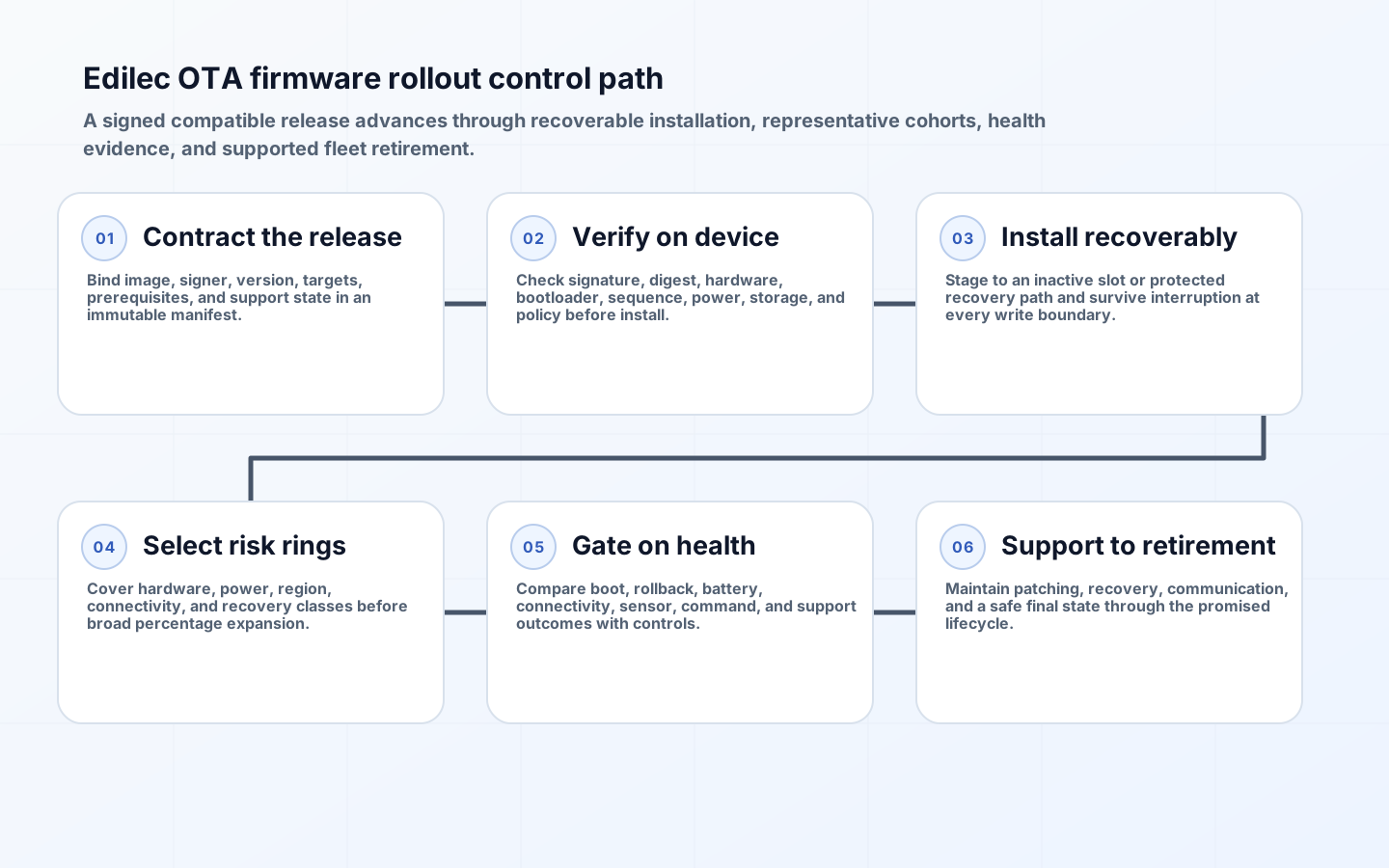
An OTA firmware update strategy is a production safety system, not a file-delivery feature. A fleet may contain several board revisions, bootloaders, radio modules, flash layouts, battery profiles, and regional network conditions under one product name. Once an image leaves the laboratory, the update path must authenticate it, survive interruption, reveal hardware-specific regressions, and restore a usable device without a truck roll.
The operating model should separate authoring, authorization, distribution, installation, and acceptance. That separation is consistent with the roles in the IETF's firmware update architecture: the party producing firmware need not be the party authorized to release it. Build a signed, immutable release, target it to an explicit compatibility set, and expand only when device and service evidence satisfy predetermined gates.
Define the firmware release contract and compatibility boundary
Begin with an inventory keyed by immutable hardware identity: product family, board and component revisions, bootloader generation, current application version, secure-element state, storage capacity, power source, geography, and critical operating mode. Treat missing inventory as a separate risk cohort. A release manifest should name the image digest, signing identity, version sequence, compatible hardware predicates, minimum bootloader, dependencies, installation requirements, release channel, and an expiry or withdrawal state. The device must reject an image whose signature, digest, target identity, sequence policy, or prerequisites fail.
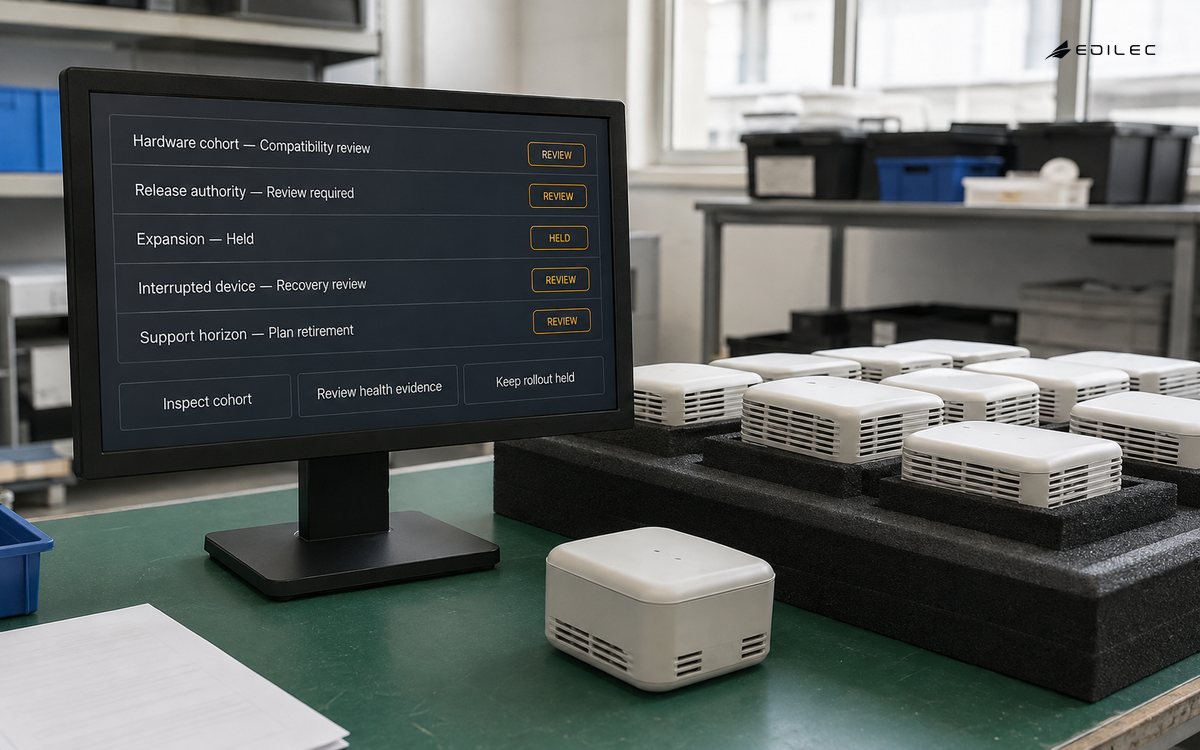
Version policy needs more precision than 'newer wins.' Define whether downgrade is normally prohibited, which recovery key can authorize an exception, and how revoked signing keys are recognized on intermittently connected devices. Protect the root of trust separately from online release credentials. NIST's IoT device cybersecurity baseline identifies secure software update as a core capability; that capability includes verifying and authenticating updates before installation, not merely encrypting the download channel.
| Field | Purpose | Gate evidence | Failure action |
|---|---|---|---|
| Image identity | Bind bytes to version and signer | Digest and signature verify on every supported target | Reject before writing executable flash |
| Compatibility predicate | Limit release to tested hardware and bootloader combinations | Matrix test plus device inventory match | Remain on current image and report reason |
| Install preconditions | Protect power, storage, temperature, and operating work | Device-side checks immediately before install | Defer with bounded retry |
| Acceptance rule | Distinguish a boot from a healthy release | Boot confirmation plus application health window | Revert or enter recovery |
| Support state | Make availability and withdrawal explicit | Published lifecycle record and fleet query | Stop offering withdrawn image |
Build a power-loss-safe installation and device update rollback path
A reliable device update rollback starts in the boot chain. On capable hardware, use A/B slots: download into the inactive slot, verify before activation, atomically switch a small boot metadata record, and require the new application to confirm health within a bounded window. If confirmation never arrives, the bootloader selects the last known-good slot. Keep the boot decision data resilient to torn writes with redundant records, sequence numbers, and checksums. Updating the bootloader itself deserves a narrower cohort because a defect there can remove the recovery mechanism.
Constrained single-bank devices need an equally explicit recovery design: a protected minimal recovery image, resumable page writes, a staging area, or an external programmer path. Test interruption at every flash erase and write boundary, not only during download. Differential images can save bandwidth but increase dependency and reconstruction complexity; retain a full-image escape route for unknown baselines. Multi-controller products must define image dependencies and activation order because partially updating a main MCU, radio, and sensor controller can produce a valid boot but an invalid product.
Design rollout rings around risk and fleet health gates
A phased firmware rollout should move through meaningful populations: laboratory endurance devices, employee or owned canaries, a small field ring with broad hardware coverage, regional or customer rings, and general availability. Random percentages alone are insufficient. The first field ring should deliberately include every supported board revision, power profile, connectivity class, and high-risk peripheral. Keep critical installations and sites with no physical recovery path in later rings until comparable devices prove the release.
Define gates before the rollout. Useful fleet health gates include download completion, verification failure, installation failure, boot-loop detection, rollback rate, application heartbeat, battery depletion, reconnect latency, sensor plausibility, command success, cloud error rate, and support contacts. Compare candidate devices with a matched control cohort because seasonal load or a cloud incident can affect both. AWS IoT Jobs documents constant and exponential rollout rates plus abort criteria; remember that stopping new work does not undo installations already in progress or completed.
| Ring | Population design | Minimum observation | Promotion question |
|---|---|---|---|
| Engineering | Instrumented devices and fault injection | Repeated install, reboot, power-loss, and recovery cycles | Can every supported path return to known-good firmware? |
| Owned canary | Staff or company-controlled field units across hardware variants | At least one representative operating cycle | Are product outcomes and resource use within bounds? |
| Field pilot | Small diverse customer cohort with reachable support | Enough time to include reconnects and real duty cycles | Is candidate health no worse than matched control? |
| Expansion | Regions and customer groups in bounded increments | Gate window after each material increase | Are failures localized, understood, and recoverable? |
| General availability | All eligible devices except explicit holds | Continuous monitoring through adoption tail | Can remaining devices update before support expiry? |
Operate pause, rollback, and recovery as different controls
Pause stops assigning the release to new devices. Cancel asks queued devices not to start. Rollback activates a known-good compatible image on devices that can still execute the update agent. Recovery handles devices that cannot boot the application or reach the service. These controls solve different failure states and should have separate runbooks, permissions, and telemetry. Never describe a fleet rollback as instantaneous: sleeping devices, offline sites, and installations already underway create a long tail.
Use idempotent job execution and stable reason codes. A device should report downloaded, verified, deferred, installing, rebooting, accepted, rolled back, or recovery-required with release and hardware identity. Preserve local logs across reboot where storage allows, but bound them to avoid exhausting flash. During a bad rollout, first stop expansion, protect command and ingestion services from reconnect surges, identify affected compatibility cells, and choose disablement, targeted rollback, or forward fix based on device reachability and data compatibility.
Turn support windows and IoT end-of-life into engineering requirements
A support promise must fund signing infrastructure, build reproducibility, vulnerability intake, dependency maintenance, test hardware, distribution, monitoring, customer communication, and recovery expertise for the stated period. NIST IR 8259 Rev. 1 describes foundational manufacturer activities across the product lifecycle in its April 2026 final publication. Record the security update support period at launch and connect each shipped device model to that commitment.
Before end-of-life, inventory devices that cannot reach the last supportable release, provide repeated notice through appropriate channels, preserve update artifacts and verification material, and define whether functionality will continue locally when cloud services retire. Do not intentionally brick a sound device merely because a subscription ends. Where operation would become unsafe, provide a proportionate isolation, replacement, or decommissioning path. Keep a final recovery image and support documentation available for the promised period, and document what happens to certificates, personal data, ownership transfer, and fleet APIs.
Test and observe the whole firmware delivery system
Release qualification should cover signature failure, expired credentials, replayed manifests, downgrade attempts, low power, full storage, corrupt chunks, clock error, lost connectivity, captive networks, server throttling, power removal at every write stage, peripheral mismatch, schema migration, and repeated rollback. Maintain physical representatives for every support cell and automate power cycling. A simulator can exercise scale and protocol behavior, but it cannot prove flash timing, thermal effects, RF coexistence, or boot-ROM behavior.
Run periodic recovery drills with production-equivalent keys and authorization controls. Measure the percentage of the fleet whose exact state is known, time to pause, time to identify a failing hardware cell, rollback reachability, and time to restore service. Reconcile update service records with device-reported versions rather than treating job dispatch as installation. The strongest success metric is not adoption speed; it is how much exposure can be changed while every device remains recoverable and supportable.
Key takeaways
- Sign an immutable manifest and image, then enforce hardware, bootloader, sequence, power, and storage compatibility on the device.
- Use A/B or protected recovery architecture and test power loss at flash boundaries before field release.
- Build rings from hardware and operating risk, with promotion gates based on candidate-versus-control health.
- Separate pause, cancel, rollback, and recovery because each acts on a different device state.
- Treat the published support window as a funded operational obligation through secure end-of-life.
FAQ
How large should the first OTA ring be?
Large enough to cover every important compatibility cell and produce useful health evidence, but small enough for direct investigation and recovery. A fixed percentage is misleading: one percent of a homogeneous fleet may miss a rare board revision, while a few dozen deliberately selected devices can expose it.
Should firmware rollback be automatic?
Automatic rollback is appropriate for local, unambiguous failures such as repeated boot failure or a missing acceptance heartbeat. Product-level anomalies may require a server-side decision because reverting could conflict with migrated data, safety state, or a changed protocol. Bound attempts so two images do not alternate forever.
What happens to devices that remain offline during a rollout?
Keep an eligibility record independent of a short-lived job, and reevaluate compatibility when the device reconnects. It may need an intermediate bootloader or application image rather than the newest release. Expire withdrawn releases, but preserve a tested path from every supported baseline.
Conclusion
A dependable OTA program combines cryptographic authorization, recoverable installation, risk-shaped rings, measurable health gates, and a credible lifecycle promise. When the release service knows exactly which devices may install an image and each device can return to a known-good state, firmware change becomes a controlled fleet operation instead of a remote wager.