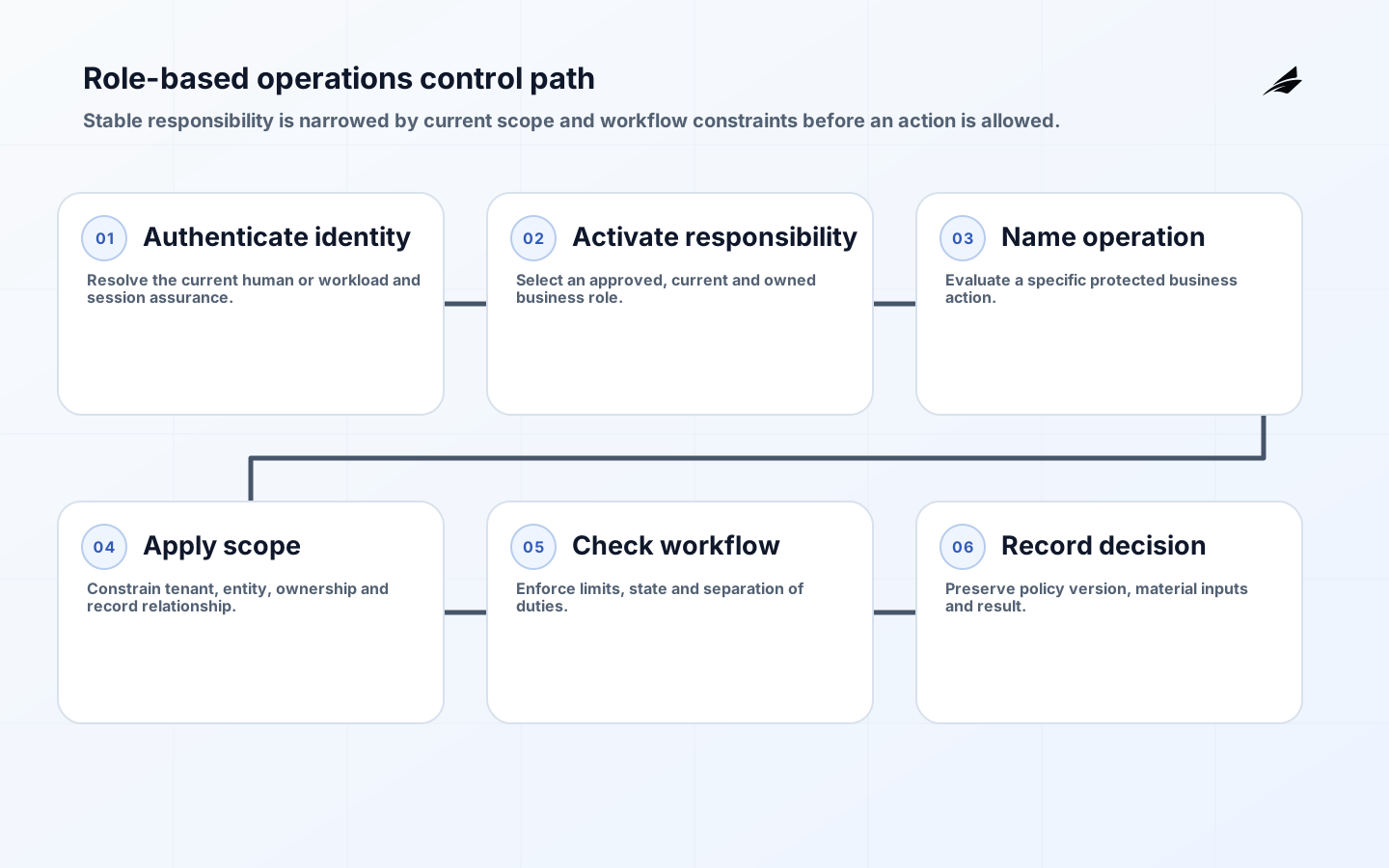
Role-based operations connect responsibility to the actions people can perform across ERP, CRM, finance, service and workflow systems. The objective is not to give every job title a bundle of screens. It is to let an authenticated person perform the minimum business operations required for a current responsibility, within the right tenant, department, amount, record state and time, while preserving evidence that managers and auditors can understand.
This guide extends Edilec's work on ERP integration roadmaps, trustworthy CRM automation and safe SaaS admin consoles. NIST's RBAC model separates users, roles, permissions, operations and objects. That foundation remains useful, but multi-team companies usually need scoped attributes and workflow constraints as well as roles.
Map responsibilities before creating roles
Start from real scenarios: create a customer, change a price, approve a refund, close a period, export personal data or impersonate a user. For each operation, name the accountable role, required inputs, resource scope, limits, conflicting duties, exceptional path and evidence. Interview practitioners and managers separately; documented process often differs from daily work. Build roles around stable responsibilities such as account owner or payment approver, not temporary projects, seniority labels or every small organizational variation.
| Design element | Question | Evidence |
|---|---|---|
| Subject | Which human or workload identity is acting? | Identity and session assurance |
| Role | Which stable responsibility is active? | Approved assignment and owner |
| Operation | What business action is requested? | Named permission and API check |
| Resource scope | Which tenant, region or records are affected? | Material attributes and policy result |
| Constraint | Which state, amount or separation rule applies? | Policy version and decision reason |
Combine roles with explicit scope and constraints
Keep the role catalog small enough to review. A role grants named operations; attributes then narrow where and when those operations apply. For example, an invoice approver may act only for one legal entity, below a threshold, on an invoice they did not create. NIST SP 800-162 describes attribute-based decisions using subject, object, operation and environment attributes. This hybrid avoids a separate role for every region and limit while keeping the base responsibility intelligible.

Centralize policy semantics without creating a fragile single runtime dependency. Applications should use a shared permission vocabulary and tested decision component, while local enforcement remains close to the protected operation. Deny by default, evaluate on every request, and never rely on hidden buttons as authorization. Batch jobs, exports, APIs and support tools require the same controls as the primary interface.
Automate joiner, mover and leaver events
Define an authoritative workforce or partner source, then map approved identity attributes into application assignments. SCIM standardizes common user and group provisioning operations, but a protocol does not decide entitlement policy. Treat inbound group changes as requests that must satisfy local mapping, ownership and conflict rules. Make deprovisioning urgent, observable and retryable. Disable sessions and privileged credentials as well as directory accounts, and reconcile the target system against the source regularly.
Moves are harder than joins. A promotion or department transfer can accumulate access if the process only adds new groups. Model replacement and expiry, require an end date for temporary roles, and alert on orphaned accounts or assignments without a current owner. Emergency access should be time-bound, strongly authenticated, approved where feasible and reviewed immediately after use.
Enforce separation of duties in workflow state
Static role conflicts catch obvious combinations such as vendor maintainer and payment approver. Dynamic separation catches the more important case in which one person creates and approves the same transaction. Store actor and state history so the policy engine can evaluate the relationship at decision time. Decide how small teams handle unavoidable conflicts: a second-line review, lower limit or delayed reconciliation is better than an undocumented administrator bypass.
Carry authorization through integrations
An approved action often crosses CRM, workflow, ERP and payment systems. Preserve the requesting identity, business purpose and authorization context in a correlated command or event, but let each receiving system enforce its own boundary. Service identities need narrowly scoped credentials and rotation. Do not let a highly privileged integration account erase the difference between approved and unapproved source actions. Reconciliation should detect target changes that did not originate through the controlled path.
| Control | Preventive behavior | Detective evidence |
|---|---|---|
| Least privilege | Role grants only named operations | Unused and denied permission trends |
| Scoped access | Tenant and record attributes constrain action | Cross-scope denial and negative tests |
| Separation of duties | Creator cannot approve same transaction | Actor and state history |
| Lifecycle | Provision, replace and revoke from authority | Source-to-target reconciliation |
| Emergency access | Time-bound approval and strong authentication | Session recording and post-use review |
| Service identity | Dedicated credential with narrow audience | Secret age and anomalous call pattern |
Make access review decision-ready
A manager cannot review opaque group names or thousands of atomic privileges. Show the business role, scope, sensitive operations, reason, assignment source, last use, conflicts and owner. Ask a specific question: does this person still perform this responsibility for this scope? Route application and data-owner reviews for high-consequence access. Record the decision and verify that removals reached every target. Measure stale access and remediation time, not review clicks alone.
Roll out one controlled workflow at a time
- Inventory identities, systems, high-consequence operations and current exception paths.
- Model one workflow with stable roles, scopes, limits and separation rules.
- Implement server-side enforcement and negative authorization tests.
- Connect authoritative lifecycle events and reconcile assignments.
- Pilot with real users, support staff and approvers; capture denied legitimate work.
- Remove legacy grants only after proving the replacement and recovery path.
Test policy as a business contract
Create a permission matrix from representative scenarios, then encode positive and negative tests at the API or policy boundary. Include cross-tenant identifiers, changed ownership, disabled accounts, expired access, stale tokens, conflicting roles and direct requests to hidden operations. Test bulk endpoints and exports separately. Verify denial does not disclose whether a protected record exists and the audit event contains a useful reason without sensitive content.
Run role mining cautiously. Usage can reveal obsolete permissions and patterns, but past activity does not prove legitimate need. Compare suggestions with policy and workflow owners. During rollout, provide a fast path for missing access and classify requests as role-design defects, assignment errors, exceptional duties or training issues. That feedback improves the model without normalizing permanent elevation.
Track orphaned identities, ownerless assignments, unused sensitive roles, toxic combinations, emergency use, review completion and revocation latency. Sample allowed high-consequence actions as well as denials. The system should make access predictable for operations and transparent for assurance while keeping exceptional authority scarce and visible.
Key takeaways
- Engineer roles from stable responsibilities and real business operations.
- Use attributes to constrain scope without multiplying role variants.
- Automate revocation, replacement, expiry and reconciliation across systems.
- Enforce separation where transactions change state, not only in role catalogs.
- Present access evidence in language an accountable reviewer can decide.
Frequently asked questions
Should a multi-team company use RBAC or ABAC?
Usually both. Roles express stable responsibilities and remain reviewable; attributes narrow tenant, ownership, amount, state, location or time. Pure per-user grants do not scale, while a highly dynamic policy with no role vocabulary can be difficult for managers to understand. Use the simplest combination that represents actual decisions.
Does single sign-on solve role management?
No. SSO authenticates the user and may carry attributes or groups, but each application still needs entitlement mapping, enforcement, lifecycle handling and evidence. An identity-provider group should not silently become permission truth without an owner and tested contract.
How often should access be reviewed?
Set cadence from consequence and change rate. Privileged, financial or sensitive-data roles need more frequent review than low-risk read access. Event-driven review after transfers, contract end, role-owner change or suspicious use is often more valuable than waiting for a calendar cycle.
Migrate from inherited permissions safely
Export current accounts, groups, direct grants and recent activity from every target. Map them to proposed responsibilities and mark grants with no owner, no use or no clear purpose. Do not automatically copy privileged access into the new model. Ask business and data owners to resolve ambiguous cases, and preserve a time-limited record of the old mapping for support and audit.
Run the new policy in observation mode where the platform permits it: compare expected allows and denies with actual work without granting authority twice. Pilot a department with representative exceptions. Provide a rollback for assignment data, but keep security fixes that remove demonstrably inappropriate access. During cutover, shorten review intervals and monitor denied legitimate actions, cross-scope attempts and legacy-path use.
Decommission direct grants and obsolete groups only after target reconciliation passes. Remove synchronization jobs, cached tokens and service credentials tied to the legacy model. Update joiner, mover, leaver and support documentation. A migration is complete when new assignments originate through the governed lifecycle and no hidden route can restore inherited privilege.
Record denied legitimate work as product evidence. Repeated exceptions usually indicate a missing responsibility, unclear scope or workflow defect, not a reason to grant everyone broader access.
Conclusion
Role-based operations succeed when the access model mirrors accountable work. A small role vocabulary, explicit scope, state-aware constraints and reliable lifecycle automation make permissions both usable and defensible. Build the model through representative workflows, enforce it at every system boundary and keep decisions visible enough that teams can correct access without returning to permanent administrators.