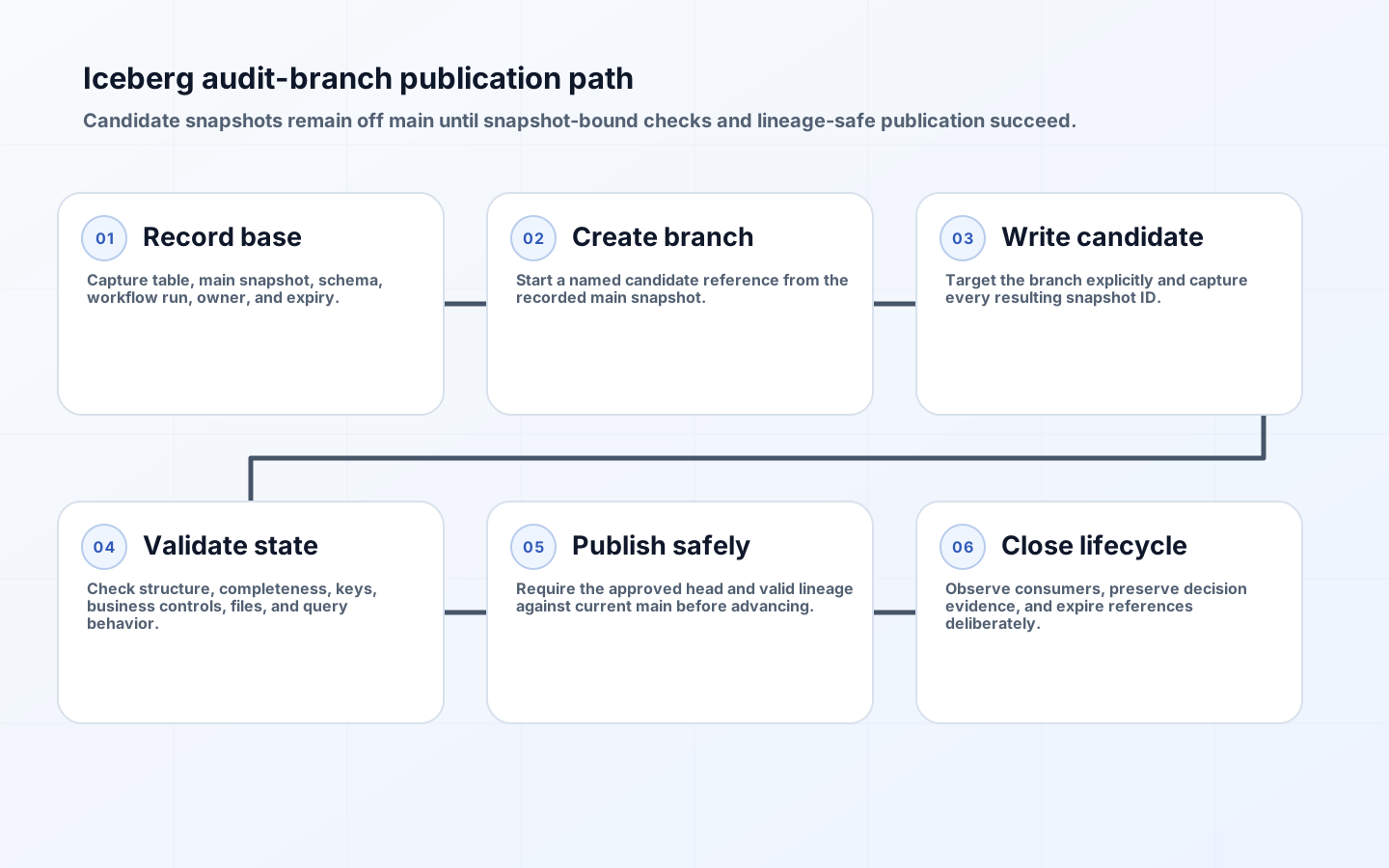
Apache Iceberg branching lets a data team commit candidate changes to a named table reference without moving the table's main branch. Readers of main continue to see its current snapshot while a job writes, validates, and reviews a different snapshot lineage. This makes branching useful for write-audit-publish workflows, risky backfills, maintenance experiments, and controlled corrections. It does not make an invalid change safe automatically: the branch still needs ownership, validation, publication rules, and retention.
The key mental model is that a branch is a named reference within one Iceberg table, not a copied table or isolated storage account. Snapshots are immutable table states connected by parent relationships; references point into that history and retention settings keep required snapshots reachable. Data files can be shared across references. This design makes branch creation inexpensive, but it also means careless expiration or orphan-file operations can undermine recovery expectations if reference policy is not coordinated with maintenance.
Understand snapshots, branches, and tags
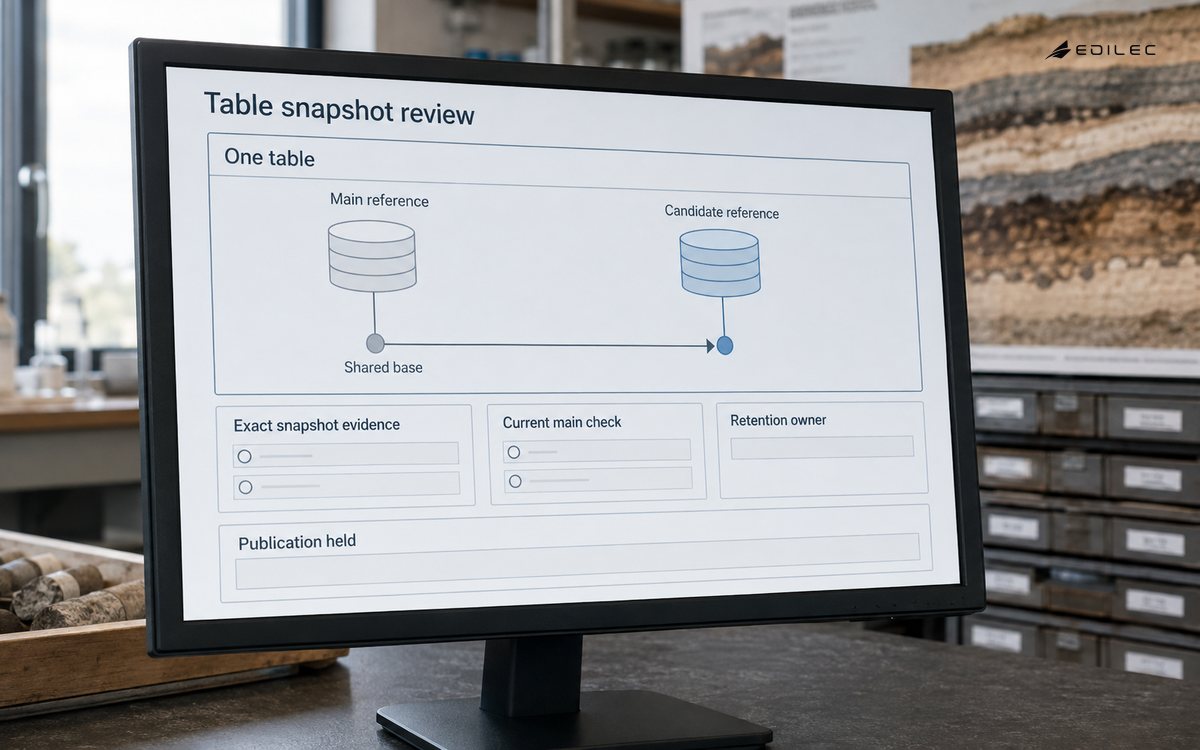
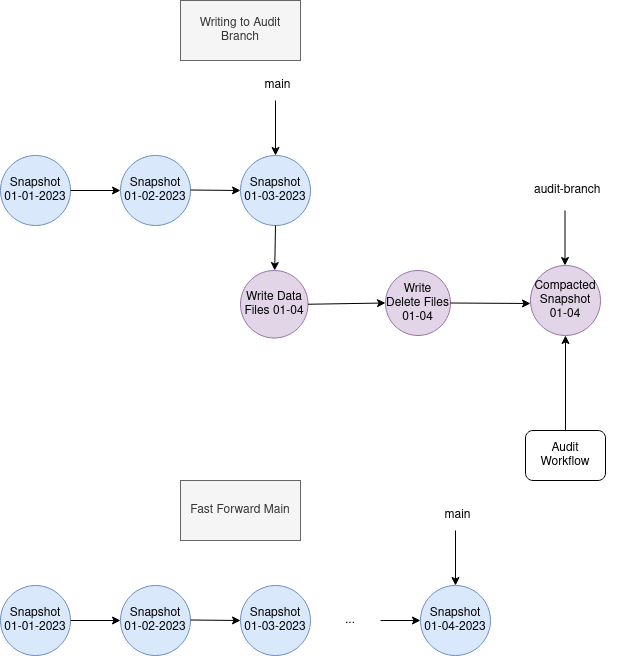
Every successful Iceberg commit produces table metadata that identifies a current snapshot. A branch provides a movable named head for a line of work; a tag provides a named historical reference suited to preserving a significant state. The table specification defines snapshot references and retention attributes. Engines and catalogs expose different commands, so validate support before making a branch part of a critical workflow. The main branch remains special because ordinary reads and writes usually resolve there unless another reference is selected explicitly.
Isolation is at the table snapshot level. A branch does not create new database permissions, compute quotas, or consumer namespaces by itself. A writer with authority to update main may still bypass the audit path, and a reader can query the branch if its engine and access allow it. Treat reference names as workflow state, then use catalog authorization, job identities, and policy to enforce who may create, write, validate, publish, or remove them.
| Object | What it identifies | Typical use | Important limit |
|---|---|---|---|
| Snapshot | Immutable table state and parent lineage | Time travel and commit evidence | Retention may eventually expire it |
| Branch | Named movable snapshot reference | Candidate writes and staged publication | Not a security boundary |
| Tag | Named historical reference | Release marker or investigation hold | Needs explicit retention policy |
| Separate table | Independent metadata and lifecycle | True environment or ownership isolation | Duplicates governance and often data |
| External audit record | Decision, checks, actor, and run evidence | Compliance and operating history | Must link back to snapshot IDs |
Design naming, ownership, and retention first
Use names that identify workflow and run without embedding secrets or uncontrolled user text. A pattern such as auditjobrun can connect a branch to an orchestrator execution, but keep within catalog naming rules. Store table identifier, branch, starting snapshot, expected main snapshot, job version, owner, and expiry in an external run record. The branch name alone is not enough evidence after deletion or reuse, so never infer identity only from a mutable label.
Choose retention from investigation and recovery needs. A failed branch may need several days for debugging; a published branch may need only enough time to verify consumers because a tag or audit record preserves the release point. Configure minimum snapshots and maximum reference age deliberately, then align snapshot expiration. Long-lived references retain snapshot ancestry and associated files, so unlimited branches turn an inexpensive workflow feature into persistent storage and metadata growth.
- Create each candidate branch from an explicitly recorded main snapshot.
- Give one workflow identity authority to write the candidate and a narrower publisher authority to advance main.
- Set an expiry and cleanup owner when the reference is created.
- Record snapshot IDs before and after every commit and publication action.
- Alert on expired, ownerless, or unexpectedly long-lived references.
Build a write-audit-publish sequence
Start by reading main's current snapshot ID and creating the candidate reference from that state. Configure the write job to target the branch explicitly. In Spark with supported Iceberg extensions, writes can address a branch through branch-qualified identifiers or write-audit-publish configuration. Do not rely on a session default that another job can omit accidentally. After writing, capture the candidate head snapshot and verify that main has not moved as a side effect.
Run validation against the branch-qualified table. The check suite should include schema and partition expectations, row and key counts, null and domain rules, reconciliation to source controls, duplicate detection, and query behavior for critical consumers. Compare the candidate to the recorded base and current main, not simply to yesterday's table. A large legitimate input change can invalidate fixed thresholds, while an unintended overwrite can pass a shallow row-count check.
| Check class | Candidate evidence | Failure it detects | Publication response |
|---|---|---|---|
| Structural | Schema IDs, partition spec, sort order | Unexpected evolution | Block and inspect writer |
| Completeness | Source controls and row coverage | Missing files or filters | Block and rerun safely |
| Uniqueness | Key duplicates and merge cardinality | Replay or join fan-out | Quarantine conflicting keys |
| Business validity | Ranges, referential rules, balances | Semantically corrupt values | Route to data owner |
| Operational | File counts, sizes, scan plan | Small-file or rewrite regression | Repair candidate before publish |
Publish only from a proven lineage
A fast-forward publication is appropriate only when the candidate head is a descendant of main's current head under the procedure's requirements. That condition matters because another writer may advance main after the branch was created. If main moved independently, blindly replacing its reference could discard visible commits. Re-read main immediately before publication and require the expected lineage. When it diverges, stop, classify the concurrent change, and rebuild or reconcile the candidate from the new base.
Treat publication as a privileged compare-and-set decision. Bind validation evidence to the exact candidate snapshot, not merely the branch name, and reject publication if the head changed after checks. Record actor, timestamp, old main snapshot, new main snapshot, validation revision, and orchestration run. Keep the publisher small: it should verify evidence and move the approved reference, not rerun transformations with broader credentials.
Control schema changes and maintenance
Schema selection follows reference semantics in supported operations, but schema changes deserve a separate compatibility review. A candidate data write that assumes a new column can fail or be misread if the schema visible through main changes concurrently. Record schema ID with the base and candidate snapshots. Prefer additive, compatible evolution before dependent writes, and test every engine that will read the published state. Branch validation in one Spark version is not evidence that all query engines interpret evolution identically.
Coordinate snapshot expiration, orphan-file removal, manifest rewriting, and data-file compaction with branch policy. Maintenance jobs should understand active references and use Iceberg-supported operations rather than deleting files by storage age. File-rewrite experiments are strong branch candidates because query plans and metrics can be inspected before publication, but validate that the procedure and engine preserve correctness when concurrent commits occur. Test recovery from a failed maintenance commit in a nonproduction table.
Plan failure and recovery paths
If transformation fails before commit, clean temporary outputs through supported maintenance after the safety interval. If it commits but validation fails, preserve the branch long enough to investigate and keep main unchanged. If publication succeeds and a consumer regression appears, create a deliberate corrective commit or use a supported snapshot procedure according to your governance; do not casually mutate history while writers continue. Recovery should identify the exact visible snapshot and protect later valid commits.
Test control-plane failures too: catalog outage after data files are written, publisher timeout with an unknown result, duplicate orchestration delivery, expired credentials, and a cleanup job racing with investigation. Every action must be retry-aware. On timeout, read current references before attempting again. An idempotency key in the external run record helps the orchestrator distinguish a repeated request from a new candidate.
Implement with a narrow pilot
Choose one table with stable ownership, meaningful quality controls, and manageable write frequency. Verify catalog and engine support for branches, tags, branch writes, metadata queries, and publication procedures. Create a service identity matrix, retention defaults, and an external audit table. Exercise a normal publish, a validation failure, concurrent main advancement, publisher timeout, and cleanup. Measure added storage, metadata, validation duration, and time to diagnose failures.
Promote the pattern only when the workflow can prove that ordinary consumers remain on main, candidate writers cannot publish, validations bind to snapshot IDs, conflicts stop safely, and maintenance preserves live references. Provide a reusable library around those invariants rather than copying SQL snippets. Branching is most valuable when it reduces the special handling around high-risk writes while leaving a clear, reviewable trail.
Key takeaways
- An Iceberg branch is a named snapshot reference in one table, not an independent copy or permission boundary.
- Bind writes and checks to explicit references and record immutable snapshot IDs.
- Publish only when validated lineage still matches current main; divergence requires reconciliation.
- Coordinate reference retention with snapshot expiration and file maintenance.
- Test retries and unknown outcomes around catalog and publisher failures before production use.
Frequently asked questions
Does creating a branch copy all data files?
No. The reference points to snapshot metadata, and snapshots can share existing files. New writes add files and metadata. Retaining branch ancestry can keep files reachable longer, so storage impact depends on changed data and retention.
Can consumers query a branch?
Yes, when their engine supports reference-qualified reads and authorization permits it. Production views and jobs should resolve main explicitly or through controlled defaults so audit data is not exposed accidentally.
Can two divergent branches be merged automatically?
Do not assume source-control-style merging. Fast-forward requires compatible lineage. Divergent data changes need workload-specific recomputation or reconciliation that preserves concurrent valid writes.
Conclusion
Apache Iceberg branching creates a practical boundary between producing a candidate table state and making it visible on main. The safety comes from the operating protocol around the feature: explicit bases, snapshot-bound validation, privileged publication, conflict stops, coordinated retention, and tested recovery. With those controls, data changes become auditable commits instead of opaque in-place mutations.