Hybrid post-quantum TLS adds a post-quantum key-establishment component to a classical TLS 1.3 exchange so session confidentiality does not depend on one cryptographic assumption. The idea is straightforward; the migration is not. Larger key shares travel through clients, servers, proxies, content-delivery networks, load balancers, inspection devices, and constrained networks. Unsupported groups, packet fragmentation, implementation limits, retries, and silent fallback can turn a cryptographic pilot into a connectivity incident or a false assurance claim.
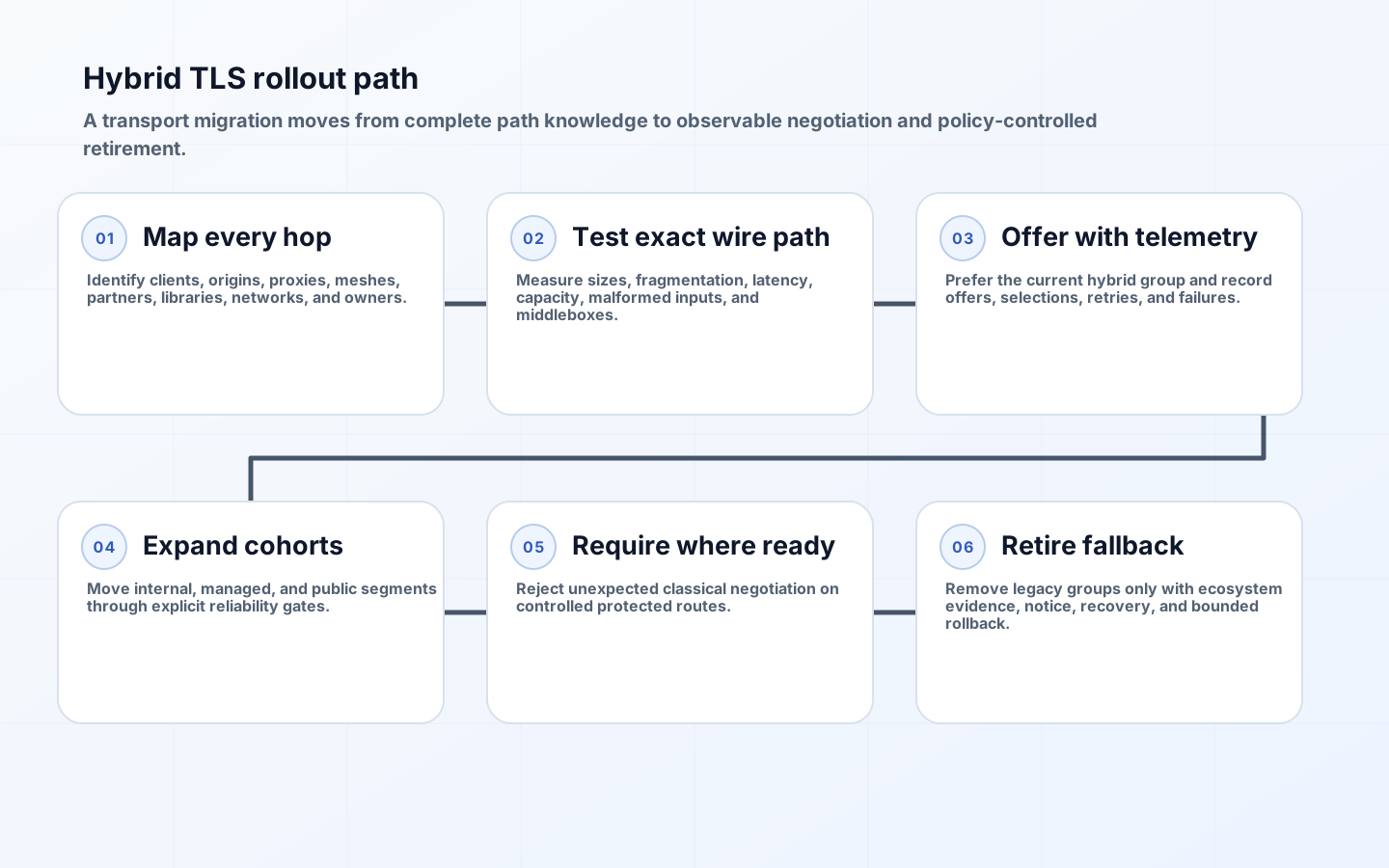
Plan the work as a transport change, not an algorithm toggle. Map every TLS termination and origination point, decide which traffic has long-lived confidentiality value, verify library and service support, test the exact wire behavior, deploy to observable cohorts, and define when fallback is permitted. Keep certificate authentication and key exchange conceptually separate: a hybrid key exchange can protect session establishment while the certificate chain still uses classical signatures.
Start from the current standards state
FIPS 203 defines ML-KEM itself, but does not define a TLS negotiation. As of July 13, 2026, the IETF TLS working group's ECDHE-MLKEM draft defines hybrid groups including X25519MLKEM768, SecP256r1MLKEM768, and SecP384r1MLKEM1024. It remains an Internet-Draft, so version, code point, and implementation stability require active tracking. Do not present a draft implementation as final cross-vendor standardization.
TLS 1.3 provides the negotiation and key-schedule framework. A hybrid group combines classical ECDHE and ML-KEM inputs so the resulting handshake is intended to remain secure if at least one component remains secure, assuming the combiner and implementation meet their design. This does not automatically make certificate signatures post-quantum, repair endpoint compromise, or protect data after decryption at the application.
Map the real TLS architecture and target state
Inventory public edge, API gateways, service meshes, ingress and egress proxies, application servers, database connections, message brokers, VPNs, management planes, mobile clients, desktop agents, third-party callbacks, health checks, and monitoring probes. Record where TLS terminates, library and version, configuration owner, supported groups, certificate path, session resumption, middleboxes, client population, and update authority. One browser-to-edge success says nothing about edge-to-origin or partner API coverage.

Define the target per route. A public service may initially offer a hybrid group and classical alternatives for compatibility, while managed internal services may require hybrid after a readiness date. Long-lived confidential traffic should receive priority, but endpoint updateability matters: a closed fleet with known libraries may be safer to pilot than a public endpoint with unknown legacy clients. Document whether protection is end to end or only on one segment.
| Path | Key questions | Likely constraint | Pilot evidence |
|---|---|---|---|
| Browser to edge | Which clients offer the group and what is negotiated? | Long-tail clients and CDN support | Negotiation and failure telemetry by cohort |
| Edge to origin | Do both managed endpoints share implementation? | Proxy and load-balancer versions | Wire capture, latency and fallback result |
| Service mesh | Can sidecars and control plane roll independently? | Mixed-version fleet and retries | Canary namespaces and route-level metrics |
| Mobile or desktop | How quickly can clients update? | Offline and unsupported versions | Version matrix and minimum-client policy |
| Partner API | Who controls standards and change window? | Contract and cross-vendor schedule | Joint interoperability test |
| Constrained network | Will larger messages fragment or time out? | MTU, radio, memory and loss | Real network and device measurements |
Test size and compatibility on the actual path
Measure ClientHello and ServerHello sizes, packet count, fragmentation, retransmission, handshake latency, CPU, memory, connection rate, and failure reason. Test common and worst paths: low MTU, IPv6, lossy mobile networks, tunnels, satellite or industrial links, old proxies, TLS inspection, and strict firewalls. Larger key shares can expose assumptions in buffers and middleboxes even when endpoints implement the group correctly. Test at production concurrency because cryptographic and packet overhead can affect capacity.
Separate key-share growth from certificate-chain growth. Hybrid key exchange does not require PQC certificates. If a later signature migration enlarges certificates and signatures, the effects accumulate in different handshake messages. RFC 8879 defines TLS certificate compression, but support, algorithms, resource limits, and security behavior need independent validation. Compression is not a reason to ignore certificate-chain design or decompression limits.
Make negotiation and fallback observable
Instrument offered groups, selected group, TLS version, endpoint or proxy, client family, handshake result, retry, alert, and route. Avoid logging secrets or uniquely identifying client data beyond necessity. Dashboards should distinguish a client that never offered hybrid, a server that declined it, a middlebox failure, and a retry that succeeded classically. A configuration-enabled count is not adoption; negotiated-session coverage is.
Define fallback policy by route and phase. During an offer-first public pilot, classical fallback may be expected for unsupported clients. In a managed require-hybrid cohort, fallback indicates misconfiguration or downgrade and should fail or alert according to policy. Protect configuration and telemetry from tampering. An attacker who can force classical negotiation without detection can preserve connectivity while defeating the migration objective.
| Mode | Behavior | Appropriate stage | Risk control |
|---|---|---|---|
| Observe only | Record client and infrastructure capability | Before enabling | No security claim; validate telemetry |
| Offer hybrid | Prefer hybrid, allow classical | Compatibility pilot | Measure negotiated rate and retry |
| Cohort preference | Enable for selected routes or clients | Canary rollout | Compare reliability and performance |
| Managed requirement | Reject non-hybrid on controlled path | After fleet readiness | Exception and break-glass process |
| Public retirement | Remove selected classical fallback | Ecosystem and policy readiness | Customer notice and unsupported-client plan |
| Emergency rollback | Temporarily restore prior negotiation | Material incident | Approval, expiry and affected-data record |
Review protocol and implementation security
Use maintained implementations that track the intended draft or final specification, with test vectors, constant-time attention, robust parsing, entropy, and secure error handling. NIST SP 800-227 explains KEM use and security considerations; application teams should consume protocol-library abstractions rather than compose ML-KEM directly. Confirm the build uses final ML-KEM, not an incompatible pre-standardization variant hidden behind a legacy name.
Threat-model endpoint and control-plane compromise. Hybrid transport cannot protect plaintext at a compromised proxy, stolen session tickets, exposed logs, or malicious certificate authority. Protect TLS configuration, libraries, keys, deployment artifacts, and observability. Test malformed key shares, invalid ciphertexts, repeated decapsulation failures, resource exhaustion, and error side channels. Patch the implementation as a normal security dependency throughout the pilot.
Roll out with cohorts and bounded rollback
Build a lab interoperability matrix across every implementation pair, then enable a small internal route, employee or synthetic client cohort, low-risk external percentage, and progressively broader segments. Compare handshake success, tail latency, CPU, memory, bandwidth, connection reuse, retries, and application errors against classical control cohorts. Include failover regions, disaster recovery, autoscaling, and restored configurations; secondary paths often lag the primary.
Define stop conditions and a rollback that restores known-good configuration without changing certificates or unrelated security settings. Capture evidence before rollback: affected implementations, selected groups, packet traces, error codes, route, and timing. Rollback reduces availability risk but reopens quantum-vulnerable key establishment for affected sessions. Record the interval and data classes, assign a correction owner, and set an expiry for the exception.
Operate the migration as an evolving dependency
Track IETF document state, code points, library releases, provider support, security advisories, and vendor roadmaps. Pin implementation versions and test upgrades; draft evolution can require coordinated changes. Include hybrid capability and negotiated coverage in the cryptographic inventory. Contract with edge, proxy, and managed-service providers for transparent algorithm support, telemetry, notice of changes, and a migration route that does not require replacing unrelated services.
Set explicit milestones: architecture mapped, telemetry proven, lab matrix passed, internal hybrid target reached, selected long-lived-data routes protected, managed routes requiring hybrid, and approved classical groups retired. Keep certificate-signature migration as a linked but distinct program. This prevents teams from claiming quantum-safe TLS when only key exchange changed, or delaying useful key-establishment protection until the entire public PKI ecosystem is ready.
Key takeaways
- Treat hybrid TLS as a negotiated transport change across every termination and origination point.
- Track the IETF specification state and exact implementation version; the current ECDHE-MLKEM work is still a draft.
- Test handshake size, fragmentation, middleboxes, capacity, and failures on real network paths.
- Measure selected groups and retries, not configuration capability alone.
- Separate key-exchange progress from certificate-signature migration and govern fallback as a risk decision.
Frequently asked questions
Does hybrid key exchange require a PQC certificate?
No. TLS key exchange and certificate authentication are distinct. A deployment can negotiate hybrid ECDHE-ML-KEM while using a classical certificate signature, which remains a separate migration dependency and security consideration.
Why not require hybrid immediately?
Unknown clients, proxies and network paths may not support it reliably, and the relevant IETF work is evolving. Managed paths can move faster; public paths usually need measured offer, cohort, requirement, and retirement stages.
Is classical fallback always a downgrade vulnerability?
Not during an explicitly offer-compatible phase, but it means those sessions lack the post-quantum component. On a route designated hybrid-required, unexpected fallback is a policy failure and possible downgrade signal.
Conclusion
A safe post-quantum TLS migration proves both cryptographic negotiation and ordinary connectivity. Map the full path, implement a current reviewed construction, test size and failure behavior, observe selected groups, and expand through controlled cohorts. Use fallback deliberately and preserve rollback evidence. This approach protects high-value traffic earlier while keeping the organization honest about draft maturity, classical certificate signatures, unsupported clients, and the segments that remain outside hybrid coverage.