The DPoP vs mTLS decision is about how an OAuth client proves possession of a key when it requests and uses an access token. Both approaches can make a stolen token less useful to an attacker who lacks the bound private key. They do not prevent every credential theft, authorize business actions or compensate for a compromised client. The choice should follow client capabilities, certificate infrastructure, proxy boundaries and the resource server's ability to verify proof consistently.
Bearer tokens are portable by design: possession is generally enough to use one. Sender-constrained tokens add a cryptographic condition. This guide extends Edilec's OAuth security architecture into high-risk API profiles where replay could move money, expose regulated records or change privileged configuration. The correct option is the one the whole request path can operate, observe and rotate, not the one with the more attractive protocol name.
Define the sender-constrained token goal
A sender constraint binds a token to key material associated with the authorized client. The authorization server records a confirmation method in or alongside the token; the resource server checks that the caller demonstrates possession of the matching private key. RFC 9700 recommends sender-constrained access tokens where practical because they reduce the impact of access-token leakage. The proof must be checked at token issuance and resource use.
Write the threat statement precisely. If tokens leak from browser storage, logs, telemetry, an API gateway or a downstream service, ask whether the attacker also obtains the client's private key or certificate. If both live in the same exportable file, binding adds limited separation. If malware controls the legitimate client process, it may ask that process to produce valid proofs. Sender constraint is replay resistance, not endpoint integrity or transaction authorization.
| Decision factor | DPoP | OAuth mTLS | Architecture consequence |
|---|---|---|---|
| Proof channel | Application-layer signed JWT | TLS client certificate proof | Choose where verification terminates |
| Key identity | Public JWK thumbprint | Certificate or public-key thumbprint | Coordinate AS and RS confirmation claims |
| Request binding | Method and URI in each proof | TLS connection authenticates client key | Account for proxies and URL normalization |
| Client fit | Useful where apps can sign HTTP proofs | Strong fit for managed server workloads | Inventory libraries and certificate support |
| Operations | Nonce, clock, replay-cache and key lifecycle | PKI issuance, trust, renewal and TLS routing | Fund the control plane, not only coding |
Understand how DPoP binds an HTTP request
RFC 9449 defines a DPoP proof as a signed JWT sent in an HTTP header. It includes a public key and claims that bind the proof to the HTTP method and target URI; proofs also carry issuance time and a unique identifier. For resource requests, the proof includes a hash of the access token. The authorization server can bind the issued token to the public key's thumbprint, while the resource server verifies the matching proof.
DPoP is application-layer proof, so clients need signing capability and servers need strict URI, method, algorithm and claim validation. Reverse proxies must preserve enough canonical request information for verification. Define trusted forwarded-header behavior and reject ambiguous host or scheme reconstruction. Use the authorization-server nonce mechanism where deployment risk warrants it, and maintain a bounded replay cache for proof identifiers. Loose clock windows and inconsistent URL normalization quietly weaken the design.
Understand OAuth mTLS certificate binding
RFC 8705 specifies mutual-TLS client authentication at the authorization server and certificate-bound access tokens for protected resources. The token's confirmation data identifies the certificate used by the client. At the resource server, the TLS client certificate must match that binding. The standard supports PKI mutual TLS and a self-signed certificate method for client authentication, but deployment policy still controls registration and trust.
mTLS suits centrally managed servers, gateways and workloads that already have reliable certificate issuance and rotation. Its hardest questions appear at TLS termination. If a load balancer verifies the certificate and forwards traffic to an application, the application must receive authenticated certificate context through a protected mechanism that untrusted clients cannot spoof. End-to-end mTLS avoids that translation but can complicate service routing, inspection and managed platform integration.
Choose by client and access-edge reality
DPoP often fits public clients and heterogeneous HTTP stacks because proof occurs above TLS and does not require a client certificate handshake. That does not make browser support automatic: key storage, non-exportability, refresh-token binding and library maturity still matter. mTLS often fits confidential clients under enterprise control, where platform PKI can provision a certificate and network infrastructure can retain the authenticated connection context. Test actual SDKs, gateways and hosting products before setting policy.
A portfolio may use both. For example, a mobile client can use DPoP to reach an API edge while backend workloads use mTLS between controlled services. Do not make one resource accept the same token under either proof method unless its token profile unambiguously states the binding and the validator enforces it. FAPI 2.0 permits approved sender-constraining options within a coordinated security profile; interoperability requires selecting and advertising the supported option.
Operate proof validation as a security service
Central libraries can parse proofs and confirmation claims, but each resource endpoint must fail closed when binding is absent, malformed or mismatched. Record safe diagnostics: token issuer, client ID, binding method, key thumbprint, proof age, validation result and gateway route. Never log private keys, full tokens or reusable proofs. Metrics should separate ordinary expiration from binding mismatch, replay detection, certificate expiry, trust failure and clock skew so operators know what to repair.
Plan key changes before launch. DPoP key rotation usually requires obtaining new tokens bound to the new key; mTLS certificate renewal requires overlap that both authorization and resource paths recognize. Decide whether lost key material revokes refresh tokens and active access tokens. Rehearse emergency replacement without disabling all clients. The session security guide provides a useful companion model for renewal and revocation decisions.
| Verification test | DPoP expected result | mTLS expected result | What failure reveals |
|---|---|---|---|
| Replay token without client key | Reject missing or invalid proof | Reject absent or different certificate | Binding enforced at resource |
| Reuse previous request proof | Reject replay or request mismatch | Connection may remain valid; token still bound | DPoP replay cache behavior |
| Change HTTP method or target | Reject htm or htu mismatch | Evaluate normal API authorization | Correct application-layer binding |
| Rotate legitimate key | Old token fails with new key | Old-bound token fails with new certificate | Coordinated token renewal |
| Terminate TLS at proxy | DPoP verifies with canonical URI | Certificate context must be protected | Trust boundary is explicit |
Use the six-stage Edilec sender-constraint selection
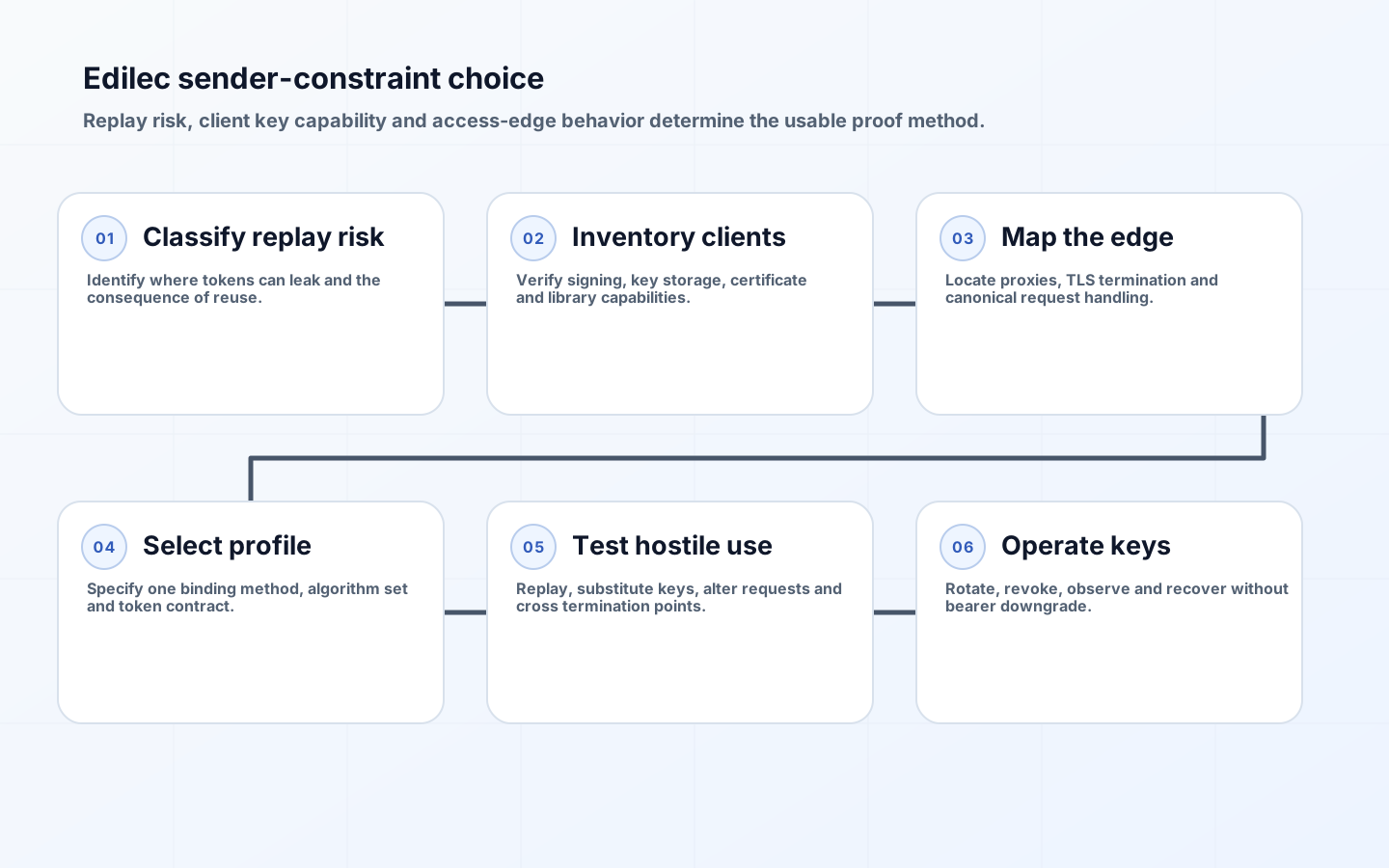
The selection process should move through six concrete stages: classify replay impact, inventory client key capability, map every TLS and proxy boundary, select one token profile, test hostile proof cases and rehearse key lifecycle. The Edilec diagram at this heading makes dependencies visible to identity, API, network and client teams. A proof-of-concept that bypasses the production gateway or certificate service does not answer the deployment question.
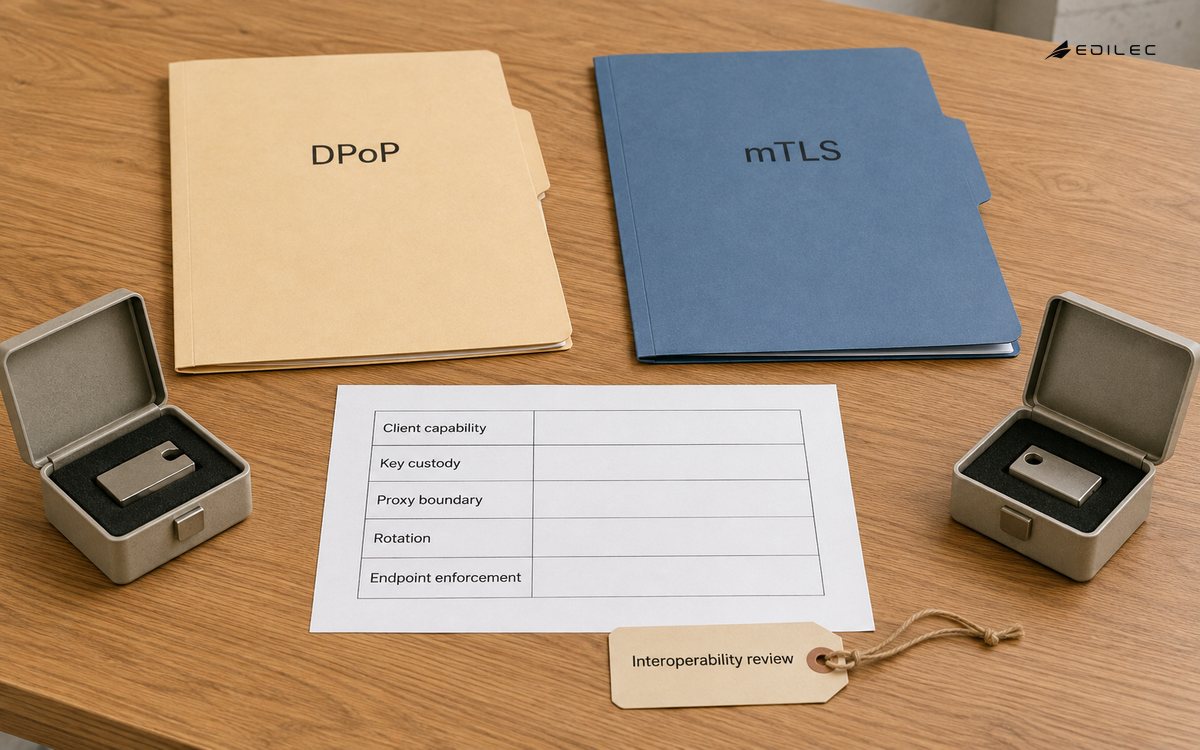
Run the tests against a minimally privileged API client first. Capture a token, attempt it from another process, alter method and URI, substitute a key, cross a proxy, rotate credentials and simulate clock drift. Verify both denial and operator evidence. Edilec's secure API access control guide should remain the source for endpoint authorization; proof possession establishes the sender, not permission for every object or action.
Set interoperability requirements before procurement
When selecting an authorization server, API gateway or client platform, require evidence for the exact binding profile rather than a general proof-of-possession claim. Ask which algorithms, nonce behavior, certificate methods, proxy patterns, token formats and error cases are supported. Confirm whether introspection returns confirmation data and whether gateways pass verified binding context safely. Contract tests should run during upgrades because a component can remain OAuth-compatible while losing a DPoP claim, changing URI canonicalization or terminating client certificates differently.
Document fallback policy as part of interoperability. A client that cannot create a proof must not retry with an ordinary bearer token against the same high-risk scope. If legacy access must remain, place it on a separate client registration, audience and risk acceptance with a dated retirement plan. This separation keeps telemetry honest and prevents a transient key or certificate incident from turning into an automatic security downgrade exactly when operators are under pressure.
Key takeaways
- Use sender constraints to reduce token replay value, while treating client compromise and authorization as separate risks.
- Prefer DPoP where application-layer signing and heterogeneous client support are stronger than certificate operations.
- Prefer OAuth mTLS for managed workloads with dependable PKI and trustworthy TLS termination.
- Specify one binding method per token and enforce it at both the authorization server and resource server.
- Test key loss, renewal, proxy behavior, replay, clock skew and observability before choosing a portfolio standard.
Frequently asked questions
Does DPoP replace TLS?
No. DPoP proofs and tokens still travel over TLS. TLS protects confidentiality and server authentication in transit; DPoP adds application-layer proof that the caller controls the key bound to the token. Disabling normal TLS validation would expose the entire protocol exchange.
Does mTLS make the client fully trusted?
No. mTLS proves control of registered certificate key material and can bind a token to it. The resource server must still validate token claims, scopes, tenant and business authorization. A legitimate client can be compromised or request an impermissible operation.
Can DPoP and mTLS be used together?
A system can layer them, but added complexity needs a specific threat justification. Most profiles choose one sender constraint for an access token. If transport mTLS is required independently and DPoP binds the token, document both failure semantics and ensure intermediaries preserve each proof.
Conclusion
DPoP and OAuth mTLS can both constrain token use to a key-holding client. DPoP expresses proof in signed HTTP messages; mTLS derives proof from the authenticated TLS client certificate. The stronger design is the one whose keys, proxies, authorization server and resource servers maintain the binding under real deployment conditions.
Select from measured client and infrastructure constraints, then publish a precise token profile and conformance suite. Tie the result to Edilec's OAuth field guide so ordinary flow, redirect, scope and token-validation controls remain intact. Sender constraint should close a replay path without creating an unowned key-management path.