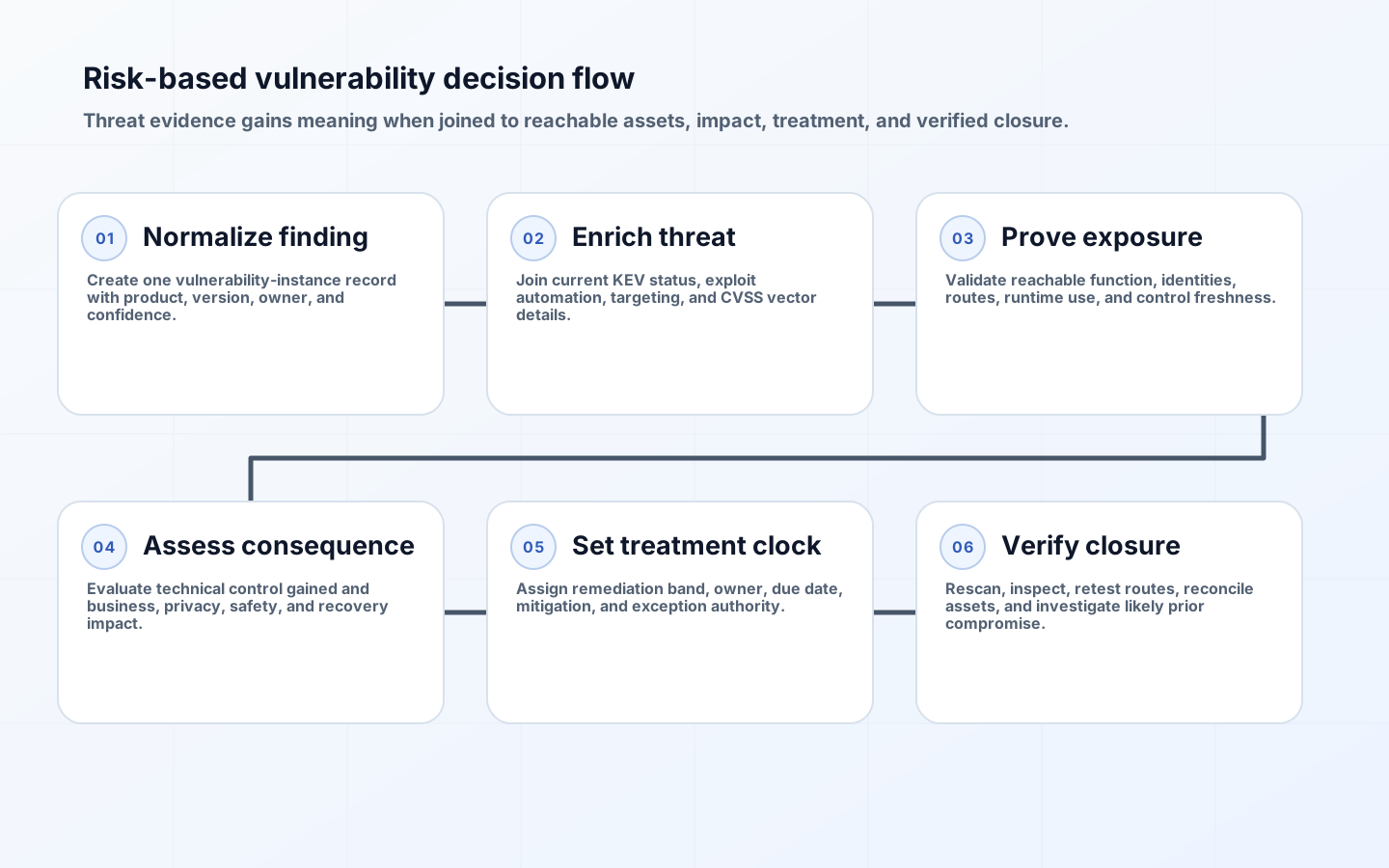
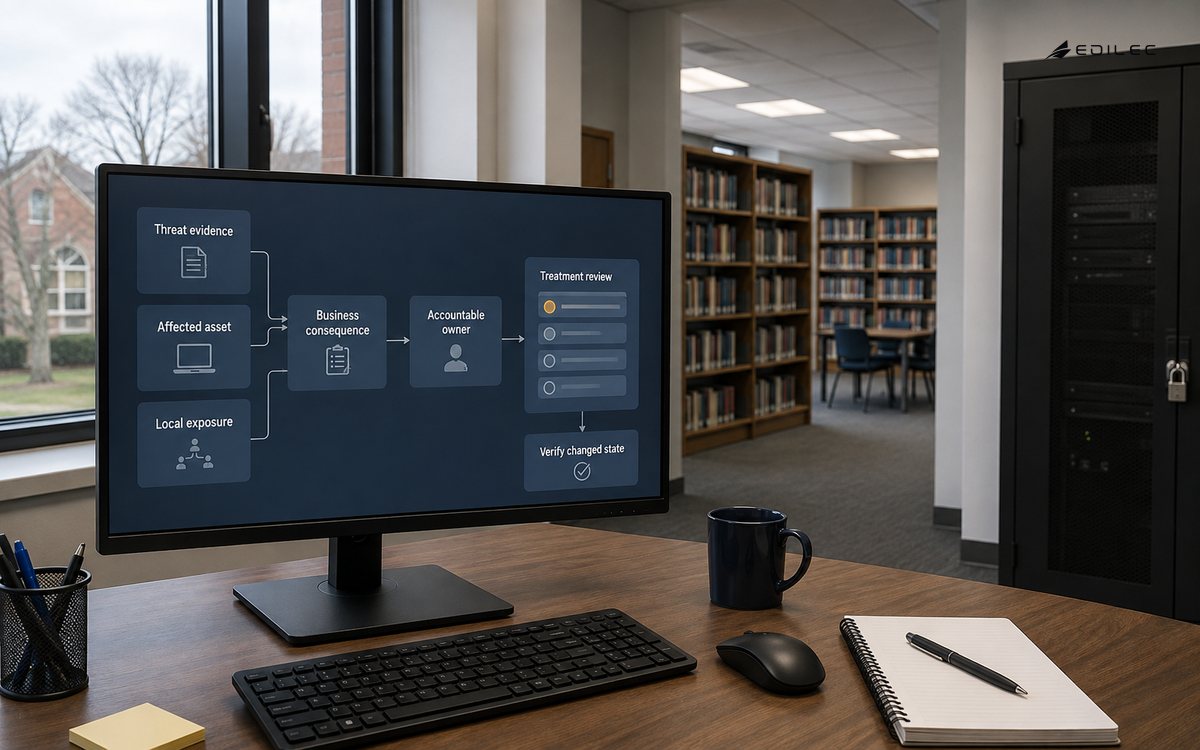
A CVSS Base score describes intrinsic technical severity under standardized assumptions. It does not know whether the vulnerable component is installed, reachable, exposed to the internet, protected by a control, used for a critical business process, or already being exploited. CISA KEV vulnerability prioritization adds observed exploitation, but KEV alone still does not locate the weakness in your environment. Effective patching joins authoritative threat evidence to an exact asset and an accountable deadline.
The operational question is: which vulnerable instances can an adversary reach, exploit, and use to cause material harm before the team can safely remediate them? Answering it requires inventory, exposure, exploit evidence, technical impact, business context, and treatment options. The goal is not a mysterious composite score. It is a transparent queue whose order, clock, owner, and exceptions can be defended and updated when facts change.
Use the current KEV and federal policy context
CISA maintains the KEV catalog as a living set of vulnerabilities with evidence of exploitation in the wild. The official KEV data repository publishes machine-readable catalog data and schema. Ingest it on a schedule, retain the source version and retrieval time, validate records, and alert on additions and changed fields. A stale monthly spreadsheet discards the catalog's main operational value: prompt evidence updates.
Federal deadlines also changed in June 2026. CISA BOD 26-04 replaced the earlier flat KEV-centered model with prioritization based on asset exposure, KEV status, exploit automation, and post-exploitation technical impact. The official FedRAMP response describes those dimensions and adoption dates for affected cloud offerings. The directive binds covered federal agencies, not every private enterprise, but its decision variables provide a useful model when adapted to local risk, maintenance, and legal obligations.
Build a fact-based prioritization model
Represent each work item as a vulnerability-instance pair, not a CVE alone. One CVE may affect an internet gateway, an isolated lab appliance, a disabled library, and a container image that never runs; those instances have different urgency. Join scanner or SBOM observations to asset identity, deployed version, runtime state, network path, identity privileges, data classification, owner, and service criticality. Track confidence and freshness for every join so missing context is visible rather than treated as low risk.
| Decision factor | Evidence | Urgency signal | Common error |
|---|---|---|---|
| Known exploitation | Current KEV entry and threat record | Confirmed exploitation in the wild | Treating old exploit rumors as equivalent |
| Exposure | External inventory, routes, firewall and service validation | Untrusted actors can reach vulnerable function | Equating a public IP with exploitable reachability |
| Automation | Reliable exploit path and precondition analysis | Attack steps can scale with little tailoring | Assuming every proof of concept is automatable |
| Technical impact | Privileges and control gained after exploitation | Partial or total control, lateral movement or safety effect | Using CVSS number without reading vector |
| Business consequence | Asset role, data, users, dependencies and recovery | Material mission, financial, privacy or availability harm | Assigning criticality by hostname alone |
Use decision bands with explicit rules. For example, emergency treatment may require reachable KEV exposure with automatable exploitation and control of a high-impact asset. Urgent treatment may include any reachable KEV, any vulnerability with credible active targeting of your sector, or a severe unauthenticated path to a critical service. Routine treatment covers verified affected instances with lower immediate exploit conditions. A review band catches incomplete telemetry, disputed applicability, or fragile remediation where an analyst must resolve facts quickly.
Use CVSS as structured input, not the queue
CVSS 4.0 separates Base, Threat, Environmental, and Supplemental metric groups. Base expresses intrinsic characteristics and reasonable worst-case severity; Threat can reflect exploit maturity; Environmental tailors impact and exploitability to deployment. Preserve the vector, version, source, and score rather than storing only a number. Two equal scores may contain very different attack paths and impacts, which matter for remediation sequencing and compensating controls.
Do not downgrade a KEV merely because its Base score is below an internal critical threshold. Conversely, do not automatically interrupt production for every high Base score when the vulnerable feature is unreachable and reliable controls are verified. CVSS is valuable for technical comparison and impact decomposition. It is not asset inventory, threat intelligence, business analysis, or a patch calendar. If a dashboard labels Base score as risk, correct the label and expose the missing dimensions.
Prove exposure and reachability carefully
Internet exposure includes more than an address. Determine whether traffic reaches the vulnerable service and function through load balancers, APIs, proxies, VPNs, partner links, management planes, and identity gates. Validate from an appropriate external vantage point and reconcile cloud, DNS, certificate, endpoint, and network inventories. Authentication reduces some paths but may not protect pre-authentication flaws, compromised accounts, or broadly issued partner credentials. Record the tested path and time because routes and controls change.
Application and library reachability needs equal discipline. A package can be present without its vulnerable code path being invoked; VEX may express that analysis, but the claim requires evidence and expiry. Edilec's VEX operating guide explains how to govern such status. Treat confirmed non-reachability as a documented control that can change after configuration, feature, or dependency updates, not as permanent deletion of the finding.
Set clocks by risk and treatment path
Start the clock when the organization has actionable notice under its policy, and define that event precisely. Assign an incident-like window for the most exposed, exploited, automatable, high-impact cases; shorter operational windows require on-call ownership, tested deployment channels, and decision authority. Lower bands can use longer targets, but all affected supported assets need a treatment date. A queue with no due date is a report, not vulnerability management.
| Treatment | When appropriate | Required evidence | Closure condition |
|---|---|---|---|
| Patch or upgrade | Supported fix is deployable | Testing, rollout and rollback plan | Fixed version verified on every in-scope instance |
| Configuration mitigation | Vendor-backed setting blocks exploit path | Exact setting, coverage and monitoring | Mitigation verified and patch date retained |
| Isolation | Exposure can be removed faster than patching | Route, identity and enforcement proof | No unapproved path reaches vulnerable function |
| Disable or retire | Feature or asset is unnecessary or unsupported | Owner approval and dependency check | Service absent and inventory reconciled |
| Time-bound acceptance | Treatment risk exceeds short-term exposure | Risk owner, rationale, compensating controls and expiry | Replacement completed or renewed by authority |
Separate mitigation from remediation. A firewall rule may reduce immediate exposure but leave vulnerable software that can reappear through route changes or internal compromise. Keep the finding open with revised urgency and a final patch, upgrade, or retirement target. Where exploitation may have preceded the fix, remediation is also not incident closure: perform forensic triage proportional to exposure and impact, preserve relevant telemetry, rotate affected credentials, and investigate persistence.
Patch quickly without abandoning change safety
Emergency does not mean untested. Maintain representative canaries, automated health checks, backups, rollback artifacts, dependency maps, and maintenance authority before a crisis. NIST SP 800-40 Rev. 4 frames patching as enterprise preventive maintenance and emphasizes planning across risk response, inventory, and verification. The best way to meet a compressed clock is to make routine change safe, observable, and reversible.
If a patch is unavailable, use vendor guidance but independently verify the resulting exposure. Block vulnerable interfaces, restrict identities, reduce privileges, remove internet routes, add detections, or shut down the service. Document the exact threat path each control interrupts. Generic statements such as enhanced monitoring are insufficient unless telemetry and response can detect and contain the expected technique within the required window.
Automate enrichment and verify closure
The pipeline should ingest vulnerability observations and KEV changes, normalize identifiers, resolve affected products, join assets and owners, calculate decision factors, create work, and re-evaluate when any input changes. Human review remains necessary for disputed applicability, business impact, safety, and exceptions. Keep rules versioned and replayable. A scoring formula that cannot show which evidence produced the band will fail exactly when executives and operators need to challenge it.
Closure requires independent verification: rescanning, package or image inspection, configuration confirmation, external-path testing, and runtime reconciliation as appropriate. Report time to triage, time to effective mitigation, time to verified remediation, overdue exposure by band, exception age, reopened findings, and inventory coverage. Avoid celebrating raw ticket counts; closing many low-risk items while one exposed KEV remains unresolved is not success.
Key takeaways
- Use current KEV data as authoritative exploitation evidence, not as a complete local risk score.
- Model each vulnerable asset instance with reachability, automation, impact, owner and evidence freshness.
- Keep CVSS vectors as useful technical input while rejecting Base-score-only queues.
- Distinguish immediate mitigation, final remediation, and post-exploitation investigation.
- Close work only after the changed state is independently verified across all affected instances.
Frequently asked questions
Should every KEV receive the same SLA?
No. Known exploitation creates urgency, but exposure, exploit automation, post-exploitation control, business consequence, and current mitigations affect the treatment clock. Covered federal entities must follow applicable directives; other organizations should document their own risk-based bands.
Can a VEX statement close a KEV finding?
Only if its applicability claim is trustworthy, matches the exact product and version, and is supported by current reachability evidence. Keep change triggers and expiry because a feature, configuration, or dependency update can invalidate the analysis.
What if patching could cause an outage?
Compare exploit risk with change risk explicitly. Apply the strongest verified temporary mitigation, test backup and rollback, use canary rollout, involve the service risk owner, and keep a dated final-remediation plan. Indefinite deferral without evidence is not risk management.
Conclusion
A defensible patch queue begins with evidence of exploitation and ends with verified change on a known asset. KEV, exposure, automation, technical impact, business consequence, and control effectiveness each contribute a fact that CVSS Base cannot supply alone. Build those facts into transparent bands and clocks, preserve safe change practices, and investigate possible compromise where the exposure warrants it. The result directs scarce engineering time toward the instances an adversary can actually use.