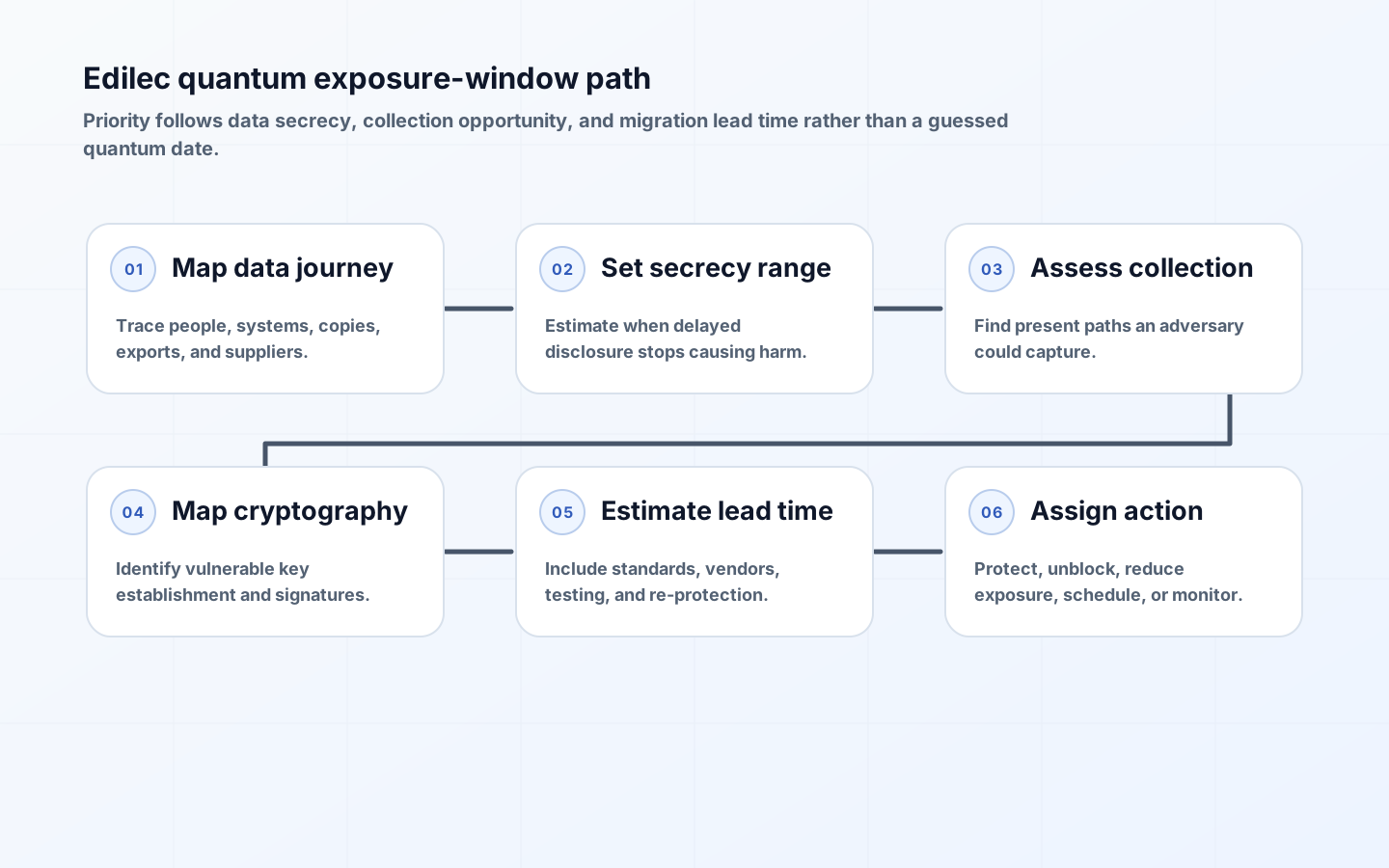
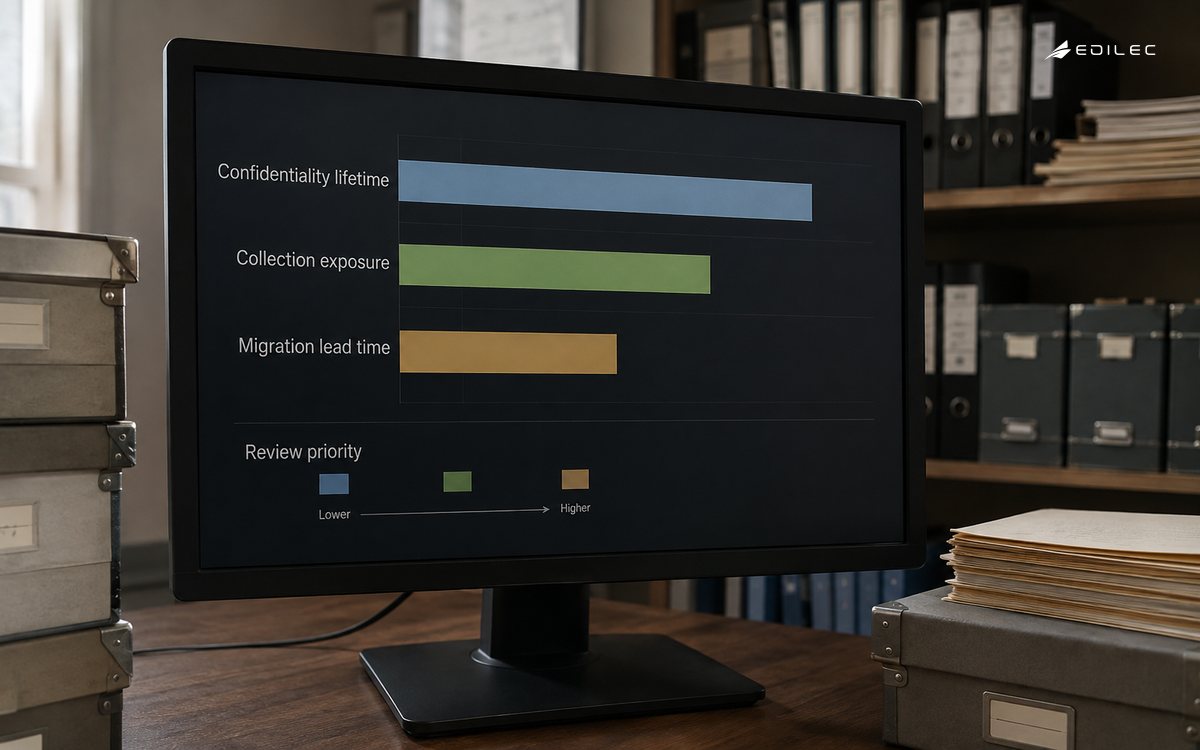
Harvest now decrypt later risk changes the date of the security decision. An adversary does not need a cryptographically relevant quantum computer today if it can capture quantum-vulnerable ciphertext now, preserve it, and decrypt it while the underlying information still matters. Consequently, a migration plan based only on asset criticality or predicted quantum-computer arrival can put the wrong systems first. The useful comparison is between the period during which data must remain confidential, the adversary's opportunity to collect it, and the time the organization needs to replace every relevant cryptographic dependency.
The UK NCSC preparation paper advises organizations to begin discovery and planning despite uncertainty about quantum timelines. Joint US quantum-readiness guidance specifically recommends recording sensitive datasets, their required protection length, and externally exposed access paths. These are not forecasts that a quantum machine exists; they are inputs to a defensible risk decision under uncertainty.
Assess data journeys, not database labels
Use a data journey as the assessment unit: a defined information class moving among people, services, stores, backups, exports, and counterparties for a business purpose. A database marked confidential may contain records with different secrecy horizons, while the same high-value record may cross email, APIs, analytics pipelines, disaster-recovery replication, and supplier systems. Record creation, collection source, data subjects, legal and contractual obligations, downstream derivations, locations, transmission paths, archives, deletion rules, and accountable owner. Then map the public-key mechanisms that establish keys or protect access along that journey.
Build the quantum exposure-window model
For each journey, estimate confidentiality lifetime from the business event, not merely the retention period. A record can be retained for audit after its sensitive content loses value, or deleted operationally while stolen copies remain valuable to an adversary. Estimate the earliest plausible collection date, ongoing collection opportunity, migration lead time, and time needed to re-protect retained copies. A useful warning condition is that required secrecy extends beyond the sum of migration completion and the assumed quantum transition point. Avoid turning that expression into false precision; represent ranges, assumptions, and scenario bands.
| Input | Question | Evidence | Uncertainty treatment |
|---|---|---|---|
| Confidentiality lifetime | When does disclosure cease to cause material harm? | Owner, law, contract, threat model | Use a range and review trigger |
| Collection opportunity | Can an adversary capture ciphertext now? | Topology, telemetry, supplier path | Separate observed and plausible access |
| Cryptographic exposure | Which quantum-vulnerable public-key operation protects it? | CBOM and protocol trace | Record unknown or mixed paths |
| Migration lead time | How long to replace and verify all dependencies? | Pilot, vendor roadmap, architecture | Use pessimistic dependency case |
| Re-protection feasibility | Can stored copies be re-encrypted or re-issued? | Data format and key control | Include lost and third-party copies |
| Adversary motivation | Who benefits from delayed disclosure? | Threat intelligence and mission analysis | Score capability separately from intent |
Prioritize action with risk bands
Place journeys into action bands rather than calculating an opaque universal score. Immediate engineering work belongs to externally collectable data with long confidentiality life and long migration lead time. Near-term pilots fit long-lived data where the organization controls endpoints but has unresolved interoperability. Contract and architecture work comes first where suppliers control the cryptography. Monitor shorter-lived data with rapid replacement capability, while still removing obsolete algorithms under ordinary policy. The NIST NCCoE migration program emphasizes both cryptographic visibility and interoperability; the prioritization should fund those different kinds of work explicitly.
| Band | Typical profile | Action now | Exit evidence |
|---|---|---|---|
| Protect first | Long secrecy, exposed path, slow migration | Pilot PQC or hybrid protection and reduce collection | Target path verified end to end |
| Unblock | High-value journey controlled by supplier or standard | Contract, test access, redesign, contingency | Credible dated dependency plan |
| Re-protect | Retained copies can be transformed | Plan key custody, format conversion, verification | Sample and restore tests pass |
| Reduce exposure | Migration not ready but collection can be limited | Minimize data, segment paths, shorten retention | Observed exposure materially reduced |
| Scheduled transition | Moderate lifetime and known upgrade | Align with product and PKI release | Legacy path disabled on schedule |
| Monitor | Short-lived value and rapid replacement | Track standards and inventory drift | Assumptions remain valid |
Reduce exposure before full migration
PQC deployment is not the only immediate risk treatment. Stop collecting fields that do not support a purpose, shorten unnecessary retention, tokenize data before external movement, separate identity from content, reduce broad exports, close unused endpoints, and strengthen symmetric encryption and key governance where appropriate. These measures do not make quantum-vulnerable key establishment safe, but they can reduce the volume and usefulness of captured material. For stored data, determine whether the organization can re-encrypt every authoritative and backup copy and whether an adversary or former supplier may already hold an immutable ciphertext copy.
Govern assumptions and dependency dates
Record the source and review date for every estimate: data value horizon, adversary collection capability, standards availability, vendor delivery, certificate ecosystem readiness, hardware capacity, and migration duration. NIST's IR 8547 initial public draft provides transition direction, but application-specific profiles and final organizational dates still require tracking. Trigger reassessment when NIST guidance changes, a supplier ships support, a breach exposes encrypted archives, a new external integration appears, retention changes, or pilots reveal a larger performance or interoperability cost.
Run a data-owner quantum risk workshop
Bring the data owner, records or privacy lead, service architect, security engineer, supplier owner, and threat analyst. Select one information class and identify the event from which secrecy matters, the earliest date harm expires, and the legal, safety, commercial, or mission basis for the range. Trace creation, API movement, email, remote access, backups, analytics, exports, archives, and supplier copies. Mark where quantum-vulnerable public-key operations establish transport or content keys and distinguish unaffected symmetric protection. Estimate optimistic and pessimistic lead times for standards, products, contracts, testing, deployment, re-protection, and verified removal. Then ask where an adversary can collect material now and whether collection would be visible.
Evaluate immediate reduction through minimization, shorter retention, local processing, segmentation, tokenization, fewer exports, and stronger access. Assign an action band and fund the first dependency-removing task: protocol pilot, vendor commitment, data-flow redesign, archive experiment, or exposure closure. Record evidence that would change the band and give every unknown an owner rather than averaging uncertainty into a score. Review after purpose or retention change, new integration, incident, supplier release, standard update, or pilot result. Portfolio governance should compare the age of unresolved high-risk assumptions, time to unblock supplier dependencies, protected volume moved to target paths, and independently observed legacy exposure. Those measures reveal risk reduction better than a count of systems labeled quantum-ready.
- Separate disclosure harm by population: the same dataset may carry lifelong identity or health consequences for people but only short commercial value for the organization.
- Include authenticity lifetime where forged signatures, records, commands, or software could cause future harm; confidentiality is not the only quantum-sensitive business property.
- Treat externally managed backups and immutable archives as separate exposure decisions because the primary system owner may lack keys, conversion tools, or deletion authority.
- Challenge the assumption that a private circuit prevents collection; endpoints, providers, lawful access, misconfiguration, insiders, and future compromise can create capture opportunities.
- Document whether hybrid mechanisms reduce risk in the chosen protocol and whether composition, negotiation, downgrade, certificates, and peers have authoritative profiles and test evidence.
- Avoid re-encrypting compromised ciphertext in place and calling it repaired: if an adversary already captured the old copy, later protection cannot revoke it.
- Use procurement and retention decisions to reduce lead time now, including replaceable interfaces, export formats, support commitments, deletion verification, and test environments.
Executive reporting should show the top data journeys, their secrecy ranges, current collection routes, blocking dependencies, first risk-reduction action, accountable owner, and next evidence date. Do not report a speculative countdown to a quantum computer as though it were a delivery metric. Report what management controls: exposure reduced, contracts changed, pilots completed, target paths verified, retained copies re-protected, and assumptions retired. This keeps urgency tied to observable work while allowing scientific and standards uncertainty to remain explicit.
Quantum risk prioritization takeaways
- Assess complete data journeys and copies rather than relying on one system classification.
- Separate confidentiality lifetime from retention and from the predicted arrival of a capable quantum computer.
- Include current collection opportunity, cryptographic exposure, migration lead time, and re-protection feasibility.
- Use transparent action bands with ranges and assumptions instead of an artificially precise score.
- Reduce collection, retention, exports, and exposed paths while PQC dependencies mature.
- Reassess on standards, supplier, architecture, incident, and data-purpose changes.
Harvest now, decrypt later risk FAQ
Does every encrypted dataset face the same quantum risk? No. The concern principally affects quantum-vulnerable public-key cryptography and varies with collection opportunity, secrecy lifetime, key-establishment design, and migration timing.
Should a team predict the quantum-computer date? Use scenario ranges for planning, not a single promised date. Decisions can be justified by data lifetime and migration lead time without pretending the scientific timeline is certain.
Does deleting the live record remove harvest-now risk? It reduces future exposure, but it cannot recall ciphertext already collected or copies held in backups, exports, archives, logs, or supplier systems.
Conclusion
Quantum risk becomes actionable when it is expressed as a data exposure window. Connect the required secrecy horizon to present collection routes, actual cryptographic dependencies, and realistic migration time. That approach directs scarce engineering and procurement effort toward information that can be stolen now and still cause harm later, while keeping uncertain forecasts visible as assumptions rather than facts.