Secure software procurement requirements turn product-security expectations into observable buying and renewal decisions. They ask whether the product is safe in the buyer's intended deployment, whether secure behavior is the default, whether the manufacturer can prevent and respond to vulnerabilities, and what evidence survives the sales process. A long questionnaire about the vendor's corporate controls cannot answer all of those questions because enterprise security and shipped-product security are related but different.
The buying team needs security, procurement, legal, architecture, privacy, operations and business owners at the table before the RFP. Use Edilec's vendor risk guide for risk context and this guide for product acceptance. The goal is not to demand every possible artifact. It is to select requirements tied to likely harm, score them consistently, test critical claims and preserve enforceable remedies when reality differs.
Tier the purchase before writing requirements
Classify data, users, administrative power, integration privileges, availability dependency, deployment model, internet exposure, update mechanism and exit difficulty. A public scheduling tool and a privileged endpoint-management platform should not receive the same evidence burden. Identify deal breakers early: unsupported encryption, shared administrator accounts, no security-event export, unbounded subprocessor access, short support lifecycle or inability to revoke users may disqualify a product regardless of discount.
Write abuse cases for the intended deployment. Could a compromised vendor account export records, could an update reach every endpoint, could one tenant cross into another, could a departed administrator retain access, or could the buyer remain exposed after support ends? Requirements should reduce these paths. This keeps the review focused when vendors answer with broad certifications and helps the business owner understand why a control affects selection.
| Risk tier | Typical product | Minimum product-security evidence | Verification depth |
|---|---|---|---|
| Low | No sensitive data or privileged integration | Support policy, disclosure route, basic security configuration | Document review and sample configuration |
| Moderate | Business records and workforce SSO | Secure defaults, logs, lifecycle controls, vulnerability process | Guided demonstration and reference evidence |
| High | Regulated data or consequential transactions | Architecture boundaries, strong admin controls, tested response and supply-chain evidence | Technical validation and contractual acceptance |
| Critical | Fleet control, identity plane or essential operations | Independent assessment, resilience exercise, update integrity and rapid incident duties | Hands-on test, executive risk acceptance and ongoing monitoring |
Convert Secure by Demand questions into evidence
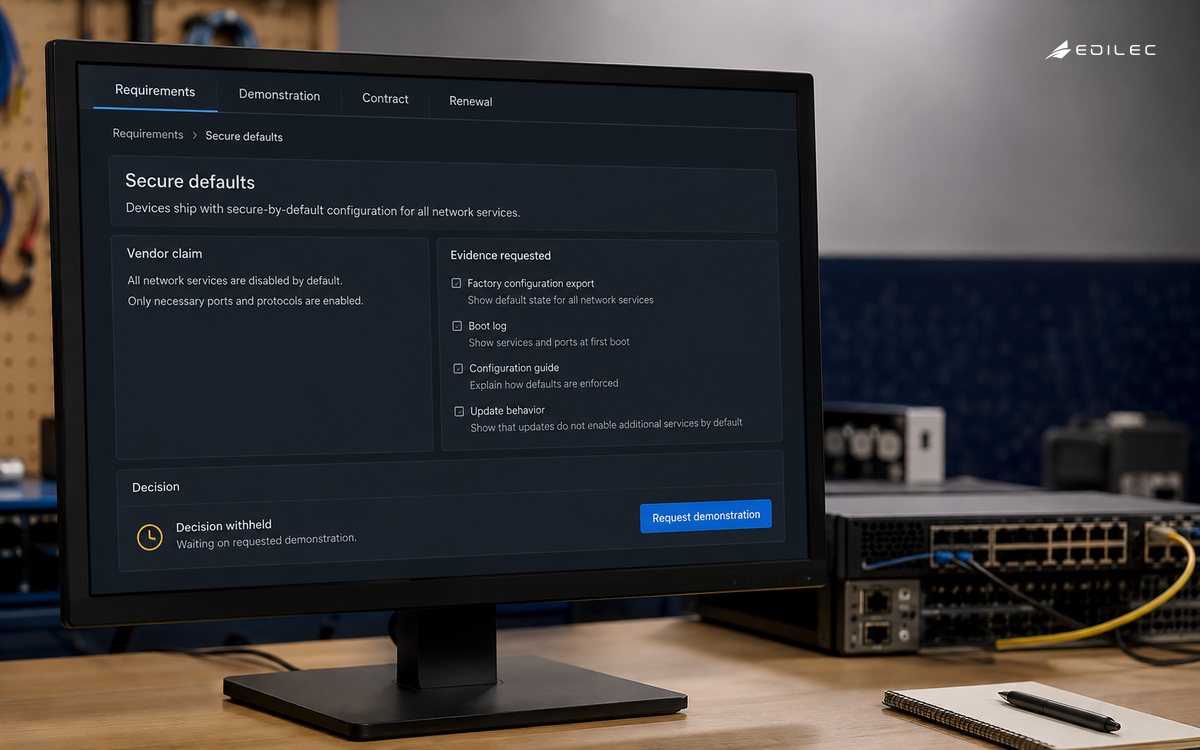
The CISA Secure by Demand Guide encourages customers to examine a manufacturer's product-security approach before, during and after procurement. Its companion Secure by Design initiative frames manufacturer responsibility, transparency and leadership from the producer side. Ask about secure defaults, authentication, logging, vulnerability disclosure, patching, component risk, supported versions and customer communication as applicable. For every question, specify an acceptable evidence form and evaluator. A yes/no answer with no product or version scope should earn little confidence.
Request evidence in layers. Public documentation and release notes establish baseline claims. A recorded or live demonstration shows current behavior. Controlled test-tenant access lets the buyer verify configuration and event output. Independent assessment can support higher-risk areas under appropriate confidentiality. Do not demand sensitive source code or exploit details without a reason and protection plan. Evidence collection itself creates confidential data that needs access limits, retention and deletion.
Score product behavior, defaults and manufacturer practice
Separate mandatory requirements from weighted preferences and future roadmap items. Score shipped default behavior highest, configurable capability next, committed dated remediation below that, and unsupported aspiration at zero. Apply weights established before proposals arrive. Require evaluators to cite evidence and record assumptions. Use the CISA and FBI Product Security Bad Practices update as an applicable challenge list, especially for products supporting critical infrastructure. A polished narrative should not offset a failed deal breaker unless the accountable risk owner accepts a documented exception with compensating controls and an exit date.
Cover manufacturer practice with a common vocabulary. NIST SP 800-218 describes SSDF practices for preparing the organization, protecting software, producing well-secured software and responding to vulnerabilities. Ask the vendor to map its process and artifacts to applicable practices, but avoid treating a self-attestation as proof of every release. Select samples relevant to the purchased product and verify they are current.
Run product-security demonstrations and acceptance tests
Give every finalist the same scenario script. Create a tenant, inspect defaults, enroll administrators, configure SSO and lifecycle management, attempt a forbidden cross-role action, generate audit events, revoke a session, export data, rotate an integration credential and locate support-lifecycle information. For on-premises software, inspect update verification and secure deployment guidance. Record product version and configuration so later changes do not invalidate the comparison.
Test negative behavior, not just setup success. Can a non-admin change policy through an API, does a disabled user retain a token, can a public link be created despite tenant policy, are critical admin actions absent from logs, or does a backup restore weaken security settings? Coordinate testing with vendor permission and avoid production systems. Findings should state impact, reproducibility, expected requirement and vendor response rather than presenting a penetration-test score with no buying consequence.
| Requirement | Acceptance method | Contract trigger | Renewal evidence |
|---|---|---|---|
| Secure admin authentication | Demonstrate enforcement on UI, API and support paths | Reject if any privileged bypass remains | Coverage and exception report |
| User deprovisioning | Disable test user and verify sessions/tokens close | Remediation before go-live | Measured closure test |
| Security event export | Generate named events and ingest them | Schema and availability commitment | Event coverage change log |
| Vulnerability response | Review policy and sample advisory timeline | Notification and remediation duties | Annual performance summary |
| Support lifecycle | Confirm version and end dates | Minimum notice and migration assistance | Current support matrix |
Write requirements into acceptance and contract terms
Contract language should identify product, editions, deployment, required configuration, evidence, delivery date and remedy. Address vulnerability and incident notification, supported versions, patch availability, security-feature pricing, material architecture changes, subprocessor changes, data return, deletion and transition assistance according to risk and applicable law. Avoid an absolute promise that software is secure; define specific obligations the parties can perform and verify. Legal counsel should adapt terms to jurisdiction and deal context.
Prevent security capability from becoming an unaffordable add-on after selection. State which controls and logs must be included in the purchased tier and how pricing changes are handled. Link milestone payment or production acceptance to high-priority tests where commercial leverage permits. Define a cure process and proportionate remedies for failed obligations. An unbounded right to terminate may sound strong but provide little continuity for a deeply integrated system; require export and migration support.
Monitor product security through renewal and change
Review release notes, advisories, support status, material control changes, security-event coverage, critical vulnerabilities, incident performance and unresolved exceptions on a risk-based cadence. Re-run a compact acceptance suite after major upgrades or architecture changes. The vendor should notify the buyer when a secure default changes or a feature used as a compensating control is retired. Do not wait for renewal to discover that the deployed version is unsupported.
Track findings as owned decisions: requirement, evidence date, status, risk, vendor action, buyer mitigation and deadline. Edilec's audit log guide is relevant when validating event evidence, while the identity governance guide helps test lifecycle controls. Reuse evidence across reviews only when product, version, deployment and time remain applicable.
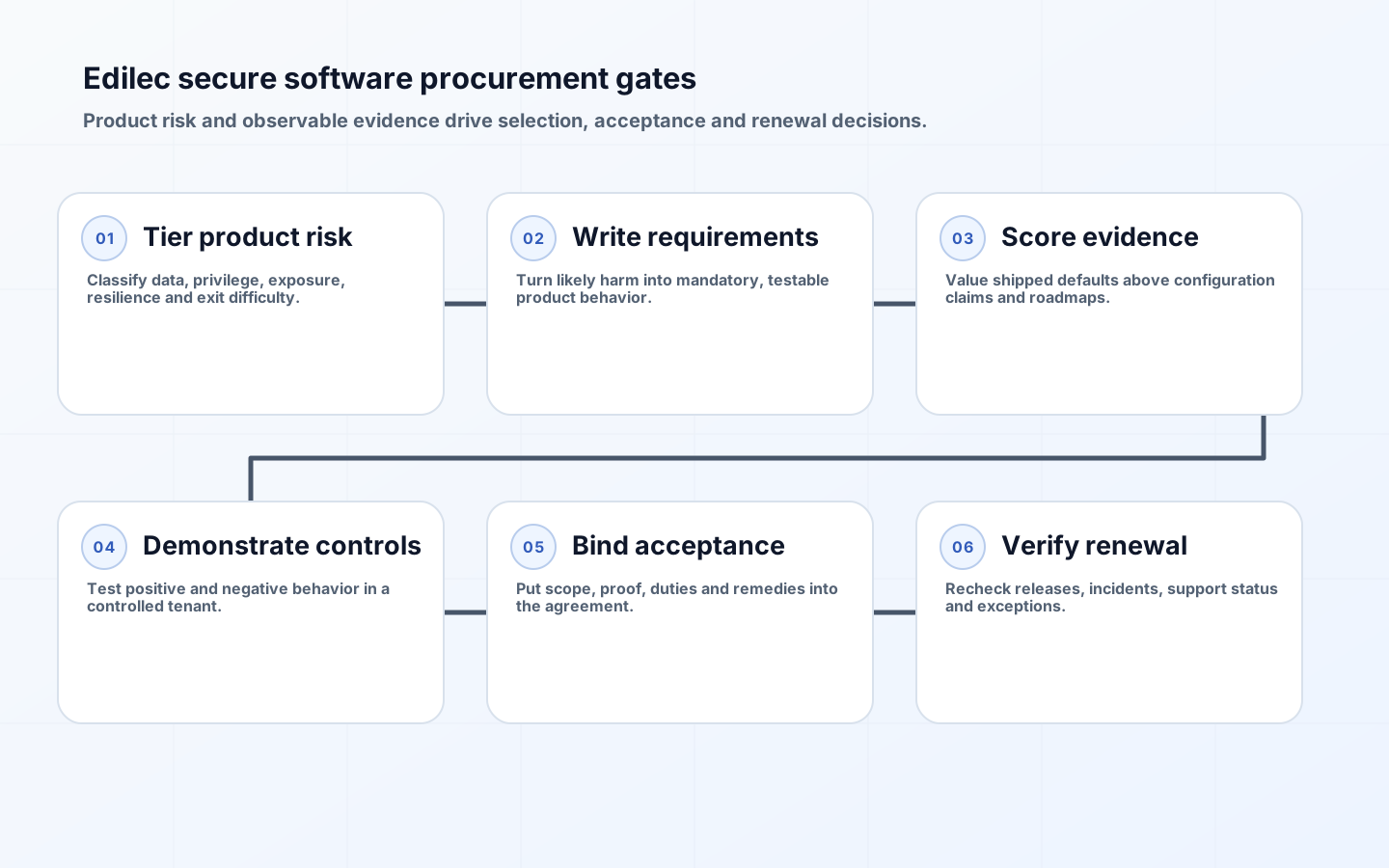
Use the six-stage Edilec secure procurement gates
The Edilec sequence covers risk tiering, testable requirements, evidence-based scoring, controlled demonstration, contractual acceptance and continuous renewal review. Use each gate to stop a purchase that lacks required information rather than collecting concerns after commercial commitment. The diagram at this heading gives procurement and security a shared process while preserving who owns technical judgment, contract negotiation and residual risk acceptance.
Pilot the method on an upcoming moderate-risk renewal. Reconstruct which claims originally influenced selection, verify them in the current product, convert gaps into requirements and compare results with support and incident experience. This reveals whether the evidence burden is proportionate and whether the contract provides usable leverage. Improve the standard requirement library after each purchase, but tailor it to product risk rather than pasting every control into every RFP.
Preserve a decision record the operator can use
At selection, publish an internal decision record with intended deployment, evidence reviewed, test results, accepted exceptions, compensating controls, contract commitments, owners and renewal dates. Give operations the secure baseline and monitoring obligations rather than leaving them in procurement attachments. When an incident or upgrade occurs, this record explains which product behaviors the organization relied on and which vendor contacts or remedies apply. Redact commercially sensitive material for broader audiences, but keep the authoritative record accessible to security and service owners.
Key takeaways
- Tier product risk and define deal breakers before vendors shape the evaluation.
- Turn every important question into scoped evidence and a named verification method.
- Score shipped secure defaults above configurable features, roadmaps and unsupported assertions.
- Test negative behavior in a controlled tenant and bind material results to acceptance and remedies.
- Continue verification through releases, incidents, support lifecycle and renewal rather than relying on one questionnaire.
Frequently asked questions
Is a SOC 2 report enough for software procurement?
No. It can provide useful assurance about scoped controls at the service organization, but buyers must still assess the product's defaults, authorization, lifecycle behavior, vulnerability response and fit for the intended deployment. Read scope, period and exceptions carefully.
Should every buyer require an SBOM?
Require component transparency when it supports a risk and the buyer can protect and use the evidence. Define format, frequency, product mapping, vulnerability coordination and access. An unused file should not displace more decision-useful product testing.
What if a vendor refuses detailed evidence?
Offer proportionate alternatives such as controlled demonstration, independent report, customer portal or contractual attestation. If a critical claim remains unverifiable, score that uncertainty as risk. Commercial popularity does not make missing evidence true.
Conclusion
Secure software procurement shifts buyer attention from policy volume to product behavior and manufacturer accountability. It ties likely harm to clear requirements, verifies the claims that matter, and carries obligations into acceptance and renewal. This gives safer products a real commercial advantage and prevents security review from ending as a filed questionnaire.
Start before the shortlist, preserve evidence behind every score and test the highest-impact failure paths in the actual product. Align exceptions with Edilec's least-privilege field guide so access to vendor systems and buyer data remains bounded. A disciplined gate can improve security without making every purchase equally slow.