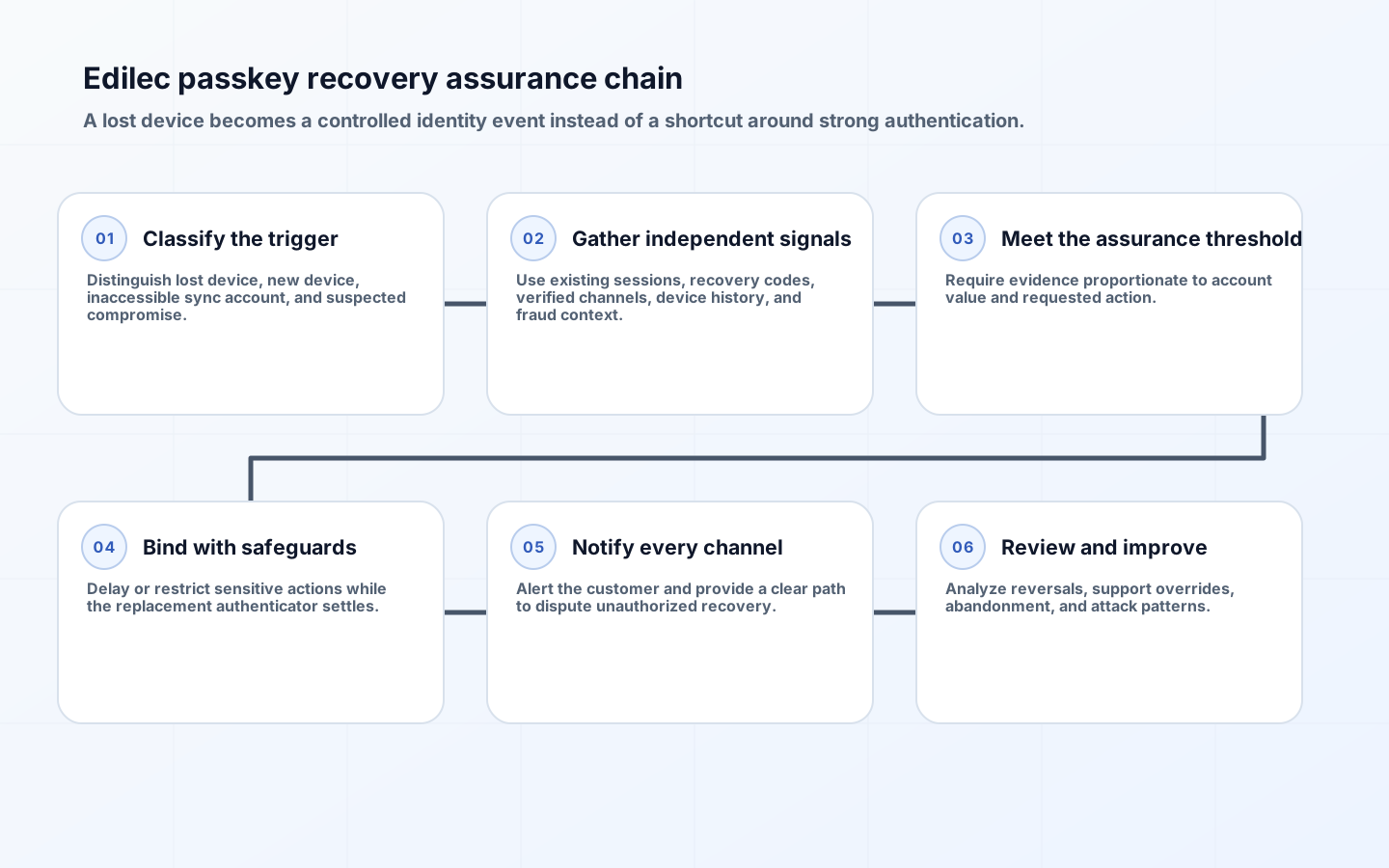
Passkey account recovery is the system that decides who may regain control when a customer cannot use a previously bound authenticator. It is not merely a password-reset screen with different copy. A product may implement WebAuthn perfectly and still suffer account takeover if a caller can persuade support to bind a new passkey using public profile data, a compromised mailbox, or a recently ported phone number. Recovery must preserve the account's intended assurance while remaining usable for legitimate device loss and ecosystem change.
WebAuthn keeps the private key with the authenticator and scopes assertions to the relying party, but the protocol does not decide the product's recovery policy. The Web Authentication specification also distinguishes backup-eligible multi-device credentials from single-device credentials. A synced credential may arrive on a replacement device through its credential provider; a device-bound credential will not. Products need explicit behavior for both cases and must not assume that every missing credential means the same risk.
Define the account-recovery security boundary
Separate three operations that teams often collapse: restoring an existing session, recovering account access, and binding a replacement authenticator. An existing trusted session may let a customer manage credentials, but a high-impact rebinding should still require recent authentication or additional evidence. Recovery may establish a restricted session without immediately permitting payout changes, data export, credential deletion, or recovery-channel updates. This separation gives legitimate customers progress while containing the value of a fraudulent recovery attempt.
Start from account harm rather than channel convenience. Segment ordinary content accounts, paid subscriptions, financial accounts, health records, administrator roles, and accounts holding valuable virtual assets. Record the actions an attacker could take, whether those actions are reversible, and which evidence the service already has. Use the threat-modeling guide to enumerate attackers against registration, session, recovery, support, and post-recovery changes, not just against the primary sign-in ceremony.
Classify device loss and authenticator events
A customer who has a new phone but retains access to a synced passkey presents a different event from someone who lost every device and cannot access the sync provider. Other states include a damaged security key, a stolen device with an active session, deliberate credential removal, suspected credential-provider compromise, and an account whose recovery channels were recently changed. Ask the minimum questions needed to classify the state, then select a pathway. A single universal recovery flow gives attackers the easiest route available.
NIST's authenticator-event guidance addresses binding, loss, theft, unauthorized duplication, expiration, and renewal. Product teams should map those events to machine-readable case types and response duties. Loss may invalidate a credential after verified replacement; suspected compromise also calls for session revocation, recent-action review, risk escalation, and customer notification. Preserve credential identifiers and event history so the service can revoke one authenticator without unnecessarily destroying all access.
Build a passkey account recovery state machine
Implement recovery as states with explicit transitions: request received, risk classified, evidence pending, evidence threshold met, restricted access issued, new authenticator bound, sensitive-action hold active, customer notified, and case closed or disputed. Every transition should record the actor, evidence types, decision rule, timestamp, device and network context, and policy version. Idempotency prevents repeated submissions from producing multiple credentials. Rate limits should apply to account, device, network, recovery channel, and evidence artifact where lawful and proportionate.
| Customer state | Useful evidence | Result | Safeguard |
|---|---|---|---|
| Another passkey is available | Fresh WebAuthn authentication and current session context | Bind replacement credential | Notify and allow rapid reversal of unexpected binding |
| Trusted session but no authenticator | Session age, device continuity, recent risk, independent channel | Restricted recovery session | Delay credential deletion and high-value changes |
| Recovery code available | Single-use code plus contextual checks | Permit controlled rebinding | Consume code, rotate remaining set, notify all channels |
| No bound factor available | Reproofing evidence proportionate to account harm | Manual or automated reviewed recovery | Cooling-off period and enhanced monitoring |
| Suspected theft or takeover | Fraud signals, known contact route, historical account evidence | Contain first, then re-establish control | Revoke sessions and credentials; review recent actions |
| Evidence cannot meet threshold | Incomplete or conflicting signals | Deny or escalate with redress | Do not downgrade to knowledge questions |
Choose independent recovery evidence
Evidence is strongest when compromise of one component does not defeat every check. A second passkey, a separately stored recovery code, a previously verified address, an established device, and account-history details held by the service can contribute different information. Email or SMS may help notify and corroborate, but using the same mailbox or phone both to initiate and approve a high-risk recovery offers limited independence. Avoid static security questions; answers are discoverable, reusable, and difficult for customers to remember consistently.
Do not turn behavioral risk scores into unexplained identity proof. Device novelty, impossible travel, automation patterns, recent recovery-channel changes, and high request velocity are reasons to add review or deny a route, not proof that the claimant is the legitimate customer. Define evidence combinations, confidence thresholds, and prohibited substitutions. NIST explains the requirements and limits of recovery codes and other authenticators in its authenticator guidance. Test policy against both takeover attempts and customers with sparse histories.
Control authenticator rebinding and sensitive actions
After recovery, bind the new passkey in a ceremony associated with the intended account and record user verification, credential properties, and the authorizing recovery case. Do not automatically delete old credentials unless compromise is established; give the customer an inventory and a way to revoke recognizable entries. Conversely, when theft is suspected, invalidate the affected credential and active sessions promptly. The session security guide helps align session renewal and revocation with the recovered identity state.
Apply a time-bounded hold to actions that would make takeover durable or extract value: changing verified contacts, removing all authenticators, creating API credentials, exporting sensitive data, changing payout destinations, or transferring assets. The hold can be shorter when recovery used an existing phishing-resistant authenticator and longer when it relied on reproofing. Tell legitimate customers exactly what is restricted and how to challenge an unauthorized event. Silent friction creates support load and can drive customers toward less secure channels.
Secure customer support and redress
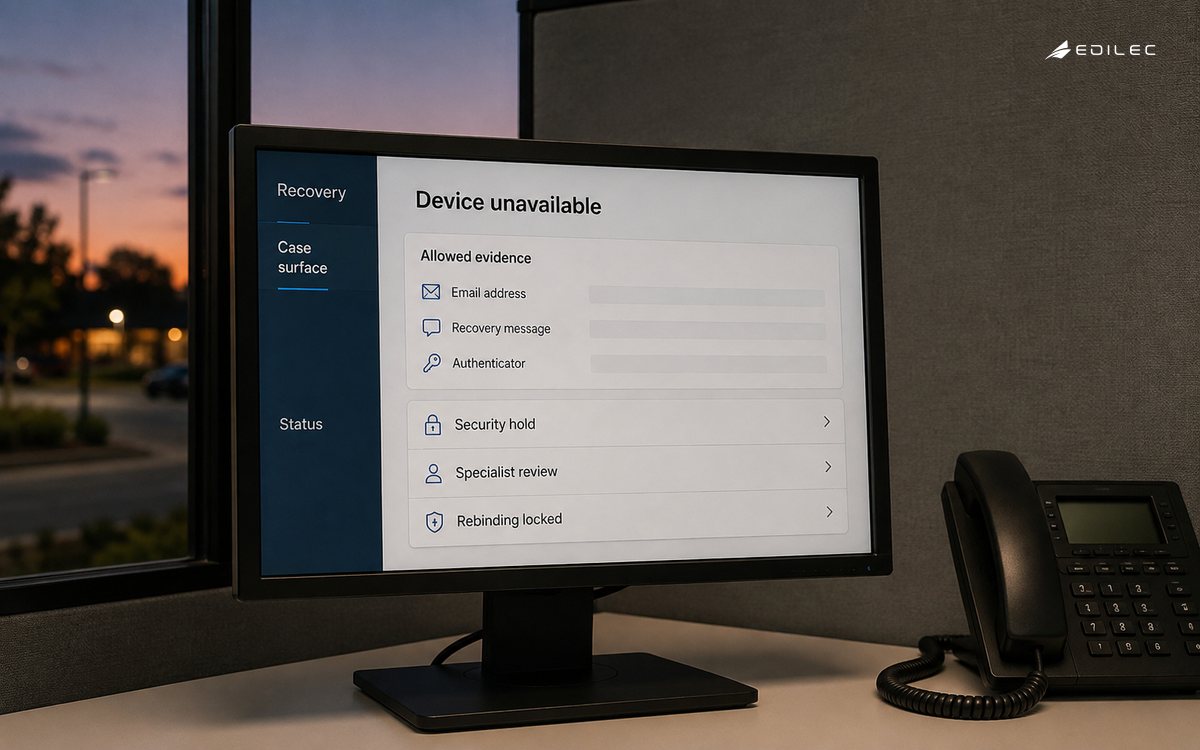
Support agents should execute policy, not invent identity checks during emotional calls. Provide a case interface that reveals allowable evidence, recent security events, risk holds, and escalation routes while minimizing unnecessary personal data. Require dual approval for exceptional high-value recovery and prohibit staff from requesting passwords, full recovery codes, or remote device control. Monitor agents' search, view, override, and credential-binding actions. An attacker may target support tooling directly, so administrative authentication and least privilege matter as much as the customer flow.
Redress is a security control because a legitimate customer needs a fast route to stop or reverse fraudulent recovery. Send event notices to every established channel, include the time, device or location context appropriate for privacy, and provide a non-session-dependent dispute route. Preserve evidence under a documented retention schedule. Accessibility, language, name changes, international travel, and lack of conventional credit history must be tested as product requirements rather than treated as exceptions after launch. The authentication-flow guide offers a broader model for humane failure states.
Test recovery as an account-takeover surface
| Test | Expected control | Evidence to retain | Release blocker |
|---|---|---|---|
| Mailbox is compromised | Email alone cannot bind a new passkey | Decision trace and denied transition | Email link creates unrestricted session |
| Phone number was recently ported | Risk hold or independent evidence is required | Signal inputs and policy outcome | SMS silently replaces all authenticators |
| Attacker knows personal profile data | Knowledge answers do not satisfy recovery | Support script and test recording | Agent accepts public facts as proof |
| Customer has an active stolen-device session | Sensitive changes require fresh assurance | Session age and step-up result | Session can delete every credential |
| Concurrent recovery requests occur | Requests are idempotent and rate-limited | Case correlation and throttle events | Multiple credentials or contradictory states appear |
| Legitimate customer lacks common evidence | Accessible redress reaches reviewed decision | Completion, wait, and appeal outcomes | No route exists except insecure exception |
Run tests before launch and after changes to identity providers, fraud vendors, support tooling, session policy, or credential-management interfaces. Measure successful takeover simulations, false acceptance, false rejection, abandonment, time to containment, disputed-recovery reversal, support override, and post-recovery fraud. Segment outcomes by recovery pathway and customer population. A low overall fraud rate cannot justify a route that is trivially exploitable, and a very strict route is not successful if legitimate customers permanently lose access without redress.
Passkey account recovery takeaways
- Separate session restoration, account recovery, authenticator binding, and sensitive-action authority.
- Classify the event before choosing evidence or invalidating credentials.
- Use independent evidence combinations proportionate to account harm.
- Model recovery as auditable, idempotent states with rate limits and explicit transitions.
- Restrict durable and high-value changes after higher-risk recovery.
- Treat support, notification, dispute, accessibility, and outcome measurement as security controls.
Passkey account recovery FAQ
Do synced passkeys eliminate recovery? No. They reduce some device-replacement failures, but customers can lose access to the sync account, change ecosystems, disable backup, or face compromise. The relying party still needs credential inventory, alternative recovery, notification, and containment.
Should a recovery email immediately create a new passkey? Usually not by itself. An email link can start a case or corroborate a request, but higher-impact accounts should require independent evidence before rebinding and should restrict sensitive actions afterward.
Should all old passkeys be deleted after recovery? Delete or revoke credentials known or suspected to be compromised. For routine replacement, showing the customer an inventory and allowing selective removal may preserve safe continuity. Policy should clearly distinguish loss from compromise.
Conclusion
Passkeys strengthen the front door, but account ownership is ultimately defended across enrollment, sessions, recovery, rebinding, support, and redress. A good recovery design classifies what happened, gathers independent evidence, grants only the authority justified by that evidence, and makes suspicious changes visible and reversible. That approach lets customer products gain WebAuthn's phishing resistance without moving their account-takeover problem to the help desk.