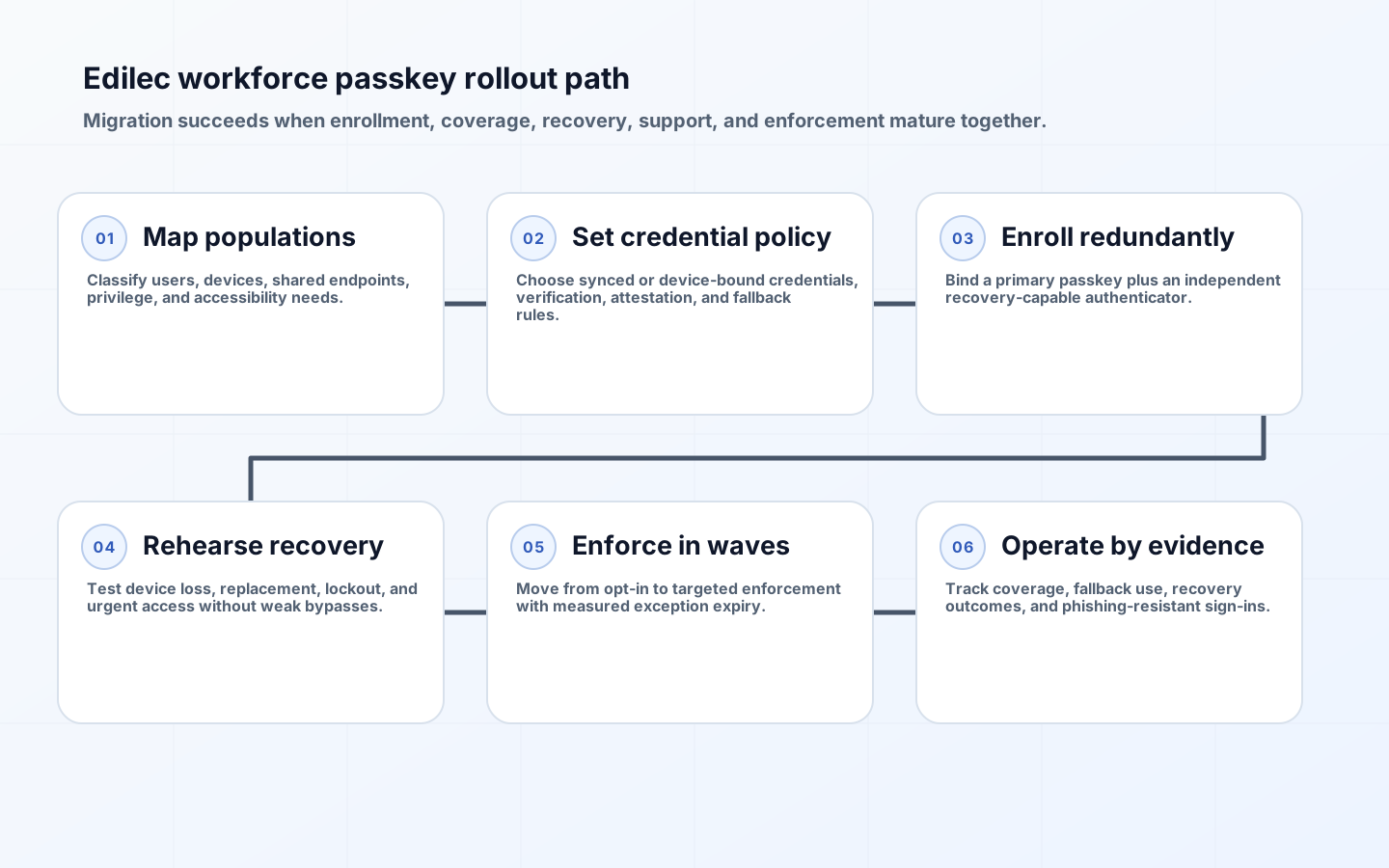
A workforce passkey rollout replaces a reusable, verifier-known secret with public-key authentication bound to the legitimate service. That is a material defense against credential phishing, but enabling WebAuthn in an identity provider is only the protocol step. A real deployment must cover enrollment, managed and personal devices, shared workstations, privileged users, contractors, accessibility, replacement devices, emergency access, and support. If recovery still falls back to an easily persuaded help desk or a relayable code, attackers will simply move from the sign-in page to the exception path.
The technical foundation is clear. NIST authenticator guidance identifies WebAuthn as a phishing-resistant authentication method and distinguishes local activation secrets from centrally verified passwords. The Web Authentication Level 3 specification defines registration and authentication ceremonies in which a relying party verifies a signed challenge. Program success, however, is measured by how many relevant sign-ins use that property and whether employees can recover without creating a lower-assurance route.
Set outcomes for the workforce passkey rollout
Define the security outcome before choosing enrollment prompts. Useful objectives include eliminating password entry for privileged administration, reducing successful adversary-in-the-middle phishing, removing shared OTP seeds, and making every authenticator binding attributable. Add operational objectives: a replacement laptop can be activated within an agreed time, inaccessible users have a documented assisted route, and support can distinguish ordinary device loss from suspected compromise. These outcomes prevent the project from declaring victory at registration count while daily work continues through legacy factors.
Build a population matrix from identity, device-management, application, and location data. Separate managed laptop users, mobile-only workers, shared-station operators, virtual desktop users, external collaborators, service desk staff, and privileged administrators. For each group, record supported browsers and platforms, whether local user verification is available, whether cross-device authentication is allowed, and which critical applications bypass central sign-in. The broader SSO and MFA rollout guide is useful for mapping dependencies; passkey planning adds credential portability and recovery constraints.
Choose synced and device-bound credential policy
Do not treat every passkey as operationally identical. WebAuthn exposes backup eligibility and backup state, allowing a relying party to distinguish credentials that may be synchronized from single-device credentials. Synced passkeys can improve continuity across a worker's approved ecosystem; device-bound credentials can provide stronger control for privileged or regulated use cases. The right rule follows the transaction. A general employee portal might accept an approved sync fabric, while production administration might require a managed hardware authenticator with a non-exportable key and recorded inventory.
Document relying-party identifiers and domain ownership before pilot enrollment, because credentials are scoped to the relying party. Set user-verification requirements, acceptable authenticator classes, attestation policy where justified, maximum credentials per account, naming conventions, and whether unmanaged devices may create credentials. Avoid collecting attestation data merely because it is available; define the decision it supports and its privacy implications. The FIDO specifications index provides the protocol family, while NIST's syncable authenticator appendix explains additional controls for sync fabrics.
Design enrollment, recovery, and enforcement as one path
Require resilient enrollment rather than one successful ceremony. During an already authenticated, high-confidence session, guide the employee to register a primary passkey and an independent recovery-capable authenticator appropriate to their role. That might be a second managed device, a hardware security key stored separately, or controlled recovery codes. Record who initiated the binding, the session assurance, credential identifier, authenticator properties, device context, and completion result. Never let an email link alone authorize a new passkey, because control of email may already depend on the compromised workforce account.
| Situation | Primary approach | Recovery design | Enforcement gate |
|---|---|---|---|
| Managed knowledge worker | Platform or approved synced passkey with user verification | Second managed device or separate security key | Two usable credentials and successful recovery rehearsal |
| Privileged administrator | Device-bound hardware-backed credential | Two inventoried keys held separately plus governed break-glass | Legacy factor removed from privileged path |
| Shared workstation | Roaming security key or cross-device flow without local credential sharing | Supervisor-assisted controlled replacement | Shift and handoff tests complete |
| Contractor or partner | Federated phishing-resistant sign-in or scoped local passkey | Sponsor-reviewed reproofing and expiry | Contract end date and owner recorded |
| Accessibility exception | Compatible alternative phishing-resistant authenticator | Accessible assisted process with equivalent checks | User test confirms independent completion |
Engineer recovery before removing passwords
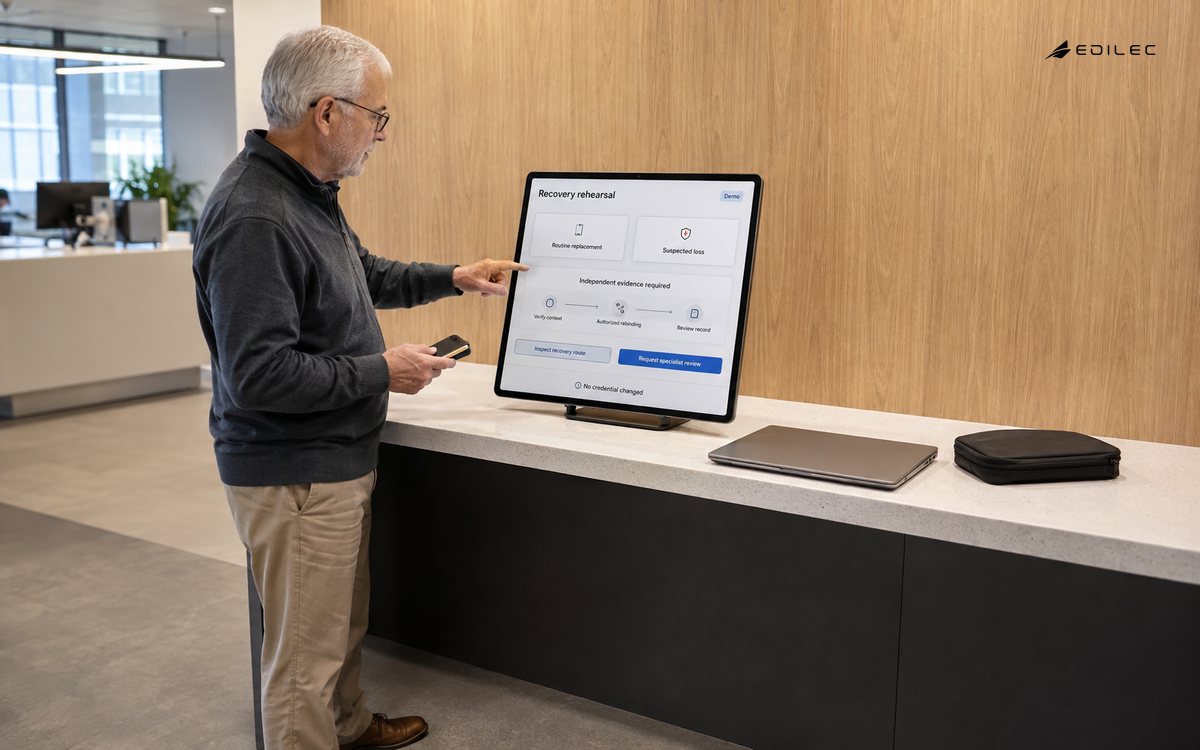
Model at least four events: lost authenticator, unavailable but not lost device, suspected theft, and routine device replacement. The response differs. An unavailable device may justify a short, restricted session based on another bound authenticator; suspected theft requires immediate invalidation, session review, and stronger rebinding. NIST's authenticator event requirements cover binding, loss, compromise, expiration, and renewal. Translate those events into service desk scripts, automated controls, escalation thresholds, and evidence fields.
Assisted recovery should combine independent evidence and limit what happens next. Existing managed-device posture, a separate bound authenticator, a verified corporate channel, manager confirmation, and recent account context can contribute, but no single weak signal should silently replace strong authentication. After higher-risk recovery, notify the worker through multiple channels, revoke old credentials and sessions, apply a cooling-off period to sensitive changes, and create a reviewable case. Emergency access must use dedicated accounts or credentials, not a universal bypass that support staff can apply to any identity.
Pilot and enforce in risk-based waves
Start with IT and security participants who can generate detailed failure reports, then include representative business groups rather than only enthusiasts with new devices. Test browser changes, remote work, mobile and desktop transitions, shared endpoints, VDI, lost-device scenarios, and applications that reauthenticate during sensitive actions. Keep a feature-controlled rollback for presentation or orchestration defects, but do not make rollback re-enable a weak factor for privileged access. The authentication flow design guide helps teams locate step-up and session boundaries that need separate testing.
Move through observable states: eligible, invited, first credential bound, redundant coverage achieved, legacy factor unused, and legacy factor disabled. Enforcement should follow redundant coverage and recovery readiness, not a calendar alone. Exceptions need an owner, reason, compensating control, expiry, and migration date. A legacy application that cannot consume central authentication is an integration backlog item; it should not be hidden inside a permanent tenant-wide password policy. Privileged roles, finance approval, source control, and identity administration usually deserve the earliest enforced waves.
Prepare support and lifecycle operations
Give support staff a decision tree that starts with event type and risk, not with a generic reset button. The console should show credential inventory, last successful use, device management state, recent session risk, recovery attempts, and pending security holds without exposing private key material. Separate staff who collect evidence from those who approve high-risk rebinding. Train with simulations of executive impersonation, urgent travel, SIM change, hostile manager claims, and a caller who knows employee data. Quality review should sample both approvals and denials for consistency.
Lifecycle automation must address joiners, movers, leavers, device refresh, leave of absence, and identity-provider migration. Passkeys bound to the corporate account should stop authorizing when employment or entitlement ends even if a device remains usable. Preserve event evidence long enough for investigation, but minimize device and attestation data. Align ownership and recertification with the identity governance lifecycle. A passkey program is an authentication change inside a larger identity-control system.
Measure coverage, fallback, and recovery
| Measure | Decision it supports | Healthy interpretation | Warning signal |
|---|---|---|---|
| Eligible users with redundant credentials | Whether enforcement can expand | Coverage includes independent recovery | High registration but only one device per user |
| Phishing-resistant share of sign-ins | Whether exposure is actually falling | Critical journeys consistently use WebAuthn | Passwords or OTP remain common after enrollment |
| Recovery completion by pathway | Which routes are reliable and fair | Legitimate users finish with equivalent assurance | One demographic or device group abandons disproportionately |
| Support override and reversal rate | Whether assisted recovery is controlled | Overrides are rare, reviewed, and attributable | Urgency routinely bypasses required checks |
| Legacy-factor use after credential binding | What should be retired next | Use declines to documented exceptions | Silent fallback masks broken passkey flows |
| Time to revoke a lost credential | Containment readiness | Revocation and session response meet target | Inventory cannot identify the affected authenticator |
Segment every measure by population, device type, location, privilege, and application. Aggregate success can conceal a shared-workstation group that depends on support or a privileged application still accepting OTP. Review attempted phishing, suspicious recovery, and credential-binding events alongside usability data. The goal is not the smallest help-desk queue; it is dependable access with fewer transferable secrets. The MFA rollout cost and scaling guide provides a broader operating-cost lens for staffing and adoption decisions.
Workforce passkey rollout takeaways
- Define success as phishing-resistant sign-in coverage and controlled recovery, not registrations alone.
- Choose synced or device-bound credentials according to transaction risk and device governance.
- Require redundant authenticators before enforcing password removal.
- Treat every recovery and post-enrollment binding as a security-sensitive event.
- Enforce in population waves with owned, expiring exceptions.
- Measure fallback use, recovery outcomes, revocation speed, and accessibility across user groups.
Workforce passkey rollout FAQ
Can a company keep passwords during migration? Yes. A staged coexistence period is often necessary, but policy should prevent the retained password from remaining an unrestricted fallback for protected journeys. Track its use, restrict it with contextual controls, and assign a retirement condition. Otherwise the attacker can ignore the passkey and continue targeting the transferable credential.
Are synced passkeys acceptable for employees? They can be appropriate when the sync fabric, account recovery, device ecosystem, and transaction risk meet organizational policy. More sensitive administration may justify device-bound, hardware-backed credentials. The choice should be explicit and tested rather than inferred from the word passkey.
How many authenticators should a worker enroll? There is no universal number, but enforcement should not create a single point of failure. Most programs need a primary credential and an independent recovery-capable option. Privileged users commonly need two separately stored hardware authenticators plus governed emergency access.
Conclusion
A successful workforce passkey rollout makes phishing-resistant authentication ordinary without making account recovery improvisational. Build the credential policy around real populations, require resilient enrollment, rehearse device loss, constrain support authority, and enforce only when evidence shows that users can continue securely. Passkeys remove a major class of transferable secrets; disciplined lifecycle and recovery design ensure the organization does not recreate that weakness under a different button.