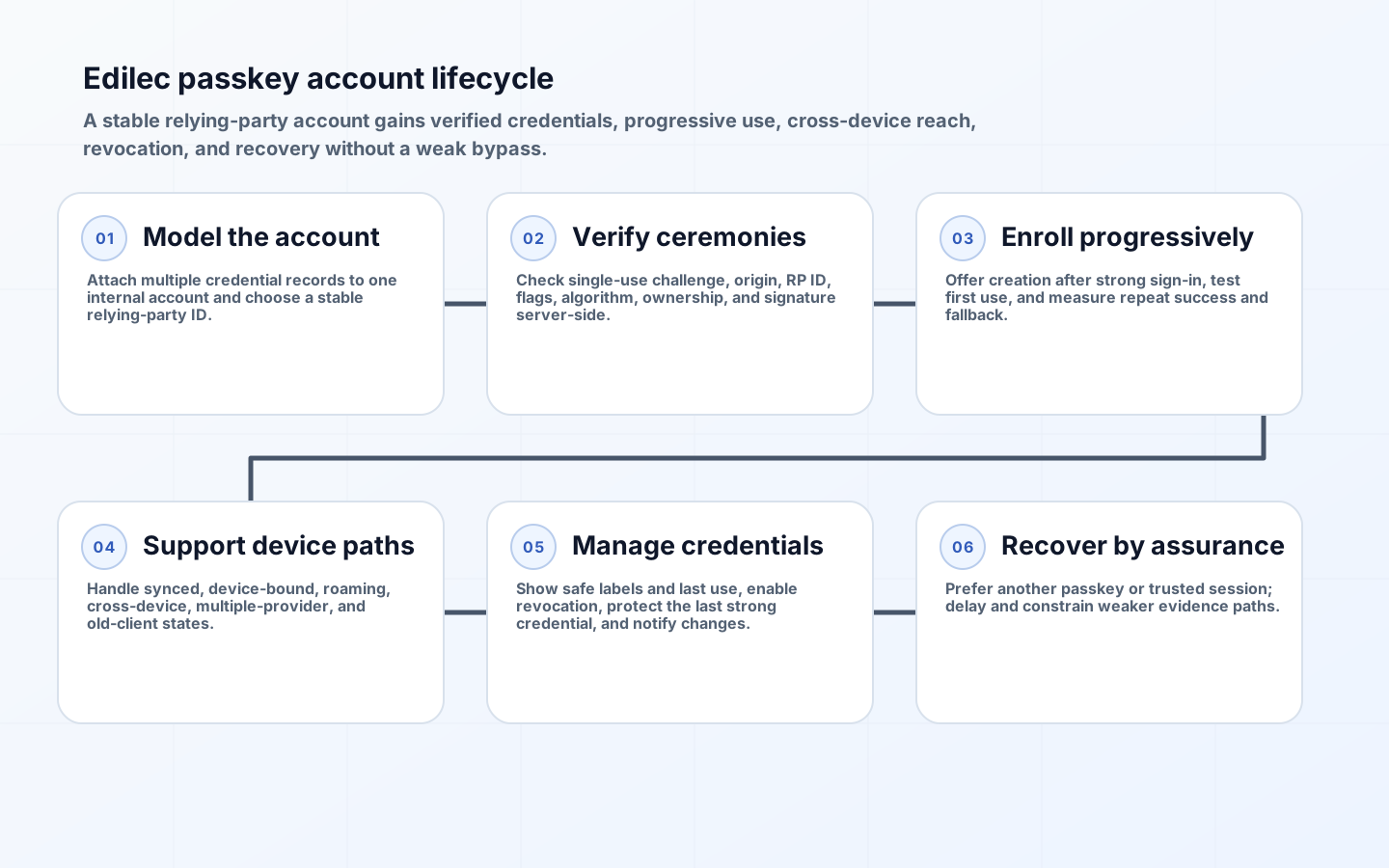
Passkey implementation for apps is an account-lifecycle program, not a replacement login button. WebAuthn creates a public-key credential scoped to a relying party; the private key remains with an authenticator or credential provider. That design resists phishing and server credential theft, but customer success still depends on enrollment timing, synced and device-bound credentials, cross-device use, revocation, device loss, support, and mixed password states.
The safest rollout gives an account several independent ways to recover without making a weak channel equivalent to a passkey. Keep the server's identity model separate from any single credential, allow multiple credentials, bind native apps to the same relying-party domain correctly, and instrument outcomes without collecting biometric or authenticator secrets. Recovery deserves more scrutiny as passkey adoption rises because attackers will move toward the remaining bypass.
Define the account, credential, and relying-party model
Represent a passkey as one credential attached to an internal account: credential ID, public key, signature counter where applicable, transports, creation time, last use, friendly label, backup-related signals if available, and revocation state. Store the opaque user handle separately from email or username. Let one account register multiple passkeys so a user can maintain more than one provider or device. Never assume one credential identifies the complete person lifecycle.
Choose the relying-party ID before implementation. It determines credential scope and is difficult to change after enrollment. Web origins must be secure and expected; native iOS and Android applications need platform association with the relying-party domain. Google's passkey architecture guide describes the RP server, client, authenticator, and password manager roles. Centralize challenge creation and verification so web and native clients share security semantics.
| Record | Server stores | Server must not infer | Control |
|---|---|---|---|
| Account | Stable internal ID and verified contact state | That email possession alone is strong recovery | Risk-tiered recovery policy |
| Credential | Credential ID, public key, metadata, status | Private key or local biometric | Unique constraint and revocation audit |
| Ceremony | Single-use challenge, expected origin/RP, expiry | Success from client UI alone | Atomic consume after verification |
| Session | Account, assurance, device/session risk, expiry | Permanent trust from one sign-in | Rotation and step-up rules |
| Recovery | Evidence path, approvals, changes, notifications | Equivalence of every fallback method | Delay and high-risk review |
Implement registration and authentication verification correctly
For registration, generate a high-entropy, short-lived, single-use challenge on the server; bind it to the intended account and ceremony; send RP and user data plus supported algorithms; prefer a discoverable credential for passkey UX; and exclude known credential IDs to reduce duplicates. On return, verify challenge, expected origin, RP ID hash, user presence, required user verification, credential type, algorithm, and attestation policy before storing the public key.
For authentication, create a new challenge and verify the assertion's challenge, origin, RP ID hash, flags, credential ownership, and signature over authenticator data and client-data hash. Use a maintained WebAuthn server library and keep its conformance tests. The current WebAuthn Level 3 specification defines discoverable credentials, ceremonies, and privacy requirements. Client success callbacks are transport, not proof; only server verification may create a session.
Design progressive enrollment and mixed credential states
Begin with opt-in enrollment after a recent strong sign-in or successful account creation. Explain that the passkey uses the device's credential provider and screen lock, without claiming it is stored only on that device. Offer enrollment at a moment with context, then test sign-in before encouraging password removal. Conditional mediation on supported browsers can surface passkeys inside a familiar username field while preserving other methods.
Roll out by platform capability, account risk, region, and support readiness. Measure prompt shown, creation attempted, created and server-verified, first successful use, cancellation, no-credential, cross-device use, fallback, and recovery. Separate technical errors from user cancellation. Do not measure adoption as credentials created; dormant credentials can coexist with password dependence. A meaningful metric is the proportion of eligible returning sign-ins completed with a passkey without fallback.
| Stage | Population | Primary evidence | Do not advance when |
|---|---|---|---|
| Employee and test | Known devices and recoverable accounts | Ceremony correctness and support scripts | Origins, associations, or revocation fail |
| Opt-in pilot | Low-risk customers on supported clients | Creation, first use, cancellation, fallback | Support cannot diagnose provider states |
| Broad enrollment | Eligible signed-in customers | Repeat usage and cross-device success | Recovery volume or lockout rises |
| Passkey-first | Returning users with discoverable credentials | Password fallback declines without conversion loss | Account discovery leaks or UX regresses |
| Password retirement | Explicitly eligible account segment | Multiple recovery evidence and stable operations | Weak recovery remains password-equivalent |
Handle sync, cross-device authentication, and provider choice
Synced passkeys may appear on a user's other devices through a credential provider. Device-bound passkeys or security keys may not. Cross-device authentication can let a nearby device approve sign-in, often through a QR-mediated flow. Google's supported environments guidance documents provider and cross-device behavior across Android and Chrome. Do not build provider-specific assumptions into the account model.
Always offer a visible path to use another device or sign-in method. On shared devices, avoid revealing all account identifiers before user interaction. A user may delete a passkey locally while the server credential record remains, or revoke it server-side while a provider still displays it. Build credential management that lists recognizable labels and last use, supports revocation, and clearly distinguishes deleting server access from removing a credential at the provider.
Design account recovery without rebuilding a phishing bypass
Prefer recovery from another registered passkey, an already trusted session, or a pre-enrolled high-assurance method. Encourage more than one credential before removing passwords. For lower-assurance recovery, combine signals, apply a delay for sensitive accounts, notify existing channels and sessions, limit immediate high-risk changes, and provide a way to contest. A help-desk agent should follow evidence policy and cannot simply decide identity from confidence or personal familiarity.
Apple's passkey support documentation recognizes creating a new passkey for recovery or revoking shared access. Treat recovery completion as a security event: rotate sessions where appropriate, record the method, notify the user, review credential labels, and prompt enrollment of a new passkey. Rate-limit account discovery and make responses indistinguishable where differences could enumerate registered users.
Operate revocation, monitoring, and support
Provide an authenticated credential-management surface showing creation date, label, recent use, and revoke action. Require step-up for revoking the last strong credential or changing recovery channels. Log credential registration, assertion verification result, revocation, recovery start and completion, and support intervention with purpose-limited metadata. Do not log challenges, full assertion bodies, public-key material unnecessarily, or personal device names copied from a provider.
Support tooling should explain whether failure occurred before a credential was offered, during client mediation, at association or origin validation, or during server verification. Give agents safe customer instructions without exposing cryptographic internals or override buttons. Rehearse domain migration, compromised session, lost phone, changed phone number, provider outage, user with no other device, and accidental last-credential removal. Publish operational objectives for successful sign-in and recovery completion, not just API availability.
Test threats, associations, and compatibility states
Create negative ceremony tests for replayed and expired challenges, wrong origin, incorrect RP ID, credential registered to another account, unsupported algorithm, malformed authenticator data, missing required user verification, duplicated credential ID, and concurrent challenge consumption. Test native association files with store-signed builds and production domains. Verify that a compromised client cannot choose the account attached to a valid credential or suppress server checks.
The UX matrix should include no screen lock, provider disabled, enterprise restrictions, browser without conditional mediation, multiple matching accounts, multiple providers, roaming security key, cross-device timeout, camera unavailable, offline state, and an old app that lacks passkeys. Keep password or federation fallback rate-limited and protected by existing controls during transition. Accessibility tests must cover system credential sheets, focus return, QR instructions, cancellation, and clear recovery language.
Key takeaways
- Model passkeys as multiple revocable credentials attached to an account, never as the account itself.
- Verify every ceremony server-side against a single-use challenge, expected origin, RP ID, flags, and signature.
- Roll out progressively and measure repeat passkey use, fallback, and recovery rather than registrations alone.
- Support synced, device-bound, and cross-device states without assuming a particular credential provider.
- Make recovery risk-tiered and independently controlled so it does not become the attacker's easier login path.
FAQ
Does the server receive Face ID or fingerprint data?
No. Local user verification is performed by the authenticator or platform. The relying party receives a signed assertion and flags, not the biometric. Product copy and logs should preserve that distinction.
When should passwords be removed?
Only after the target account segment has reliable passkey use, more than one recovery path where appropriate, proven cross-device support, and a recovery process at least as strong as the desired assurance. Passkey-first can precede password removal by a substantial period.
What if a user deletes a passkey from their password manager?
The server may not receive immediate notice. The stale credential will fail or no longer be offered, while other credentials can still work. Let the user revoke the server record from credential management and avoid treating an unused record as evidence of compromise by itself.
Conclusion
Passkeys improve authentication when cryptographic correctness and account operations reinforce each other. A stable RP model, verified ceremonies, progressive enrollment, provider-neutral cross-device design, multiple credentials, and strong recovery let web and mobile teams reduce password dependence without exchanging phishing risk for lockout or support bypass risk.