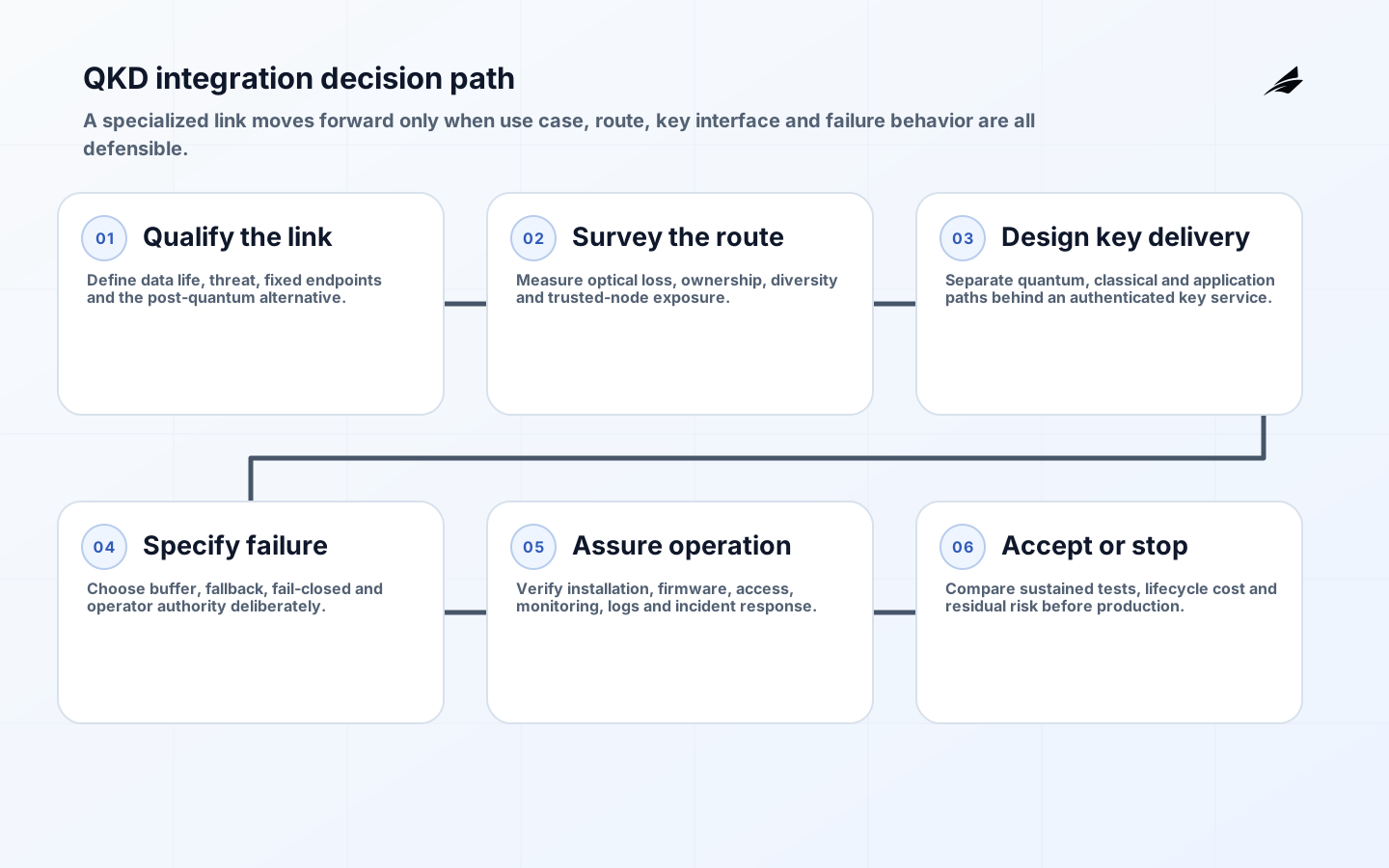
QKD integration planning begins with a narrow question: which communications link has a confidentiality requirement, physical route and operating model that justify specialized quantum key distribution equipment? QKD can let two endpoints establish key material while detecting certain interference on the quantum channel. It does not encrypt application data by itself, authenticate every device, replace access control or remove the need for conventional cryptography. A useful plan therefore treats QKD as one component in a larger key-management and network-security system, not as a universal quantum-safe upgrade.
The distinction matters because the UK National Cyber Security Centre recommends post-quantum cryptography as the primary mitigation for the quantum threat and describes QKD as suitable only for some specialized cases. NIST’s standardized post-quantum algorithms run on conventional systems and can protect broadly distributed applications. QKD instead depends on dedicated physical infrastructure, distance and loss budgets, trusted endpoints, operational monitoring and an authenticated classical channel. This FAQ explains how to evaluate that trade, design the interfaces and test the resulting service without overstating what QKD proves.
Where does QKD fit, and where does it not?
Start with data life, consequence and topology. A plausible candidate is a small number of fixed, high-value links between controlled facilities where interception risk is material, routes are known and long-term operation is funded. A poor candidate is a mobile workforce, a public API with thousands of changing peers, a global SaaS edge or any system whose path traverses infrastructure that cannot host or monitor QKD equipment. If ordinary certificate, key-rotation and configuration weaknesses remain unresolved, QKD will not compensate for them.
Define the security property in testable language. The requirement may be fresh symmetric key material between two sites, evidence when a quantum channel is outside operating tolerance, or separation from an existing public-key exchange. It should not be “unhackable communications.” Endpoints can still be compromised, implementation defects can expose keys, denial of service remains possible and trusted relays can become high-value targets. Compare QKD with a post-quantum or hybrid key-establishment design using the same threat model, service objective and total operating cost.
| Decision factor | QKD implication | Planning evidence |
|---|---|---|
| Topology | Best suited to stable endpoint pairs or managed networks | Route map, distance, optical loss and ownership |
| Threat | Addresses key establishment, not endpoint compromise | Threat model and residual-risk record |
| Availability | Quantum channel faults can interrupt key supply | Key buffer, fallback and alerting tests |
| Scale | Equipment and trusted nodes increase operational load | Five-year capacity and lifecycle model |
| Alternative | PQC is deployable through conventional software stacks | Comparable PQC or hybrid proof of concept |
What belongs in a QKD reference architecture?
Draw three paths separately. The quantum channel carries quantum states. The authenticated classical channel supports protocol coordination and must resist active manipulation. The application path consumes key material and protects business traffic using an approved symmetric mechanism. Show QKD devices, key-management systems, encryptors, applications, monitoring, time sources and administrative access. For every boundary, record who operates it, what identity it uses, which logs exist and whether plaintext key material can cross the boundary.
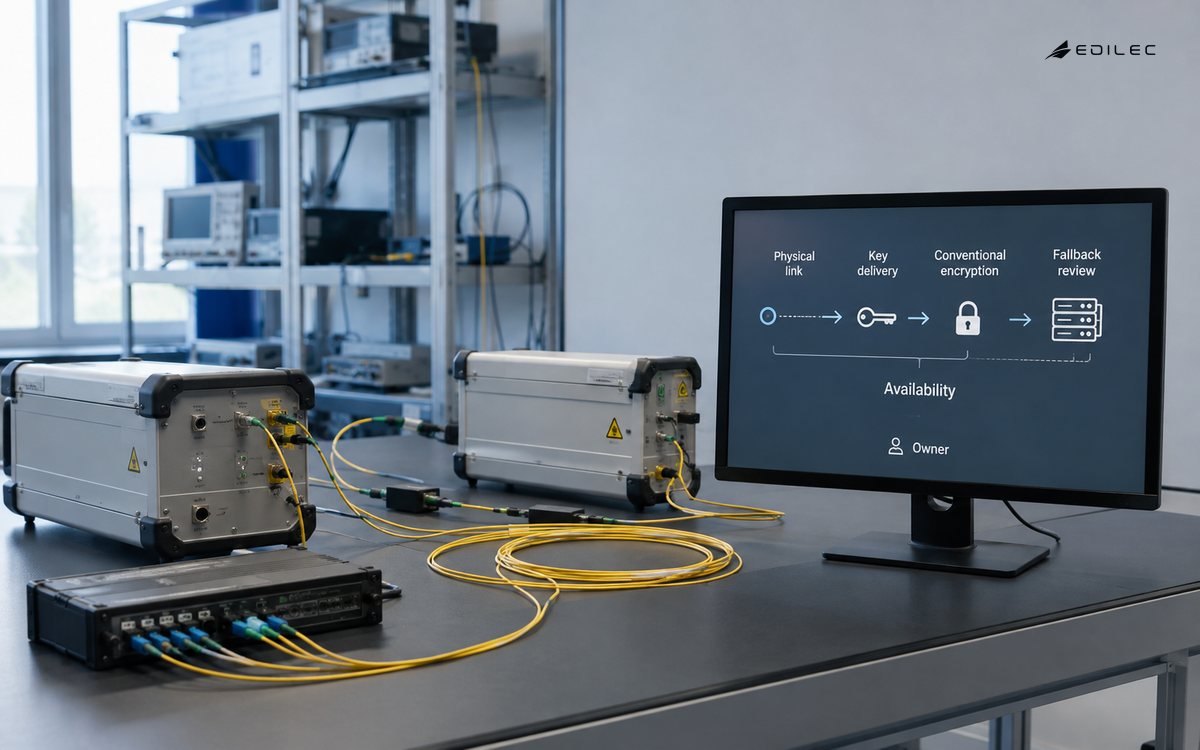
Network design must include optical constraints rather than stopping at a logical diagram. Measure attenuation, connector loss, splices, wavelength coexistence, environmental variation and maintenance access. If trusted nodes extend distance, document their physical protection and the fact that they must be trusted with key material. Diversity claims require route surveys: two fibers in different ducts that enter the same building riser are not independent. Reserve test ports and an acceptance method so later carrier work can be distinguished from a device fault.
How should applications receive and use QKD keys?
Keep applications independent of QKD hardware. A key-management layer should authenticate consumers, authorize a named key purpose, expose health and allocation state, prevent key reuse and preserve synchronized identifiers without logging secret values. ETSI GS QKD 014 defines a REST-based model for delivering keys from a QKD network to applications. It is a useful interoperability reference, but the implementation still needs local decisions about client identity, rate limits, tenancy, key lifetime, failure semantics and audit retention.
Specify what happens when key generation slows or stops. Options include drawing from a bounded key buffer, reducing rekey frequency, switching to a separately approved post-quantum or hybrid exchange, or failing closed. The right behavior depends on business consequence. An emergency fallback that silently uses an unapproved algorithm defeats the security objective; a hard stop that disconnects a safety-critical service may be worse. Make mode changes explicit, observable and reversible, and require operators to know which mode protected each session.
| Interface contract | Required behavior | Acceptance test |
|---|---|---|
| Consumer identity | Mutually authenticated and least privileged | Unknown and expired identities are rejected |
| Key allocation | Unique key ID, purpose and bounded lifetime | Concurrent clients never receive reused material |
| Health state | Generation, buffer and device state exposed | Degraded mode triggers an actionable alert |
| Fallback | Approved mode and decision authority documented | Channel loss exercises the intended transition |
| Audit | Metadata recorded without secret key values | Investigator can reconstruct mode and ownership |
How is a QKD service assured and operated?
Assurance covers more than protocol mathematics. Establish trusted installation, device identity, firmware provenance, secure configuration, calibration, tamper response and controlled maintenance. Limit administrator privileges and separate network, security and key-management duties where practical. Record configuration baselines and approved changes. A vendor certificate or laboratory result applies to a defined product and configuration; it does not prove that the deployed fiber route, key consumer, fallback logic or operating process is secure.
Operate QKD as a service with measurable indicators: secret-key generation rate, usable key inventory, quantum bit error rate or vendor-equivalent quality signal, channel uptime, failed allocations, fallback duration and unresolved device alerts. Set thresholds from tested behavior rather than marketing maxima. Run incident scenarios for fiber degradation, time drift, equipment replacement, suspicious error changes, key-manager compromise and loss of a trusted node. Preserve logs from quantum equipment, classical control, key management and encryptors on synchronized time.
What does a defensible pilot and rollout look like?
A pilot should answer a decision, not merely produce a successful encrypted session. Phase one validates the use case and compares QKD with a PQC or hybrid alternative. Phase two surveys the route and tests optical performance. Phase three integrates one nonproduction key consumer through the intended key-management interface. Phase four exercises degraded operation, fallback, monitoring and maintenance. Only then should a production candidate run for a representative environmental and operational period.
Use exit criteria at each phase. Stop if the route cannot sustain the required key rate across expected conditions, if the application must couple directly to proprietary hardware, if fallback cannot be audited, or if lifecycle cost exceeds the value of the protected link. Procurement should cover replacement lead times, interoperability evidence, software support, vulnerability handling, data export, spares and secure decommissioning. Retain architecture and automation so a device or carrier change does not require rediscovering the entire service.
Worked example: linking two controlled facilities
Consider two research facilities connected by leased dark fiber and exchanging a small number of high-value datasets. The team first documents that the confidentiality period exceeds the expected migration window and that both endpoints have controlled physical security. A route survey measures loss across normal environmental conditions. The design places the QKD system behind a key-management service, while the application uses an approved encryptor and never calls vendor hardware directly. A post-quantum fallback is configured as a separately visible operating mode rather than a silent downgrade.
Acceptance includes sustained key generation, competing consumers, fiber interruption, key-buffer depletion, administrator lockout, equipment replacement and log correlation. The security team verifies that a trusted relay is not introduced without review. Operations proves that an alert identifies whether the fault is optical, device, key-management or consumer-side. The economic review includes route lease, spares, calibration, support and replacement, then compares the result with a PQC-only design. This produces an evidence-based deployment decision rather than a technology demonstration.
The decision record also names the person authorized to accept residual trust in endpoints and physical routes, ensuring a technical pilot cannot silently become a business risk decision.
Key takeaways
- Choose QKD only for a defined link and threat model after comparing a post-quantum alternative.
- Separate quantum, authenticated classical and application data paths in the architecture.
- Decouple applications through an authenticated, auditable key-management interface.
- Design key shortage, fallback and denial-of-service behavior before production.
- Accept the service through route, interoperability, failure and operational tests rather than a single demonstration.
Frequently asked questions
Does QKD replace post-quantum cryptography?
No. PQC can be deployed across broad software and protocol estates, while QKD requires specialized links and equipment. Many organizations will use PQC as the general migration path and consider QKD only for a small number of fixed, high-consequence connections.
Can QKD work over any distance?
No. Feasible distance depends on technology, optical loss and network design. Trusted nodes or other architectures may extend reach but add trust, physical-security and operational requirements. A route survey and sustained test are essential.
Is certified QKD equipment enough for assurance?
No. Product assurance is one input. The deployed channel, key manager, consumer authorization, fallback behavior, administration, monitoring and incident process must also be assessed and tested.
Conclusion
Good QKD integration planning is deliberately modest. It identifies one valuable security property, makes physical and trust assumptions visible, isolates applications from equipment details and proves behavior under failure. Teams that cannot explain the key path, fallback state and operational owner are not ready to deploy. Teams that can compare QKD honestly with PQC, test every handoff and fund the lifecycle can make a defensible decision about where this specialized technology belongs.